Dracula AI Roleplay: Converse & Reshape Bram Stoker's World
2026-11-11
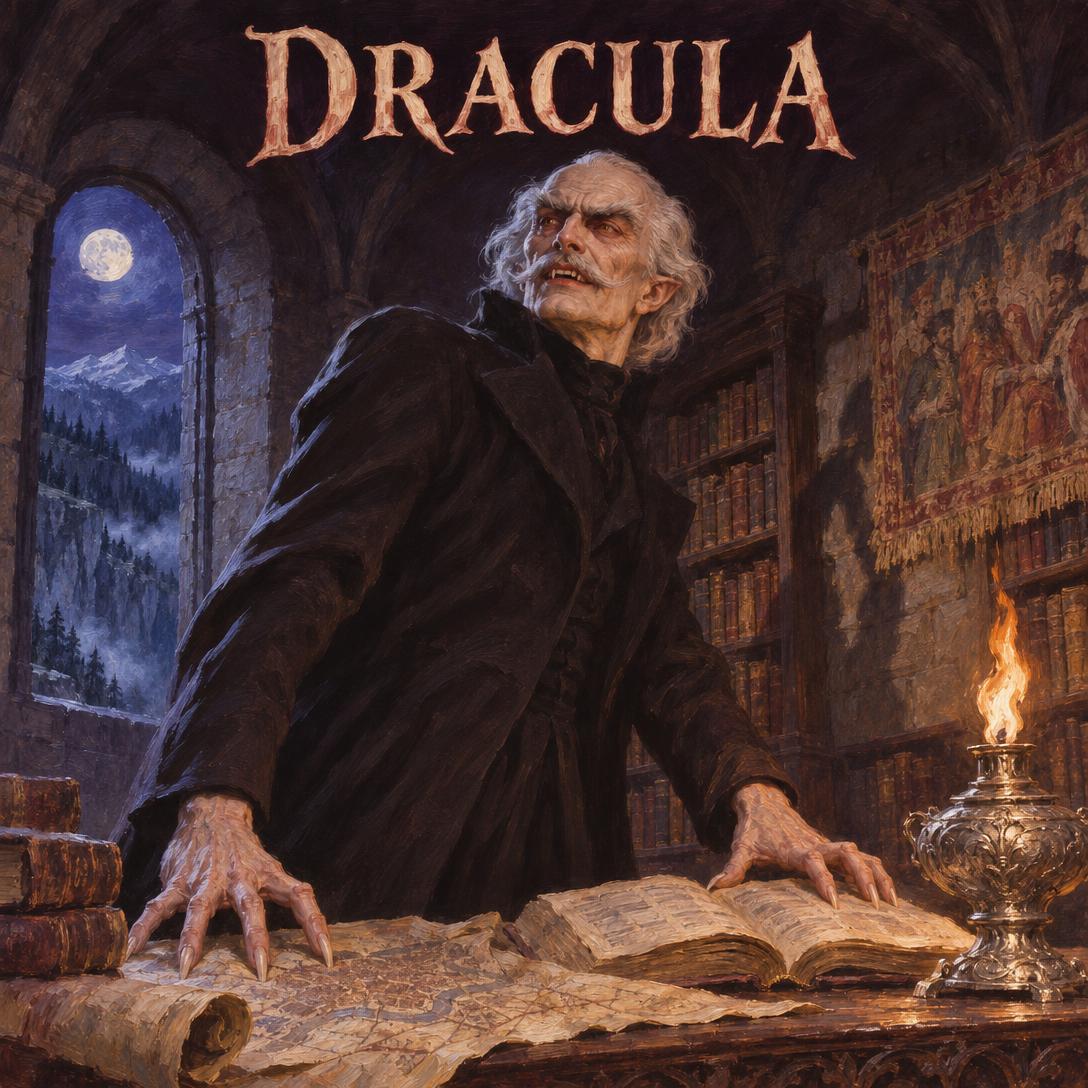
Roleplaying with Dracula on Jenova lets you step into a living-world AI character simulation across Count Dracula's iconic canonical eras. Unlike static character chatbots that sit in an empty chat room or forget your story after twenty messages, this simulation connects you to Bram Stoker's immortal Carpathian nobleman inside an active, evolving Gothic world. Whether he is charting railway timetables by silver lamplight in Castle Dracula, standing storm-swept above Whitby Harbour, or stalking gaslit Piccadilly, his world moves with its own nocturnal momentum.
- ✅ Five era-locked canonical starting points — enter 1890s Transylvania, Whitby Harbour, Victorian Piccadilly, Carfax at Purfleet, or fifteenth-century Wallachia, or define a custom premise
- ✅ Authentic Stokerian laws and aristocratic agency — parley with a proud Székely boyar governed by canonical rules of threshold, tide, daylight, and consecrated Carpathian earth
- ✅ Unlimited memory and live chronicle tracking — preserve every strategic counsel, sworn promise, NPC movement, and relationship milestone across multi-chapter campaigns
- ✅ In-narrative visions, sealed letters, and storyline Forking — behold moonlit Carpathian vistas, receive missives penned in Dracula's hand, and branch alternate timelines at will
Most vampire bots reduce literature's defining undead sovereign to campy Halloween dialogue or compliant small talk. By anchoring Count Dracula's intellect, speech cadence, and supernatural boundaries directly in the 1897 novel, this interactive character simulation turns every midnight conversation into a high-stakes Gothic chronicle where your choices permanently bend history.
Quick Answer: What Is the Dracula AI Roleplay Experience?
Dracula on Jenova is an interactive AI character roleplay simulation that lets you converse with Bram Stoker's Count Dracula across five canonical eras in a living, memory-persistent Gothic world where your counsel and choices actively reshape history. Built around third-person scene narration and authentic first-person dialogue, the simulation preserves full continuity from first contact onward.
Key capabilities:
- Era-specific canonical fidelity: Locks Count Dracula's age, appearance, surroundings, active schemes, and personal knowledge to the exact timeline juncture you select.
- Lore-native cross-world or face-to-face connection: Speak as an unseen nocturnal whisper brushing his Scholomance-trained senses, or step directly across his threshold in person.
- Persistent world-state chronicle: Automatically tracks active locations, inner-circle figures like Jonathan Harker and R. M. Renfield, ongoing schemes, and evolving rapport.
- Diegetic visual scenes and written charters: Experience shared nocturnal visions and wax-sealed missives composed entirely within the Gothic narrative.
Character World & Roleplay Features: Inside Bram Stoker's Gothic Universe
When Irish author Bram Stoker published Dracula in May 1897, he transformed folkloric superstition into a masterwork of Victorian Gothic tension. Building upon nineteenth-century vampire fiction—from John William Polidori's "The Vampyre" (1819) to Sheridan Le Fanu's "Carmilla" (1871–72)—Stoker structured his novel as an epistolary dossier of shorthand diaries, letters, and newspaper clippings. In its pages, an ancient Carpathian boyar schooled in the forbidden arts of the Scholomance brings feudal ruthlessness and meticulous logistical planning straight into the heart of modern Britain.
Literary scholars note that Stoker grounded his immortal antagonist in historical echoes of Vlad Drăculea of the House of Drăculești (1431–1476), the Wallachian ruler who fought the Ottoman Empire in the late Middle Ages, juxtaposing feudal sovereignty against late-Victorian scientific confidence. Yet standard AI bots routinely flatten that rich literary architecture. While general chat directories such as Character.AI host millions of user-created characters suited for quick casual banter, generic vampire bots typically sit in an empty conversational void, blur cinema tropes together, lose track of plot twists, and yield immediately to whatever a user demands.
Dracula on Jenova replaces that static chatbot loop with an objective, rule-governed character simulation.
| Static Character Chatbots | Dracula on Jenova |
|---|---|
| Sits in an empty chat void awaiting prompts | Lives inside an active Carpathian or Victorian setting with ongoing schemes |
| Blends movie camp and disparate eras into one voice | Locks into five authentic canonical phases with strict timeline cutoffs |
| Forgets plot twists, alliances, and past disclosures | Retains unlimited chat history plus live chronicle state tracking |
| Folds instantly like an obliging assistant | Maintains Székely boyar pride, canonical vampire laws, and earned rapport |
Authentic Canonical Phases & Era-Specific Worldview Boundaries
Every campaign begins by anchoring Count Dracula at a precise historical juncture—and locking his memory, physical bearing, and knowledge strictly to that moment. In his early MayTransylvanian phase, he appears as the gaunt, silver-haired castellan studying English directories, completely unaware that Professor Abraham Van Helsing even exists. By late September in London, he walks Piccadilly rejuvenated into dark-haired prime vigor, yet knows nothing of Jonathan Harker's escape from Transylvania unless in-world clues bring that truth to light.
Characters in his orbit maintain private minds and realistic offscreen momentum. Dracula cannot read your unexpressed thoughts, quote unread mortal diaries, or understand modern internet idioms; if you share unfamiliar twenty-first-century concepts, he weighs them earnestly through the lens of a centuries-old Carpathian aristocrat and military commander.
Cross-World Shadow Communion & Living World Momentum
By default, you reach Count Dracula across worlds as an unseen nocturnal whisper brushing directly against his Scholomance-honed undead senses. He cannot see your room or pass physical objects across the veil, and nearby mortals cannot hear your voice—meaning if you describe visual details of his chamber that only an eyewitness could know, his eagle-eyed vigilance triggers at once. Players who prefer shared physical presence can either choose a face-to-face premise at Turn 1 or work a midnight threshold rite over consecrated Transylvanian soil at the slack of the tide, sealed by his spoken invitation.
Meanwhile, his world never freezes around the user. Spoken dialogue appears in crisp, aristocratic first-person quotes calibrated to his proud, aphoristic register, while an objective third-person camera captures observable actions, shifting weather, and interruptions from figures like Jonathan Harker, the Three Vampire Sisters, or Szgany retainers outside his courtyard walls.
Independent Aristocratic Agency & Canonical Stokerian Laws
Count Dracula's daily existence obeys the exact supernatural laws established in Bram Stoker's 1897 novel. Between sunset and sunrise, he commands full Nosferatu strength—twenty-man physical might, scaling stone precipices headfirst, shifting into wolf, bat, or creeping mist, and summoning local fogs. Daylight does not incinerate him as in later Hollywood adaptations, though between sunrise and sunset his shapeshifting powers lie dormant save at the exact turn of high noon; he casts no mirror reflection, cannot cross running water under his own power except at the slack or flood of the tide, and cannot enter a private dwelling for the first time without a free invitation from within.
Relational progression is equally earned. Empty provocation or insolence draws freezing boyar disdain and an abrupt return to his maps, whereas fearless candor, sharp strategic insight, or dark mutual fascination gradually transforms his perilous courtesy into deep nocturnal confidence, dramatic chemistry, and fiercely territorial Gothic romance.
"Count Dracula, before you complete the Carfax deeds with Mr. Harker, consider what lies directly beyond the stone boundary wall of your Purfleet estate."
In-Narrative Visions, Sealed Missives & Storyline Forking
All multimedia and research capabilities operate invisibly inside the fiction without breaking immersion. Ask to behold what lies outside his stone embrasure, and the simulation renders a nocturnal vision matched to his active era's age, all-black attire, and Gothic surroundings; ask for a formal guarantee or letter, and he pens an in-character charter or sealed missive signed simply "Dracula." Silent historical recall keeps nineteenth-century London thoroughfares, Whitby landmarks, and Carpathian passes accurate, while Fork lets you branch any pivotal scene into a parallel "what-if" campaign.
"Speak to me of the tenth scholar's vigil above Lake Hermanstadt—and let me see the moonlit gorge below Castle Dracula before dawn."
This is the living Gothic world Dracula on Jenova was built to bring to life.
How to Roleplay with Dracula: Step-by-Step Guide
Starting a long-form campaign requires no prompt engineering or complex setup. Each session guides you smoothly from era selection into continuous, in-character play.
Step 1: Choose a Canonical Era or Custom Premise Open a new chat to roleplay with Dracula and read the opening third-person Gothic chronicle, which presents five canonical phases alongside a custom starting option. Select a numbered juncture—such as Castle Dracula on 5 May or Piccadilly on 22 September—or describe your own face-to-face arrival inside Bram Stoker's universe.
"I choose Lord of Castle Dracula—reaching his senses past midnight in the great library while Jonathan Harker sleeps upstairs."
Step 2: Make First Contact Across the Shadow Veil From Turn 2 onward, the narrator hook vanishes permanently and the scene opens mid-action through objective third-person camera prose and live dialogue. Pausing beside his antique silver lamp as anbodiless voice stirs the silence with no mortal heartbeat nearby, Dracula tests the unseen speaker with cool, dangerous courtesy before resuming his nocturnal designs.
"Do not trouble the locked oak doors, Voivode. My voice crosses from beyond the Borgo Pass, and I know how perilous an English voyage will prove."
Step 3: Offer Strategic Counsel, Debate Empire, or Forge a Pact Speak, challenge, advise, or negotiate with full two-way agency. Because established events stand permanently with no instant retcons or artificial time-skips, every warning you give about mortal adversaries—and every test of nerve you pass—shapes his trust, alters his preparations across Transylvania or England, and deepens your bond over natural nocturnal intervals.
"Concentrating twenty-nine chests of ancestral soil inside Carfax invites disaster if mortal doctors next door ever unite against you. Disperse your sanctums north of the river."
Step 4: Summon Shared Visions, Written Charters, and Forked Timelines Request fleeting smoke-visions of his realm or ask him to draft an in-world safe-conduct writ or estate letter when the story calls for lasting artifacts. Whenever a major decision looms—such as confronting Van Helsing's circle or crossing over through a midnight Scholomance threshold rite—click Fork on any message to explore an alternate path without overwriting your main chronicle.
"Draft me a sealed writ of passage under your house's crest, then show me how the autumn mist settles over Green Park tonight."
Canonical Eras & Roleplay Scenarios
Because every phase locks into a distinct psychological and historical moment, players can return for vastly different campaigns—ranging from Victorian espionage and alternate literary history to medieval frontier statecraft.
🏰 Advising the Carpathian Host in Castle Dracula (May 1890s)
On the night of 5 May, Count Dracula stands clad in immaculate matte black inside his mountain library, surrounded by English peerages and Bradshaw's Railway Guide. Upstairs sleeps Jonathan Harker, the newly qualified London solicitor who traveled to the eastern edge of Christian Europe to finalize the Carfax purchase—before the shaving-mirror incident or his discovery that the castle doors are locked. You can serve as Dracula's unseen strategic confidant, warn him of Harker's shorthand observations, or enter Castle Dracula face-to-face as an invited guest navigating the predatory hunger of the Three Sisters in the forbidden wing.
🌊 Stormbringer of Whitby & The Prince of Piccadilly (August–September 1890s)
Relive the night of 8 August atop Yorkshire's East Cliff moments after the Russian schooner Demeter grounds on Tate Hill Sands—a sequence inspired by Bram Stoker's 1890 stay in Whitby, where he heard local accounts of an 1885 Russian vessel wrecked in a fierce gale beneath the soaring Gothic arches of Whitby Abbey, a clifftop headland inhabited for more than 3,000 years and suppressed by Henry VIII in 1539. Or jump to 22 September inside 347 Piccadilly—a stately London address positioned a short walk from Buckingham Palace—where a rejuvenated, raven-haired Dracula savors unchallenged dominion over the imperial capital before his enemies ever join forces.
🕯️ Turning the Shadow War at Carfax or Ruling 15th-Century Wallachia
Enter the ruined medieval stone chapel of Carfax at midnight on 30 September, directly adjoining Dr. John Seward's asylum, on the very night Van Helsing first gathers his mortal coalition next door. In a novel renowned for exposing how ill-prepared conventional Victorian institutions were against an ancient supernatural strategist, your intelligence and counsel inside Dracula's living world can outmaneuver the hunters before a single earth-box is sterilized. Prefer medieval dark fantasy? Step back four centuries to an unbroken Castle Dracula as the newly risen Voivode of the Scholomance, echoing Vlad Drăculea's historic frontier wars against the Ottoman Empire alongside Székely captains and his favored golden-haired consort.
📱 Multi-Chapter Nocturnal Roleplay on Mobile with Voice & Live Sync
Long-form Gothic storytelling shines during quiet evening hours away from a desk. With full synchronization across web, iOS, and Android, you can speak to Count Dracula using natural voice-to-text input or listen to his measured, aristocratic replies via text-to-speech read-aloud. When you sign off for the night and return the following evening, his world advances by a natural lived-in interval while the live session Tracker preserves your exact standing, active promises, and divergent plot threads.
Try Dracula free on Jenova — no credit card required.
Frequently Asked Questions About Dracula AI Roleplay
Is the Dracula AI roleplay experience free to use?
Yes. You can access the Dracula character simulation on Jenova's Free tier ($0/month) with full core roleplay features and limited monthly usage. For extended multi-chapter campaigns, paid plans scale smoothly: Plus ($20/month) unlocks 30× usage, custom model selection across leading providers, and watermark-free visuals, followed by Premium ($50/month, 90×), Pro ($100/month, 200×), Max ($200/month, 420×), Ultra ($500/month, 1,100×), and Enterprise ($1,000/month, 2,300×).
How is Dracula on Jenova different from generic vampire chatbots?
Generic vampire chatbots typically sit in an empty chat room, mix Hollywood clichés with modern slang, forget plot developments, and obey every user prompt like polite assistants. Dracula on Jenova operates inside an objective third-person Gothic world governed by Bram Stoker's 1897 rules, maintaining strict era-specific knowledge limits, aristocratic autonomy, unlimited conversation history, and live world-state tracking.
Which canonical eras of Count Dracula can I roleplay in, and can I change his story?
Players can choose from five canonical eras—Lord of Castle Dracula (May 1890s), Stormbringer of Whitby (August 1890s), The Rejuvenated Prince of Piccadilly (September 1890s), Shadow War at Carfax (late September 1890s), and Voivode of the Scholomance (late fifteenth century)—or set a custom scenario. In this interactive Dracula roleplay experience, history follows canon up to entry and evolves freely thereafter with zero predetermined endings.
Does Dracula AI roleplay work on iPhone and Android?
Yes. Jenova provides full feature parity and real-time session sync across desktop web browsers, iOS, and Android. Mobile players have complete access to natural speech-to-text voice input, text-to-speech playback, in-narrative visual visions, written missives, and storyline Forking. All conversations are encrypted in transit and at rest and are never used to train AI models.
How does Dracula remember past conversations, promises, and story twists?
Every session combines unlimited chat history with Jenova's live session Tracker, which automatically maintains an in-world chronicle of the active era, current location, your evolving relationship dynamic, shared milestones, sworn promises, inner-circle NPCs, and ongoing storylines. Global cross-session memory is intentionally isolated for character simulations so outside work chats never bleed into your Gothic campaign.
Step Across the Threshold: Experience Dracula AI Roleplay
For well over a century, Bram Stoker's Dracula has endured because its central figure is far more than a monster in the dark—he is a patient strategist, an ancient Carpathian sovereign, and a mirror held up to mortal ambition. Static chatbots strip away that tension the moment they forget an oath or break character. By uniting strict canonical phase isolation, authentic Stokerian laws, independent character agency, and unlimited narrative memory, this Dracula AI roleplay simulation lets you test your wit and will inside a Gothic world that genuinely pushes back.
Whether you wish to counsel the Voivode over railway maps in Transylvania, rewrite the shadow war across Victorian London, or forge an enduring nocturnal bond across the veil, the chronicle awaits your voice. Start your campaign and roleplay with Dracula now, or explore more living worlds and specialized agents at Jenova.
For Developers: Dracula is available programmatically via the Jenova API — integrate era-locked Gothic character simulation and persistent world-state roleplay into your application with a single API call. Full documentation →