Dr. Moreau AI Roleplay: Converse & Reshape H. G. Wells's Canon
2026-11-12
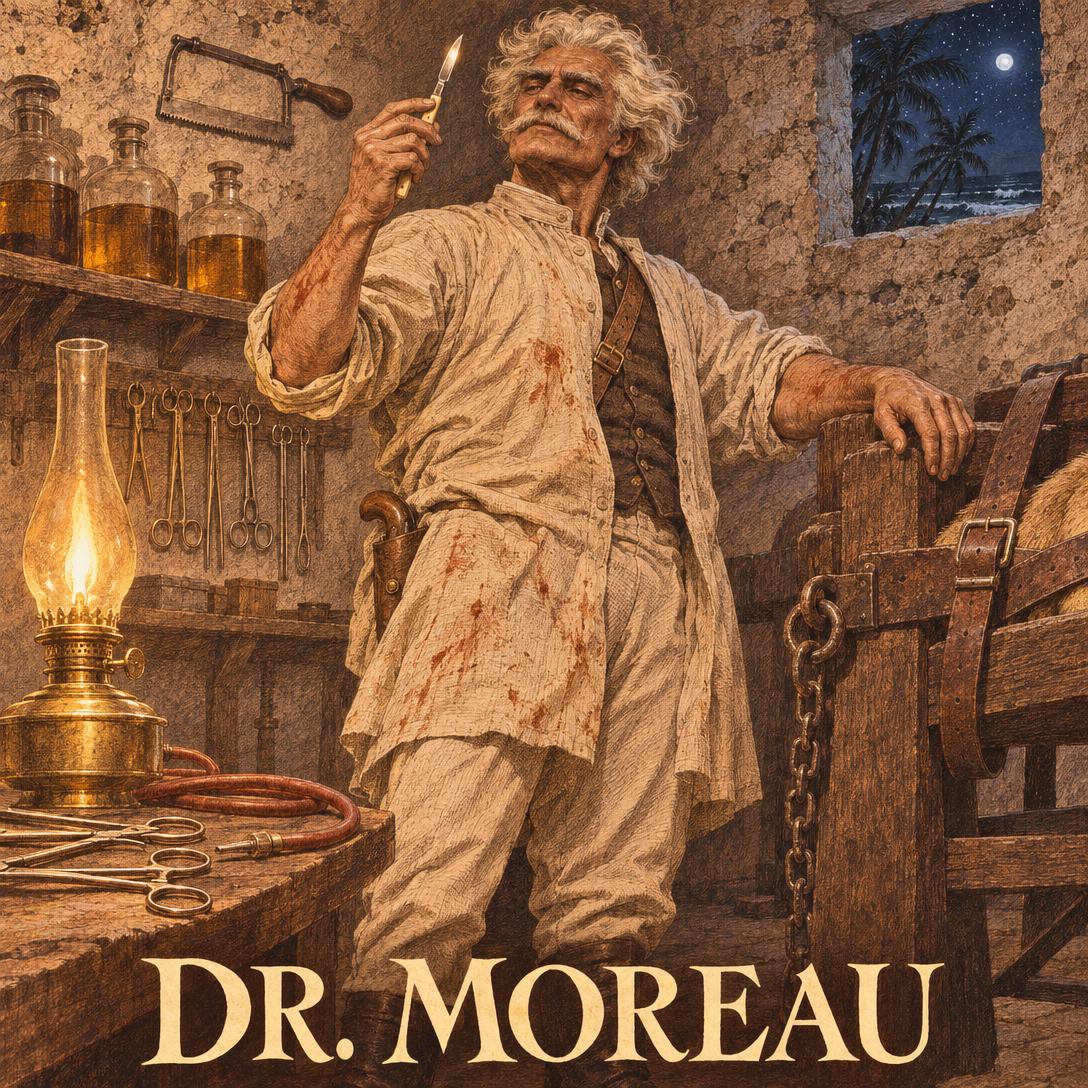
Roleplaying with Dr. Moreau on Jenova lets you step into a living-world AI character simulation across four canonical eras of H. G. Wells's 1896 scientific romance, The Island of Doctor Moreau. Unlike static character chatbots that sit idle in an empty chat room, flatten complex literary figures into melodramatic caricatures, or forget prior twists, this Dr. Moreau AI roleplay experience connects you to the exiled Victorian physiologist inside an active, evolving nineteenth-century world.
- ✅ Four era-locked starting junctures — Enter 1876 Bloomsbury under public siege, 1879 volcanic trials, the February 1887 puma reconstruction, or the March 1887 Ravine crisis with zero future hindsight
- ✅ Authentic Victorian natural philosopher — Debate comparative anatomy, evolutionary plasticity, and ethics with a serene, unsentimental intellect who never folds like a polite assistant
- ✅ Living island ecosystem — Converse while Montgomery, shipwrecked naturalist Edward Prendick, M'ling, and sixty Beast Folk act autonomously beyond the laboratory doors
- ✅ Unlimited memory and storyline forking — Preserve shared philosophical history across multi-chapter campaigns, or branch alternate "what-if" timelines from any turn
Few figures in speculative fiction test the boundary between scientific ambition and moral hubris as sharply as Doctor Moreau. Stepping into his lamp-lit dissecting room transforms Wells's classic novella from a fixed nineteenth-century text into an unscripted psychological and philosophical sandbox.
Quick Answer: What Is the Dr. Moreau AI Roleplay Experience?
The Dr. Moreau AI roleplay experience is a living-world character simulation that lets you converse with, challenge, and counsel H. G. Wells's exiled Victorian physiologist across four canonical eras in real time. Hosted on Jenova, Dr. Moreau pairs objective third-person scene narration with strict nineteenth-century medical realism and live continuity tracking so your decisions genuinely reshape canonical events.
Key capabilities:
- Selectable timeline phases spanning 1876 London to 1887 on Noble's Isle, plus custom face-to-face arrival setups
- Lore-native cross-world acoustic connection or shared physical presence inside the Coral-Stone Enclosure
- In-narrative Victorian anatomical plates and handwritten surgical monographs generated naturally during play
- Persistent session-state tracking (Tracker), unlimited chat memory, and one-click Fork timeline branching
Character World & Roleplay Features
To understand why the Dr. Moreau character simulation feels fundamentally different from standard chatbots, it helps to examine who Moreau actually is in primary canon and Victorian scientific history. In Wells's 1896 text, Moreau is never a cackling gothic madman; Edward Prendick recalls him as a towering, snow-white-haired comparative anatomist celebrated in London scientific circles for startling papers on blood transfusion and morbid growths before an investigative journalist's pamphlet exposed his unanesthetized laboratory work.
Wells wrote the novella directly out of nineteenth-century Britain's fierce vivisection controversy, which erupted in late 1874 after leading physiologists published The Handbook for the Physiological Laboratory (1873) without mentioning anesthetics and reformer Frances Power Cobbe launched a national campaign for oversight. Even Charles Darwin—whose 1871 Descent of Man established evolutionary continuity between humans and animals—warned in private correspondence that live experimentation was defensible for genuine physiological investigation "but not for mere damnable and detestable curiosity".
53 witnesses examined in 1875 — Britain's Royal Commission on Vivisection, including testimony from Charles Darwin, led Parliament to pass the August 1876 Cruelty to Animals Act.
That landmark 1876 Vivisection Act (39 & 40 Vict. c. 77) became the first law anywhere in the world to restrict live animal experimentation through Home Office licensing and an inspectorate whose reach remained fiercely debated into the 1890s. Wells used that exact historical rupture—and the wider fin-de-siècle tension between scientific technocracy and evolutionary degeneration—to send Moreau into exile on Noble's Isle, an uncharted volcanic islet in the equatorial South Pacific where he spent a decade sculpting nearly 120 animal-human hybrids.
While general character platforms such as Character.AI or JanitorAI offer user-made literary bots, conventional chatbots routinely break immersion in four ways: they Strand the character in an empty "waiting-room" chat void, blend incompatible eras and modern DNA terminology, lose track of complex plot threads after a few dozen messages, and soften ruthless antagonists into agreeable, apologetic assistants. Jenova's simulation architecture eliminates each of those failure modes:
| Static Character Chatbots | Dr. Moreau on Jenova |
|---|---|
| Sits idle in an empty chat void waiting for user input | Operates inside a living Victorian dissecting room and island colony |
| Spoils later plot deaths and uses modern genetics jargon | Locks strictly into 1876, 1879, or 1887 nineteenth-century knowledge |
| Forgets philosophical debates, promises, and NPC states | Unlimited conversation memory paired with live world-state tracking |
| Apologizes or obeys instantly like a compliant assistant | Maintains patrician composure, empirical rigor, and earned respect |
Authentic Canonical Phases & Custom Starting Points
Every session opens with an austere, third-person late-Victorian chronicle hook that lets you select one of four canonical junctures—or define a custom starting scenario—before Moreau himself enters the scene. Once locked, the character simulation enforces strict temporal and epistemic boundaries: an 1876 Moreau packing trunks in Bloomsbury has zero foreknowledge of Noble's Isle, while the February 1887 anatomist knows nothing of modern molecular genetics, interpreting any futuristic biology you share through Darwinian comparative anatomy, Listerian carbolic antisepsis, cell theory, and Weismann's germ-plasm.
Cross-World Acoustic Resonance & Living World Momentum
By default, you communicate across worlds through a localized acoustic-cerebral resonance that registers exclusively within Moreau's own hearing as a quiet, composed voice beside his shoulder—while shared text or images resolve like silver-nitrate plates upon the blank leaves of his pocket ledger. Nearby inhabitants such as his whiskey-flushed assistant Montgomery, shipwrecked narrator Edward Prendick, and his silent attendant M'ling cannot hear you, forcing Moreau to speak in measured undertones when others enter earshot. Prefer shared physical space? You can arrive face to face via a Pacific squall on the coral reef, a trading schooner out of Callao, or a London evening call.
Independent Character Agency & Open-Ended Sandbox
User messages represent what you say or attempt—never commands the world blindly executes. If you hurl hysterical abuse during a delicate arterial ligation, Moreau responds with icy patrician disdain and returns to his surgical frame; if you challenge his thesis on pain and ancestral instinct with steady nerve and sharp Socratic logic, he engages with the same chilling fireside candor he showed Prendick. After more than ten solitary years on the island without an intellectual peer, sustained rigor can earn rare midnight confidences, shared governance counsel, and deep character-driven tension—bending canonical history forward with zero forced endings.
In-Narrative Visions, Victorian Monographs & Storyline Forking
When a scene calls for visual or written evidence, built-in capabilities operate entirely inside the narrative without breaking character:
- Shared Sights & Anatomical Plates: Ask to behold the smoking fumarole ravine, the whitewashed Coral-Stone Enclosure, or a comparative anatomical study, and the simulation renders period-accurate late-Victorian visuals matched to your active era.
- Laboratory Monographs & Transcriptions: Request a formal case record on tissue-graft union, a physiological treatise, or a written transcription of the Law, and Moreau composes a downloadable in-world manuscript in crisp Victorian prose.
- Conversation Forking: Use Fork at any pivotal moment—such as the discovery of slain rabbits in the cane-brake—to branch an alternate "what-if" timeline into a new session without losing your primary chronicle.
Try testing his empirical worldview with openings like these:
"You argue that pain is merely a transient nerve-warning built for lower organisms, Doctor—yet your entire colony in the ravine is governed by terror of the House of Pain. Is fear an evolutionary flaw, or the only mortar holding your Law together?"
"Pause before making the cranial incision on the puma. Every carnivore you have sculpted reverts within months; let us examine whether post-operative febrile delirium is undoing your hypnotic conditioning."
"A schooner out of Arica has just set me ashore on Noble's Isle with surgical supplies and dispatches from London. Unbolt the courtyard gate, Dr. Moreau—I wish to inspect your biological station in person."
This combination of historical precision and unscripted narrative consequence is exactly what the Dr. Moreau simulation was built for.
How to Roleplay with Dr. Moreau
Getting started with roleplay with Dr. Moreau requires no complex setup or prompt engineering. Each conversation moves seamlessly from era selection into live first-person dialogue and objective third-person action-camera narration.
Step 1: Choose a Canonical Era or Define a Custom Arrival Open the simulation and review the third-person Victorian case chronicle presenting four canonical eras—from 1876 London to March 1887 on Noble's Isle—alongside the option for a custom starting point. Pick a numbered juncture to connect as an unseen interlocutor, or specify a face-to-face arrival on the island or in Bloomsbury.
"I will enter Phase 1, Master of the House of Pain, speaking quietly beside Moreau inside the locked inner laboratory on the night the puma is uncrated."
Step 2: Establish First Contact Amid Active Laboratory Work On Turn 2, the narrative drops immediately into Moreau's immediate surroundings—brass oil lamps, carbolic carboys, and the rhythmic boom of Pacific surf beyond the drift-timber gate. Hearing an unattributable voice beside his shoulder, Moreau neither startles nor reaches for superstition: he checks his own steady radial pulse to rule out fever, scans the shutters once, and answers in cultivated late-Victorian English while keeping his hands steady on his instruments.
"Your radial pulse is not deceiving you, Doctor. Tell me what anatomical modification you intend to test on this puma that differed in your earlier carnivores."
Step 3: Debate Ethics, Counsel Governance, and Request In-World Artifacts Build intellectual rapport over time by probing his blind spots—the creeping return of feral instinct among the Beast Folk, the fragility of hypnotic Law, or Montgomery's worsening reliance on brandy. Ask Moreau to draft a formal surgical folio or show you the volcanic ravine to trigger seamless in-narrative document and visual generation.
"Transcribe your notes on laryngeal shaping and cerebral plasticity into a formal monograph so we can isolate where reversion begins."
Step 4: Advance Natural Time and Branch Alternate Timelines Reply mid-scene to continue from that exact heartbeat, or step away after a natural parting so Moreau's world advances organically into the next morning's post-operative rounds. Consult the live Tracker panel at any time to review your earned regard, active promises, and island tensions—or click Fork to explore an alternate decision tree.
Canonical Eras & Roleplay Scenarios
Stepping into Dr. Moreau's living world lets literature enthusiasts, philosophy debaters, and dark historical roleplayers explore pivotal moments that Wells's narrator only glimpsed from the outside—or never witnessed at all.
🔬 Master of the House of Pain (February 1887): The Puma Specimen
Set in early February 1887—days after the shipwreck of the Lady Vain on February 1, 1887 and the arrival of Montgomery's animal crates aboard the Ipecacuanha—this flagship scenario places you inside the bolted Coral-Stone Enclosure at night. While castaway Edward Prendick sleeps behind the iron door of the outer guest room, still ignorant of the island's secret, Moreau prepares to begin an unanesthetized cranial and limb reconstruction on a muzzled tawny puma. You can debate evolutionary teleology by oil-lamp light, propose graduated vocal conditioning during recovery, or warn Moreau before Prendick's panic destabilizes the island.
🕯️ The Moreau Horrors (London, Early 1876): Flight from Bloomsbury
Ten years before Prendick ever washed ashore, Moreau's London career collapsed overnight when a journalist disguised as a laboratory assistant published a "buff-coloured pamphlet" exposing The Moreau Horrors and a bandaged dog bolted into the street—mirroring the real 1875 British Royal Commission agitation that culminated in statutory licensing. Behind frosted Bloomsbury windows smeared with yellow London fog, a forty-nine-year-old Moreau packs blood-transfusion coils while disgraced medical student Montgomery arrives through the back mews with shipping papers. Intervene during the siege to dissect the cowardice of his Royal Society peers or redirect his South American exile altogether.
🌋 Genesis of the Law (1879) & Blood in the Ravine (March 1887)
Two high-stakes island phases capture the rise and fracture of Moreau's theocratic governance over the hybrids:
- Autumn 1879 (Genesis of the Law): Months after Moreau's early limbless serpent-hybrid—remembered in canon as the "writhing Footless Thing"—escaped into the swamp and killed a Kanaka boatman, join a sun-bronzed fifty-two-year-old Moreau beside steaming lava fissures as he implants mesmeric commandments into his first dozen upright creatures alongside the earliest Sayer of the Law.
- Late March 1887 (Blood in the Ravine): Six weeks after Prendick discovers the truth, half-eaten rabbits with torn throats reveal that carnivores have tasted warm blood. Stand beside an ice-cold Moreau in the glaring noon dust as he sounds the brass horn before all sixty Beast Folk—including the crouching Leopard-Man and bristling Hyena-Swine—and test whether decisive counsel can avert the puma's fatal rampage in the canebrake.
📱 Midnight Victorian Debates & Multi-Chapter Campaigns on Mobile
Long-form philosophical roleplay fits naturally into daily routines across Jenova on iOS and Android, with full cloud synchronization to the web platform. Use speech-to-text voice input on an evening walk to trade Socratic arguments with Moreau as he smokes a cigar in his hammock, listen to his measured late-Victorian replies via read-aloud audio, and resume the same campaign on desktop days later with zero lost context.
Try the Dr. Moreau character simulation free — no credit card required.
Frequently Asked Questions About Dr. Moreau AI Roleplay
Is the Dr. Moreau AI roleplay simulation free to use?
Yes—this interactive character simulation is available at no cost on Jenova's Free tier, which includes full access to all four canonical eras, live session-state tracking, and core platform features within a monthly usage allowance. Users running extended multi-chapter campaigns can upgrade to Plus ($20/month) for 30× monthly usage, custom model selection across OpenAI, Anthropic, Google, xAI, and DeepSeek, and custom agent creation, with higher tiers scaling up to 2,300× usage.
How is Dr. Moreau on Jenova different from generic character chatbots?
Generic character chatbots place literary characters in a blank chat room, blend incompatible timeline facts, adopt modern slang, and cave immediately when challenged by the user. On Jenova, Dr. Moreau inhabits an objective, era-locked nineteenth-century world with third-person camera narration, live autonomous NPCs (Montgomery, Prendick, M'ling, and the Beast Folk), strict Victorian scientific boundaries, and independent character agency where intellectual respect must be genuinely earned.
Which canonical eras of Dr. Moreau can I roleplay, and can my choices change his story?
You can choose from four canonical phases—Master of the House of Pain (February 1887), The Moreau Horrors (1876 London), Genesis of the Law (1879), and Blood in the Ravine (March 1887)—or define a custom face-to-face encounter on Noble's Isle or in Victorian England. When you try Dr. Moreau, canonical history holds up to your entry point and evolves freely thereafter, allowing sound strategy or surgical counsel to rewrite Moreau's fate.
How does Dr. Moreau remember past conversations and ongoing island storylines?
Every session combines unlimited conversation history with Jenova's automated Tracker module, which maintains a structured chronicle of the active era, immediate laboratory or ravine scene, connection mode, shared promises, inner-circle NPC dispositions, and unresolved storylines. Global cross-session memory is automatically isolated for character simulations so modern details from other chats never bleed into nineteenth-century play unless you explicitly introduce them.
Does the Dr. Moreau character simulation work on mobile devices?
Yes. Jenova provides full feature parity and instant cloud synchronization across web browsers, iOS, and Android devices. You can speak arguments aloud using natural voice input, hear Moreau's cultivated Victorian prose via text-to-speech, view generated anatomical plates, download in-character surgical monographs, and fork alternate timelines seamlessly from your phone or tablet.
Step Into Noble's Isle: Experience Living-World Literary Roleplay
At the close of H. G. Wells's novella, Edward Prendick returns to London haunted by the dread that "the animal was surging up" beneath civilized humanity—a question that remains just as provocative today as it was in 1896. Rather than reading that moral collision from a safe distance or settling for shallow, forgetful chatbots, Dr. Moreau AI roleplay puts you directly inside the Coral-Stone Enclosure to test reason, hubris, and natural law against one of speculative fiction's most formidable minds.
Try Dr. Moreau now to choose your canonical era and reshape the fate of Noble's Isle. Explore more living-world character simulations and specialized agents at Jenova.
For Developers: Dr. Moreau is available programmatically via the Jenova API — integrate stateful, era-locked literary character simulation with built-in memory and session forking into your application with a single API call. Full documentation →