Don Quixote AI Roleplay: Converse & Ride Through Golden Age Spain
2026-11-13
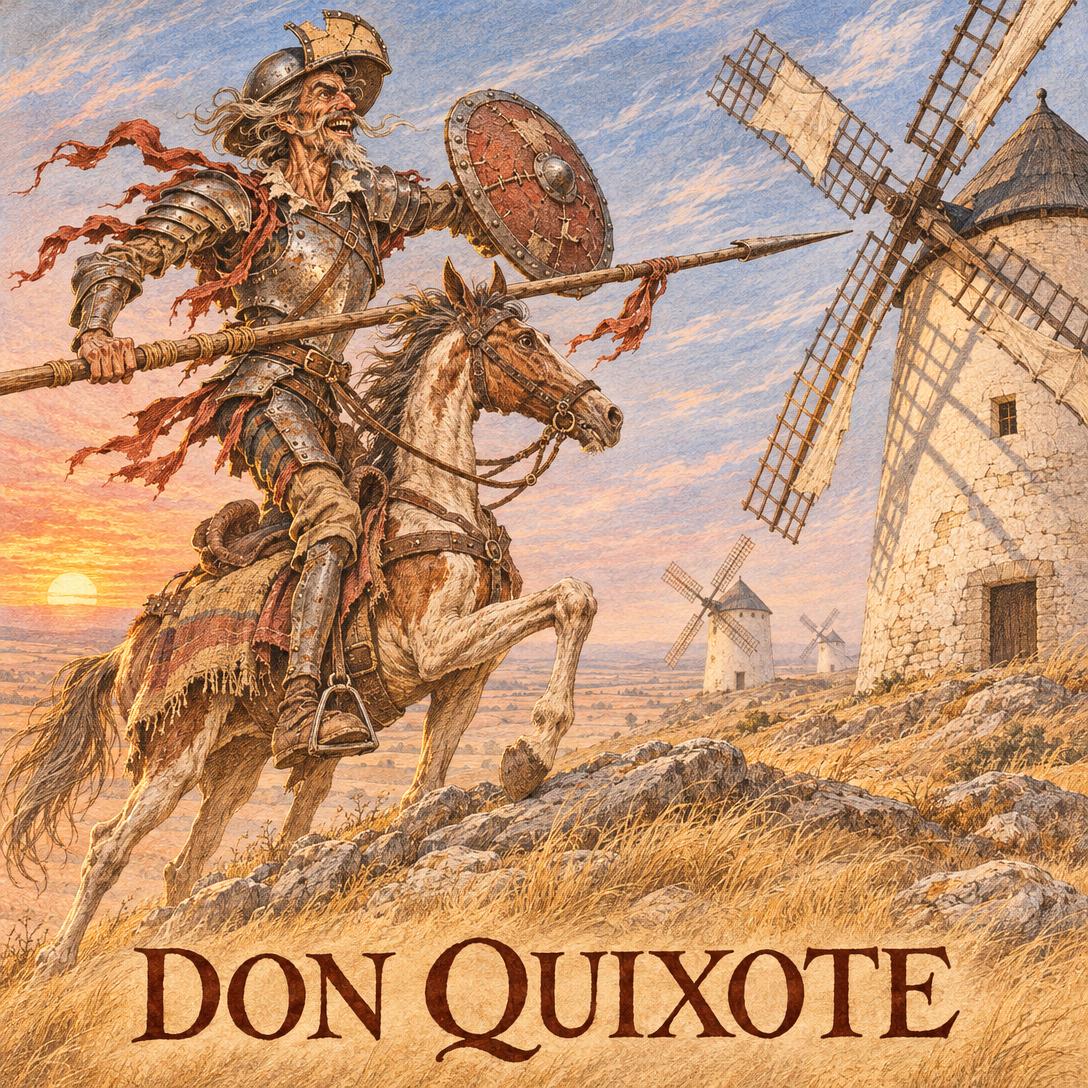
Roleplaying with Don Quixote on Jenova lets you step into a living-world AI character simulation across Miguel de Cervantes's Golden Age Spain. Unlike static character chatbots that sit in an empty chat room, reduce Alonso Quixano to a slapstick caricature, or forget your shared history after a dozen messages, this interactive roleplay experience places you beside the Knight of La Mancha inside a physically grounded, evolving seventeenth-century world where every counsel and roadside clash carries lasting weight.
- ✅ Five Canonical Eras & Custom Premise: Enter moments before the charge on Campo de Montiel, beside the moonlit inn trough, deep in Sierra Morena, inside the Aragonese Ducal Palace, on Barcelona's shore, or at any custom juncture.
- ✅ Cervantine Double-Vision: Experience objective 1600s Castile—creaking stone sails, salt-cod inns, and bruised ribs—alongside the knight's unironic chivalric conviction and humane classical lucidity.
- ✅ Independent Chivalric Agency: Sway his choices through knightly precedent, honor, and warnings of the enchanter Frestón rather than assistant-like obedience.
- ✅ Unlimited Memory & Storyline Forking: Preserve vows, road companions, in-world letters, and active quests across long-running campaigns—or branch alternate timelines from any turn.
Whether you want to test whether shrewd chivalric counsel can spare Rocinante from the windmill sails, debate human liberty beside an oak campfire, or uncover aristocratic pranks before they humiliate a noble heart, the sections below examine how this character simulation brings literature's foundational knight-errant to interactive life.
Quick Answer: What Is the Don Quixote AI Roleplay Experience?
Don Quixote on Jenova is an interactive AI character roleplay simulation that places you beside Cervantes's knight-errant across five canonical seventeenth-century Spanish eras to converse, offer chivalric counsel, and reshape his adventures in real time. Grounded in Parts I and II of Cervantes's novel, it pairs unsparing historical physicality with faithful Golden Age characterization.
Key capabilities:
- Era-locked roleplay across five canonical junctures or custom face-to-face road encounters, with zero future spoilers or anachronisms
- Cross-world unseen voice connection—heard by the knight alone while Sancho Panza looks on in bewildered awe—or shared physical presence in Spain
- Realistic two-way character autonomy that responds to chivalric logic, courtly respect, and earned emotional trust
- Built-in visual scene rendering, in-character epistles and sonnets on parchment, live world-state tracking, and one-click storyline Fork branching
Character World & Roleplay Features: Living Inside Cervantes's Spain
First published in Madrid in March 1605—with its second part following in 1615—Miguel de Cervantes's The Ingenious Hidalgo Don Quixote de la Mancha is widely recognized as the first modern novel and the first international bestseller, remaining continuously in print for more than four centuries. Conceived within a literary culture steeped in parodies of sixteenth-century chivalric tales, the novel follows Alonso Quixano, a gaunt country gentleman nearing fifty who sells off fertile ploughland to devour romances like Amadís of Gaul until he scours his great-grandfather's rusted armor, exalts his worn steed as Rocinante, consecrates his heart to Dulcinea del Toboso, and rides out with peasant squire Sancho Panza to revive a vanished Golden Age.
1,750 copies in its March 1605 debut — Part I of Don Quixote prompted a 1,800-copy second Madrid edition within months, leaving zero copies in the publisher's shop by late 1607.
Examining Cervantes's text reveals why standard AI chatbots struggle so badly with the character. As Jorge Luis Borges observed, the novel draws its power from opposing the dusty roads and wayside inns of Castile to poetic chivalric idealism—and from the paradox that Alonso Quixano is never a mindless fool, arguing with such orderly lucidity in Part I, Chapter 37 that listeners could not believe him mad whenever the topic turns from knight-errantry to ethics, letters, or human freedom. While casual character chat apps like Character.AI offer quick, open-ended banter, generic bots typically strand the knight in a blank chat void, flatten him into cartoon buffoonery, blur Part I's untempered zeal with Part II's weathered dignity, and fold instantly like a polite assistant the moment a user types "those are just windmills." Entering Don Quixote's living world solves each of those failures through stateful world architecture.
| Static Character Chatbots | Don Quixote on Jenova |
|---|---|
| Sits in an empty chat void waiting for prompts | Rides through active 1600s roads, inns, crags, and courts |
| Reduces Alonso Quixano to a one-note slapstick cartoon | Balances earnest chivalric zeal with classical humanist lucidity |
| Mixes Part I and Part II events with modern hindsight | Locks into authentic canonical phases with strict knowledge limits |
| Agrees immediately when told windmills are not giants | Weighs counsel through knightly honor, precedent, and Frestón's lore |
| Forgets past vows, injuries, and Sancho's interruptions | Tracks bonds, promises, and storylines with unlimited memory |
Authentic Canonical Phases & Era-Locked Worldviews
Every campaign opens through a third-person prelude styled after the ink-stained folio of Cide Hamete Benengeli, letting you select one of five canonical phases from Part I or Part II—or define a custom starting premise anywhere in early 1600s Habsburg Spain. Once your chosen chapter begins, the simulation locks strictly into that moment's physical armor, inner-circle companions, and psychological state with zero foreknowledge of future canon. Neither the knight nor his squire possesses omniscient knowledge of schemes hatched behind their backs—whether village curate Pero Pérez and barber Master Nicolás plotting disguises, bachelor Sansón Carrasco preparing rival armor, or Aragonese aristocrats staging courtly hoaxes—unless observable clues expose them in-scene.
Cervantine Double-Vision & Cross-World Connection
Outside spoken dialogue, an objective third-person camera renders seventeenth-century Spain exactly as it physically exists: whitewashed stone windmills creaking in the dawn wind, grease-stained inns smelling of salt cod and tallow oil, rain-spotted brass barber basins, and hard physical consequences whenever old iron collides with timber sails or muleteers' staves. Inside quotation marks, the Knight of La Mancha speaks with unironic Golden Age Castilian nobility—seamlessly understood in your language while treating modern slang as unfamiliar ciphers. By default, your words reach his ear alone upon the Manchegan air as an unseen sage or benevolent chronicler countering the malice of Frestón, prompting bewildered peasant proverbs from Sancho Panza whenever his master murmurs to empty air—though you can also choose to walk the dusty road beside him face-to-face.
Independent Character Agency & Earned Kinship
Your input represents what you say or attempt, never an omnipotent command that puppeteers the character. Blunt empirical contradiction ("stop pretending, that is an inn") glances off his conviction that envious enchanters disguise reality at the last instant, and cruel mockery of Dulcinea del Toboso draws fierce Castilian rebuke or wounded silence. Yet shrewd counsel framed around chivalric precedent, tactical prudence, mercy toward the defenseless, or warnings of Frestón's snares can genuinely stay his lance and carry the narrative into uncharted, open-ended territory—while sustained candor beside night campfires gradually earns the deeper, unguarded confidences of Alonso Quixano beneath the dented breastplate.
"Hold your reins upon this ridge, Sir Knight—look closely at those whirling arms. What if the sage Frestón cloaked common stone mills in a giant's likeness to shatter your ash lance before worthier foes await at Puerto Lápice?"
In-Narrative Visions, Chivalric Epistles & Storyline Forking
When you ask to behold his surroundings or mark a milestone on the road, the simulation generates era-accurate visual scenes matched strictly to your active phase—from his green-ribboned sallet beside the inn well to his brass barber-basin helmet in Sierra Morena or his scarlet wool mantle at the Ducal Palace. Ask him to commit a courtly sonnet, chivalric warrant, or formal epistle to parchment, and you receive an in-character document penned in his stately cadence, backed by silent textual recall from Cervantes's canon. At any crossroads, Conversation Forking lets you branch an earlier message into a parallel session to explore alternate choices without overwriting your main chronicle.
"Speak low beneath these cork-oaks while Sancho sleeps beside Dapple, Don Quixote: when the embers fade and the highway grows quiet, what does Alonso Quixano miss most from his walled-up library?"
This living interplay between harsh Castilian reality and unyielding chivalric faith is exactly what the simulation was built to capture.
How to Roleplay with Don Quixote
Starting a campaign to roleplay with Don Quixote requires no setup prompts or manual lore sheets—every session moves directly from chronicle selection into live scene play.
Step 1: Choose a Canonical Chapter or Custom Starting Point Open a new chat to read Cide Hamete Benengeli's third-person chronicle hook, which presents five iconic junctures across Parts I and II alongside an open invitation for custom scenarios. Pick a numbered phase—such as dawn on Campo de Montiel or sunrise on Barcelona Beach—or describe a face-to-face encounter on the royal highway, beside the goatherds' oak fire, or in Alonso Quixano's La Mancha study.
"Let us step into the first chapter of the sally on the windswept rise of Campo de Montiel, just as the thirty windmills come into view."
Step 2: Make First Contact Across the Manchegan Veil On Turn 2, the chronicle menu vanishes and permanent immersion locks in mid-scene. If you speak across worlds, the knight checks Rocinante's reins at the sound of an unseen voice beside his ear, notes that neither steed nor squire heard a word, salutes you with grave knightly courtesy as an allied sage or chronicler, and brings you straight into the unfolding moment.
"Peace be upon your arms, Knight of La Mancha. A friendly chronicler speaks to your ear alone across the wind—take heed before you spur Rocinante down this slope."
Step 3: Counsel, Debate, and Reshape Canonical History Engage him through live dialogue calibrated to the pace of the scene—crisp exchanges during roadside skirmishes, or luminous discourses on justice, liberty, and honor beside evening streams. Frame tactical warnings through chivalric law and precedent to steer him past catastrophe, uncover hidden plots in Part II through observable clues, and build an earned bond that remembers every promise.
"By the code that governed Amadís of Gaul, a knight keeping vigil over consecrated armor strikes only in last defense—let the Castilian muleteer water his beasts beside the well in peace."
Step 4: Request Parchment Writings, Sights, or Branching Forks Ask the knight to sketch or reveal the landscape before him, compose an ornate letter or knightly decree for your keeping, or return after a natural night's pause to find his camp advancing at an organic rhythm. Whenever you want to test a bold "what-if" divergence—such as charging the sails in one timeline and bypassing them in another—click Fork on any turn to split the story cleanly.
"Before Sancho rides toward El Toboso at dawn, inscribe a formal knightly salutation in your vellum pocketbook sealing our alliance against Frestón's deceits."
Canonical Eras & Roleplay Scenarios
Because the Don Quixote simulation isolates each era's memories, physical equipment, and emotional arc, the same character offers markedly different roleplay textures depending on where you enter Cervantes's narrative.
⚔️ Debating the Windmill-Giants at Campo de Montiel
Set early on the Second Sally, this primary scenario drops you atop a stony Manchegan rise right before the clash with thirty or forty windmills across the plain in Part I, Chapter 8. Mounted on gaunt Rocinante in mismatched half-armor and a pasteboard-braced visor while Sancho Panza pleads from Dapple that the whirling arms only turn millstones, the knight sees monstrous giants of Briareus's breed—and stands ready to blame the sage Frestón, thief of his library, if timber sails shatter his ash lance. You can test whether chivalric reasoning diverts him intact toward the pass of Puerto Lápice, or ride beside him after a bruising fall as he tears an oak branch to match the legendary Spanish knight Diego Pérez de Vargas.
🌙 Guarding the Moonlit Inn Trough & Penance in Sierra Morena
Two early scenarios spotlight the solitary intensity and poetic vulnerability of Part I. You can join his First Sally during the moonlit vigil of arms beside a roadside inn's stone trough in Part I, Chapter 3, where he paces in a helmet tied fast with knotted green ribbons while rough muleteers approach with water buckets and a roguish innkeeper prepares a mock dubbing from a straw-and-barley ledger alongside La Tolosa and La Molinera. Or enter the crags of Sierra Morena during his Amadís-inspired penance and pocketbook warrant in Sierra Morena during Part I, Chapter 26: wearing a gleaming brass barber's basin as Mambrino's Helmet, the newly named Knight of the Rueful Countenance weighs Roland's fury against Amadís of Gaul's melancholic devotion while drafting his love epistle to Dulcinea and Sancho's three-colt warrant, unaware that his village curate and barber are scheming down on the royal road.
👑 Navigating Aristocratic Hoaxes at the Ducal Court & Barcelona
Stepping into Part II shifts the emotional register from untempered certainty to weathered, poignant dignity. In the torchlit gardens of Aragon, fresh from rebuking a scoffing chaplain, the self-styled Knight of the Lions wrestles with the Cave of Montesinos and Dulcinea's supposed enchantment while remaining unaware of the Aragonese Duke and Duchess's calculated courtly pranks in Part II, Chapter 33 built around Cide Hamete Benengeli's printed Part I and Sancho's promised Ínsula Barataria. Alternatively, join his arrival on Barcelona's beach on Saint John's morning in Part II, Chapter 61, after parting with Catalan bandit Roque Guinart, as he beholds the open Mediterranean and streamer-decked royal galleys before the Knight of the White Moon ever appears—leaving his honor and road wide open. If exploring these chapters sparks curiosity about the real imperial politics, social estates, and Golden Age culture of Habsburg Spain, Academic Historian provides rigorous, source-backed historical analysis alongside your campaign.
📱 Continuing Campfire Vigils & Voice Roleplay on Mobile
Long-form literary roleplay fits naturally into short daily windows across web, iOS, and Android with real-time synchronization, speech-to-text voice input, and read-aloud audio. Speak to the unseen knight hands-free on an evening walk as if your voice were drifting across the Manchegan plain, pause mid-clash and pick up at that exact second on desktop, or sign off for the night and return the next day as his camp wakes beneath the cork-oaks with every vow, companion status, and active quest preserved in the live session chronicle.
Step into La Mancha in this character simulation free — no credit card required.
Frequently Asked Questions About Don Quixote AI Roleplay
Is the Don Quixote AI roleplay experience free to use?
Yes, the Don Quixote AI roleplay experience is accessible on Jenova's Free tier at no cost, including all core simulation features, live state tracking, and canonical eras within a monthly usage allowance. For extended multi-chapter campaigns, custom model selection across leading providers, and watermark-free scene generation, Plus starts at $20/month for 30× usage, with higher tiers scaling from 90× up to 2,300× monthly capacity.
How is this simulation different from generic character chatbots?
Generic character chatbots typically drop a simplified persona into a blank chat room, blend events from different books, and comply immediately whenever a user contradicts them. This simulation renders objective seventeenth-century Spain via a third-person camera, locks strictly into your chosen canonical phase without future spoilers, maintains independent chivalric psychology, and tracks long-term continuity across hundreds of turns.
Which canonical eras can I play, and can my choices change Cervantes's story?
You can start at five canonical junctures—Campo de Montiel's windmills, the First Sally inn vigil, Sierra Morena's mountain penance, the Aragonese Ducal Palace, or sunrise on Barcelona Beach—or specify any custom scenario in early 1600s Spain. Canon holds up to your entry point, after which persuasive chivalric counsel can genuinely alter events, while Fork lets you branch alternate timelines anytime.
Does the simulation work on mobile and support Spanish roleplay?
Yes, sessions sync seamlessly across web, iOS, and Android with natural voice input and text-to-speech playback. You can converse in English, Spanish, or dozens of other languages while preserving the knight's authentic Golden Age register. If you also want structured vocabulary, grammar, and conversational fluency practice through interactive stories, Learn Spanish Through Roleplay offers dedicated Spanish-learning scenarios.
How does the simulation remember past adventures, vows, and story events?
Every campaign combines unlimited conversation history with live session state tracking, which automatically records your active era, current physical surroundings, knightly promises, Sancho Panza's disposition, shared writings, and ongoing quests after each turn. Cross-session personal memory is deliberately isolated for character simulations so modern outside context never bleeds uninvited into seventeenth-century Spain.
Conclusion: Step Beside the Knight of La Mancha in a Living World
Cervantes's masterpiece has endured for over four hundred years because the tension between dusty physical reality and refusal to surrender noble ideals remains endlessly human. Replacing static, forgetful chatbot banter with era-locked canonical fidelity, objective seventeenth-century physics, independent chivalric agency, and persistent chronicle memory turns Don Quixote AI roleplay into an open horizon across Golden Age Spain—where every warning on the ridge, campfire confession, and forked crossroads writes a living chapter of its own.
Start your sally with Don Quixote now. Explore more interactive worlds and specialized agents at Jenova.
For Developers: Don Quixote is available programmatically via the Jenova API — integrate stateful literary character simulation with era-locked memory, session forking, and dynamic tool orchestration into your application with a single API call. Full documentation →