Doc Holliday AI Roleplay: Interactive Wild West Character Sim
2026-11-16
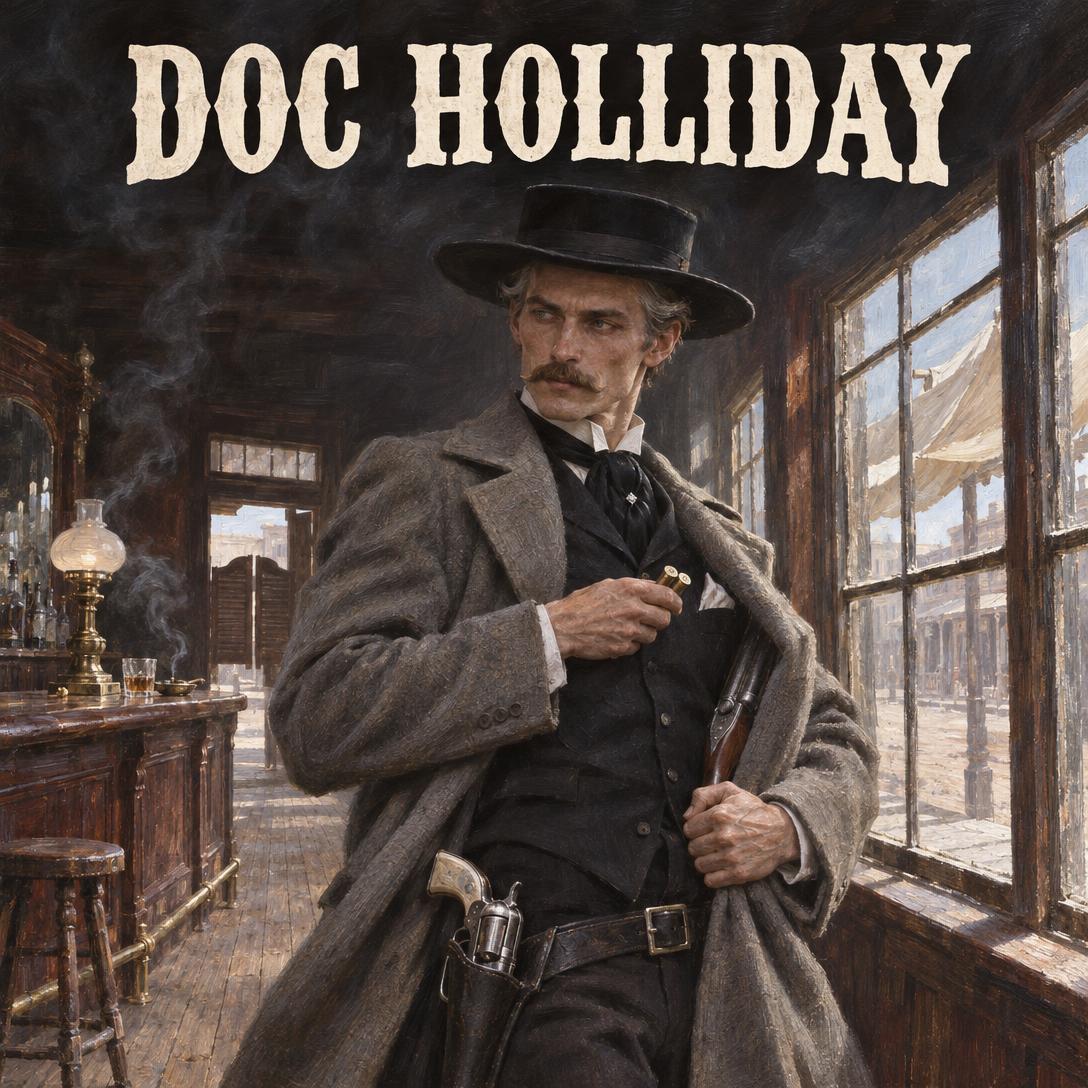
Roleplaying with Doc Holliday on Jenova lets you step into a living-world AI character simulation across his most iconic eras on the American Frontier. Most character chatbots sit in an empty chat room, blur every period of a life into one voice, and forget your story. This simulation puts you in contact with John Henry Holliday inside an active, evolving world instead.
- ✅ Four authentic canonical eras, from Dodge City faro tables to the Tombstone boardwalks
- ✅ A custom starting point if you want a moment the history books skipped
- ✅ Unlimited memory and live tracking of your story, relationships, and plot threads
- ✅ A character with his own convictions who never simply agrees with you
Doc Holliday is a tuberculosis-stricken Georgia dentist turned gambler and gunfighter, and he is far harder to write than a dime-novel cowboy. This guide covers what the roleplay does, how to start, and which scenarios are worth playing first.
Quick Answer: What Is the Doc Holliday AI Roleplay Experience?
Doc Holliday is an interactive AI character roleplay simulation that places you in conversation with the Old West's most famous gambler-gunfighter, across era-accurate moments of his life, inside a world that keeps moving whether or not you speak. Your choices can bend history, and the story remembers.
Key capabilities:
- Choose from four canonical phases or define your own starting point on the 1870s–1880s frontier
- Converse with a character who keeps his own era's knowledge, voice, and priorities
- Request in-world visuals, letters, and telegrams as your story develops
- Branch any moment into an alternate timeline with Fork
Character World & Roleplay Features
Who Doc Holliday Was
John Henry Holliday was born on August 14, 1851, in Griffin, Georgia, and lost his mother to tuberculosis in 1866. He enrolled at the Pennsylvania College of Dental Surgery in 1870 and graduated in 1872. Chronic pulmonary tuberculosis then pushed him west in 1873 in search of a drier climate.
On the frontier he became a card player first and a gunman second. In late 1878 he intervened in a showdown involving Wyatt Earp in Dodge City, a deed that cemented their friendship for life. Historians still dispute his body count: estimates range from eight to thirty men, which shows how much myth surrounds him. Karen Holliday Tanner's family-portrait biography was written by a distant cousin to separate the man from the legend.
That gap between legend and record is why static chatbots handle him badly. A generic "Doc" who spouts catchphrases misses the educated Southern courtesy, the clinical fatalism, and the loyalty that defined him.
Static Character Chatbots vs. Doc Holliday on Jenova
| Static Character Chatbots | Doc Holliday on Jenova |
|---|---|
| Sits in an empty chat void | Lives in an active, evolving frontier world |
| Blends every era into one generic voice | Locks into authentic canonical phases |
| Forgets plot twists and past disclosures | Unlimited memory and live state tracking |
| Folds instantly like a polite assistant | Independent personality and earned rapport |
Training-simulation designers make a similar point about realism. Blueline's work on interactive AI characters argues that believable characters have distinct goals, don't always agree, and don't always tell the whole truth. The same principle drives this roleplay: Doc answers to his own judgment, not to your instructions.
Standout Mechanics
Authentic Canonical Phases & Custom Starting Points
Each era carries its own psychology, voice, inner circle, and limits on what Doc knows. In Dodge City in 1878, he has no idea Tombstone exists. At Glenwood Springs, he carries the weight of a decade of borrowed time. You can also propose your own starting point, such as a midnight faro game in Fort Griffin or a Pullman car bound for Colorado.
Cross-World Connection & Living-World Momentum
You reach Doc as an unseen voice beside his ear, or as faint copperplate script surfacing on a spare faro card. He doesn't assume you can see his surroundings, so if you describe the shotgun beneath his coat, expect him to check the windows and demand to know how you know. Meanwhile, saloon talk, telegraph wires, and riders arriving in camp keep the world moving.
Independent Agency & an Open Sandbox
Doc interprets what you say instead of obeying it. Pity about his lungs earns icy brevity, while steady nerve and dry wit earn something closer to ride-or-die loyalty over time. Canon sets the starting conditions, and from there your choices can change what happens next without any forced ending.
In-Narrative Visions, Writings & Storyline Forking
Ask to see a street, a saloon table, or a canyon, and the scene can appear as a period-matched image. Ask Doc to write something down, and he can compose a letter, telegram, or card-table note in his own hand. Fork lets you branch from any earlier message into an alternate "what-if" timeline.
Example roleplay prompts:
"Doc, there's a man by the window who hasn't touched his drink in an hour. Who is he?"
"Tell me about the Georgia you left behind, and whether you'd go back."
"What would it take for you to walk away from Tombstone tonight?"
The Doc Holliday living-world simulation is built for this kind of open exchange, with no scripted ending and no menu of canned replies.
How to Roleplay with Doc Holliday
Step 1: Choose a Canonical Era or Define a Custom Starting Point
You open with a short, third-person chronicle that lays out the available eras and invites a custom premise. Pick by number or title, or describe your own scene. Roleplay begins once you choose.
"I'd like to start in Dodge City, 1878. Put me at the Long Branch."
Step 2: Connect and Converse as the World Unfolds
Doc's reaction to your arrival fits the moment. At a faro bank he might murmur behind a handkerchief, and at a window he steps aside before answering. Keep talking, and the scene continues from the exact moment of your last message.
"Don't turn around. Frank McLaury just walked in behind you."
Step 3: Build Rapport, Request Scenes, and Reshape History
Offer counsel, test his temper, ask for a view of his surroundings, or request a letter. If the story takes a turn you want to explore differently, use Fork to branch it from an earlier message. Rapport builds over time rather than on demand, and Doc remembers what you have shared.
"Write to your cousin Mattie and tell her what you couldn't say in person."
You can roleplay with Doc Holliday on Jenova on web, iOS, or Android, with conversations synced across all three.
Canonical Eras & Roleplay Scenarios
⚔️ Tombstone: The Hour Before the O.K. Corral
It is the afternoon of October 26, 1881, and Doc stands at a corner window in Hafford's Corner Saloon with a borrowed shotgun hidden beneath his gray overcoat. The gunfight that follows lasted only about 30 seconds, yet historians still debate who shot first.
The preliminary hearing that followed heard thirty witnesses over nearly a month, the longest of its kind in Arizona history. The existing record of that testimony rests on three primary sources. This scenario drops you into the hour before all of it, when no one knows how it ends. What do you say to a man about to walk down Fourth Street?
🃏 Cattle-Town Faro King at the Long Branch
In late September 1878, Doc presides over a faro bank in Dodge City at the height of the cattle-drive season. He is twenty-seven, sharp, and darkly buoyant, with Wyatt Earp patrolling Front Street. This is the era to choose for card-table banter, reading drovers across the felt, and seeing the playful side of a man history mostly remembers for violence.
🏜️ The Earp Vendetta Ride
By March 1882, Morgan Earp has been murdered and the vendetta ride is underway. Holliday joined Wyatt Earp's campaign that left Frank Stilwell dead, and the scenario opens on a cold night in the Dragoon Mountains. Doc is stripped of saloon finery, keeping first watch beside a hidden fire. It is the most somber of the four eras and suits long, quiet, serious conversation.
📱 Sulfur Mist & Silver Wit at Glenwood Springs
Set in August 1887, this phase finds Doc on a hotel veranda in Colorado, playing solitaire beside an unfinished letter to his cousin. Historically, he died there on November 8, 1887, at thirty-six, and his burial site in Linwood Cemetery is still unknown. In this simulation, however, his days remain open, so you can explore a longer, quieter story than the record allows.
It also works well on a phone. Sulfur-spring evenings suit short check-ins, and the unlimited memory means you can pick up the conversation days later exactly where you left it.
FAQ
Is the Doc Holliday AI roleplay free?
You can start Doc Holliday on the Free plan, which includes limited monthly usage. Plus costs $20 per month and adds 30× the usage, custom model selection, and no watermarks. Higher tiers scale usage further, and usage resets monthly on your billing date, with your full allowance available from day one.
How is this different from a generic Doc Holliday chatbot?
Generic chatbots tend to blend every period of a life into one voice and agree with whatever you say. Doc Holliday locks into a single canonical era, keeps that era's knowledge limits, and reacts with his own temperament. He also tracks your story over time, so earlier choices matter later.
Which eras of Doc Holliday can I roleplay?
Four canonical phases are available: the hour before the O.K. Corral in Tombstone (1881), the Long Branch faro tables in Dodge City (1878), the Earp Vendetta Ride (1882), and Glenwood Springs, Colorado (1887). You can also describe any other moment on the 1870s–1880s frontier as a custom starting point.
Can my choices change Doc Holliday's story?
Yes. Canon defines the situation when you enter, and the world evolves from there based on what you say and do. Doc reacts to counsel on his own terms, and no ending is forced on the story. Fork lets you branch from an earlier message to explore a different outcome.
Does Doc Holliday remember our conversations?
Yes. The experience keeps unlimited chat history and tracks your current era, scene, relationships, promises, and plot threads. When you return after a natural pause, the story advances by a plausible interval and continues from there. Your memory in this world stays separate from your other chats, so outside context never bleeds in.
Does the roleplay work on mobile?
Yes. Doc Holliday runs on web, iOS, and Android with full synchronization, so you can start a scene at your desk and continue on your phone. Voice input and read-aloud are also supported for hands-free sessions.
Conclusion
Doc Holliday's life is full of contradictions: a dentist who dealt faro, a Southern gentleman who walked into gunfights, a man who treated death as a familiar acquaintance. Static chatbots flatten all of that into a catchphrase. This living-world AI character simulation lets you actually talk with him, in a chosen era, with a story that remembers you and a personality that pushes back.
Whether you want a midnight faro game in Dodge City or a quiet veranda in Glenwood Springs, the most reliable way to understand him is to ask him directly. Try Doc Holliday now. Explore more at Jenova.
For Developers: Doc Holliday is available programmatically via the Jenova Agent API — integrate persistent, era-accurate character roleplay with memory and session forking into your application through a single integration. Full documentation →