AI DnD Spell Generator: Balanced Homebrew Spells & Printable Cards
2026-10-20
Trading Card Game Creator helps you design balanced, table-ready D&D spells by combining card mechanics, lore writing, and original card art. If you're looking for a DnD spell generator in October 2026, you probably want more than a random name table. You want a complete spell with a level, school, components, saving throw, and upcast scaling that won't break your campaign.
Most spell tools organize official spells or format text you've already written. This AI handles the harder part: designing and balancing the spell itself.
- ✅ Builds complete spell entries with every standard field: level, casting time, range, components, duration, school, class list, and effects
- ✅ Checks damage, saving throws, and higher-level scaling against existing spells of the same level
- ✅ Writes in-world lore and flavor text that matches your setting's tone
- ✅ Generates original card art so each homebrew spell looks like it belongs in the deck
Homebrew magic is one of the most rewarding parts of running or playing Dungeons & Dragons. A signature spell can define a villain, a wizard's school, or a whole region of your world. To see why a dedicated AI spell designer helps, it's worth looking at what makes homebrew spells difficult in the first place, and why many DMs end up shelving their best ideas.
Quick Answer: What Is a DnD Spell Generator?
A DnD spell generator is a tool that creates Dungeons & Dragons spells, including mechanics, flavor, and formatting, so players and Dungeon Masters get usable homebrew magic in minutes instead of hours of cross-referencing rules. AI-powered generators go beyond random tables. They design custom spells for your specific concept and check them for balance.
Key capabilities:
- Full spell entries that follow the official structure: level 0–9, school of magic, components, duration, and effects
- Balance review against the spell slot economy and comparable official spells
- Lore, naming, and flavor text tailored to your campaign setting
- Card-ready formatting and original art for printable spell decks
Why Homebrew Spell Design Is Harder Than It Looks
Tabletop roleplaying keeps growing, and D&D dominates the hobby. More players means more homebrew, and more tables asking whether a custom spell is fair.
USD 2.41 billion — Projected global tabletop RPG market size in 2026
94.3% — Share of surveyed TTRPG players who play Dungeons & Dragons (2020 survey)
85% — Increase in Google search interest in Dungeons & Dragons since 2020
Every official spell follows a precise structure. The 2024 Basic Rules on D&D Beyond define:
- Spell levels from 0 to 9
- Eight schools of magic
- Verbal, Somatic, and Material components
- Area shapes from Cone to Emanation
- Spell save DC calculated as 8 + your spellcasting ability modifier + your Proficiency Bonus
Writing a spell that fits that structure and plays fairly is frustratingly difficult:
- Balance is invisible until it breaks. A spell that looks reasonable on paper can outshine every other option at its level. Often you only find out mid-session, when the encounter collapses.
- Rules versions have shifted. The 2024 ruleset changed spellcasting in subtle but meaningful ways. One example is the rule that you can expend only one spell slot per turn. Older homebrew may need rewording.
- Formatting takes time. Casting time, range, duration, concentration, class lists, and upcast text all need consistent wording before a spell is usable at the table.
- Organization is a constant chore. Players on , sorted by level and alphabetized by hand.
Existing tools solve part of this. TableMancer manages spellbooks, preparation, and slot tracking. SpellCards.app produces print-ready cards for D&D 5.5e, including homebrew content. Both are built to store, track, and print spells. Designing and balancing a brand-new spell is still left to you.
This is the gap Trading Card Game Creator was built to fill.
Why Trading Card Game Creator Works as a DnD Spell Generator
Trading Card Game Creator is a complete card design studio covering mechanics, lore, card art, and balance. D&D spells are cards: a name, a cost (the spell slot), a set of rules, and an effect that must hold up against everything else in the deck. That makes card design skills a natural fit for homebrew magic.
You describe the fantasy, such as "a necromancer's spell that turns a creature's shadow against it." The AI returns a full spell entry, explains its design choices, and flags where it might be too strong or too weak.
| Traditional Approach | Trading Card Game Creator |
|---|---|
| Cross-reference the rulebook, forums, and comparable spells for an evening | Get a complete, rules-structured spell entry in one conversation |
| Guess at damage dice and hope playtesting catches problems | Receive a balance rationale comparing your spell to official spells of the same level |
| Write flavor text separately, if at all | Lore, naming, and description written to match your setting |
| Leave homebrew cards blank or pull art from the internet | Original card art generated for each spell |
| Re-type everything into a card layout | Card-ready text you can print or format into a deck |
Balance Built Around the Spell Slot Economy
Spell slots are, in the words of the official rules, the main way a spellcaster's magical potential is represented. A level 3 Wizard has only four level 1 slots and two level 2 slots, so every slot is a meaningful cost.
The AI weighs your spell's effect against that cost. It looks at:
- Damage per slot level
- Area of effect
- Whether it requires Concentration
- Save-for-half versus all-or-nothing outcomes
- How it scales with higher-level slots
"Design a level 3 Evocation spell for a storm sorcerer that's competitive with Fireball but trades raw damage for battlefield control. Explain your balance reasoning."
Every Field a Spell Card Needs
Homebrew spells fail at the table when they leave out details. Common gaps include an undefined range, a missing material component, or no instructions for casting at higher levels. Ask for a full stat block and you'll get every field standard spell cards use.
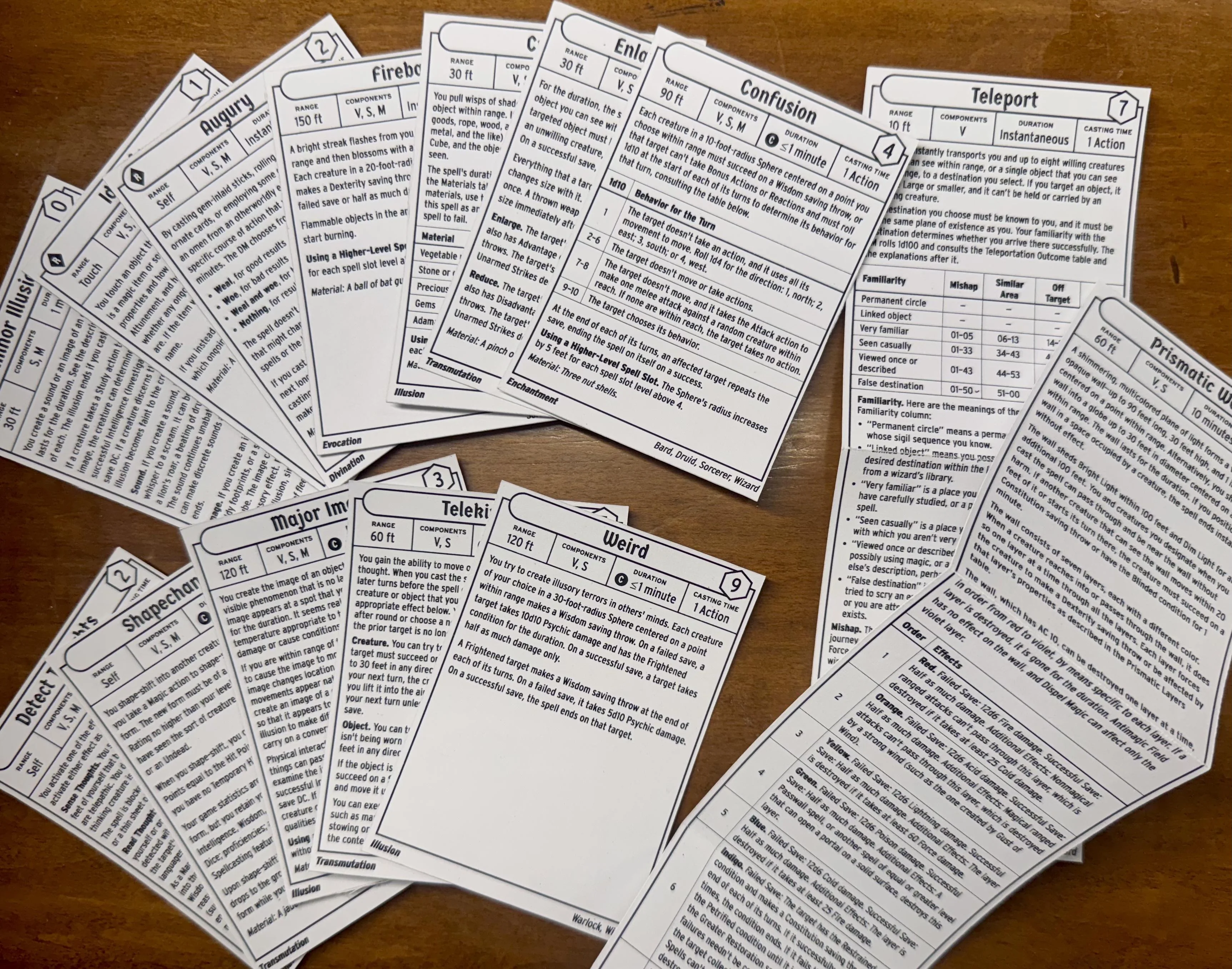
Here's an illustrative example of the kind of complete entry you can build:
Ember Thorn Lattice Level 2 Conjuration (Druid, Ranger)
- Casting Time: Magic action
- Range: 60 feet
- Components: V, S, M (a charred rose stem)
- Duration: Concentration, up to 1 minute
- Effect: Burning thorns fill a 15-foot Cube centered on a point within range. The area becomes Difficult Terrain. A creature that enters the area for the first time on a turn or starts its turn there makes a Dexterity saving throw, taking 2d6 Fire damage on a failed save or half as much on a success.
- Using a Higher-Level Spell Slot: Damage increases by 1d6 for each slot level above 2.
- Design note: The area is smaller than Spike Growth's, but save-for-half fire damage and Concentration keep the spell in level 2 territory.
Lore and Flavor That Fit Your World
A spell is more memorable when it has a history. Ask who invented it, which order guards it, or what it costs the caster emotionally. The AI writes flavor text and backstory that turns a mechanical effect into a story hook your players will remember.
"Write a short in-world history for Ember Thorn Lattice. It was created by a circle of druids who burned their own forest rather than let it fall to a lich."
Original Art for Every Card
Blank homebrew cards look like afterthoughts next to official ones. The agent generates card art in a consistent style, so a custom spell deck looks like a finished set rather than a patchwork.
Related Agents You'll Also Find Useful
Spell design rarely happens alone. It sits inside a larger campaign-building workflow. If you're also working on characters, lore, or printed handouts, these agents fit alongside your spell creation.
Name Generator
If you're also stuck naming the archmage who wrote your spell, Name Generator brings cultural and linguistic depth to character, place, and faction names.
- Names grounded in real linguistic patterns, so a desert empire and a northern clan sound distinct
- Works for characters, organizations, and fictional brands
- Useful for naming spell schools, arcane orders, and signature villains
Creative Fiction Writer
When a spell's lore grows into a full campaign arc, Creative Fiction Writer helps develop the world around it with research-backed, authentic worldbuilding.
- Story development across any genre, including high fantasy and grimdark
- Editorial feedback on campaign intros, read-aloud text, and session recaps
- Polished prose from first draft to final version
PDF Generator
Once your spells are finished, PDF Generator turns them into a professionally formatted document. Use it for a homebrew spellbook, a player handout, or a supplement for your group.
- Automatic layout and formatting conventions
- Clean, print-ready output
- A good fit for compiling a full homebrew spell compendium
Try it free. No credit card required.
How to Generate a DnD Spell With AI
Step 1: Describe the Spell Concept Start with the fantasy, not the mechanics. Tell the AI spell designer which class casts it, roughly what level it should be, and what moment you want it to create at the table.
"I want a level 1 Warlock spell for a Great Old One patron that makes an enemy briefly hear whispers of its own death."
Step 2: Set Your Rules and Table Context Specify your ruleset (2014 or 2024), your party's level, and how tactical your group is. A spell for a 4-player, level 5 party in a combat-heavy campaign should be built differently from one for a roleplay-focused table.
"Use the 2024 rules. My party is level 5, and I want this to be useful outside combat too."
Step 3: Stress-Test the Balance Ask the AI to compare your spell against official spells of the same level. Have it identify exploits and explain how it scales with higher slots. This is where you catch problems before your players do.
"Compare this to Hex and Dissonant Whispers. Is it stronger? How could a clever player abuse it?"
Step 4: Add Lore and Card Art Once the mechanics are final, ask for a short in-world history and a card illustration in your preferred style, such as ink and watercolor, dark gothic, or classic fantasy.
"Write two sentences of flavor text and create card art in an ink-and-watercolor style with deep purples and sickly green light."
Step 5: Format for Play Request the final spell in card-ready format with every field filled in. Print it, add it to your spell tracker, or compile several spells into a homebrew supplement.
Real-World DnD Spell Generator Use Cases
🧙 A Signature Spell for a Wizard's Arcane Order
Scenario: A DM wants a secret spell known only to a city's mage guild, one the players can earn after a three-session questline.
Traditional Approach: An evening of reading comparable spells, guessing at numbers, and rewriting the description until it sounds official.
Trading Card Game Creator: A complete level 4 spell with balance notes, a guild history, and a card illustration, ready for the reward scene.
- Balance checked against official spells of the same level
- Lore that connects the spell to the questline
- Card art that makes the reward feel tangible
📱 Improvising a Scroll Mid-Session on Your Phone
Scenario: Players loot a dead cultist's satchel and ask what the strange scroll does. The DM has nothing prepared.
Traditional Approach: Stall, improvise vague effects, and risk handing out something overpowered.
Trading Card Game Creator: The DM types a quick prompt on their phone and gets a themed, balanced spell before the next player's turn ends.
- Fast, coherent output during live play
- Mechanics that are fair at the party's current level
- Consistent with what the players already know about the cult
🃏 A Printable Spell Deck for New Players
Scenario: A group with two first-time players wants physical spell cards, including three homebrew spells from the DM's setting.
Traditional Approach: Print official cards, then hand-write the homebrew ones on index cards that look nothing like the rest.
Trading Card Game Creator: Homebrew spells formatted to match the official card fields, each with matching art. The finished set is compiled into a print-ready document with PDF Generator.
- Homebrew cards that match the look of official cards
- Every field filled in, so new players don't have to ask
- One printable file for the whole table
🔄 Updating Old Homebrew for the 2024 Rules
Scenario: A long-running campaign moves to the 2024 ruleset. The DM has a dozen custom spells written in older language.
Traditional Approach: Re-read the new rules and manually rewrite each spell, hoping nothing was missed.
Trading Card Game Creator: Paste each spell along with the relevant rules text. Get revised wording, such as Magic action casting times and updated area terminology, plus notes on any balance shifts.
- Consistent terminology across your whole homebrew catalog
- Flags interactions affected by rule changes
- Saves the old version alongside the new one for reference
Frequently Asked Questions
Is there a free DnD spell generator?
Yes. You can start designing homebrew spells on a free tier that includes all core features with limited monthly usage. That's enough to build several complete spells with balance notes and flavor text. If you design spells for every session or build full homebrew compendiums, paid plans start at $20/month and include substantially higher usage, custom model selection, and no watermarks on generated images.
Can AI create balanced homebrew spells for D&D 5e?
AI can produce a well-reasoned first draft. Trading Card Game Creator compares damage, area, duration, and upcast scaling against official spells of the same level, and it explains its reasoning so you can judge for yourself. Treat the output as a strong starting point rather than a guarantee. Playtesting with your group is still the final test of balance, because table style and party composition change how any spell performs.
Does the AI work with the 2024 D&D rules?
Yes. Tell it which ruleset you're using, and it will structure the spell accordingly, including Magic action casting times and the one-spell-slot-per-turn rule. For the highest accuracy, paste relevant rules text into your prompt, especially for edge cases. The official 2024 Basic Rules spell chapter is a reliable reference to share.
Can I name spells and characters with AI too?
Yes. Spell names often carry the creator's name, like "Tasha's" or "Bigby's," so naming matters. Name Generator creates culturally coherent names for the archmages, orders, and places behind your spells. That keeps your homebrew consistent with the rest of your setting.
Can I make printable spell cards with an AI spell generator?
Yes. Ask for your spell in card format, and you'll get every standard field: level, school, casting time, range, components, duration, effect, and higher-level scaling. You can also request original card art. Print the cards directly, add them to a spell-card tool, or compile a full deck into a formatted document.
Does it work on mobile?
Yes. The experience is the same on web, iOS, and Android, with settings synced across devices. That makes it practical for mid-session improvisation: generate a spell on your phone at the table, then refine it on your laptop after the game.
Conclusion: Design Magic Your Table Will Remember
Homebrew spells are where campaigns get their personality. The hard work has always been the in-between steps: balancing damage against slot cost, filling in every rules field, writing lore, and making cards that look finished.
An AI DnD spell generator handles that work, so you can spend your prep time on what the spell means in your world. Whether you need a guild's secret evocation, a cursed scroll on the fly, or a full printable homebrew deck, the process now takes minutes instead of evenings.
Try Trading Card Game Creator now and build your first custom D&D spell. Explore more at Jenova.
For Developers: Trading Card Game Creator is available programmatically via the Jenova API. Integrate AI spell and card design into your TTRPG app or virtual tabletop with a single API call. Full documentation →