AI DnD Skill Challenge Generator: Build DCs, Stakes & Outcomes
2026-10-20
Game Designer Assistant works as an AI DnD skill challenge generator. It turns a one-line scene idea into a table-ready encounter with DCs, success and failure thresholds, a skill map for your party, and fail-forward consequences. As of October 2026, many Dungeon Masters still build these scenes by hand. Fifth edition never formally carried over the skill challenge subsystem from 4th edition. As The Angry GM puts it, it's "gone in name only." This AI handles the structure so you can focus on running the scene.
- ✅ Sets DCs using the Dungeon Master's Guide's easy, moderate, and hard benchmarks, adjusted for your party's level
- ✅ Scales success and failure thresholds to the size of your party
- ✅ Maps each challenge across all 18 skills so every player has a meaningful move
- ✅ Writes fail-forward consequences so a lost challenge still moves the story
Skill challenges are one of the best tools for making exploration and social scenes feel as tense as combat. They are also one of the easiest to get wrong. To see why a generator helps, it's worth looking at what DMs face when they build these encounters from scratch.
Quick Answer: What Is a DnD Skill Challenge Generator?
A DnD skill challenge generator is an AI tool that builds structured, non-combat D&D encounters, including DCs, success and failure thresholds, skill options, and consequences. It lets a Dungeon Master run a tense multi-turn scene with a fraction of the usual prep.
Key capabilities:
- DCs calibrated to party level and the official difficulty tiers
- Success and failure counts scaled to party size and scene length
- Skill-by-skill suggestions tied to the fiction, from Athletics to Persuasion
- Narrative outcomes for full success, partial success, and failure
Why Building D&D Skill Challenges From Scratch Is So Hard
Kobold Press defines a skill challenge as "a series of ability checks undertaken by all PCs working together, trying to achieve a specific goal." Campfire describes it as an encounter-style framework with turn-based play but no grid or minis. The concept is simple. Writing a good one before Thursday night is the hard part, and it sits on top of an already heavy prep load.
29% of 3,663 polled DMs say they spend three hours or more preparing a roughly four-hour session — Sly Flourish D&D surveys
57% of polled DMs primarily run homebrew adventures, so no published module supplies their skill challenges — Sly Flourish D&D surveys
41% of 6,900 respondents in a 2026 poll have played D&D for five years or less — Sly Flourish D&D surveys
2–3 hours of prep per hour of play is a common pattern in published Game Master surveys, and new GMs often spend more — DungeonsDeep on the Game Master shortage
But designing a skill challenge that actually plays well is frustratingly difficult:
- Threshold math. Too few successes and the scene ends before it builds tension. Too many and it drags. DCs that feel fine at level 3 become trivial by level 9.
- Spotlight imbalance. Without structure, one character carries the scene. Kobold Press calls skill challenges a fix for "just having the bard do all the talking . . . again."
- Dice without drama. A long-running RPG Stack Exchange thread captures a common frustration: skill challenges that feel like nothing more than "sequences of die chucking."
- Dead-end failures. A failed challenge that simply blocks the party stalls the session. The 2024 Dungeon Master's Guide on Roll20 advises calling for a roll only when there are "meaningful consequences for failure." That means you also have to design those consequences.
This is exactly the prep a purpose-built game design AI was made to take off your plate.
Why Game Designer Assistant Works as Your Skill Challenge Generator
Game Designer Assistant is a game design partner built for brainstorming, systems analysis, and documentation. Those three skills are exactly what a good skill challenge needs. You describe the scene, the stakes, and your party. It returns a complete encounter you can run as written or adjust in a follow-up message.
The difference shows up in the details. You get more than "roll Stealth, DC 15." You get a challenge whose numbers, skill options, and outcomes are designed together.
| Traditional Approach | Game Designer Assistant |
|---|---|
| Guessing DCs, then discovering mid-session they're too easy or too punishing | DCs calibrated to party level and the official easy/moderate/hard tiers |
| One or two players carry the scene while others wait | A skill map that gives every character a fiction-grounded option |
| A failed challenge blocks the plot and stalls the session | Fail-forward outcomes with costs, complications, and partial successes |
| An hour or more of prep for a single non-combat scene | A complete draft in one conversation, refined in follow-up messages |
| Generic "make a check" narration | Read-aloud text and reactions for each success and failure |
Calibrated DCs That Match Your Party
The 2024 DMG sets DC 10 for easy tasks, 15 for moderate, and 20 for hard. It notes that a character with a 10 in the relevant ability and no proficiency succeeds at an easy task "around 50 percent of the time." Kobold Press suggests a simpler rule of thumb for skill challenges: DC = 9 + the party's proficiency bonus. When in doubt, it recommends leaning toward too easy. For a level 5 party, that means DC 12. The assistant applies these benchmarks and explains its reasoning, so you can push the difficulty up or down on purpose.
Thresholds Scaled to Party Size
Kobold's framework sets the win condition at twice as many successes as there are PCs, before reaching as many failures as there are PCs. A four-player party needs 8 successes before 4 failures. Community designs on D&D Beyond often cap failures at three for a tighter, tenser scene. Tell the AI whether you want a quick five-minute obstacle or a session-defining set piece, and it sizes the thresholds to match.
A Skill Map Where Every Player Has a Move
Good challenges reward creative skill use. Awesome Dice's guide to better skill challenges stresses prioritizing player agency and ensuring diverse skill usage. The assistant suggests how each of the 18 skills could plausibly contribute. In a sewer chase, Animal Handling might calm the rats, and Religion might let a character recognize a shrine marking the way out. It can also follow Kobold's "each skill once per PC" rule, which keeps players from spamming their best modifier.
Fail-Forward Consequences and Degrees of Outcome
The DMG encourages degrees of failure. A failed Persuasion check might mean the queen won't help, while failing by 5 or more lands the character in the dungeon. The generator builds this layering into every challenge. It writes outcomes for a clean win, a costly win, and a loss that still moves the story forward. This follows Kobold's advice that failure can make the goal cost more rather than block it entirely.
Printable Trackers and Rules Sanity Checks
Many tables use a visual tracker like the reference sheet below. It covers the six-step flow, a DC ladder, and success and failure boxes.
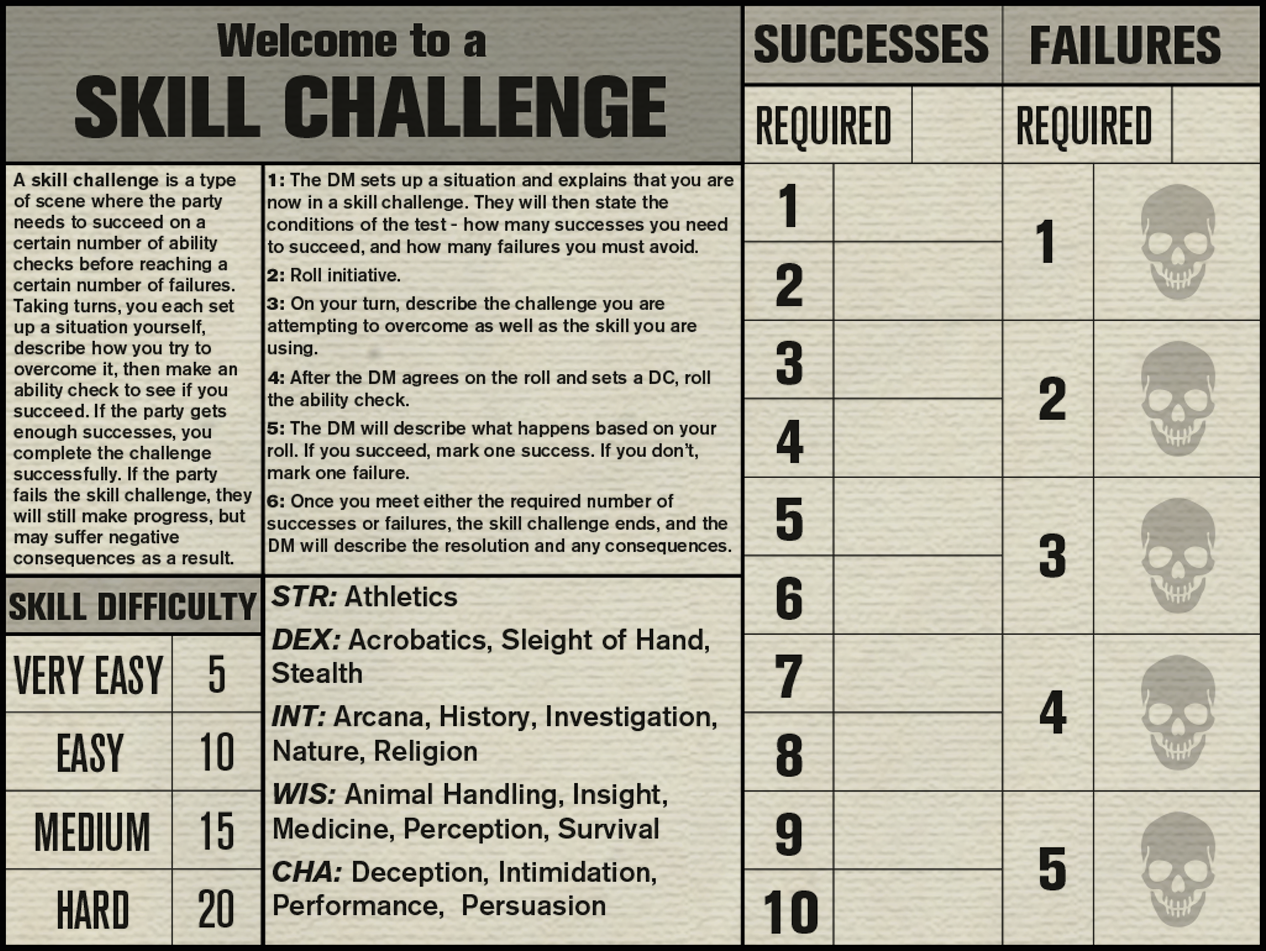
A close look at this kind of handout shows where a design partner adds value. The sheet lists DC 5 as "Very Easy," but the 2024 DMG says to let characters succeed at very easy tasks without making a check. Including DC 5 checks in a challenge just inflates the success count. The sheet also has players roll initiative. Kobold instead recommends letting players choose their order, because parties are "significantly more likely to succeed if the character with the highest modifier goes first." The assistant can flag choices like these and adapt your tracker to the method your table prefers.
Example prompts:
"Build a skill challenge for four level 6 characters escaping a collapsing dwarven mine. Medium difficulty, 3 failures max, and the consequence of failure should be losing their cart of ore, not dying."
"My party is a bard, a ranger, a wizard, and a barbarian. Design a social skill challenge at a noble's masquerade where the barbarian has real options beyond Intimidation."
"Rework this skill challenge so it uses degrees of failure. Failing by 5 or more should trigger an extra complication."
Related Agents You'll Also Find Useful
Skill challenges rarely exist in isolation. These agents fit naturally into the same prep workflow.
Name Generator
If you're also populating the scene with NPCs, Name Generator can create culturally coherent names for the guard captain, the smuggler contact, and the scheming viscountess.
- Names for characters, places, and factions with linguistic consistency
- Batches of options so you can pick what fits your setting's tone
- Useful for improvising NPCs the party unexpectedly decides to interrogate
PDF Generator
Once your challenge is finalized, PDF Generator can turn it into a clean, printable handout or DM reference page.
- Professionally formatted documents from plain text
- Good for player-facing trackers and DM cheat sheets
- Keeps your session notes organized in a consistent format
The Mansion
If you're the "forever GM" who rarely gets to play, which is a burnout pattern DungeonsDeep describes as common in tabletop, The Mansion puts you on the player side for once.
- An interactive mystery where you explore and uncover secrets
- Choices that shape how the story unfolds
- A way to study pacing and tension from the player's chair
Try the game design AI free, no credit card required.
How to Generate a D&D Skill Challenge With AI
Step 1: Describe the Scene and the Stakes Start with what the party is trying to accomplish and what happens if they fail. Kobold Press calls this step one: tell players "what they stand to gain and to lose."
"The party must cross the Glasswind Desert before the cult completes its ritual in three days."
Step 2: Share Your Party Details Give Game Designer Assistant your party's level, classes, and notable skill proficiencies. This lets it calibrate DCs and write options that play to each character's strengths.
"Level 4 party: half-orc paladin (Athletics, Intimidation), halfling rogue (Stealth, Sleight of Hand), elf druid (Nature, Survival), human cleric (Medicine, Religion)."
Step 3: Choose Length, Difficulty, and Tone Specify how long the scene should run and how punishing failure should be. A three-failure cap creates urgency, while a longer threshold suits a set piece that fills the whole session.
"Make it about 30 minutes of play, moderately hard, with a dread-building tone. Failure costs them a day and some supplies."
Step 4: Review and Refine the Draft Read the output with a critical eye. Check that the DCs, skill options, and consequences fit your table, then ask for revisions in plain language. You remain the final authority on the rules.
"Swap the Arcana option for something the paladin can contribute, and add a twist when they hit their second failure."
Step 5: Run It and Log the Outcome Run the challenge, then tell the assistant how it went. It can carry the consequences forward into your next session's hooks and keep your campaign threads consistent across sessions.
"They succeeded but took two failures. Write the opening scene for next session reflecting their exhaustion."
Skill Challenge Examples and Results
🏰 Infiltrating a Noble's Masquerade
Scenario: A party of five needs to locate a stolen signet ring at a crowded masquerade before the host notices them.
Traditional Approach: An hour or more of prep sketching NPCs, guessing DCs, and hoping the bard doesn't solo the scene.
With Game Designer Assistant: A 10-success, 5-failure challenge scaled to party size. Each player gets distinct paths, such as Performance to distract the host, Insight to read the room, Sleight of Hand to lift the ring, and Athletics to scale a balcony.
- Every character has a clear role
- Degrees of failure: a bad Deception roll raises suspicion before it ends the scene
- Read-aloud reactions for each guest the party approaches
📱 Improvising Mid-Session From Your Phone
Scenario: The players ignore your planned dungeon and decide to chase a fleeing informant through the market.
Traditional Approach: Stalling with a bathroom break while you scribble numbers on scrap paper.
With the AI assistant on mobile: You type a quick prompt on your phone under the DM screen and get a chase-style skill challenge with DCs, obstacles, and outcomes within moments. Full support across web, iOS, and Android means your laptop can stay closed.
- No need to break the table's momentum
- Obstacles that react to the current scene
- Consequences you can drop straight into the next encounter
🌲 Surviving a Harsh Wilderness Trek
Scenario: The party must cross a haunted marsh. EN World's classic list of skill challenge ideas names "finding your way through a harsh environment" as a staple.
Traditional Approach: A single Survival check that one character rolls while everyone else watches.
With the AI assistant: A multi-stage trek in which each failure costs something tangible, such as rations, time, or a lost pack mule. Successes reveal lore about the marsh's curse.
- Exploration that involves the whole party
- Attrition that feeds into the next combat
- Clues woven into successes so the story advances either way
🎓 A New DM's First Skill Challenge
Scenario: A first-time DM wants to run a non-combat scene but has never designed one.
Traditional Approach: Hours of reading forum threads and blog posts, then still feeling unsure about the math.
With the AI assistant: A complete challenge that includes a plain-language explanation of why each DC and threshold was chosen. The new DM learns the design logic while preparing a real session.
- Learn by doing, with the reasoning shown
- Confidence going into the session
- A reusable template for future challenges
Frequently Asked Questions
What is a skill challenge in D&D 5e?
A skill challenge is a structured non-combat encounter where the whole party makes a series of ability checks toward a shared goal. They must reach a set number of successes before accumulating too many failures. The format originated in 4th edition D&D. It isn't a formal 5e subsystem, but DMs widely adapt it using frameworks like the one from Kobold Press.
How many successes and failures should a D&D skill challenge have?
A common formula from Kobold Press is twice as many successes as there are player characters, before reaching as many failures as there are PCs. Four players would need 8 successes before 4 failures. Many DMs cap failures at three for shorter, tenser scenes. An AI skill challenge generator can size thresholds to your party and the pacing you want.
Is Game Designer Assistant free to use?
Yes. You can use Game Designer Assistant on a free plan that includes all core features with limited usage. Paid plans start at $20 per month for significantly higher usage, and limits reset monthly with no daily caps. Many DMs find the free tier enough to design a few skill challenges per session.
Does an AI skill challenge generator work with the 2024 D&D rules?
Yes. Skill challenges run on standard ability checks, so they work with both the 2014 and 2024 rules. The 2024 Dungeon Master's Guide's guidance on typical DCs, group checks, and degrees of failure fits naturally into skill challenge design. You can tell the generator which edition your table uses and it will match the terminology.
Can I print skill challenge trackers for my table?
Yes. Once your challenge is finalized, you can turn it into a formatted handout with success and failure boxes, DCs, and skill prompts. PDF Generator produces clean, printable documents from your challenge text, giving you a physical tracker your players can see during the scene.
Will an AI generator replace the Dungeon Master?
No. A skill challenge generator handles prep work like math, structure, skill options, and draft narration. The DM still reads the table, adjudicates creative ideas, and decides what fits the story. Treat the AI as a design partner whose drafts you review and adjust, not as the final word on rules or pacing.
Run Better Skill Challenges With Less Prep
Skill challenges bring the structure and tension of combat to exploration and roleplay. Building them by hand means juggling DC math, success thresholds, spotlight balance, and fail-forward consequences, often on top of hours of other session prep. An AI DnD skill challenge generator compresses that work into a single conversation. You get balanced D&D skill challenges, tailored skill maps, and outcomes that keep the story moving whether the dice cooperate or not.
Whether you're planning a heist, a desert crossing, or an improvised market chase, a dedicated design partner gives every player a moment to shine. Try Game Designer Assistant now, and explore more at Jenova.
For Developers: Game Designer Assistant is available programmatically via the Jenova API, so you can integrate AI-powered encounter and skill challenge design into your VTT, campaign manager, or tabletop app with a single API call. Full documentation →