AI D&D Campaign: Run Unlimited Adventures With an AI Dungeon Master (May 2026)
2026-05-18
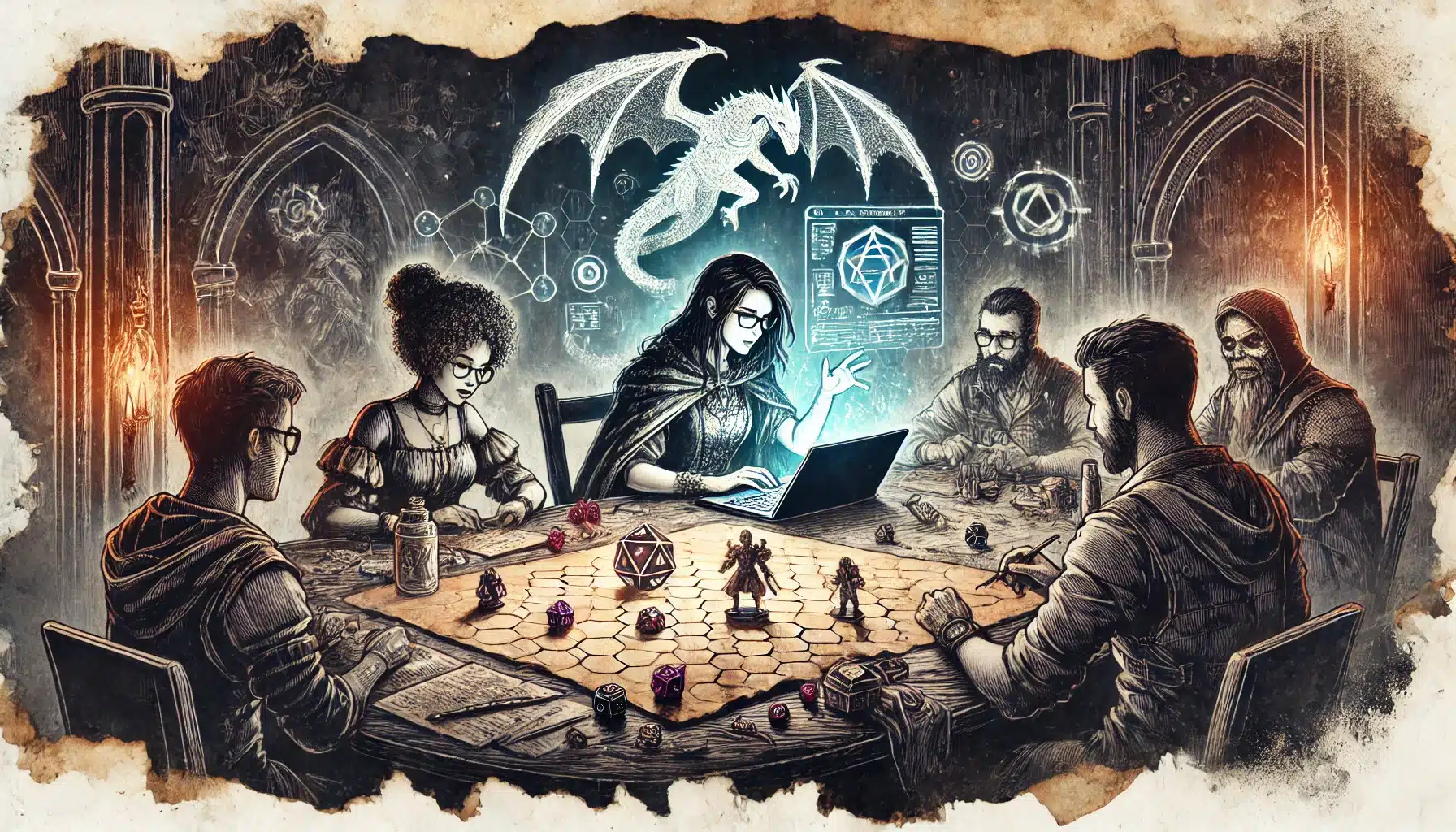
Dungeons & Dragons has never had more players — and never had fewer Dungeon Masters willing to run for them. D&D now has over 64 million players worldwide, but the demand for DMs far outstrips supply, creating a structural bottleneck that scheduling apps and Discord servers can't solve (AIDungeonMaster.ai). The global tabletop RPG market is expected to reach $2.4 billion in 2026** and grow to **$6.3 billion by 2035 (Industry Research), while the broader AI roleplay chatbot market is valued at $1.2 billion** and projected to hit **$8.92 billion by 2033 — a CAGR of 28.5% (Skywork.ai).
The result in 2026: campaigns that die after three sessions, players who never find a group, and DMs who burn out from the cognitive load of managing rules, NPCs, faction politics, and narrative simultaneously. Meanwhile, general-purpose AI tools like ChatGPT can start a campaign in seconds — but forget your character's name after twenty turns, apply D&D rules incorrectly with total confidence, and have zero memory between sessions.
Jenova's Roleplay Game Master was purpose-built for this exact problem: an AI Dungeon Master with unlimited persistent memory, perfect NPC consistency, multi-model flexibility, and system-agnostic design that runs campaigns across D&D 5e, Pathfinder, Call of Cthulhu, homebrew systems, and any genre you can imagine.
Quick Answer: What Is an AI D&D Campaign?
An AI D&D campaign is a tabletop RPG adventure where a large language model serves as the Dungeon Master — narrating the story, controlling NPCs, adjudicating rules, resolving combat, and adapting the plot to player choices in real time, without scripted dialogue trees, predetermined endings, or scheduling constraints.
- Run full campaigns 24/7 with adaptive NPCs using the Roleplay Game Master
- Play any system or setting — D&D 5e, Pathfinder, Call of Cthulhu, homebrew, sci-fi, horror, historical
- NPCs that remember and evolve — characters that hold grudges, pursue agendas, and react to your reputation
- Switch between AI models mid-campaign — GPT-5.4, Claude Opus 4.6, Gemini 3.1 Pro Preview, and more
The Problem: Why Running a D&D Campaign Is Still So Difficult in 2026
The tabletop renaissance is real. The infrastructure to support it hasn't kept pace.
The DM Shortage Isn't a Meme — It's a Structural Crisis
"D&D has 64M+ players, but the data shows that demand for DMs far outstrips supply — and the problem is getting worse, not better." — AIDungeonMaster.ai
Every D&D campaign requires a Dungeon Master. A skilled DM doesn't just narrate — they manage world state, voice dozens of NPCs, adjudicate rules on the fly, and adapt the story to unpredictable player decisions in real time. Finding a DM who can commit to a regular weekly game is hard. Finding one whose schedule aligns with three to five other adults is functionally impossible for millions of players. The result: campaigns collapse after a few sessions, players spend more time in "looking for DM" channels than actually playing, and experienced DMs burn out under the cognitive load.
General-Purpose AI Breaks After Session One
Using ChatGPT or Claude as an improvised DM is the most accessible entry point — and the one most likely to disappoint within an hour. As extensive 2026 testing found:
"The experience falls apart over time. General-purpose chatbots have limited context windows, which means they forget details from earlier in the conversation — and they have no memory between sessions at all." — AIDungeonMaster.ai
Your carefully described character backstory evaporates by the second combat encounter. The NPC who swore revenge three scenes ago doesn't remember you exist. The tavern keeper your party befriended last week has been completely wiped from the AI's memory.
AI NPCs Still Can't Hold a Conversation
Even purpose-built game studios struggle with NPC consistency. At GDC 2026, AI-powered NPC demos produced a tavern keeper who "refused and said the tavern doesn't cook fowl — while sitting next to a fully cooked chicken." Conversations "weren't always coherent," and townsfolk "struggled to give distinct personalities" (Polygon via GDC 2026 coverage). If studios with dedicated engineering teams can't solve NPC consistency, a generic chatbot doesn't stand a chance sustaining a multi-session D&D campaign with recurring characters.
Rules Accuracy Is a Liability, Not a Feature
"LLMs will confidently apply rules incorrectly — telling you that your Level 3 wizard can cast 5th-level spells, or that you can attack three times with a longsword as a Rogue. They're generating plausible-sounding D&D content, not actually implementing the rules." — AIDungeonMaster.ai
D&D runs on precise mechanical interactions: action economy, spell slot management, ability score modifiers, proficiency bonuses, advantage/disadvantage. A DM who gets these wrong doesn't just break immersion — they break the game. General-purpose chatbots treat D&D rules as creative writing prompts, not mechanical systems.
Single-Model Lock-In Limits Campaign Versatility
Different campaign scenarios demand different AI strengths. A psychologically complex court intrigue needs nuanced prose. A mystery investigation needs sharp logical reasoning. A sprawling fantasy epic needs massive context retention for lore consistency. Being locked into one AI model means accepting its weaknesses across every type of campaign moment.
Why Roleplay Game Master Is the Best AI for D&D Campaigns
This is exactly what Roleplay Game Master was built for.
Unlike general-purpose chatbots that treat D&D as an afterthought, or dedicated platforms that lock you into narrow systems, the Roleplay Game Master is a specialized AI Dungeon Master designed from the ground up for immersive, long-form tabletop RPG campaigns.
| Challenge | General AI (ChatGPT, Claude) | Dedicated Platforms (AI Dungeon, Friends & Fables) | Roleplay Game Master |
|---|---|---|---|
| Campaign memory | Single session only | Limited "world info" or session-only | Unlimited persistent memory across sessions |
| NPC consistency | Personality drifts after a few exchanges | Varies; often inconsistent over time | Perfect persona fidelity indefinitely |
| Rules accuracy | Improvised, frequently incorrect | D&D-specific but often limited to 5e | Interprets rules contextually with player-directed adjudication |
| System support | Any (but shallow) | Usually D&D 5e only | Any system: D&D, Pathfinder, CoC, Shadowrun, FATE, homebrew |
| Model flexibility | Locked to one model | Locked to one model | GPT-5.4, Claude Opus 4.6, Gemini 3.1 Pro Preview, and more |
| DM availability | Always available but forgets everything | Always available, limited memory | Always available, never forgets |
Unlimited Memory That Spans Entire Campaigns
The breakthrough that makes AI D&D campaigns viable in 2026 isn't better prose — it's memory. The Roleplay Game Master maintains persistent cross-session memory of your entire campaign: every NPC relationship, every quest thread, every item in your inventory, every faction alliance, every promise made and betrayal suffered. Your 50th session picks up exactly where your 49th left off — no recaps needed, no "world info" entries to manage manually, no context window ceiling where the AI starts summarizing and losing critical details.
Adaptive NPCs With Goals, Fears, and Agendas
NPCs in the Roleplay Game Master don't just react — they have motivations that evolve based on your actions. Betray an ally, and they remember. Help a stranger, and it ripples through the world. Ignore a faction's demands, and they act without you. The blacksmith who sold you a discount sword in session two still remembers the favor you did — and expects one in return in session twenty.
Multi-Model Creative Flexibility
Different campaign moments demand different AI strengths. You might use Claude Opus 4.6 for psychologically complex character dramas and emotional NPC interactions, GPT-5.4 for mystery investigations and precise rule adjudication, and Gemini 3.1 Pro Preview for epic-length campaigns with extensive lore that needs massive context retention. Jenova lets you switch models mid-campaign — your world state, character sheets, NPC relationships, and quest progress persist across every model change.
System-Agnostic by Design
You're not locked into D&D 5e. Run Pathfinder 2e, Call of Cthulhu, Shadowrun, FATE, Powered by the Apocalypse, Mork Borg, or any homebrew system you've designed. Describe your mechanics, and the AI interprets them — tracking hit points, spell slots, sanity points, corruption meters, or whatever your system demands.
Competitor Context
ChatGPT and Claude can handle casual D&D sessions through careful prompting, but they "don't track hit points, spell slots, initiative order, or any mechanical state" (AIDungeonMaster.ai). AI Dungeon pioneered AI-powered text adventures but "was built as a general interactive fiction platform, not specifically for D&D" and "doesn't natively understand D&D 5e rules, classes, or combat mechanics" (AIDungeonMaster.ai). Friends & Fables offers Discord-based group play but is "constrained by Discord's interface" with no dedicated game UI (AIDungeonMaster.ai). Tools like Tabletop Arc and Archivist AI excel at session transcription and campaign management — turning audio into searchable transcripts and maintaining lore wikis (Tabletop Arc) — but they assist human DMs rather than replacing them. The Roleplay Game Master combines frontier model access with specialized RPG architecture: persistent memory, adaptive NPCs, system-agnostic design, and multi-model flexibility — purpose-built for campaign-length experiences.
Example Prompts for AI D&D Campaigns
"Run a D&D 5e campaign set in a coastal city controlled by three rival merchant guilds. I'm playing a level 5 half-elf rogue named Kael who's secretly working for the weakest guild while infiltrating the strongest. Start with my handler giving me my first assignment — make the dialogue tense. Track my hit points, spell slots, and inventory."
"I want to run a horror one-shot using Call of Cthulhu 7th edition rules. Set it in a 1920s New England fishing village where something is wrong with the tide. I'll play a journalist investigating disappearances. Keep the pacing slow — dread over jump scares. Use sanity mechanics."
"Continue my campaign from last session. Kael just discovered that the merchant guild he's infiltrating is smuggling something alive through the harbor. I want to investigate the warehouse tonight. Remind me what happened with the dock foreman NPC — did he seem suspicious or cooperative last time?"
Start your first campaign with Roleplay Game Master free — no credit card required.
Related Agents You'll Also Like
The Mansion
A standalone mystery experience that plays like a D&D horror one-shot. You wake in a mansion with no memory. Other inhabitants have secrets. Exploration reveals clues, trust-building with NPCs unlocks hidden paths, and your choices determine which of multiple endings you reach. For D&D players who want an AI-powered adventure with built-in narrative structure, The Mansion delivers a self-contained campaign you can start immediately.
- AI-driven tension that escalates based on your exploration patterns
- Multiple endings determined by discovery depth and relationship choices
- Environmental storytelling through object relationships and atmospheric detail
The Asylum
Horror investigation in a shuttered psychiatric institution. For players who want their D&D horror sessions turned up to maximum — sanity-testing exploration, unreliable narration, and an atmosphere that makes every corridor feel like a saving throw.
- Psychological horror mechanics with escalating dread
- Investigation-driven progression rewarding careful observation
- Persistent world state that tracks what you've disturbed
Creative Fiction Writer
For DMs and players who want to turn their AI D&D campaign into polished prose — session summaries, novelized recaps, or full campaign novelizations. The Creative Fiction Writer adapts to any genre and maintains persistent memory, making it the ideal partner for transforming your campaign's best moments into stories worth sharing.
- Adapts writing style to match your campaign's tone — epic fantasy, noir, horror, comedy
- Persistent memory for character voices and plot continuity across chapters
- Polishes raw session notes into publication-quality prose
Manga Creator
Visualize your campaign's most iconic moments — character portraits, battle scenes, dramatic reveals, and party group shots. The Manga Creator maintains character visual consistency across illustrations, so your fighter looks the same in the tavern scene as they do in the dragon fight.
- Character reference sheets for consistent visual identity
- Panel-by-panel scene illustration for campaign highlight reels
- Multiple art styles from anime to Western fantasy illustration
How It Works: Running an AI D&D Campaign Step by Step
Here's the complete workflow for launching and sustaining a D&D campaign using the Roleplay Game Master — from your first message to your fiftieth session.
1. Set your campaign parameters.
Tell the AI what kind of campaign you want: the system (D&D 5e, Pathfinder, homebrew), the setting (high fantasy, urban noir, post-apocalyptic), the tone (heroic, gritty, comedic), and any house rules. The AI builds the world, generates NPCs with their own motivations, establishes faction dynamics, and drops you into the opening scene with full mechanical tracking.
"Run a gritty D&D 5e campaign in a dying kingdom where magic is outlawed. Low fantasy — no fireballs, no resurrections. The economy is collapsing, bandits control the trade roads, and the king is rumored to be dead. Start me in a border town where refugees are arriving from the east."
2. Create your character.
Bring your own character sheet, describe a character concept for the AI to build out, or let it generate one. Provide as much or as little detail as you want — the agent locks in every detail and weaves them into every interaction for as long as the campaign runs.
"My character is Sable Ashveil, half-elf ranger, level 3. STR 12, DEX 16, CON 14, INT 10, WIS 15, CHA 8. Favored enemy: undead. She's pragmatic, distrustful of authority, and carries a longbow she carved from a dead tree in the Wastes. She has a pet hawk named Dust who scouts ahead."
3. Play.
From here, it's pure conversation. Describe your actions, speak in character, make decisions. The AI responds as every NPC in the world — adapting dialogue, advancing quest threads, resolving combat, and tracking consequences.
"I approach the caravan camp at dusk. I send Dust ahead to scout for guards while I circle around to the supply wagons. I want to see what they're carrying before I decide whether to trade or steal."
The AI doesn't just resolve the action — it considers the caravan's security level, whether Dust's scouting is detected, what the wagons contain based on the region's economy, whether anyone recognizes you from a previous encounter, and what happens if you're caught.
4. Continue across sessions.
Close the chat, come back tomorrow, next week, or next month. Your campaign is exactly where you left it. Every NPC remembers you. Every quest thread is intact. Every faction alliance is tracked. Every item in your inventory is accounted for.
5. Switch models for different campaign demands.
Need atmospheric prose for a horror dungeon crawl? Switch to a model that excels at that. Need sharper logical reasoning for a courtroom trial or political negotiation? Switch again. Your campaign persists across model changes — no context lost, no characters forgotten.
Results & Use Cases
🗡️ Solo D&D Between Group Sessions
Scenario: A D&D player has a weekly group game but wants to run solo adventures with their character between sessions — exploring backstory, developing relationships with NPCs the group glossed over, or running side quests.
Traditional Approach: Write journal entries. Read choose-your-own-adventure modules. Wait until next week.
With Roleplay Game Master: Run solo adventures that feel like real D&D — with a DM who adapts to your actions, tracks your character sheet, and generates encounters calibrated to your level. Your ranger's solo quest to track down the undead threat in the Wastes becomes a fully realized campaign arc between group sessions.
🎭 The DM Who Needs a Break
Scenario: A DM has been running a weekly campaign for eight months and is creatively exhausted. They want to play — not run — but the group has no backup DM.
Traditional Approach: The campaign goes on hiatus. Players drift. The group disbands.
With Roleplay Game Master: The AI takes over as DM for a side campaign, a one-shot, or a full backup arc while the human DM recharges. The group keeps playing, the burned-out DM gets to be a player for the first time in months, and the AI maintains world state, NPC consistency, and rules adjudication that would take a new human DM weeks to learn.
📱 Twenty Minutes on the Commute
Scenario: A player has 20 minutes on public transit and wants their campaign to progress meaningfully — not just consume time.
Traditional Approach: Scroll through D&D subreddits. Theorybuild in a character planner. Don't actually play.
With Jenova on mobile: Pick up the ongoing campaign. The full world state, character sheet, and NPC memory are already there. Play a quick encounter, negotiate with a merchant, explore a dungeon room. Twenty minutes later, the campaign has actually advanced. Persistent memory means nothing is lost between mobile sessions.
🌍 The Homebrew World Builder
Scenario: A creator has spent months designing an original fantasy world with unique magic systems, political structures, and cultural norms — and wants to stress-test it through actual gameplay before running it for their group.
Traditional Approach: Recruit playtesters. Spend hours explaining the homebrew rules. Watch them misunderstand the magic system. Revise. Repeat.
With Roleplay Game Master: Describe the homebrew system — magic costs, political factions, combat mechanics, cultural taboos — and the AI runs it as written. Play through scenarios that test whether the magic system breaks at high levels, whether the political dynamics produce interesting conflicts, and whether the world feels lived-in. Discover problems through play, not theory.
📚 Campaign-to-Novel Pipeline
Scenario: A player's AI D&D campaign has produced genuinely memorable moments — betrayals, last stands, unlikely alliances — and they want to turn them into a written story.
Traditional Approach: Try to write a novel from memory. Struggle to reconstruct dialogue. Give up.
With Creative Fiction Writer: Feed the campaign's key moments, character profiles, and world details to Creative Fiction Writer. The agent produces polished prose that captures the characters' voices, the world's atmosphere, and the emotional beats of your adventure — transforming your campaign logs into stories worth sharing.
FAQ
What is an AI D&D campaign?
An AI D&D campaign is a tabletop RPG adventure where a large language model serves as the Dungeon Master — narrating the story, controlling NPCs, adjudicating rules, resolving combat, and adapting the plot to player choices in real time. Unlike scripted video game RPGs, you interact through natural language: describe your actions, speak in character, and make decisions freely. Specialized agents like the Roleplay Game Master maintain unlimited memory and sustain complex, multi-session campaigns — something general-purpose chatbots structurally cannot do.
Can AI actually run D&D properly?
AI can run immersive D&D campaigns with adaptive storytelling, consistent NPCs, and mechanical tracking — but the quality depends entirely on the tool. General-purpose chatbots like ChatGPT "don't track hit points, spell slots, initiative order, or any mechanical state" and "frequently apply rules incorrectly" (AIDungeonMaster.ai). Purpose-built agents like the Roleplay Game Master are designed specifically for RPG mechanics: they track character sheets, manage combat, and maintain world state across sessions.
How is this different from AI Dungeon?
AI Dungeon pioneered AI-powered text adventures but "was built as a general interactive fiction platform, not specifically for D&D" — it "excels at freeform narrative adventures but doesn't natively understand D&D 5e rules, classes, or combat mechanics" (AIDungeonMaster.ai). The Roleplay Game Master offers system-agnostic RPG support (D&D, Pathfinder, Call of Cthulhu, homebrew), unlimited persistent memory across sessions, and multi-model flexibility — choose between GPT-5.4, Claude Opus 4.6, and Gemini 3.1 Pro Preview based on your campaign's needs.
Can I use AI for D&D with systems other than 5e?
Yes. The Roleplay Game Master supports any tabletop RPG system — D&D 5e, Pathfinder 2e, Call of Cthulhu, Shadowrun, FATE, Powered by the Apocalypse, Mork Borg, homebrew systems, and custom rule sets. Describe your system's mechanics, and the AI interprets rules, manages combat, tracks character sheets, and adjudicates edge cases in real time.
Is Jenova's AI D&D campaign free to play?
Yes. Jenova offers a free tier with all core features, including full access to the Roleplay Game Master and pre-built experiences like The Mansion and The Asylum. For heavier usage, paid plans start at $20/month with no restrictions on which agents or AI models you can access. No credit card required to start.
Will the AI remember my campaign between sessions?
Yes — this is the core differentiator. The Roleplay Game Master maintains persistent memory across unlimited sessions. Every NPC relationship, quest thread, inventory item, faction alliance, and character development persists indefinitely. Return days, weeks, or months later and your campaign is exactly where you left it — no recaps needed, no context lost.
Conclusion
D&D's 64+ million players face a paradox in 2026: the hobby has never been more popular, and finding a Dungeon Master has never been harder. The TTRPG market is projected to grow from $2.4 billion in 2026 to $6.3 billion by 2035, while the AI roleplay market is accelerating toward $8.92 billion by 2033. The demand for AI-powered D&D campaigns isn't speculative — it's structural.
But the gap between a forgettable "you enter a tavern" exchange and a campaign you'll remember for months comes down to three things: memory, NPC consistency, and world-state persistence. General-purpose chatbots forget your character's name after twenty turns. GDC 2026 demos still produce NPCs that contradict themselves mid-conversation. The Roleplay Game Master remembers every detail across unlimited sessions — powered by GPT-5.4, Claude Opus 4.6, and Gemini 3.1 Pro Preview, with the RPG intelligence to bring any world, any system, and any character to life.
Explore mystery horror in The Mansion and The Asylum. Turn your campaign's best moments into polished prose with the Creative Fiction Writer. Visualize your party and their world with the Manga Creator.
Try Roleplay Game Master free — no credit card required. Explore the full agent library at Jenova.