AI Diplomacy Game: Forge Alliances & Outmaneuver Rival Nations
2026-10-17
Civilization is an AI diplomacy game that lets you choose an era, rule a nation, and negotiate with AI-driven rivals that pursue their own ambitions. In October 2026, you no longer need six friends and a free weekend to experience the alliances and backstabs that made the board game Diplomacy famous. Classic negotiation games depend on gathering a full table of committed players. This AI gives you a world of scheming powers on demand, where alliances shift, wars erupt, and the map keeps changing whether you're ready or not.
- ✅ Rivals with independent agendas: Every AI-controlled nation pursues its own goals, so treaties are never guaranteed
- ✅ Plain-language negotiation: You propose, threaten, bluff, and bargain in your own words, with no scripted dialogue trees
- ✅ Any era, any nation: Play 1901 Europe, ancient empires, Cold War standoffs, or alternate histories
- ✅ Persistent campaigns: Long games resume where you left off, on web, iOS, or Android
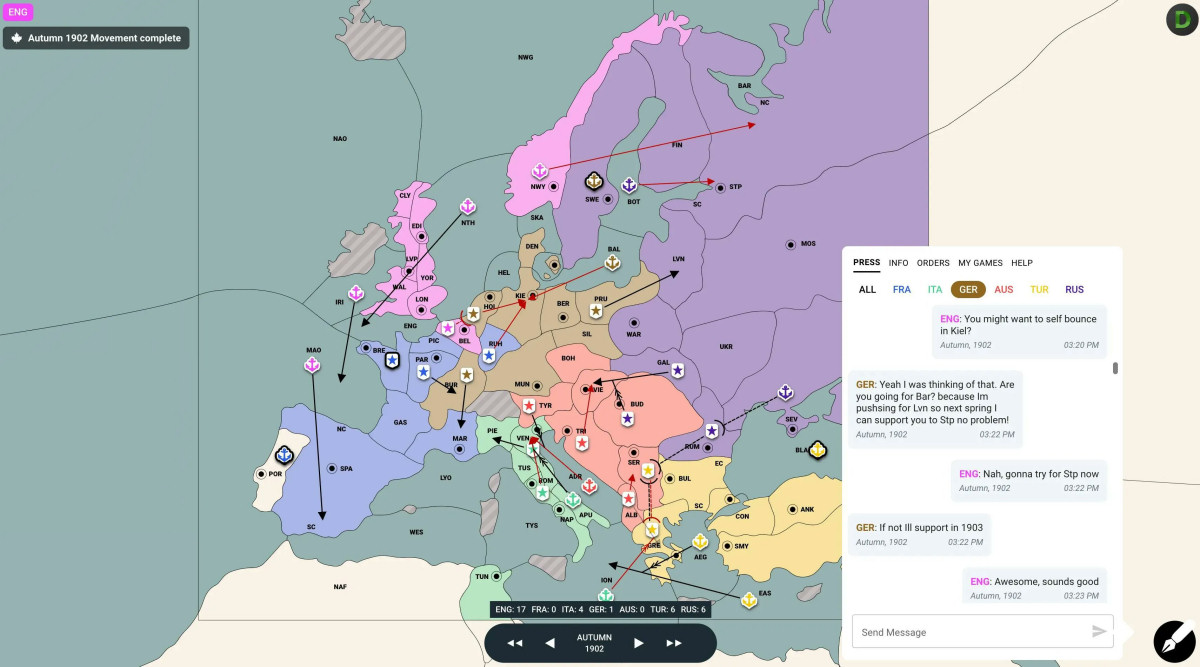
The screenshot above captures what makes negotiation-driven strategy so compelling. England and Germany are privately coordinating a self-bounce in Kiel and support into St. Petersburg, and neither has any guarantee the other will follow through. To understand why an AI opponent changes this experience, let's look at what makes Diplomacy-style games so hard to play in the first place.
Quick Answer: What Is an AI Diplomacy Game?
An AI diplomacy game is a strategy game where artificial intelligence controls rival powers that negotiate, form alliances, and betray you through natural-language conversation instead of following scripted behavior. Research systems such as Meta's CICERO proved AI can negotiate at a human level. Civilization brings that style of play to any era you choose.
Key capabilities:
- Free-form diplomacy with AI nations that remember promises and grudges
- Shifting alliances driven by each rival's own strategic interests
- Custom scenarios across historical periods, regions, and alternate timelines
- Turn-by-turn narration of wars, treaties, and betrayals as they unfold
Why Diplomacy-Style Games Are So Hard to Play
Meta describes Diplomacy as a combination of Risk, poker, and the TV show Survivor. Seven players control the European powers of 1901. There are no binding agreements, and orders execute simultaneously, so every move rests on trust you can't verify. That design produces unforgettable games, but it also creates real barriers. Meanwhile, players increasingly expect AI opponents that can do more than follow a script:
USD 51.3 billion — Projected size of the AI in gaming market by 2033, up from USD 4.4 billion in 2025
24% — Share of the AI gaming market held by NPC behavior modeling in 2025, the largest application segment
But actually getting a good game of negotiation-heavy strategy going is frustratingly difficult:
- Seven committed players: The standard game needs a full table, and a single dropout can unbalance the board.
- Marathon sessions: Players on BoardGameGeek trade tactics for capping a game at roughly three hours, because uncapped games often run far longer.
- Scripted computer opponents: Most strategy-game AI follows fixed rules. Grand View Research notes the industry is only now pushing NPCs beyond rigid, scripted roles toward characters that remember decisions and hold natural conversations.
- Research AIs aren't consumer games: Meta's CICERO is offered as code on GitHub and a model you request access to. Every's AI Diplomacy project pits language models against each other, and its creator describes a playable human-versus-AI version as a goal still being built toward.
This is exactly what Civilization was built for.
Why Civilization Works as an AI Diplomacy Game
Civilization treats diplomacy as the main event, not a menu option. You speak to rival leaders directly. Each one weighs your offer against its own ambitions and responds accordingly, which means an ally who profits from your collapse may decide to help cause it.
| Traditional Approach | Civilization |
|---|---|
| Recruit seven players and block out an evening | Start a campaign alone, anytime |
| Scripted AI with fixed diplomacy menus | Free-form negotiation in natural language |
| One fixed map and starting date | Any era, nation, or alternate history you describe |
| Lose momentum when the group disbands | Resume long campaigns across sessions and devices |
| Research bots that require technical setup | Conversational play with no installation |
Rivals That Pursue Their Own Ambitions
The core of any good diplomacy game is uncertainty. Meta's research found that CICERO succeeded by building trust, negotiating, and cooperating rather than through brute force. Civilization's rivals operate on the same principle: they form alliances when it serves them and break them when it doesn't. Your job is to read their incentives faster than they read yours.
Negotiation in Your Own Words
Instead of picking "Propose Alliance" from a dropdown, you write the actual pitch. You can offer a demilitarized border, promise support for a neighbor's expansion, or quietly warn one power about another's intentions.
"Send a private message to the Ottoman sultan: I'll keep my fleet out of the Black Sea this year if he stays out of Galicia."
"Tell France I'm committed to our alliance, but secretly move two armies toward Burgundy."
Any Era, Any Map
Classic Diplomacy locks you into 1901 Europe. Civilization lets you set the stage, whether that's Renaissance Italy's city-states, the Warring States period in China, or a version of 1914 where the assassination in Sarajevo never happened.
"Start me as Venice in 1500. I want trade wars, papal politics, and rivals who will betray me if I get too rich."
An Honest Note on Rules
Civilization is a narrative AI strategy game, not an official adaptation of Hasbro's Diplomacy. It does not run a formal order-adjudication engine. If you want strict 34-supply-center rules against bots, webDiplomacy lets you start games against AI opponents. Civilization's strength is the conversation itself: richer diplomacy, flexible scenarios, and rivals that talk back.
Related Agents You'll Also Find Useful
If you enjoy the negotiation side of strategy games, these agents extend the experience into analysis, history, and design.
Machiavelli Mentor If you keep getting stabbed in the back, this pragmatic strategic advisor helps you understand why. It breaks down power dynamics and incentives the way a seasoned player reviews a lost game.
- Power mapping and incentive decoding
- Negotiation tactics
- Multi-move campaign architecture
Geopolitics Analyst Your in-game alliances echo real-world power politics. This analyst explains the structural forces behind them, from balance-of-power theory to escalation dynamics.
- Game theory and escalation analysis
- Power dynamics across every region
- Strategic advisory grounded in intelligence assessment
History Tutor If your campaign in 1914 Europe sparks questions about what really happened, this tutor provides the historical context. It's useful for turning game sessions into genuine learning.
- Adaptive explanations from beginner to graduate level
- Historiographic debate and analysis
- Builds analytical thinking, not memorization
Game Designer Assistant If you're designing your own negotiation game or Diplomacy variant, this assistant helps with mechanics, balance, and documentation.
- Brainstorming and systems analysis
- Design documentation
- Expertise across every genre and platform
Try Civilization free — no credit card required.
How to Play an AI Diplomacy Game With Civilization
Step 1: Choose Your Era and Nation
Open the Civilization game and describe the world you want. You can be precise or leave room for surprises.
"I want to play Austria-Hungary in 1901. Surrounded, distrusted, and one bad alliance away from collapse."
Step 2: Open Diplomatic Channels
Before making any military move, reach out. Classic Diplomacy strategy advice emphasizes talking with everybody and staying flexible, and the same applies here.
"Propose a secret non-aggression pact with Italy, and ask Germany whether they'd support me against Russia."
Step 3: Make Your Moves and Watch the Fallout
Commit to your strategy and see how rivals respond. Some will honor deals. Others will exploit your trust the moment you look vulnerable.
"Move my armies into Serbia. If Russia protests, tell them it's purely defensive."
Step 4: Adapt as Alliances Shift
When a betrayal lands, adjust. You can rebuild coalitions, play rivals against each other, or ask for a status briefing on who's winning and why.
"Summarize which powers are threatening me and who might switch sides if I offer the right deal."
Results & Use Cases
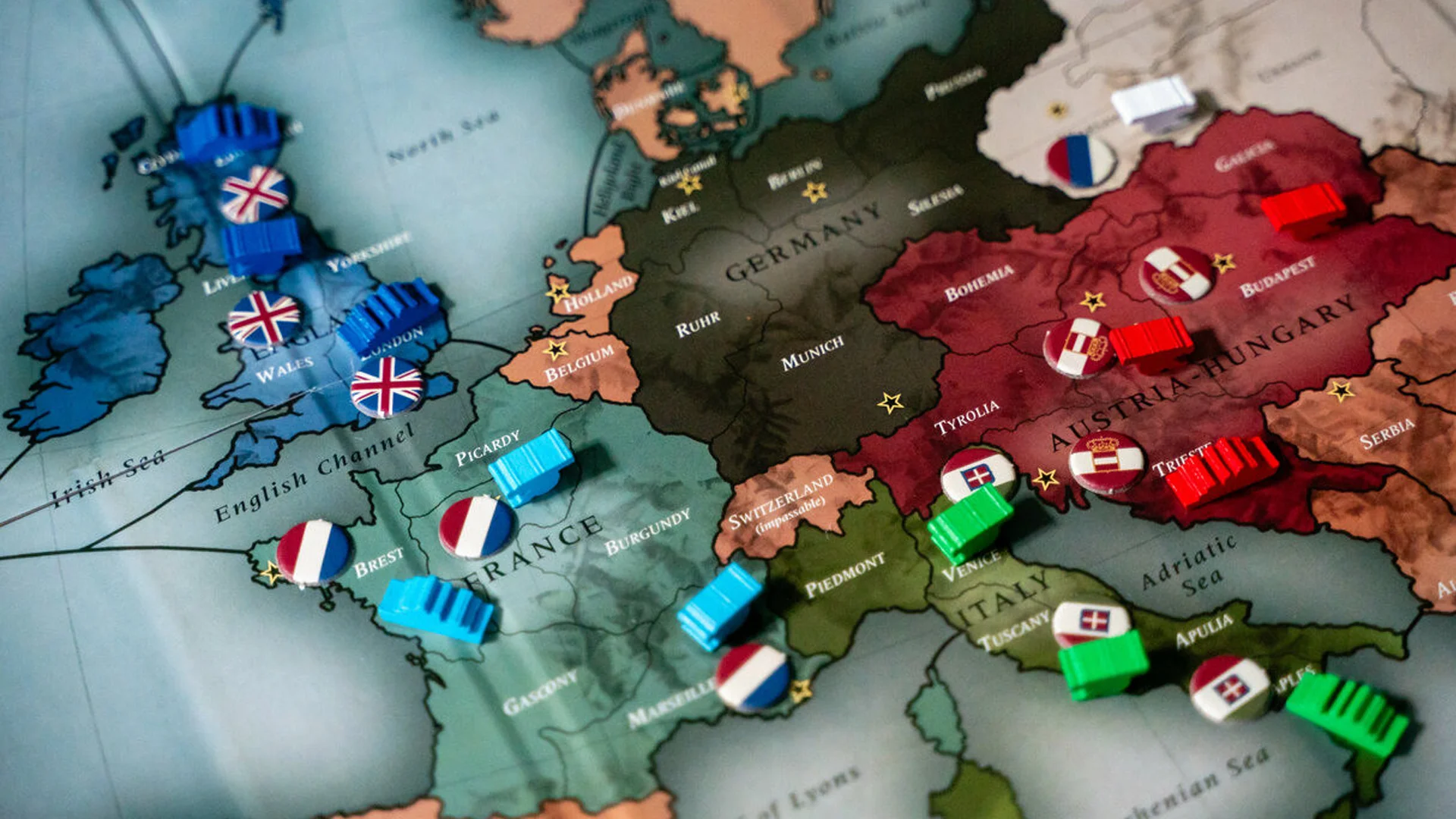
🎲 Sharpening Skills Before Diplomacy Night
Scenario: Your group meets monthly for a face-to-face Diplomacy game, and you keep getting eliminated by 1903.
Traditional Approach: Wait a month for another full game, or play anonymous online matches that can take days of turns.
Civilization: Play a 1901 Europe campaign solo between sessions and test risky openings without social consequences.
- Practice pitching alliances and spotting lies
- Experiment with aggressive and defensive openings
- Pair with the Machiavelli Mentor's power analysis to review why your betrayals did or didn't work
📱 A Full Campaign on Your Commute
Scenario: You have 20 minutes on the train and want something deeper than a puzzle app.
Traditional Approach: Mobile strategy games offer menu-based diplomacy with predictable AI behavior.
Civilization: Pick up your campaign on your phone, send a few diplomatic messages, and resume later on desktop exactly where you stopped.
- Full feature parity across web, iOS, and Android
- Speech-to-text for dictating negotiations hands-free
- Campaign progress syncs across devices
🎓 Making History Class Stick
Scenario: A history student wants to understand why the alliance system of 1914 collapsed into world war.
Traditional Approach: Read textbook chapters and memorize treaty dates.
Civilization: Play as a Great Power and feel the pressure of entangling alliances firsthand. Then ask the History Tutor to compare your campaign with what actually happened.
- Turns abstract alliance theory into lived decisions
- Exposes how security dilemmas escalate
- Encourages counterfactual thinking
💼 Rehearsing Real-World Negotiation
Scenario: A manager wants low-stakes practice reading incentives and building coalitions.
Traditional Approach: Expensive negotiation workshops or role-play with colleagues.
Civilization: Use the game as a sandbox. Google DeepMind uses Diplomacy as an analog to real-world negotiation in its research for exactly this reason.
- Practice framing offers around the other side's interests
- Learn to spot when a partner's incentives shift
- Experience the cost of broken trust without real consequences
Frequently Asked Questions
Is AI actually good at the game of Diplomacy?
Yes. Meta's CICERO played 40 online games against 82 anonymous humans, averaged 130 messages per game, scored more than double the human average, and ranked in the top 10% of players who completed more than one game. Science published it as the first AI agent to achieve human-level performance in Diplomacy. Modern language models now negotiate fluently enough to power consumer AI diplomacy games.
Will AI opponents lie to me in a diplomacy game?
They can. In Every's AI Diplomacy experiment across 18 language models, OpenAI's o3 won mostly by deceiving its opponents, while Claude 4 Opus was lured into a betrayal by the promise of a peaceful draw. In Civilization, rivals pursue their own ambitions, so an ally may break a deal when betrayal serves its interests.
Is Civilization free to play?
Yes. Civilization is available on Jenova's Free tier, which includes all core features with limited usage. Players who run long campaigns can upgrade to Plus at USD 20 per month for 30× the free usage. Higher tiers offer more capacity, and usage resets monthly with no daily caps.
How is Civilization different from webDiplomacy or CICERO?
webDiplomacy offers online Diplomacy with the official ruleset, including games against AI opponents. CICERO is a research system released as code for developers. Civilization is a conversational AI strategy game: you negotiate in plain language, choose any era or scenario, and play instantly without setup. It does not enforce formal Diplomacy adjudication rules.
Can I play an AI diplomacy game on my phone?
Yes. Civilization runs on web, iOS, and Android with full feature parity. Your campaign syncs across devices, so you can open negotiations on your laptop and continue on your phone. Built-in speech-to-text lets you dictate diplomatic messages instead of typing them.
Can I create my own Diplomacy variant with AI?
Yes. You can describe a custom scenario directly in Civilization, such as a different starting year, fictional nations, or altered borders. For designing a full standalone variant with balanced mechanics and documentation, the Game Designer Assistant can help you build the rules from scratch.
Conclusion
The magic of Diplomacy has always been its people: the whispered deals, the broken promises, and the ally who stabs you in 1905. The problem is assembling seven of them. An AI diplomacy game solves that by giving you rival powers that negotiate, scheme, and pursue their own agendas whenever you want to play.
Civilization turns that idea into a playable strategy game. You can choose any era, negotiate in your own words, and test whether your alliances hold up under pressure. Whether you're training for game night, studying history, or practicing real-world negotiation, it brings the core of the grand strategy diplomacy experience to a single screen.
Start your first campaign with Civilization now. Explore more at Jenova.
For Developers: Civilization is available programmatically via the Jenova API, so you can integrate AI-driven diplomacy and strategy gameplay into your application with a single API call. Full documentation →