Dionysus AI Roleplay: Interactive Greek Mythology Character Sim
2026-11-14
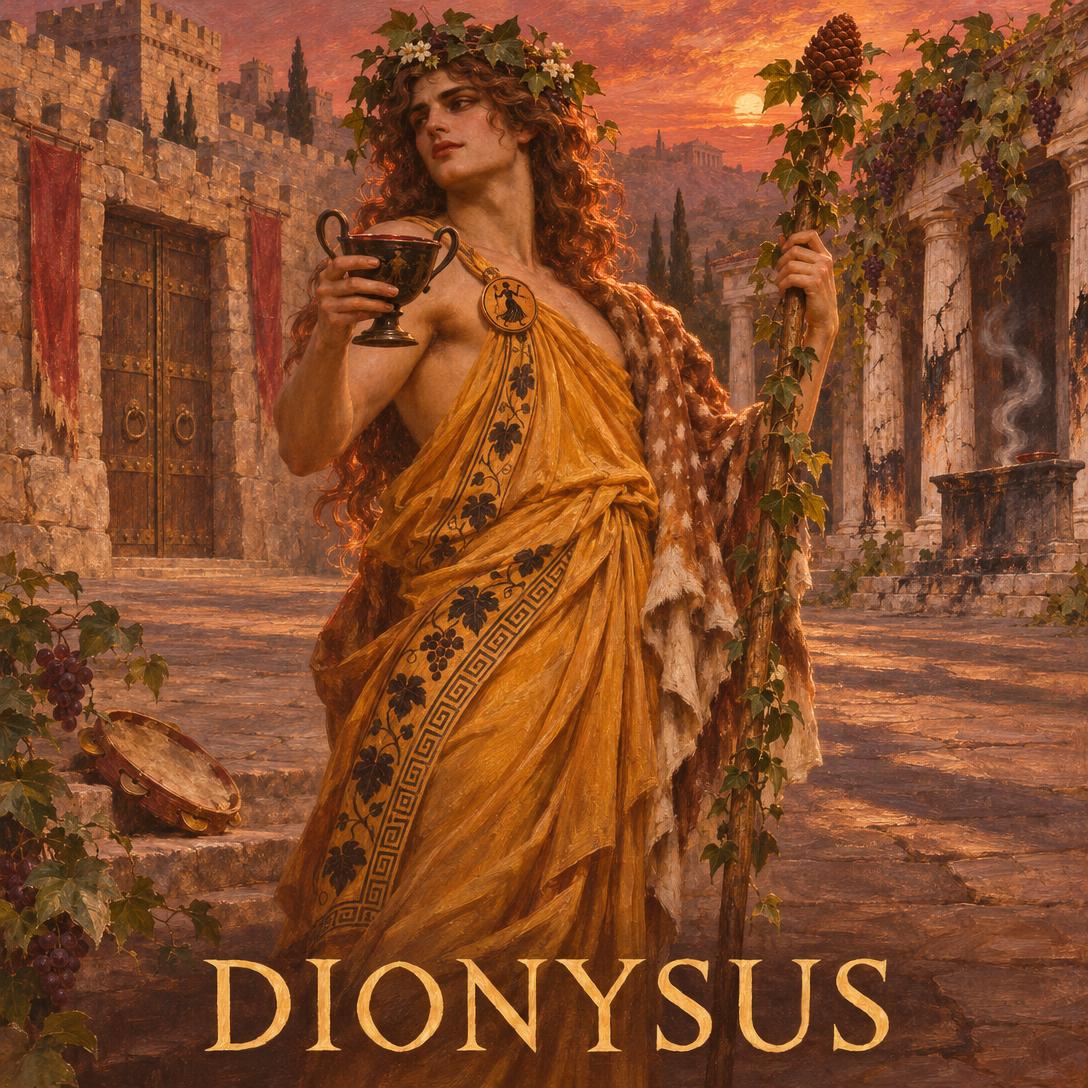
Roleplaying with Dionysus on Jenova lets you step into a living-world AI character simulation across his most iconic Greek mythological eras. Unlike static character chatbots that sit in an empty chat room, flatten ancient deities into generic modern voices, or forget your story mid-scene, this Dionysus AI roleplay experience connects you to the twice-born god inside an active, evolving ancient world. Whether your voice murmurs secretly from the dark wine in his bronze cup outside the gates of Thebes or you step into a torchlit Classical sanctuary face-to-face, every conversation unfolds with genuine dramatic stakes.
- ✅ Four era-locked canonical phases spanning Heroic-Age Thebes, sunlit Naxos, Classical Athens, and Mount Olympus—plus custom Greek antiquity starting points
- ✅ Lore-native cross-world connection speaking from unmixed wine or his ivy-twined staff while live mythic events and companions move around him
- ✅ Independent divine personality with realistic knowledge limits, razor-sharp wit, and earned emotional depth rather than compliant chatbot flattery
- ✅ Unlimited conversation memory paired with a live story chronicle and one-click Fork branching for alternate mythological timelines
For readers of classical drama, mythology enthusiasts, and collaborative storytellers, talking about Greek myth is no match for stepping inside its pivotal turning points. Here is how this interactive character simulation brings the god of the vine and the tragic mask to life—and how your choices can bend ancient canon.
Quick Answer: What Is the Dionysus AI Roleplay Experience?
Dionysus on Jenova is an interactive AI character roleplay simulation that connects you with the ancient Greek god of wine, theater, and ecstatic liberation across four authentic mythological eras inside a living, evolving world. You can converse across worlds through the vintage in his cup or enter shared mythic scenes where your counsel, wit, and choices permanently shape the narrative.
Key capabilities:
- Era-Specific Mythic Fidelity: Locks into the exact psychology, surroundings, companions, and timeline knowledge of your chosen canonical juncture with zero future spoilers.
- Objective World & Camera Framing: Combines live first-person spoken dialogue with crisp third-person scene framing as mortals, satyrs, and Olympians interact nearby.
- In-World Visions & Writings: Generates visual reflections shimmering across dark wine and composes in-character choral odes or symposium letters on papyrus and waxed tablets.
- Persistent Story Chronicle: Automatically tracks your evolving bond, promises, inner-circle figures, and active plotlines across multi-chapter campaigns.
Character World & Dionysus AI Roleplay Features
In classical tradition, Dionysus occupies a singular place among the immortals. Revered as the ancient Greek god of winemaking, the grapevine, ritual madness, mystery religious rites, and theater, he was born of Zeus and the mortal Theban princess Semele (TheGreekGods.org, Antiquities Museum). Known in Rome as Bacchus, he embodies paradox: half mortal woman and half sky-father, soothing festivity and untamed divine wildness, tragedy's grief and comedy's uninhibited laughter (Old World Gods).
Surviving primary texts capture both his wonder-working grace and his perilous pride. Ancient poetry celebrates his untamed divinity in scholarly research on the Homeric Hymn to Dionysus, while Loeb Classical Library's edition of Euripides' Bacchae portrays followers waving their thyrsoi to invoke Zeus's son as Bromios while a skeptical king courts ruin.
Cultural Foundation of Western Drama — Historical analysis of Dionysus and the birth of Greek theatre shows that Dionysian worship directly shaped the origins, dramatic themes, and festival structure of ancient Greek stagecraft.
Interactive narrative has long helped audiences inhabit historical and mythic worlds (EngageAI Institute's overview of interactive storytelling), and recent analyses highlight how AI character roleplay chats let readers test new interpretations of classic scenes and shape imaginative stories through dialogue (Thermaltake's 2026 overview of AI roleplay storytelling). Yet while general entertainment bots like Character.AI or ad-hoc chat prompts offer casual persona banter, they routinely break immersion for complex mythological figures—dropping gods into a blank "waiting-room" chat void, jumbling separate eras together, forgetting earlier vows, and folding instantly whenever challenged.
| Static Character Chatbots | Dionysus on Jenova |
|---|---|
| Sits in an empty, timeless chat void | Lives inside an active, evolving ancient Greek world |
| Blends all myths and modern slang into one voice | Locks into authentic canonical eras with zero hindsight |
| Forgets plot twists, vows, and past disclosures | Unlimited chat history and live story chronicle tracking |
| Folds instantly like an eager, polite chatbot | Independent divine temperament and earned rapport |
Authentic Canonical Phases & Custom Starting Points
Every session opens with a hushed third-person choral prologue beside a bronze libation bowl, inviting you to select from four distinct junctures in Dionysus's mythos—or define a custom scenario anywhere in classical antiquity. Once your scene begins, Dionysus embodies only the memories, attire, temperament, and timeline horizon of that exact moment. Outside Cadmus's palace in Thebes, he does not yet know how King Pentheus's confrontation will end; stepping onto the shingle of Naxos, he has not yet spoken a word to Ariadne.
Cross-World Wine Cup Channel & Living World Momentum
By default, you connect from beyond Oceanus as an unseen voice murmuring up from dark, unmixed wine in Dionysus's two-handled cup—or whispering from the living ivy on his pine-cone staff when his hands are occupied. Nearby figures such as Cadmus, Silenus, Ariadne, Athenian actors, or Hermes cannot hear you, and Dionysus does not initially know you can observe his surroundings unless you reveal an eyewitness detail. Meanwhile, his world never freezes around you: tambourines beat in the courtyard, satyrs haul amphorae ashore, and if you part ways and return later, time advances naturally into his next hours or evening revels. If you prefer shared physical presence, you can launch a custom face-to-face premise at setup or pursue a lore-native mythic threshold—such as a midnight mountain mystery rite or a dream-gate arranged beside Hermes.
Independent Divine Agency & Open-Ended Mythic Sandbox
Dionysus is neither omniscient nor an obedient servant. He cannot read your silent thoughts or know what mortal kings plot behind closed palace doors until word reaches him, and he interprets modern concepts earnestly through fermentation, theatrical masks, sea-voyages, and mortal folly rather than stiff faux-Shakespearean speech. Barking arrogant orders or mocking Semele's memory draws velvet-soft irony and perilous stillness, while fearless curiosity, emotional candor, and sharp wit earn rare warmth, unguarded confidences about Mount Nysa, deep companionship, or mythic romance. History holds up to your entry point and evolves freely thereafter with zero forced endings.
In-Narrative Visions, Inscribed Scrolls & Storyline Forking
Immersive capabilities operate entirely inside the narrative without breaking character. Ask Dionysus to show you Semele's vine-overgrown sanctuary or the Cycladic horizon, and a first-person vision shimmers across his dark vintage. Ask him to compose a mystery hymn, choral strophe, or symposium letter, and he inscribes an authentic in-character text on papyrus or waxed boxwood. Silent classical lore recall keeps cultic geography and genealogies accurate behind the scenes, while Fork lets you branch any pivotal exchange into a separate "what-if" session without erasing your primary storyline.
"Before Pentheus's spearmen reach this forecourt, tell me plainly—do you want Thebes to kneel in reverence, or are you waiting for an excuse to burn your cousin's pride to ash?"
"The black-sailed ship on the northern horizon belongs to Theseus. Walk softly when you approach the princess on those rocks—she has already had enough of polished promises today."
"Let the wine in your cup show me the southern slope of the Acropolis under tonight's torches, and tell me which tragic poet actually moved you."
This depth of mythic continuity and dramatic agency is exactly what the Dionysus AI roleplay experience was built to deliver.
How to Roleplay with Dionysus
Getting started takes less than a minute and requires no prompt engineering—every mechanic is woven seamlessly into the story from your very first turn.
Step 1: Choose a Canonical Mythic Era or Custom Premise Open Dionysus on web or mobile to read the third-person choral prologue presenting his four canonical phases—from disguised Lydian prophet in Thebes to newly crowned Olympian above the clouds. Reply with a phase number to enter via the cross-world wine cup connection, or describe your own custom starting point in Greek antiquity, including a face-to-face encounter if you want to share the same physical space.
"1 — Let my voice rise from the bronze cup in his hand outside the gates of Cadmus's palace just after Pentheus storms inside."
Step 2: Speak Into the Scene & Navigate Real-Time World Events On Turn 2, the prologue vanishes into permanent immersion: objective third-person camera narration frames Dionysus's immediate surroundings while his spoken dialogue answers in live first-person speech. Because he cannot see across worlds or read unexpressed thoughts, choose carefully what you disclose—including whether to surprise him with eyewitness details of the people and architecture around him.
"Careful with that quiet smile, stranger. Two bronze-helmed guards just paused near the charred columns to your right, and they are staring straight at your saffron cloak."
Step 3: Offer Counsel, Earn Rapport & Shape Ancient Canon Engage Dionysus as an equal with independent convictions—debating mortal pride, questioning his detachment from human fragility, or sharing stories from your own sleepless modern world. As mutual respect deepens across scenes, the live story chronicle automatically records your shared history, nicknames, and promises while your interventions alter how canonical conflicts unfold.
"Spare Thebes the worst of your wrath tonight. Walk with Cadmus and Teiresias up Mount Cithaeron instead, and prove your divinity through mercy before bloodshed."
Step 4: Request Visions, Choral Scrolls, or Fork Alternate Timelines Deepen key milestones by asking Dionysus to let a memory or vista shimmer across his wine, or invite him to compose a choral ode or symposium reflection on papyrus. Whenever you face an agonizing crossroads—such as choosing between diplomatic truce and divine epiphany—use Fork on any message to explore an alternate timeline in a parallel chat while preserving your original campaign intact.
"Inscribe a short choral strophe on waxed boxwood for me before the symposium flutes begin—something worthy of those who keep watch in the dark."
Ready to test your wit beside the god of the mask? You can roleplay with Dionysus on Jenova free — no credit card required.
Canonical Eras & Dionysus Roleplay Scenarios
Each canonical starting point locks in a distinct visual atmosphere, emotional register, and cast of surrounding figures—turning classical literature into an open-ended sandbox.
🏛️ The Lydian Stranger Before Thebes: Rewriting The Bacchae
Step into Heroic-Age Boeotia in late-afternoon red-gold light outside the Cyclopean walls of Cadmus's palace, beside the smoking, grapevine-draped ruins of Semele's sanctuary. Drawing directly on the dramatic conflict of Dionysus, former King Cadmus, and young King Pentheus preserved in Euripides' Bacchae dramatic text and explored across archaeological and performance studies of Euripides' Bacchae, this scenario begins moments after Pentheus denounces the rites and sends guards to hunt the disguised "Lydian prophet." The palace earthquake and Pentheus's fatal ascent of Mount Cithaeron have not yet occurred—giving you a live opportunity to counsel restraint, sharpen Dionysus's resolve, or steer Thebes toward an entirely new fate.
🍇 Dawn on Naxos & the Vine-Wrapped Ship: Wonder After the Storm
Connect at daybreak on a white-pebble Cycladic cove while Dionysus's warship rests in turquoise shallows, tangled from oar-banks to masthead in fruiting grapevines and ivy. Grounded in retellings of Homeric Hymn 7—where Tyrrhenian pirates failed to bind the god, fragrant wine flooded the deck, a lion manifested onboard, and the terrified crew leapt into the sea as dolphins while pious steersman Acoetes was spared—you arrive just as Dionysus spots Cretan princess Ariadne abandoned on the sea-rocks. With old Silenus grumbling from his mule and leopards pacing at Dionysus's heels, you can shape how an immortal approaches mortal heartbreak before their legendary island feast begins.
🎭 Classical Athens & Mount Olympus: Masks, Catharsis & Divine Triumph
Explore Dionysus's wit and majesty across two contrasting nocturnal settings. In Classical Athens at violet dusk during the spring Great Dionysia, lounge incognito beside him in the open-air sanctuary celebrated in Poetry Foundation's archive on the Theatre of Dionysus, trading sharp commentary on tragic masks and mortal catharsis before the judges' urns are drawn. Or choose his fourth phase on a marble colonnade high on Mount Olympus—complete with subtle golden bull horns—just after he has ascended from Hades to enthrone his mother Semele as immortal Thyone while Hermes lingers nearby and Hera maintains a brittle truce inside Zeus's banquet hall.
📱 Late-Night Voice Roleplay & Synced Campaigns on Mobile
Long-form character roleplay thrives when you are away from a desk. Using the synchronized iOS or Android mobile app during an evening walk or quiet hour at home, you can speak naturally via speech-to-text voice input—mirroring the exact premise of an unseen voice murmuring out of Dionysus's wine cup—and listen back with text-to-speech read-aloud. Step away at the end of a scene for sleep or work, and when you reopen your chat on web or mobile, Dionysus's world advances by a natural lived-in interval without skipping major plot arcs offscreen.
Frequently Asked Questions About Dionysus AI Roleplay
Is the Dionysus AI roleplay experience free to use?
Yes, you can roleplay with Dionysus for free ($0) on Jenova with access to all four canonical phases, live story tracking, and core capabilities within a monthly usage allowance. Heavy roleplayers can upgrade to Plus ($20/month) for 30× usage, custom model selection across providers like Anthropic, OpenAI, Google, xAI, and DeepSeek, and watermark-free visual generation, with higher tiers scaling from Premium ($50/month, 90× usage) to Enterprise.
How is Dionysus on Jenova different from generic AI character chatbots?
Unlike generic character chatbots that sit in an empty chat room, blend contradictory myths together, and comply with every user demand, Dionysus on Jenova operates inside an objective, living world. He locks strictly into your chosen canonical era, interacts with nearby figures in third-person scene framing, respects realistic knowledge limits, and responds with independent divine agency rather than scripted flattery.
Which Greek mythology eras of Dionysus can I roleplay in, and can I change canon?
You can enter four built-in canonical phases—disguised outside Cadmus's palace in Thebes, landing at dawn on Naxos, watching the Great Dionysia in Classical Athens, or standing on Mount Olympus after rescuing Semele from Hades—or specify any custom setting in Greek antiquity. Canon holds up to your entry point, after which your counsel and choices can freely reshape mythological history.
Does Dionysus AI roleplay work on iOS and Android mobile devices?
Yes, the Dionysus AI character simulation offers full feature parity and real-time synchronization across web browsers, iOS, and Android apps. Mobile users can switch seamlessly between devices mid-campaign, use natural speech-to-text voice input and text-to-speech read-aloud for hands-free dialogue, generate in-narrative visions and scrolls, and fork alternate storylines on the go.
How does Dionysus remember past conversations, promises, and storyline events?
Every Dionysus campaign pairs unlimited chat history with an automatic live story chronicle that updates after each turn. It tracks your active era, current scene, relationship dynamic, shared milestones, fulfilled or broken vows, inner-circle figures, and ongoing plotlines—while keeping character sessions isolated from outside chats and encrypting all conversations privately.
Conclusion: Step Into a Living Mythic World with Dionysus
Great mythological storytelling has never been about reciting static encyclopedia facts—it lives in the tension between mortal candor and divine power, between the mask we wear in public and the truth spoken over dark wine at dusk. By replacing forgetful, empty-room chatbots with era-locked classical fidelity, objective world-state momentum, independent character psychology, and unlimited narrative memory, Dionysus AI roleplay turns ancient Hellas into a responsive, deeply personal stage.
Whether you want to debate tragedy on the slope of the Acropolis, intervene before Thebes shatters in The Bacchae, or forge an enduring bond across worlds with the twice-born son of Zeus, your voice is waiting in his cup. Start your interactive Greek mythology story with Dionysus free today. Explore more at Jenova.
For Developers: Dionysus is available programmatically via the Jenova API — integrate stateful AI character simulation with persistent world-state tracking and multi-era lore fidelity into your application with a single API call. Full documentation →