AI Debate Partner: Sharpen Critical Thinking & Argumentation with AI (May 2026)
2026-05-17
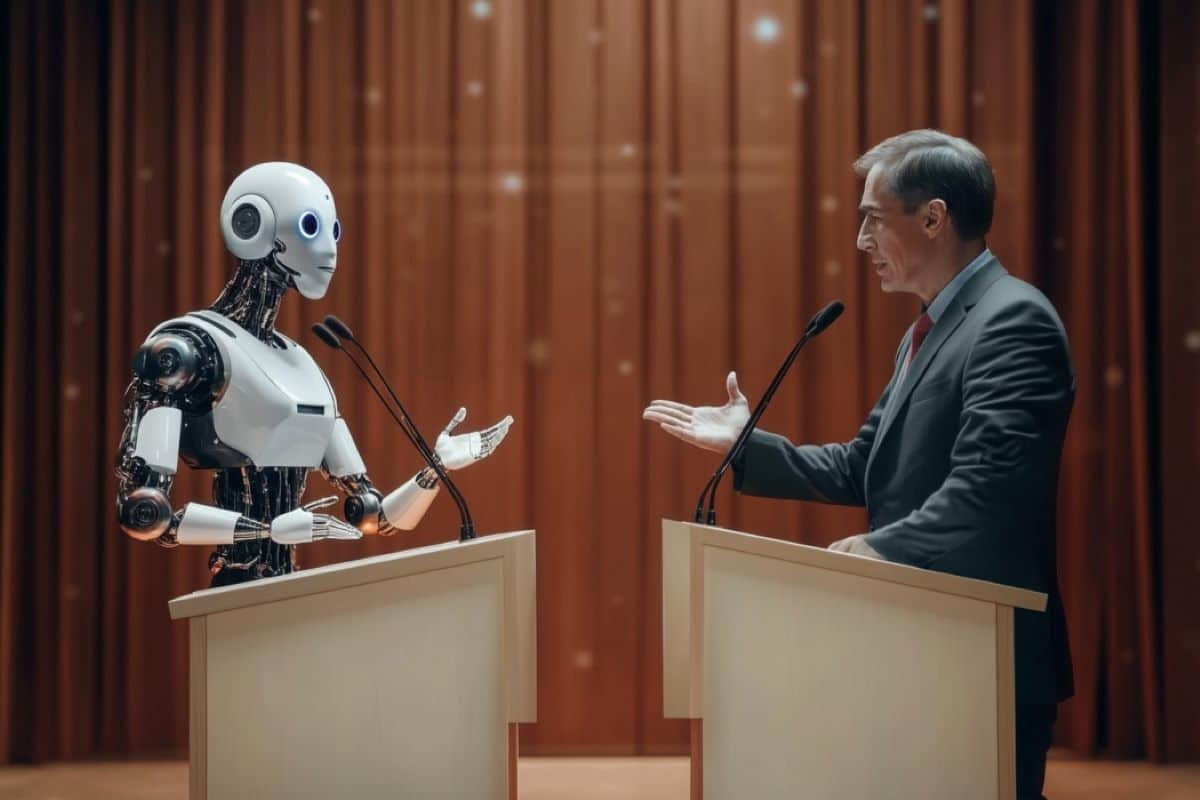
A 2025 study of 666 participants found a significant negative correlation between frequent AI use and critical thinking abilities — mediated by cognitive offloading, the tendency to let AI think for you rather than with you (source). Meanwhile, 70% of teachers worry that AI weakens critical thinking altogether (source). The irony is sharp: AI is simultaneously the threat to rigorous thinking and the most scalable tool for training it — if used correctly. The difference is whether the AI generates your arguments or forces you to defend them.
An AI debate partner does the latter. It takes a position, challenges your reasoning, exposes logical gaps, and demands you rebuild your case under pressure — the exact cognitive workout that passive AI use erodes. Jenova's The Philosopher agent is built for precisely this: Socratic questioning and structured debate across metaphysics, epistemology, ethics, politics, and any domain where rigorous argumentation matters. Combined with an Academic Research Assistant for evidence gathering and a Public Speaking Coach for delivery, the platform transforms debate practice from something that requires a willing opponent into something available on demand — 24/7, infinitely patient, and relentlessly rigorous.
Quick Answer: What Is an AI Debate Partner?
An AI debate partner is a conversational AI system that argues against your positions, challenges your logic, and trains your ability to construct, defend, and adapt arguments in real time — replicating the cognitive pressure of formal debate without requiring a human opponent.
- Socratic questioning and adversarial argumentation across any topic — try The Philosopher
- Logical fallacy detection that identifies weaknesses in your reasoning and forces you to address them
- Persistent memory tracking your argumentation patterns, blind spots, and growth across sessions
- Multi-tradition expertise spanning formal logic, rhetorical strategy, philosophical frameworks, and competitive debate formats
The Problem: Why Most People Never Develop Strong Argumentation Skills
The ability to construct and defend a rigorous argument is one of the most consequential cognitive skills — and one of the least systematically trained. Whether you're a student preparing for debate tournaments, a professional defending a strategy to a board, or a citizen trying to think clearly about complex issues, the same barrier stands in the way: you can't practice argumentation alone.
🧠 The Critical Thinking Crisis
70% of teachers worry that AI weakens critical thinking, and a 2025 study found a significant negative correlation between frequent AI use and critical thinking abilities. — Azumo AI in Education Statistics (source)
The concern isn't theoretical. As Western Michigan University's analysis of the research literature concluded, overreliance on AI tools can "foster superficial engagement, with learners depending more on these technologies for data generation and idea formulation rather than developing their analytical skills". Over 30% of students can become overly dependent on AI tools according to a Microsoft study (source). The paradox is clear: the same technology that could sharpen reasoning is instead atrophying it — because most people use AI to avoid thinking rather than to practice thinking.
🎯 The Opponent Problem
Debate is inherently adversarial. You cannot improve your argumentation by rehearsing in your head — you need someone who pushes back, who finds the flaw you didn't see, who forces you to articulate what felt obvious in your mind but falls apart under scrutiny. Finding that opponent is the bottleneck:
- Debate clubs meet weekly at best and are unavailable to most adults
- Friends and colleagues avoid intellectual confrontation
- Online forums reward rhetoric over rigor
- Professional debate coaching costs $100–$300 per hour
The result: argumentation remains an elite skill trained in competitive debate programs and law schools, inaccessible to the vast majority of people who would benefit from it.
📉 The Stakes Are Rising
The OECD's 2026 Digital Education Outlook recommends moving beyond general-purpose AI tools toward "purpose-built educational AI designed to produce durable learning gains". The Global AI Debates — an international academic competition where students ages 7 to 18 research, argue, and defend positions on consequential AI topics — has expanded rapidly, with Spring 2026 featuring competitors from the U.S., Japan, India, South Africa, and beyond (source). As NeurIPS 2026 research highlighted, AI debate as a methodology "significantly outperforms consultancy" as an assessment mechanism — suggesting that adversarial AI reasoning isn't just a training tool but a fundamentally superior way to evaluate complex claims.
In a world where 92% of students use AI in their studies (source) but most use it passively, the gap between those who can think critically and those who can't is widening. Debate practice is the corrective.
Why The Philosopher on Jenova Is Different
This is exactly what The Philosopher was built for — not to win arguments, but to make you better at them.
While general-purpose chatbots agree with you, hedge their positions, and avoid confrontation by design, The Philosopher takes a position and defends it. It deploys Socratic questioning — probing your premises, demanding definitions, exposing contradictions — with the intellectual rigor of a philosophy seminar and the patience of an opponent who never gets tired, frustrated, or personal.
| Capability | General-Purpose AI (ChatGPT, Gemini) | Jenova's The Philosopher |
|---|---|---|
| Argumentation stance | Agreeable — avoids confrontation, hedges positions | Adversarial — takes and defends a clear position |
| Logical analysis | Surface-level identification of fallacies | Deep structural critique: premise validity, inferential gaps, hidden assumptions |
| Debate format support | Unstructured conversation | Formal debate structures, Socratic dialogue, cross-examination |
| Philosophical depth | General knowledge, prone to platitudes | Expert-level engagement across epistemology, ethics, metaphysics, political philosophy, logic |
| Memory | Session-limited or shallow | Persistent cross-session memory tracking your argumentation patterns and growth |
| Pedagogical intent | Answers questions, provides information | Challenges reasoning, builds independent critical thinking |
| Model flexibility | Single provider | GPT-5.4, Claude Opus 4.6, Gemini 3.1 Pro Preview, plus xAI and DeepSeek |
🎭 Socratic Method, Not Answer Generation
The critical distinction is pedagogical. Most AI interactions follow a request-response pattern: you ask, it answers. The Philosopher inverts this. It asks you — and then interrogates your answer:
"You claim that free speech should have no limits. Define 'free speech' precisely. Now explain how your definition handles incitement to violence without either (a) admitting a limit exists or (b) redefining violence so narrowly that the principle becomes trivial."
This is the Socratic method applied at scale: the AI doesn't tell you what to think — it reveals where your thinking breaks down and forces you to rebuild it.
🧩 Persistent Argumentation Coaching
Because Jenova features persistent cross-session memory, The Philosopher remembers your recurring logical tendencies — that you consistently confuse correlation with causation in policy arguments, that your ethical reasoning defaults to consequentialism without acknowledging deontological objections, that your strongest debates happen when you steelman the opposition first. Over time, it doesn't just debate you — it coaches you by targeting your specific blind spots.
💬 Example Prompts
"Take the strongest possible position against universal basic income. I'll argue in favor. Use formal debate structure — opening statements, rebuttals, and cross-examination. Call out every logical fallacy I commit."
"I'm preparing for a Model UN debate on nuclear disarmament. Take the position of a nuclear-armed state that opposes disarmament. Push back on every moral argument I make with realpolitik counterarguments."
"I believe consciousness is purely a product of physical brain processes. Challenge this position from multiple philosophical traditions — dualism, panpsychism, idealism — and force me to defend my materialism against the strongest objections."
Related Agents You'll Also Like
Academic Research Assistant
Strong arguments require strong evidence. The Academic Research Assistant helps you discover peer-reviewed literature, structure citations, and build evidence-backed cases before entering a debate. Use it to prepare your factual foundation, then test your arguments against The Philosopher.
- Literature discovery across academic databases and citation networks
- Source evaluation and evidence quality assessment
- Citation management and bibliography generation
Public Speaking Coach
Argumentation is only half the equation in competitive debate and professional persuasion — delivery determines whether a sound argument lands or falls flat. The Public Speaking Coach develops your vocal variety, pacing, rhetorical emphasis, and audience awareness so your arguments carry the weight they deserve.
- Speech structure coaching for persuasive presentations and debate rounds
- Delivery feedback on pacing, filler words, and emphasis patterns
- Audience simulation for high-pressure speaking scenarios
Writing Assistant
Many debates ultimately become written arguments — op-eds, policy briefs, position papers, legal memoranda. The Writing Assistant helps you translate the logical structures you develop in debate into polished, persuasive prose calibrated to any audience and format.
- Adapts to any writing format, audience, and domain
- Structural editing for argumentative clarity and logical flow
- Voice calibration for academic, professional, or public audiences
LeetCode Coach
For those in technical fields, the LeetCode Coach applies the same adversarial training principle to algorithmic problem-solving. Just as debate trains logical reasoning through argument, the LeetCode Coach trains logical reasoning through code — adaptive problems, mock interviews, and pattern recognition under pressure.
- Adaptive problem-solving guidance across all difficulty levels
- Pattern recognition training that parallels logical reasoning in debate
- Timed mock sessions that replicate real-world pressure
How It Works: Your First Debate with The Philosopher
Step 1 — Choose Your Battleground
Open The Philosopher and state the proposition you want to debate. You can take either side — or ask the agent to assign you the side you're less comfortable with. Specify the format if you have a preference: formal debate structure, Socratic dialogue, cross-examination, or free-form argumentation.
"I want to debate the proposition: 'Democracies should ban political advertising on social media.' Assign me the side against the ban. Use cross-examination format — you make an opening statement, I make mine, then we question each other."
Step 2 — Engage Under Pressure
The agent opens with a structured argument and then turns the floor to you. When you respond, it doesn't nod politely — it probes. It asks for definitions, demands evidence, identifies unstated assumptions, and tests whether your conclusion actually follows from your premises. Expect follow-up questions like:
"You claim that banning political ads violates free speech. But you haven't distinguished between individual speech and corporate expenditure. Are you arguing that corporate ad spending is constitutionally equivalent to an individual expressing a political opinion? If so, defend that equivalence."
Step 3 — Receive Structural Feedback
After each exchange (or at the end of the full debate), ask for a critique. The Philosopher evaluates your arguments on multiple dimensions:
- Logical validity: Does your conclusion follow from your premises?
- Evidential support: Did you back claims with specific evidence or rely on assertion?
- Anticipation of counterarguments: Did you address the strongest objections or only the weakest?
- Rhetorical effectiveness: Was your argument clear, concise, and persuasive — or meandering and hedged?
Step 4 — Drill Specific Weaknesses
Based on the feedback, run targeted exercises. If you struggle with steelmanning — presenting the strongest version of the opposing argument before dismantling it — the agent will drill that skill specifically:
"Before you argue against universal healthcare, I want you to present the three strongest arguments IN FAVOR of it — as persuasively as if you believed them. Then we'll evaluate whether your counterarguments actually address those strongest versions or only attack weaker strawman versions."
Step 5 — Track Growth Over Time
Return regularly. The agent remembers which fallacies you tend to commit, which argument structures you've mastered, and where your reasoning still buckles under pressure. Over weeks, you develop a qualitatively different relationship with your own thinking — one where you automatically stress-test your positions before expressing them.
Results & Use Cases
📊 The Competitive Debater
Scenario: A high school student is preparing for the Global AI Debates — an international competition where students ages 7–18 argue positions on AI safety, governance, and superintelligence (source). She needs to practice cross-examination and flowing (tracking arguments across rounds), but her debate club only meets twice a week.
Traditional approach: Practices by re-reading case files. Watches YouTube debate rounds. Has no opponent to test her rebuttals against.
With Jenova: Opens The Philosopher every evening and runs a 20-minute debate on her tournament topic. The agent adopts the opposing position and runs a full cross-examination round, challenging her evidence, testing her definitions, and forcing her to rebuild arguments that collapse under scrutiny. Before each session, she uses the Academic Research Assistant to find recent evidence and statistics to integrate into her case. By tournament day, she's defended her position against more probing opposition than any single debate partner could provide.
💼 The Executive Preparing a Board Presentation
Scenario: A CFO is presenting a controversial restructuring plan to the board. She knows at least three directors will push back hard — one on financial projections, one on employee impact, one on strategic timing. She needs to anticipate their strongest objections and prepare airtight responses.
Traditional approach: Rehearses with her chief of staff, who is too deferential to challenge her convincingly. The board meeting exposes arguments she hadn't stress-tested.
With Jenova: Opens The Philosopher and describes the restructuring plan in detail. She asks the agent to argue against the plan from three distinct perspectives — financial risk, human capital, and strategic timing — rotating between them. The agent identifies a hidden assumption in her financial model she hadn't noticed and a stakeholder objection she'd dismissed too quickly. She rebuilds both arguments. At the board meeting, every challenge is one she's already defeated in practice.
📱 The Law Student on Mobile
Scenario: A 2L student is preparing for a Moot Court competition. He needs to practice oral arguments — responding to rapid-fire questions from a panel while maintaining his argument's coherence. His study group disbanded after 1L year.
Traditional approach: Reads sample briefs. Outlines his oral argument. Has no one to interrupt him with hypotheticals the way a real judge would.
With Jenova: Opens The Philosopher on his phone during his commute. Types: "I'm arguing that the Fourth Amendment should apply to geolocation data collected by third-party apps. Act as a skeptical appellate judge. Interrupt my argument with hypotheticals and force me to distinguish the relevant precedents." The agent fires back with precisely the kind of probing questions — "Counsel, are you arguing that any data shared with a third party retains a reasonable expectation of privacy? How do you distinguish this from Smith v. Maryland?" — that turn passive preparation into active performance training. He then uses the Public Speaking Coach to refine the delivery of his strongest arguments.
🧠 The Citizen Who Wants to Think Better
Scenario: A mid-career professional realizes she holds strong opinions on complex political topics — immigration, AI regulation, healthcare policy — but can't articulate why she holds them. When challenged in conversation, she gets frustrated rather than persuasive.
Traditional approach: Reads opinion articles that confirm her existing views. Argues on social media, where tribal dynamics reward aggression over rigor. Gets no closer to understanding her own positions.
With Jenova: Uses The Philosopher to systematically examine her beliefs. She states her position on immigration policy; the agent asks her to define her core values, then tests whether her policy position actually follows from those values — or contradicts them in ways she hasn't noticed. Over months, she doesn't necessarily change her positions, but she understands why she holds them and can defend them without frustration. The agent becomes a thinking partner, not an adversary.
FAQ
What is an AI debate partner?
An AI debate partner is a conversational AI that takes opposing positions, challenges your reasoning, and trains your argumentation skills through adversarial dialogue. Unlike general-purpose chatbots that try to be helpful and agreeable, Jenova's The Philosopher is built for intellectual confrontation — deploying Socratic questioning, formal logic, and philosophical rigor to expose weaknesses in your thinking and force you to address them.
Can AI really improve critical thinking?
Research shows it depends entirely on how AI is used. Passive AI use — letting AI generate answers for you — correlates with weakened critical thinking. But active AI use — where the AI challenges you to defend, refine, and reconstruct your arguments — trains exactly the skills that passive use erodes. NeurIPS 2026 research found that AI debate as a method significantly outperforms consultancy for assessing complex claims, suggesting adversarial AI reasoning is a fundamentally powerful cognitive training tool.
How is this different from just asking ChatGPT to debate me?
General-purpose chatbots are designed to be agreeable and helpful. Even when instructed to "argue against" a position, they tend to hedge, qualify, and ultimately defer to the user. The Philosopher is architecturally different — it's built with deep expertise in logical structure, philosophical traditions, and debate methodology. It commits to a position, defends it rigorously, and provides structural critique of your arguments rather than surface-level pushback.
What topics can I debate with The Philosopher?
Any topic where rigorous argumentation matters — political philosophy, ethics, technology policy, economic theory, metaphysics, epistemology, legal theory, social issues, scientific controversies, and strategic business decisions. The agent draws from formal logic, major philosophical traditions, and rhetorical theory to engage substantively with any domain.
Is The Philosopher on Jenova free to use?
Yes. Jenova offers a free tier with core features — no credit card required. You can start a debate with The Philosopher immediately. Paid plans unlock higher usage limits, custom model selection, and priority support.
Can an AI debate partner help with competitive debate preparation?
Absolutely. The Global AI Debates — featuring students ages 7–18 from multiple countries (source) — represents exactly the kind of structured argumentation that benefits from unlimited practice partners. The Philosopher can simulate cross-examination rounds, evaluate argument structure, and run rebuttal drills at any time. Pair it with the Academic Research Assistant for evidence gathering and you have a complete tournament preparation system.
Conclusion
The data paints a paradox: 92% of students use AI in their studies, yet 70% of teachers worry it's weakening the critical thinking those students need most. The problem isn't AI itself — it's the direction of the interaction. When AI generates your arguments, your reasoning atrophies. When AI challenges your arguments, your reasoning sharpens. That's the difference between using AI as a crutch and using it as a sparring partner.
An AI debate partner built for adversarial reasoning — not agreement — is the corrective the education landscape needs. The Philosopher on Jenova delivers Socratic questioning, formal logical critique, and philosophical depth across any topic, with persistent memory that tracks your argumentation patterns and targets your specific blind spots over time. Whether you're a competitive debater training for tournament rounds, an executive stress-testing a strategic proposal, or a citizen who wants to understand why you believe what you believe, it meets you with the rigor you need and the patience no human opponent can sustain.
Try The Philosopher free — no credit card required. Explore the full agent library at Jenova.