AI DCF Calculator: Build Valuation Models in Minutes, Not Hours
2026-08-19
The Fundamental Stock Analyst works as an AI DCF calculator that turns raw financial inputs into a complete discounted cash flow valuation — projecting free cash flows, deriving WACC, calculating terminal value, and returning an intrinsic value per share. Building a DCF by hand means wrestling with spreadsheet formulas, circular references, and assumption drift. This AI handles the mechanics so you can focus on whether the assumptions actually hold.
✅ Full DCF builds from your inputs — FCF projections, WACC, terminal value, NPV ✅ Sensitivity analysis across discount rate and growth rate ranges ✅ Real-time data across SEC filings, analyst estimates, and market sentiment ✅ Plain-language explanation of every assumption driving the output
To understand why this matters, it helps to look at what actually goes wrong when analysts, founders, and retail investors build discounted cash flow models the traditional way — and why the failure rate is higher than most people assume.
Quick Answer: What Is an AI DCF Calculator?
An AI DCF calculator is a tool that builds a discounted cash flow valuation from your financial inputs — projecting free cash flows, deriving a discount rate, calculating terminal value, and returning an intrinsic value estimate. Unlike a static spreadsheet, it explains each assumption and re-runs scenarios on request.
Key capabilities:
- Projects free cash flow over a 5–10 year forecast horizon from historical financials or your own estimates
- Derives WACC from cost of equity (CAPM), cost of debt, and capital structure weights
- Calculates terminal value using perpetuity growth (Gordon Growth) or exit multiple methods
- Runs sensitivity tables across discount rate and long-term growth rate assumptions
- Explains why the output moved when you change a single input — the Fundamental Stock Analyst traces the mechanism, not just the number
The Problem: Why DCF Models Break
Discounted cash flow is the most theoretically sound valuation method available. Harvard Business School describes it as "one of the most comprehensive valuation methods for estimating a company's worth." The math is not the hard part. The execution is.
94% of business spreadsheets contain critical errors that can affect decision-making and financial forecasts — Alpha Apex Group analysis of financial modeling mistakes
But building a defensible DCF is frustratingly difficult:
- Assumption sensitivity — a 1% shift in the discount rate can swing terminal value by double digits
- Time cost — a clean three-statement model takes a strong analyst 2–3 hours from scratch
- Formula fragility — circular references, broken links, and hardcoded plugs corrupt outputs silently
- Opaque outputs — a number appears, but the reasoning behind it lives in someone's head
- No scenario coverage — most models run one case when they should run three
Sensitivity to Small Assumption Changes
The DCF equation compounds. Because the denominator is raised exponentially year over year, minor changes to the discount rate produce outsized changes in present value. Harvard Business School notes that because DCF "relies on future performance estimates, it's highly sensitive to even small assumption changes—making precise discount rate estimation critical."
That sensitivity is why professional valuation practice treats DCF as an estimate rather than a precise answer. Citrin Cooperman puts it directly: accuracy "relies heavily on the reliability of projected cash flows and the chosen discount rate."
Spreadsheet Errors Hide Where Nobody Looks
The Financial Modeling Institute identifies long, multi-sheet formulas as a primary failure mode — formulas that reference values scattered across different tabs are "almost impossible to audit or understand." A single mislinked cell three schedules deep can propagate through terminal value and never announce itself.
Generic AI Tools Introduce New Risks
The obvious workaround — asking a general-purpose chatbot to build the model — has its own failure pattern. In a 2026 Wall Street Prep evaluation of four leading AI financial modeling tools, several tools "hallucinated significant portions of historical data," with errors "subtle enough to be dangerous — slightly incorrect line items, all adding up to correct subtotals."
The lesson is not that AI can't help with valuation. It's that the AI needs to be purpose-built for financial analysis, grounded in real filings, and transparent about which numbers came from where.
No Structured Scenario Analysis
Most DIY models run a single base case. The Financial Modeling Institute recommends every model include a scenarios page with base, best, and worst cases driven by the variables that are genuinely hard to forecast — inflation, interest rates, commodity prices, growth rates.
This is exactly what the Fundamental Stock Analyst was built for.
Why the Fundamental Stock Analyst Works as an AI DCF Calculator
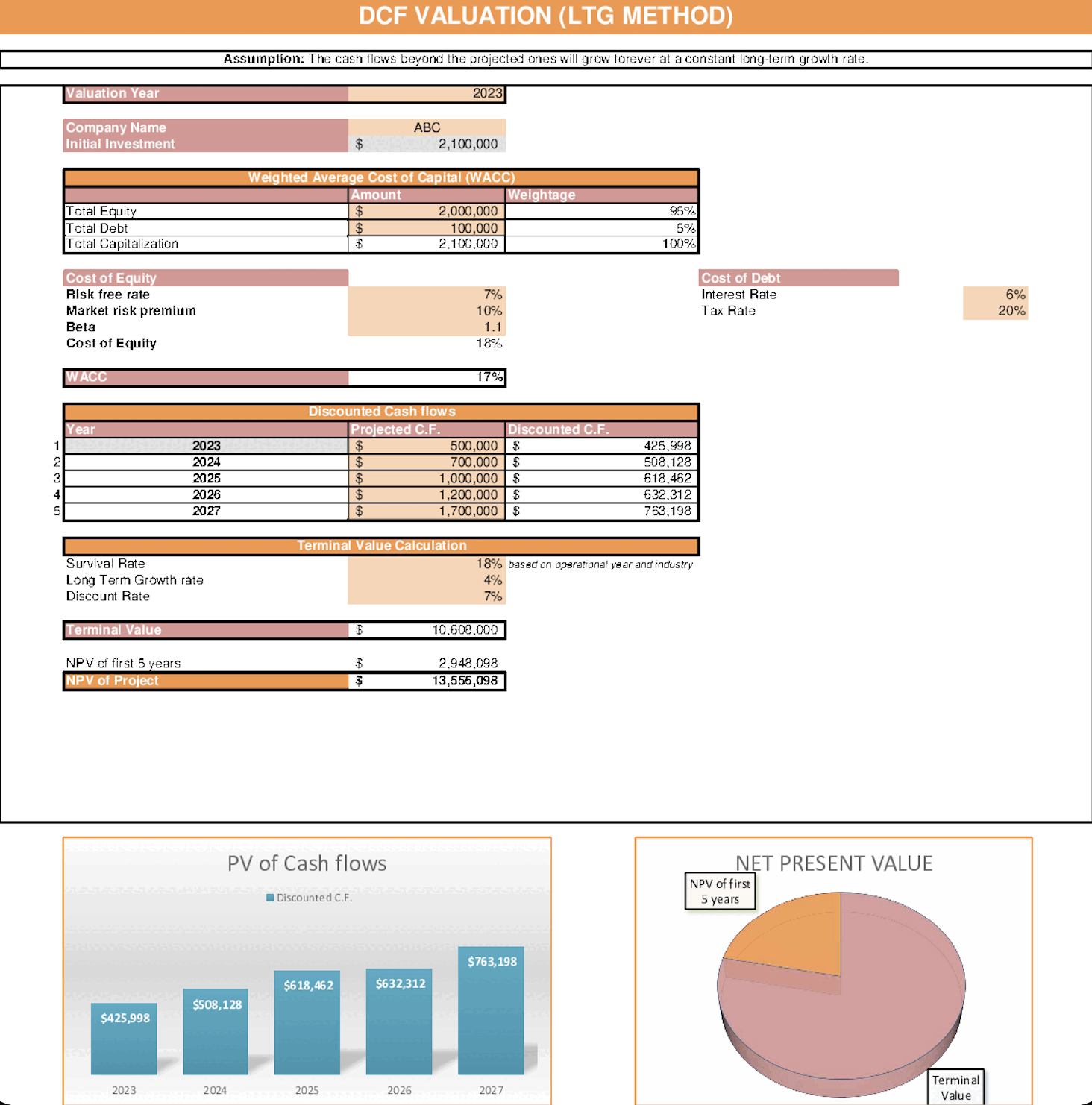
The Fundamental Stock Analyst is an equity research AI built specifically for fundamental valuation work — earnings analysis, relative valuation, business model assessment, and real-time data pulls across SEC filings, analyst estimates, and market sentiment. It doesn't just calculate. It shows the derivation.
| Traditional Spreadsheet DCF | Fundamental Stock Analyst |
|---|---|
| 2–3 hours to build from scratch | Full model structure in a single conversation |
| Formula errors hide in nested references | Every calculation step shown in plain language |
| One base case unless you build more tabs | Base, bull, and bear scenarios on request |
| WACC derived manually from scattered inputs | CAPM and capital structure walked through line by line |
| Assumptions live in your head | Each assumption stated, sourced, and challengeable |
| Re-running with new inputs means rebuilding | Change one input, get the revised output and the reason |
Full DCF Mechanics, End to End
The AI handles every component of the standard model:
- Free cash flow projection over a 5–10 year forecast horizon, built from historical financials or your own operating assumptions
- WACC derivation — cost of equity via CAPM (risk-free rate + beta × market risk premium), after-tax cost of debt, and capital structure weighting
- Terminal value using the Gordon Growth Model or an exit multiple approach, with a sanity check on what share of total value the terminal figure represents
- Present value discounting and NPV summation across the explicit forecast period plus terminal value
- Intrinsic value per share — enterprise value bridged to equity value by adding cash and subtracting debt, then divided by shares outstanding
Sensitivity and Scenario Analysis Built In
Instead of building a data table by hand, ask for one:
"Run a sensitivity table on this DCF across discount rates from 8% to 12% and terminal growth from 2% to 4%"
"What's my bear case if revenue growth comes in at half my base case assumption?"
Assumption Auditing
The most useful function isn't computation — it's challenge. Upload your existing model and ask the AI to stress-test the logic:
"Here's my DCF for a SaaS company. My terminal growth rate is 5% and my WACC is 9%. Is that defensible?"
"My terminal value is 82% of my total enterprise value. Is that a red flag?"
The AI stock research assistant will flag where your assumptions sit relative to industry norms and explain the mechanism behind the concern — not just declare it wrong.
Related Agents You'll Also Find Useful
A DCF rarely lives in isolation. These agents handle the adjacent work most valuation projects require.
Technical Stock Analyst — Once you've established intrinsic value, entry timing becomes the question. This agent reads price action, volume, and market structure to identify setups with defined risk.
- Chart pattern and momentum analysis
- Support and resistance mapping for entry and exit planning
- Volume-confirmed trend assessment
Accounting & Audit Assistant — DCF quality depends on the quality of the financials feeding it. Use this agent to normalize earnings, reclassify one-time items, and understand what's actually in the cash flow statement.
- Financial statement analysis and journal entry review
- Non-recurring item identification and adjustment
- Accounting standards guidance for cross-border comparisons
Economics Analyst — Your discount rate is an input from the macro environment. This agent provides institutional-grade context on rates, inflation, and policy that directly determines your risk-free rate and equity risk premium.
- Interest rate and monetary policy analysis
- Macro scenario modeling for sensitivity ranges
- Sector-level demand outlook to sanity-check revenue growth
Startup Advisor — For pre-revenue and early-stage companies where DCF strains, this agent brings a founder-turned-VC perspective on which valuation frameworks actually apply.
- Stage-appropriate valuation methodology selection
- Fundraising benchmark context
- Honest assessment of when DCF is the wrong tool
Try the Fundamental Stock Analyst free — no credit card required.
How It Works: Building a DCF Step by Step
Step 1: Provide the company or the inputs
Start with a ticker for a public company, or paste your own projections for a private business or internal project. The AI will confirm what it has and identify what's missing.
"Build a DCF for Company ABC. Initial investment is $2.1M, projected cash flows are $500K, $700K, $1M, $1.2M, and $1.7M over the next five years."
Step 2: Establish the discount rate
The AI walks through WACC construction — cost of equity from CAPM, after-tax cost of debt, and the equity/debt weighting from the capital structure. You'll see each component before it's combined.
"My risk-free rate is 7%, market risk premium is 10%, beta is 1.1, and my capital structure is 95% equity, 5% debt at a 6% interest rate with a 20% tax rate. What's my WACC?"
Step 3: Set the terminal value assumption
Choose perpetuity growth or an exit multiple. The AI will flag when a long-term growth rate exceeds what's economically defensible — a terminal growth rate above nominal GDP growth is a common and quiet error.
"Use a 4% long-term growth rate for terminal value and show me what changes if I drop it to 2.5%."
Step 4: Review the output and stress-test it
You get discounted cash flows by year, terminal value, NPV of the explicit forecast period, and total project NPV — plus the assumptions that produced each figure.
"Terminal value is carrying most of the valuation here. Show me the model with a 10-year explicit forecast instead of 5."
Step 5: Compare against market price
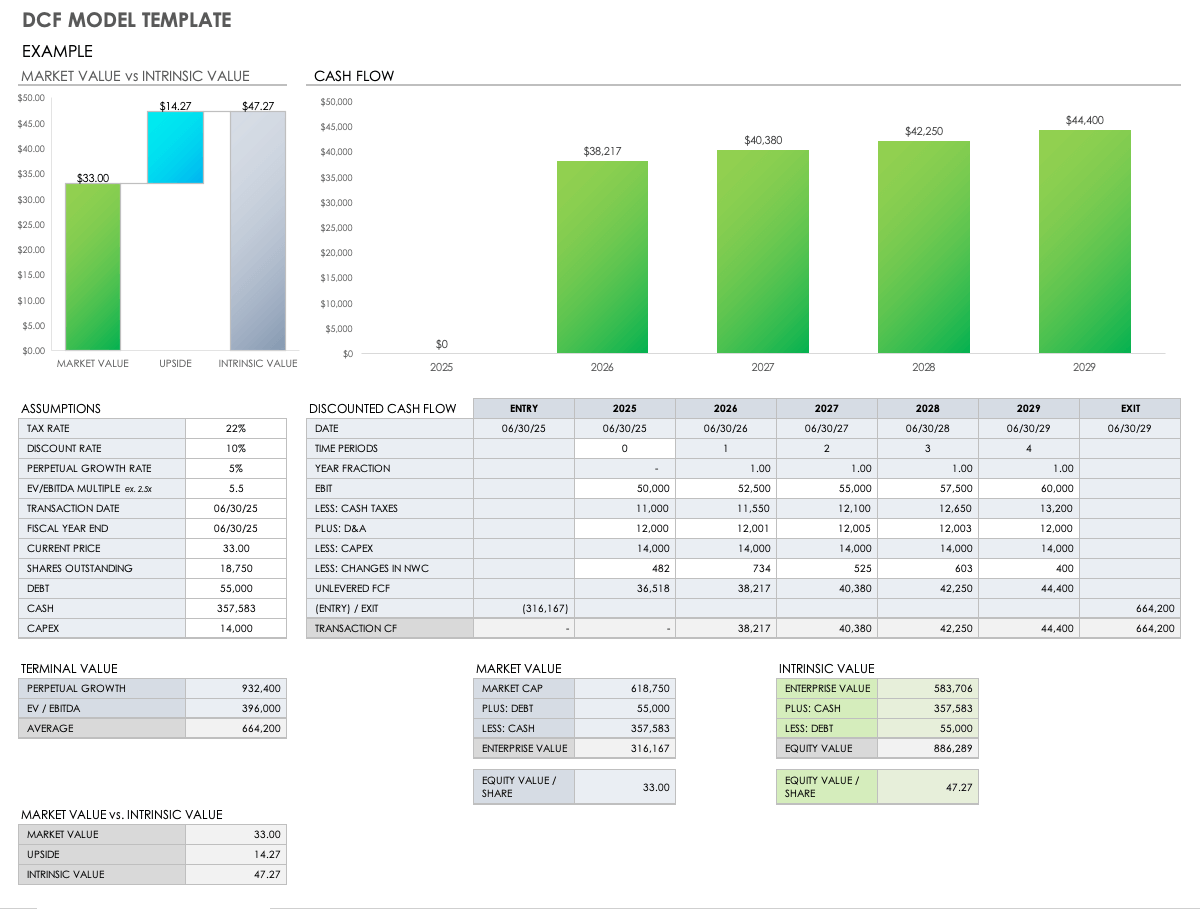
The final step in any DCF is the comparison that matters — intrinsic value against what the market is charging. As Harvard Business School's Professor Suraj Srinivasan frames it, "If the intrinsic value is higher than the current price, it could be a good investment opportunity."
Results & Use Cases
📊 Retail Investor Valuing a Public Company
Scenario: You're evaluating a mid-cap industrial stock trading at $33 and want to know whether it's undervalued.
Traditional Approach: Download 10-Ks, build a projection tab, construct WACC, build terminal value, debug the links — 3+ hours, with a real chance of a hidden formula error.
Fundamental Stock Analyst: A structured DCF with sourced historical data, explicit assumptions, and a base/bull/bear range — in a single session.
- Enterprise-to-equity bridge handled automatically (add cash, subtract debt)
- Per-share intrinsic value compared directly against market price
- Every assumption stated so you can override the ones you disagree with
💼 Founder Valuing the Business for a Raise
Scenario: You're raising a Series A and investors want to see a defensible model behind your ask.
Traditional Approach: Hire a consultant or spend a weekend in Excel producing something an investor will pick apart in ten minutes.
Fundamental Stock Analyst: A model with transparent assumptions you can actually defend in the room, plus the Startup Advisor to pressure-test whether DCF is even the right framework at your stage.
- Scenario analysis showing how the valuation holds across growth cases
- Clear articulation of what each assumption implies about the business
- Sensitivity ranges instead of a single indefensible point estimate
🎯 Capital Budgeting for an Internal Project
Scenario: Your team is deciding whether a $2.1M capital investment clears the hurdle rate.
Traditional Approach: A finance analyst builds a one-off model, presents a single NPV, and nobody in the room can interrogate the discount rate.
Fundamental Stock Analyst: NPV, IRR, and payback across multiple discount rate scenarios, with the WACC derivation shown so stakeholders can debate the actual input rather than the output.
- Project-level NPV with terminal value clearly separated from explicit forecast value
- Discount rate sensitivity so the hurdle rate discussion is grounded
- Output you can export and drop into a board deck
📱 Mobile Model Review Before a Meeting
Scenario: You're in a car twenty minutes before an investment committee meeting and want to re-check a valuation assumption.
Traditional Approach: Squint at a spreadsheet on a phone screen and hope you don't fat-finger a cell.
Fundamental Stock Analyst: Full feature parity on iOS and Android — ask the question in plain language, get the recalculation and the reasoning.
- Conversation history persists, so the model context is already there
- Voice input for hands-free assumption changes
- Same output quality as desktop, no spreadsheet required
Frequently Asked Questions
Is the AI DCF calculator free to use?
Yes. The Fundamental Stock Analyst is available on Jenova's free tier with all core features and limited monthly usage — no credit card required. Paid tiers start at $20/month for 30× the usage allowance, custom model selection, and watermark-free document exports. Usage resets monthly on your billing date with no daily caps.
How accurate is an AI-generated DCF?
The math is deterministic and reliable. The accuracy of any DCF — AI-built or human-built — depends entirely on the input assumptions. Research consistently shows DCF is highly sensitive to discount rate and growth rate estimates, which makes it an estimate rather than a precise figure. Always review the assumptions the AI states before trusting the output, and verify historical financials against source filings.
Can it build a DCF for a private company?
Yes. Provide your own revenue projections, margin assumptions, capex, working capital changes, and capital structure, and the AI will construct the model from those inputs. For private companies you'll need to estimate beta from comparable public companies — the AI can walk you through that adjustment, including unlevering and relevering.
How is this different from asking ChatGPT to build a model?
Purpose matters. General-purpose chatbots have documented issues with hallucinating financial data in modeling tasks, per Wall Street Prep's 2026 tool evaluation. The Fundamental Stock Analyst is built specifically for equity research, with real-time access to SEC filings and analyst estimates, and it shows its derivation rather than just producing a number.
Does it handle terminal value correctly?
It supports both standard approaches — the Gordon Growth (perpetuity) method and the exit multiple method — and will flag common errors, such as a terminal growth rate exceeding long-run nominal GDP growth or a terminal value that represents an implausibly large share of total enterprise value.
Can I upload my existing spreadsheet for review?
Yes. Upload your model as a file and ask the AI to audit the assumptions, check the WACC derivation, or reconcile the terminal value. This is often the highest-value use — catching the error before it reaches a committee.
Conclusion
Discounted cash flow remains the most rigorous way to estimate what a business is actually worth. The barrier was never the theory — it was the hours of spreadsheet construction, the error rate hiding in nested formulas, and the single-scenario models that collapse the moment an assumption shifts.
An AI DCF calculator removes the mechanical burden without removing your judgment. You still decide the growth rate. You still defend the discount rate. The Fundamental Stock Analyst handles the construction, shows every step of the derivation, and gives you the scenario range that makes the valuation defensible.
Try the Fundamental Stock Analyst now. Explore more at Jenova.
For Developers: The Fundamental Stock Analyst is available programmatically via the Jenova API — integrate DCF valuation and equity research into your fintech application with a single API call. Full documentation →