AI Dating Sim with Persistent Relationship History: Lasting Romance
2026-09-16
People searching for an AI dating sim with persistent relationship history are usually tired of romance that reboots the moment they close the tab. Jenova is a library of specialized agents — college romance, island social games, dark courtship, and real-world dating coaches — with persistent memory and unlimited chat history so the relationship is the save file. As of September 2026, singles already use AI to draft messages, plan dates, and play companion stories; the gap is not access to a chatbot. It is a dating sim that still knows the fight, the nickname, the rival, and the promise you made last session.
- ✅ Persistent memory so affection, canon, and consequences carry across sessions
- ✅ Open-world romance agents where friendships, rivalries, and heartbreak emerge from your choices
- ✅ Real-world dating coaches for profiles, conversation, and date logistics
- ✅ Custom agents you can shape with personality, lore, and private knowledge
To understand why this matters, look at what actually breaks when a dating sim cannot remember the relationship — and how a platform designed for continuity changes both play and practice.
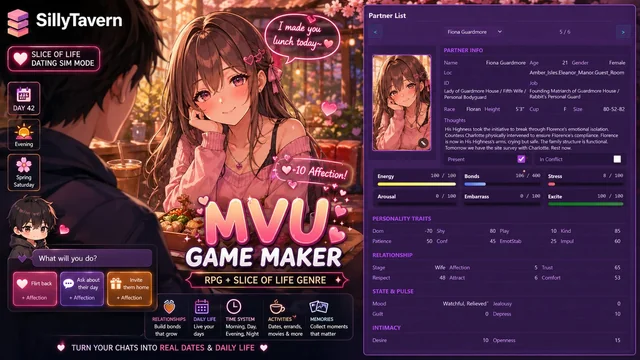
Quick Answer: What Is an AI Dating Sim with Persistent Relationship History?
An AI dating sim with persistent relationship history is a romance game or companion that stores your choices, affection, and canon so every session continues the same relationship instead of resetting the story. It behaves like a campaign, not a one-off chat.
Key capabilities:
- Cross-session memory for names, inside jokes, boundaries, and unresolved plot
- Open-world romance in agents such as College Life and Love Island, where social maps shift with your decisions
- Dark-romance campaigns that keep intrigue, desire, and fallout intact
- Adjacent coaches for real dating — profiles, openers, and date plans — without overwriting the sim
- Custom agents with your own instructions, preferred models, and private lore
Why Most AI Dating Sims Still Forget the Relationship
Online dating is already a mass habit. 39% of U.S. adults have used an online dating site or app, including 65% of adults aged 18–29, according to SSRS polling. The apps themselves are a large market:
$6 billion+ — Dating app revenue in 2025, with more than 350 million users worldwide
AI has moved into that same space. Match's Singles in America research, reported by Mashable, found that 26% of singles use AI to enhance their dating lives, and 16% have engaged with AI as a romantic companion — rising to 33% of Gen Z singles. People want a story that accumulates. Getting that continuity is still frustratingly difficult:
- Generic chatbots optimize for the next reply, not a living social world
- Companion apps often treat memory as a retention mechanic rather than a design requirement
- Affection meters and dialogue wheels mean little if canon resets overnight
- Intimate roleplay becomes training data or unclear third-party inventory
- One undirected chat cannot be a cast, a campus, an island, and a court at once
Every Session Starts as a Stranger
A dating sim without history is just fanfiction with amnesia. You re-introduce your name, re-establish the relationship, and watch the character forget the boundary you set or the confession you already made. The American Psychological Association's review of digital companions notes that these products are often engineered to recall personal lives, preferences, and past conversations — because that recall is what makes the bond feel real. When the product does not actually keep that record, the fantasy collapses into repetition.
The cost is not only extra typing. You lose compounding context: the tone the character uses with you, the rival who saw you together, the date you already planned. A sim that cannot remember cannot deepen.
Memory Gets Sold Back to You
In many companion products, remembering you is the business model. Continuity is framed as a premium so the character does not forget previous conversations. Users who have been encouraged to form an attachment then pay a recurring fee to keep the relationship intact.
That design turns a technical requirement — storing history so it can be used as future context — into emotional lock-in. Persistent relationship history should be how the dating sim works, not the ransom for leaving.
Intimate Canon Leaves Your Control
An AI dating sim with persistent relationship history will, by definition, hold sensitive material: desire, rejection, family backstory, sexual boundaries, and the private language of a relationship. Privacy research on companion products is not reassuring.
Character.AI's privacy policy — States that user data is used to train its AI and machine learning models, and advises users not to include sensitive personal information
Surfshark's study of major companion platforms also found that conversations typically lack full end-to-end encryption, and that several apps collect photos, videos, or audio. If the thing that "remembers everything" also trains on everything, the intimacy is not yours.
A Chat Window Is Not a Dating Sim
A dating sim needs a world: a cast, a clock, social consequences, and a reason last night's choice still matters. A generic chatbot can flirt. It cannot run a campus, an island villa, or a vampire court with emergent friendships and heartbreak.
APA reporting cites a 700% surge in AI companion apps between 2022 and mid-2025, with products marketed as friends, advisers, and romantic partners. Volume is not the same as design. Most of those products are still one character in one thread, not a sim with a social system.
Practice and Play Get Collapsed Into One Thread
Some people want fiction. Some people want help with real dating. 27% of couples married in 2025 met on dating apps, per SwipeStats — so the real-world side of this search is not hypothetical. Dumping island-romance roleplay, Tinder openers, and attachment-pattern analysis into a single undifferentiated log produces two failures: mixed contexts, or forgotten domain detail.
Persistent history only helps when it is scoped. The sim should remember the villa. The dating coach should remember which openers already failed. Those are different relationships.
This is exactly what Jenova was built for.
The Jenova Solution
Jenova is a platform of expert agents with persistent memory, unlimited chat history, and the ability to remember preferences, past play, and long-running stories. You do not have to stitch together a chatbot, a notes app, and a personality prompt. You pick (or build) the dating sim or coach for the job, and the memory stays with that relationship.
| Traditional Approach | Jenova |
|---|---|
| Each session starts from a blank slate | Persistent cross-session memory and unlimited history |
| One generic chatbot for every romance | Specialized dating sims, dark-romance campaigns, and dating coaches |
| Extra memory sold as a "don't forget me" upgrade | Memory built into the agent experience |
| Private roleplay used to train public models | Data is never used to train public AI models |
| Canon trapped inside one overflowing chat | Distinct agents so play, dating tactics, and self-insight stay in the right lanes |
| Locked to a single model vendor | Unified access to models from OpenAI, Anthropic, Google, DeepSeek, xAI, and others |
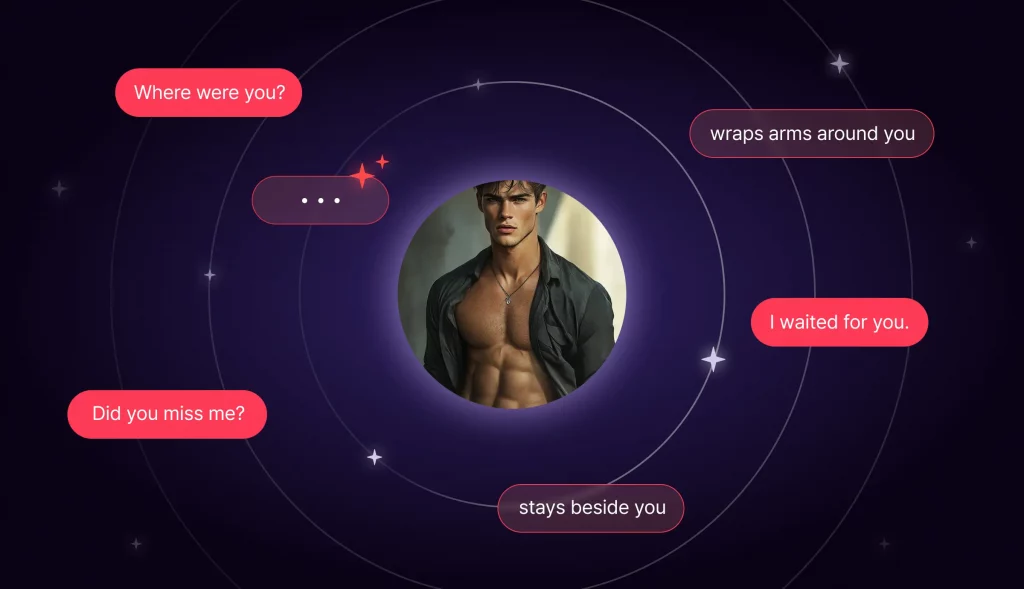
The interface people imagine — affection ticks, daily life, "Did you miss me?" — only works if yesterday still happened. Jenova's practical version of that stack is straightforward: the conversation does not vanish, the agent remembers what you told it, documents can ground canon, and different agents can hold different slices of romance and dating.
Open-World Dating Sims That Keep the Social Map
College Life is an open-world college romance where friendships, heartbreak, and connections unfold from your choices. Come back a week later and the roommate still knows what you did at the party. That is the difference between a scene generator and a dating sim.
Love Island puts you among eight singles on a private island, with emergent social dynamics — coupling, rejection, and alliance shifts that should not reset because you closed the app. Vesper Court is the dark-romance counterpart: a hidden vampire court where blood intrigue and forbidden desire change every night, and those nights need to stack.
Real-World Dating Agents That Remember What Already Failed
A dating sim is play. Real dates still need tactics. Dating App Advisor is built for profile optimization, conversation mastery, and first-date guidance — honest feedback rather than empty flattery. It is more useful when it remembers which bio already underperformed and which opener went nowhere.
Date Planner is the concierge layer: intent-driven plans, venue psychology, local research, and contingency thinking. Beauty Consultant can hold look, grooming, and presentation notes so you are not re-explaining your constraints before every Friday.
These agents do not replace human relationships. They keep the operational memory that most people currently store in screenshots.
Personality and Relationship Insight That Compounds
If you want the sim — or the real dating thread — to understand patterns rather than trivia, Personality Analyzer synthesizes Big Five, MBTI, Enneagram, and attachment language across conversations instead of scoring you from a one-shot quiz. MBTI Personality Guide can keep mistype checks, growth paths, and compatibility notes in the same thread of identity work.
Personal Therapist is the high-trust lane for emotional processing: empathetic support and evidence-based guidance, not a claim that software replaces a clinician. Keep clinical work, fiction, and dating tactics in separate agents so history stays useful instead of noisy.
Build the Sim Yourself When the Catalog Is Not Specific Enough
Game Designer Assistant is the partner if you are designing systems — affection economies, daily-life loops, cast bibles — rather than only playing them. Name Generator helps lock character and setting names so canon stays consistent.
You can also create a custom agent in minutes: instructions, preferred model, private knowledge base, tool configuration. That is the path for an original dating sim with your lore, house rules, and relationship framing. The platform still handles memory, orchestration, and history.
Platform Capabilities: Memory, Models, and Tools
Under the agents, the platform supplies what people actually mean by persistent relationship history:
- Persistent memory and unlimited history so long-running romance does not evaporate
- Private knowledge bases you can attach for character bibles, house rules, or dating notes
- Custom agents with your instructions, models, and tools
- MCP tool integration spanning Search, Maps, and other MCP-compliant servers when a date plan needs real venues
- Multi-model access so you are not locked to one vendor
- Web, iOS, and Android parity, with settings that sync across devices
- Privacy defaults that matter for romance: data is not used to train public AI models, is encrypted in transit and at rest, and is not sold to advertisers
Specialized AI Agents for Dating Sims and Relationship History
If the goal is an AI dating sim with persistent relationship history, start with agents whose job is romance, social consequence, and follow-through. The ones below are the ones most people would actually open again within a month.
College Life
College Life is the closest match to a classic campus dating sim: open-world romance, emergent friendships, and heartbreak that should still be true tomorrow. Persistent history is what lets a mid-semester choice change the rest of the year.
- Open-world college romance driven by your choices
- Friendships and rivalries that can accumulate instead of resetting
- A campaign feel rather than a one-scene chatbot
Love Island
Love Island is social strategy as romance. Eight singles, a private island, coupling and rejection that unfold from what you actually do — which only reads as a sim if the villa still remembers last night's recoupling.
- Open-world island romance with emergent social dynamics
- Connections and rejections that follow from play, not a scripted menu alone
- A cast large enough that memory has to be structural, not decorative
Vesper Court
Vesper Court is for players who want dark romance rather than campus sunlight: a hidden vampire court, blood intrigue, and forbidden desire where every night should change the board. Continuity is the difference between atmosphere and plot.
- Dark-romance framing with court intrigue
- Desire and consequence that can stack across sessions
- A long-form campaign rather than a single seduction scene
Dating App Advisor
Dating App Advisor is the real-world counterpart. Use the sims to rehearse tone; use this agent when the profile, opener, or first date is happening to an actual person. History here means which experiments already failed.
- Profile optimization across platforms
- Conversation and first-date guidance with honest feedback
- Tactics that can remember your actual track record
Date Planner
Date Planner turns intent into a plan: venues, pacing, contingencies, and local research. It is more useful when it already knows budget, neighborhood constraints, and the last date that ran too long.
- Intent-driven date architecture
- Venue psychology and backup plans
- Logistics memory so you are not redesigning Friday from scratch
Personality Analyzer
Personality Analyzer is for people who want relationship history to include why the same loop keeps happening — in a sim or in real dating. Multi-framework synthesis beats a screenshot of a quiz result.
- Integrative view across Big Five, MBTI, Enneagram, and attachment language
- Conversation-based insight instead of a one-time test dump
- A record of patterns you can revisit as the story or the dating life changes
Try Jenova free — no credit card required.
How an AI Dating Sim with Persistent Relationship History Works
Step 1: Choose the Sim or the Coach Open the platform and pick the relationship you actually want to continue — campus romance, island social play, dark courtship, or real-world dating help. If nothing fits, create a custom agent with your own instructions, model preference, and character bible.
"You are my campus dating sim. I am a second-year film student who already embarrassed myself in front of the RA. Remember the RA, the film-club rival, and that I do not want a love-triangle reset every session."
Step 2: Give It the Canon Worth Keeping Tell it the durable facts: names, boundaries, relationship status, house rules, and what is already true. Attach a document when memory should be grounded in a cast list, a lore file, or a dating-profile draft. This is how you move from a clever reply to a system of record.
"Here is the villa couple map after night four, the secret I told Maya, and the boundary that physical slow-burn stays fade-to-black. Keep those constraints when we continue."
Step 3: Keep the Same Thread Across Days Come back tomorrow and continue. Persistent memory and unlimited history mean you should not have to paste a recap. Ask the agent to recall the fight, the almost-confession, or the next social event — then correct it if a detail drifted. Corrections are part of how a long-running dating sim gets more accurate.
"Pick up after the rooftop scene. What did Julian actually hear, and how does that change breakfast with the group?"
Step 4: Split Play From Real Dating When you want help with a living person, switch agents instead of overloading the sim. Dating App Advisor can hold the Hinge thread. Date Planner can hold Saturday's logistics. Personality Analyzer can hold the pattern language. Scoped companions prevent one giant memory from becoming noise.
"Do not mix this with the island story. Review my profile photos and the last three openers that got one-word replies. Be blunt."
Step 5: Continue on Whatever Device Is in Your Hand Web, iOS, and Android share feature parity and synced settings. A commute voice note and a late-night scene should land in the same history as the desktop session. Speech-to-text is there when you would rather talk than type.
"I only have ten minutes on my phone. Recap where we left the court plot and give me the next scene, in character."
Results & Use Cases
🎭 A Campus Romance That Still Knows Last Week
- Scenario: You want a college dating sim where the party, the missed text, and the friend-group politics are still true on Tuesday.
- Traditional Approach: Re-explain the cast to a new chat, or accept that the love interest has amnesia. Demand is already there: Match found that 16% of singles have used AI as a romantic companion, but most of those products are a single character, not a campus.
- Jenova: College Life keeps the social world in one continuing campaign so choices can compound.
- You stop performing a biography every session
- Friendships and heartbreak can have a timeline
- The sim can be a year, not a scene
🏝️ Island Social Play With a Memory of Who Coupled
- Scenario: You are playing a villa-style romance and care who saw you leave whose villa.
- Traditional Approach: A chatbot that flirts on demand but cannot hold a group social graph. APA notes that companion apps surged as products designed to initiate and maintain romantic relationships — still usually one-to-one, not ensemble.
- Love Island: Holds the cast, the recouplings, and the fallout; Vesper Court can sit beside it if you want a darker campaign in a separate thread.
- Ensemble drama stays coherent
- Rejections remain part of the world
- You can play politically, not just affectionately
📱 Mobile Continuity Between Commute and Late Night
- Scenario: You voice-note a messy scene idea on the train, then finish the date night on the couch.
- Traditional Approach: The phone chatbot and the desktop chatbot do not share a life. You screenshot your own messages.
- Jenova: Full feature parity across web, iOS, and Android. Continue the same dating sim or switch to Date Planner for a real Saturday without losing either thread.
- Speech-to-text captures the raw scene on mobile
- The same agent history is waiting later
- No "I'll paste this into the other chat" tax
💼 Practice in the Sim, Execute in Real Dating
- Scenario: You want low-stakes rehearsal, then help with an actual profile and first date. SSRS found that among people who have used dating apps, sharing family values, politics, and interests still dominate what they say they want in a match — details a coach should remember.
- Traditional Approach: One companion that both roleplays a boyfriend and writes your Bumble bio, mixing fiction into advice.
- Dating App Advisor and Date Planner: One thread holds experiments that already failed; the other holds venue constraints. Personality Analyzer can sit beside them if attachment patterns are part of how you think.
- Play and real dating stay in separate memories
- Advice can reference your actual track record
- You get tactics without overwriting the sim's canon
FAQ
What is an AI dating sim with persistent relationship history?
An AI dating sim with persistent relationship history is a romance agent that retains your choices, character relationships, and story canon across sessions. On Jenova, that usually means a specialized sim such as College Life or Love Island, a dark-romance campaign such as Vesper Court, or a custom agent you configure — plus unlimited chat history so the next conversation starts from shared context, not a blank prompt.
Is Jenova free?
Yes. There is a free tier with all core features and limited usage, and paid tiers if you need more headroom. Plus is $20/month, Premium $50, Pro $100, Max $200, Ultra $500, and Enterprise $1,000, with higher usage multiples at each step. Usage resets monthly on the billing date, with no daily caps. You can try agents without a credit card on the free plan.
How is this different from a general chatbot or a companion app?
A general chatbot can flirt inside a context window; when the window ends, so does the relationship. Companion apps may store chats, but several major platforms use that data to train models. Jenova agents keep cross-session history, can attach knowledge bases, and are specialized by domain — so the campus sim, the island game, and the real dating coach are not one overflowing prompt. Data is not used to train public AI models.
Can I create a custom AI dating sim with my own characters?
Yes. You can create a custom agent in minutes with your instructions, preferred model provider, private knowledge base, and tool configuration. That is the path if you want an original setting, a specific affection system, or a relationship frame the catalog does not already cover. Game Designer Assistant can help you think through systems and documentation before you lock the agent instructions.
Does an AI dating sim with persistent relationship history work on mobile?
Yes. Web, iOS, and Android have full feature parity, including the same agents, history, and settings sync. That matters for a dating sim: the commute check-in and the late-night scene should land in the same memory as the desktop session. Speech-to-text is available when you would rather talk than type.
Is my relationship history used to train public AI models?
No. Jenova does not use your data to train public AI models, encrypts it in transit and at rest, and does not sell it to advertisers. That contrast matters because an APA overview of companion products emphasizes how much intimate detail these tools are designed to hold. A dating sim that remembers the relationship is only viable if that memory stays yours.
A Dating Sim Should Still Know You Tomorrow
The gap is no longer access to AI romance. Companion apps multiplied several times over in a few years, and a sizable share of singles already use AI to date or to play at companionship. The gap is continuity: a world that still knows the choice, the slight, the nickname, and the plan you made last session.
Jenova's answer is not one mythical omniscient boyfriend. It is persistent memory plus specialized agents — College Life for campus romance, Love Island for ensemble social play, Vesper Court for dark courtship, and dating coaches when the next message is going to a real person. You get an AI dating sim with persistent relationship history in the thread where that history belongs, without dumping every intimacy into a single forgetful chat.
Explore the full agent library at Jenova.
For Developers: Every agent in this article is available programmatically via the Jenova API — build AI dating sims with persistent relationship history into your application with a single integration. Full documentation →