AI Dating Sim: Adaptive Romance Beyond Scripted Routes
2026-08-26
An AI dating sim on Jenova lets you build chemistry with characters who remember your jokes, your boundaries, and the night you almost said the wrong thing. Traditional visual novels lock you into a handful of scripted routes. Swipe apps leave you staring at profiles that may not even be real. In August 2026, players want something in between: interactive romance that actually talks back.
- ✅ Persistent memory so affection, rivalry, and inside jokes carry across sessions
- ✅ Multiple romance genres, from sunlit island dating to dark court intrigue
- ✅ Real-world dating tools sitting next to the fantasy, not hidden behind it
- ✅ Free to start on web, iOS, and Android — no credit card required
To understand why this matters, it helps to look at what players are actually leaving behind: exhausted dating apps, finite game scripts, and chatbots that feel intimate until you notice they have no story.
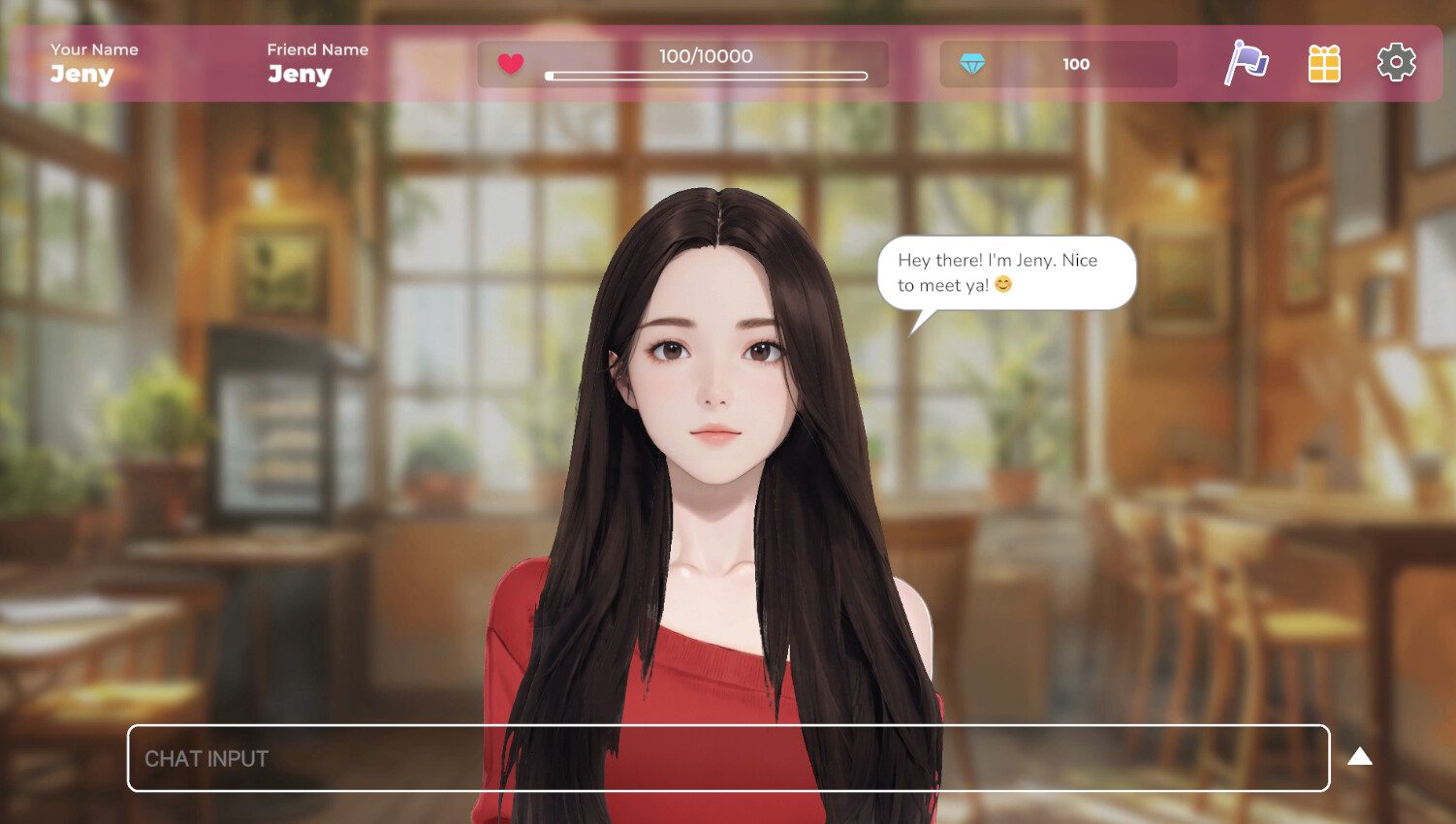
Quick Answer: What Is an AI Dating Sim?
An AI dating sim is an interactive romance game that uses generative conversation and memory so characters react to you, not just to a pre-written dialogue tree. Unlike a classic visual novel, the route is not a finite flowchart. Unlike a dating app, nobody is pretending to be a stranger in your city.
Key capabilities:
- Open-ended romance scenes with Love Island and other story-first agents
- Characters who retain your history, preferences, and unfinished arguments
- Genre range from beach-social dating to the gothic pull of Vesper Court
- Optional transfer into real dating help via Dating App Advisor and Date Planner
Why Traditional Romance Games and Dating Apps Fall Short
People still want connection. Forty-four percent of current and recent dating-platform users say they want a long-term partner, and another 40% want to date casually. The market around that desire is enormous: over 350 million people use dating apps, and the category generated just over $6 billion in 2025.
But getting a satisfying romance — on a phone or in a game — is increasingly frustrating:
- Scripted dating sims run out of new lines after a few playthroughs
- Real dating apps are crowded with deception and suspected bots
- Generic companion chatbots offer talk without a world, a cast, or stakes
- Always-on validation can feel good and still leave social skills weaker
- Almost nothing in the “AI girlfriend” category helps you date actual people
Finite Routes Make Replay Feel Like Homework
A well-written visual novel can be unforgettable the first time. The second time, you already know which gift raises affection and which confession flag you missed. The third time, you are clicking through text you have memorized to reach one unused CG. An AI dating sim is supposed to solve that — but only if the character can remember you, not just a route variable named love_points.
Dating Apps Taught People to Distrust the Chat Window
A Boston University / Ipsos survey found that 50% of respondents agree dating apps are filled with too many machines posing as real people to be trusted. Six in ten believe most people lie on dating apps. Only 10% of women — and 20% of men — agree that AI-powered dating apps will lead to more successful relationships.
That skepticism is rational. A marketplace of humans should not hide a chatbot behind a stolen photo. An honest AI dating sim does the opposite: it tells you it is a story, then commits to making that story worth playing.
Companion Chat Without a Game Becomes a Void
The broader AI companion category is growing fast. Fortune Business Insights valued it at $37.73 billion in 2025**, with a projected **$49.52 billion in 2026. The American Psychological Association notes that AI companion apps surged 700% between 2022 and mid-2025, and that Character.AI alone has reported around 20 million monthly users.
Talk is not the same thing as a dating sim. Without a setting, a cast, jealousy, timing, and consequences, you are not playing romance. You are filling silence.
Always-On Affection Can Warp Expectations
Researchers are not guessing about the emotional downside. A Harvard Business School study cited by the APA found that interacting with an AI companion can ease loneliness as effectively as talking to another person — and more than watching videos. The same research tradition warns that heavy daily use can increase isolation, and that constantly validating partners create standards no human date can meet.
Nature Machine Intelligence has argued that wellness-styled companion apps can foster ambiguous loss (grief when an app changes or shuts down) and dysfunctional emotional dependence. An AI dating sim that is sold as a substitute spouse is a different product — and a riskier one — than a romance game you can put down.
Practice Rarely Transfers to a Real First Date
Most virtual-romance products stop at the fantasy. They will not rewrite a Hinge prompt, pressure-test a first text, or build a backup plan if the restaurant is booked. If you also want better dates in the physical world, you need tools built for that job, not a character who only exists to agree with you.
This is exactly what Jenova was built for.
The Jenova Solution
Jenova treats an AI dating sim as a playable story with memory, not as a disguised dating marketplace and not as a forever-partner substitute. You pick a world. You talk. Characters respond in character. The platform keeps the thread so tomorrow’s scene can reference last night’s almost-confession.
| Traditional Approach | Jenova |
|---|---|
| Visual novel with 3–5 fixed routes | Generative scenes that branch from what you actually said |
| Dating app full of uncertain profiles | Honest fiction: you know it is a sim |
| Generic chatbot with no cast or setting | Dedicated romance worlds plus a wider agent library |
| Affection resets when the chat ends | Persistent memory across sessions and devices |
| Fantasy that never leaves the screen | Optional handoff to real dating strategy agents |
Play Romance as a Game, Not a Customer-Support Chat
Love Island is the clearest dating-sim shape on the platform: eight singles on a private island, open-world social dynamics, and relationships that form or collapse from your choices. You are not selecting “Option A: compliment her dress.” You are in the villa, managing attention, alliances, and the slow disaster of saying the quiet part out loud.
If your taste runs darker, Vesper Court drops you into a hidden vampire court — amnesia, blood intrigue, and forbidden desire that changes every night. It is still an AI dating sim in structure: attraction, secrecy, and consequence. The genre just happens to have fangs.
"I'm the new islander. I want to sit with whoever looks least impressed by me and find out why they're really here."
Keep the Fantasy Honest, Then Practice for Real Life
When you are ready to date humans again, you do not need a different website. Dating App Advisor reviews profiles, conversation openers, and first-date strategy with the kind of bluntness a love interest will never offer. Date Planner then turns intent into a plan: venue psychology, local research, and a backup if the bar is dead.
That pairing is the point. The sim is for play. The advisors are for transfer. You can flirt with a vampire at midnight and still walk into Saturday with a reservation and a better first line.
Look the Part You Are Writing
Romance is visual even when the medium is text. Fashion Consultant and Beauty Consultant help you build a look for a character you are roleplaying — or for the version of you that will appear in a real dating-app photo. Upload a screenshot, describe the scene, and get outfit or grooming notes that match the tone: campus spring, island evening, or first-date city bar.
Build Your Own Cast When the Default Roster Is Not Enough
If you want a custom heroine, a rival, or an entire school-route setup, Name Generator handles culturally fluent character names, and Game Designer Assistant helps you specify systems: affection, jealousy, time-of-day scenes, and fail states. Jenova also lets you create custom agents with your own instructions, preferred models, and private knowledge bases, so the “childhood friend who remembers the rooftop promise” can be your design, not a stock archetype.

Specialized AI Agents for AI Dating Sims
These are the agents most players actually open in the first month — the ones that sit on the romance loop, not adjacent trivia.
Love Island — Social Dating Under Pressure
Eight attractive strangers, one island, no locked corridor of “correct” dialogue. Connections and rejections emerge from how you spend attention, not from a hidden flowchart.
- Open-world romance with shifting social dynamics
- Multiple love interests and rivalries in the same run
- Replay value that comes from new conversations, not new CG hunting
Vesper Court — Dark Romance With Memory
You wake in a hidden vampire court with no memory of why. Every night can rewrite alliances. Desire is never free of politics.
- Gothic atmosphere with forbidden-romance pacing
- Character consistency across long, dangerous arcs
- A dating-sim spine inside a mystery, not a costume on a chatbot
Dating App Advisor — The Anti-Sycophant
If the sim made you braver, this agent makes you specific. It will tell you the prompt is vague, the selfie lighting is unkind, and the opener sounds like a mass text.
- Profile critique across major apps
- Conversation and first-date rehearsal
- Honest feedback instead of endless praise
Date Planner — From Chemistry to a Calendar Hold
A good scene in a dating sim has timing, setting, and an exit. A good real date needs the same things, plus a neighborhood that is actually open.
- Intent-driven plans (low-stakes coffee vs. high-signal dinner)
- Local venue research and contingency paths
- Useful after the sim, not instead of it
Fashion Consultant — Wardrobe for the Route You Are Playing
Whether you are dressing an original character or yourself, style is part of the romance signal. This agent reads the scene and the body of work you already own.
- Outfit evaluation from photos
- Wardrobe building across aesthetics
- Cultural fluency so “campus spring” and “black-tie gala” are not the same advice
Personal Therapist — When the Feelings Are Not Just Game Feelings
Dating sims stir attachment on purpose. If a story leaves you anxious, lonely, or stuck in a loop, this agent offers grounded, evidence-based conversation — support and accountability, not a second fictional spouse.
- 24/7 space to unpack dating stress
- Honest pushback instead of pure validation
- A healthier off-ramp than arguing with a love interest at 2 a.m.
Try Jenova free — no credit card required.
How an AI Dating Sim Works on Jenova
Step 1: Pick a World, Not Just a Chatbot Open the gallery and choose a romance-shaped agent. Start with Love Island if you want social strategy in sunlight, or Vesper Court if you want desire with a body count in the background. You are selecting a setting and a cast, which is what makes this a sim.
"Start me as a late arrival on the island. I am charming but I talk too much when I am nervous. Do not make anyone fall for me in the first scene."
Step 2: Set Your Character and Your Boundaries Say who you are, what you will not play, and how fast the romance should move. Persistent memory means you do not have to re-explain this tomorrow. If you are building an original route, ask Name Generator for a full cast list before the first confession.
"I want slow-burn only. No grand declarations on day one. If I ignore someone, let them notice."
Step 3: Talk Like a Person, Then Let Consequences Land Write naturally. Ask questions. Flirt badly on purpose. The value of an AI dating sim is that a clumsy compliment can close a door, and a remembered detail from three nights ago can open one. Come back the next day and reference the unfinished conversation — the agent should.
"Last night she left when the music changed. I want to find her before breakfast and not pretend I didn't notice."
Step 4: Step Out of the Story When You Want a Real Date When the practice has done its job, switch to Dating App Advisor with the same voice you have been using in-game. Paste a bio. Roleplay the first five messages. Then hand the winning version to Date Planner with your city and budget.
"Rewrite my profile so it sounds like me after that island run — warmer, less try-hard, still honest about working late."
Step 5: Save the Thread and Continue on Your Phone Jenova keeps history and memory across web, iOS, and Android. A scene you started on a laptop can continue on the train. That is how a dating sim becomes a habit instead of a one-sitting binge you forget.
Results & Use Cases
🏝️ Survive the Villa Without a Walkthrough
- Scenario: You want a dating sim you can replay with friends comparing “who did you couple up with,” not a 12-hour script you already spoiled on a wiki.
- Traditional Approach: Buy a visual novel, finish every route, then wait two years for a fan disc.
- Love Island: Each stay produces different alliances because the conversations are not a reusable flowchart.
- You can pursue, friend-zone, or get publicly rejected
- Social fallout is part of the game, not a bug
- Replay is curiosity, not homework
🦇 Binge a Gothic Romance That Does Not Reset
- Scenario: You want dangerous chemistry, political subtext, and a love interest who remembers that you lied about why you were in the east wing.
- Traditional Approach: A dark-romance book you cannot talk back to, or a chatbot wearing a vampire hat.
- Vesper Court: The court has rules. Breaking them has costs. Attraction is entangled with survival.
- Long-arc memory instead of session amnesia
- Desire with plot, not desire instead of plot
- A tone that stays gothic when you push it
💼 Use the Sim as a Low-Stakes Rehearsal
- Scenario: You have not sent a first message in months. The idea of a real chat window makes your hands go cold.
- Traditional Approach: Over-edit one opener for an hour, send nothing, feel worse.
- Dating App Advisor: Rehearse the awkward version first, then ship a cleaner one. Pair with Date Planner once someone actually says yes.
- Profile language that sounds like a person
- First-message variants you can actually send
- A Saturday plan that exists before the chat dies
A Match- commisioned report summarized by Mashable found that 26% of singles were already using AI to enhance their dating lives — a sharp jump from the prior year. Rehearsal is the healthy version of that trend. Outsourcing your entire personality is not.
📱 Play a Full Scene on Your Phone Before Sleep
- Scenario: You have twelve minutes, one earbud, and no desire to open a swipe app.
- Traditional Approach: A mobile VN with tiny tap-to-advance text, or a companion app that guilt-trips you if you try to leave.
- Jenova: Continue last night’s island conversation by voice or text, then close the app. The memory will still be there in the morning.
- Full feature parity on iOS and Android
- Speech-to-text when you do not want to type
- No need to re-establish who you are every session
If language practice is part of the fantasy, Learn English Through Roleplay can run the same dating-sim energy as a lesson — a cafe meet-cute where the grammar sticks because you cared what happened next. If the story ever turns into a real relationship, Wedding Planner is sitting in the same library. That is a later problem, and a better one.
FAQ
What is an AI dating sim, exactly?
An AI dating sim is a romance game whose characters generate new dialogue and remember your history, instead of cycling through a fixed script. On Jenova, that usually means a world with a cast — an island villa, a vampire court — not a blank chat labeled “girlfriend.” The point is playable chemistry with consequences, not a hidden bot inside a real dating marketplace.
Is an AI dating sim the same as an AI companion or AI girlfriend app?
No. Companion apps are often designed as ongoing emotional stand-ins. A dating sim is closer to interactive fiction: there is a setting, other people in the scene, and a reason to put the story down. The APA has documented both the loneliness relief and the isolation risk of heavy companion use. Treating the product as a game — and keeping real-world dating tools nearby — is the more honest design.
Is Jenova’s AI dating sim free?
Yes. Jenova has a free tier with core features and limited usage. Paid plans raise monthly usage if you play long sessions every day. You can start Love Island or any other agent without a credit card and decide later whether you need more room.
How is this different from Character.AI or Replika?
Character.AI and Replika are widely used as open-ended companions. Jenova specializes in expert agents with a job: a villa dating game, a dark-romance court, a profile critic, a date concierge. You also get persistent memory, multi-model access, and the option to build a custom character agent instead of living inside someone else’s persona list.
Can I play an AI dating sim on mobile?
Yes. Jenova runs with full feature parity on web, iOS, and Android, including synced history and speech-to-text. A scene you start at a desk can continue on a phone without re-introducing yourself to the cast.
Will an AI dating sim help me in real dating?
It can help you practice tone, timing, and emotional honesty. It will not replace another human, and it should not become the only place you feel heard. Use the sim for story. Use Dating App Advisor and Date Planner when you want the practice to leave the screen. If the feelings get heavy, talk to people in your life — and consider Personal Therapist as support, not as a second romance route.
Conclusion
Swipe apps made romance feel like inventory management. Classic dating sims made it feel like a test you could eventually memorize. An AI dating sim is the more interesting third path: a story that answers you, remembers you, and still admits it is a story.
Jenova gives that path a cast and a spine. Play Love Island when you want sun and social chaos. Open Vesper Court when you want romance with sharper teeth. When you are ready for a table in the real world, Date Planner and Dating App Advisor are already in the same library.
The best next line is the one you have not read before. Start it on Jenova.
For Developers: Every romance and dating agent in this article is available programmatically via the Jenova API — add adaptive dating-sim conversations, character memory, and related coaching flows to your own app with a single integration. Full documentation →