AI Dating Profile Assistant: Build a Profile That Actually Gets Matches
2026-08-12
An AI dating profile assistant tells you the thing no dating app will: which photo is killing your match rate, why your bio gives nobody anything to respond to, and what to change first. Apps hand you outcomes with zero explanation — fewer matches, slower replies, silence — while you guess at which of a dozen variables is broken. An AI profile assistant replaces the guessing with a specific, ranked diagnosis.
✅ Photo-by-photo audit including lead image strength and redundancy ✅ Bio and prompt rewrites that invite replies instead of listing hobbies ✅ Platform-specific strategy — Tinder, Hinge, Bumble, and Match differ meaningfully ✅ Honest critique, not the polite reassurance your friends give you
Your profile is doing all the work in a decision that takes someone under two seconds. Yet almost nobody gets real feedback on it. To understand why that gap matters so much now, it's worth looking at how large and how competitive this channel has actually become.
Quick Answer: What Is an AI Dating Profile Assistant?
An AI dating profile assistant reviews your photos, bio, and prompt answers, then tells you exactly what's underperforming and how to fix it — ranked by impact, calibrated to the specific app you're using.
Key capabilities:
- Photo audits — lead image assessment, ordering, redundancy, and gaps in your lineup
- Bio rewrites — replacing interest lists with specific, replyable hooks
- Prompt strategy — Hinge-style answers engineered to get comments rather than likes
- Platform calibration — different tactics for Tinder, Hinge, Bumble, and Match
- Positioning — communicating what you actually want so the right people self-select in
The Problem: Your Profile Is Judged Instantly and Explained Never
Online dating is no longer marginal. SSRS polling from February 2025 found that 39% of U.S. adults have used an online dating site or app, with usage concentrated heavily among younger adults.
65% of adults aged 18–29 have used an online dating site or app — SSRS Opinion Panel Omnibus, 2025
Over 350 million people use dating apps globally, in a market generating just over $6 billion in annual revenue — Business of Apps
1.46 billion dating app downloads projected in 2025, with Tinder leading, followed by Bumble and Hinge — Mobitopia market analysis
But building a profile that performs is frustratingly difficult:
- The app gives you no diagnostic data — only silence
- Friends who like you will tell you your profile looks fine
- Advice online is generic and contradicts itself across platforms
- You can't see your own photos the way a stranger swiping at speed does
- Any change you make is untestable — you never learn what worked
You're Optimizing Blind
A low match rate could originate in your lead photo, your photo ordering, your bio, your prompts, your distance settings, or your own swipe behavior. The platform tells you none of this. Most people respond by changing everything simultaneously — which guarantees they learn nothing — or changing nothing and concluding the apps are broken.
The First Photo Carries Disproportionate Weight
Academic work on dating app self-presentation, including research indexed by the National Institutes of Health, examines the meaning-making processes involved when people visually present themselves in mobile dating apps — the profile image is not decoration, it's the primary carrier of everything you're communicating. Professional dating photographers converge on the same practical point: your first photo functions as the hook that determines whether anyone taps through at all, and it needs to be clear, well-lit, and readable at a glance. Meanwhile, professionals interviewed by GQ repeatedly flag the same failures: group shots, outdated images, and sunglasses.
Most people's lead photo violates at least one of those.
One Strategy Doesn't Transfer Across Apps
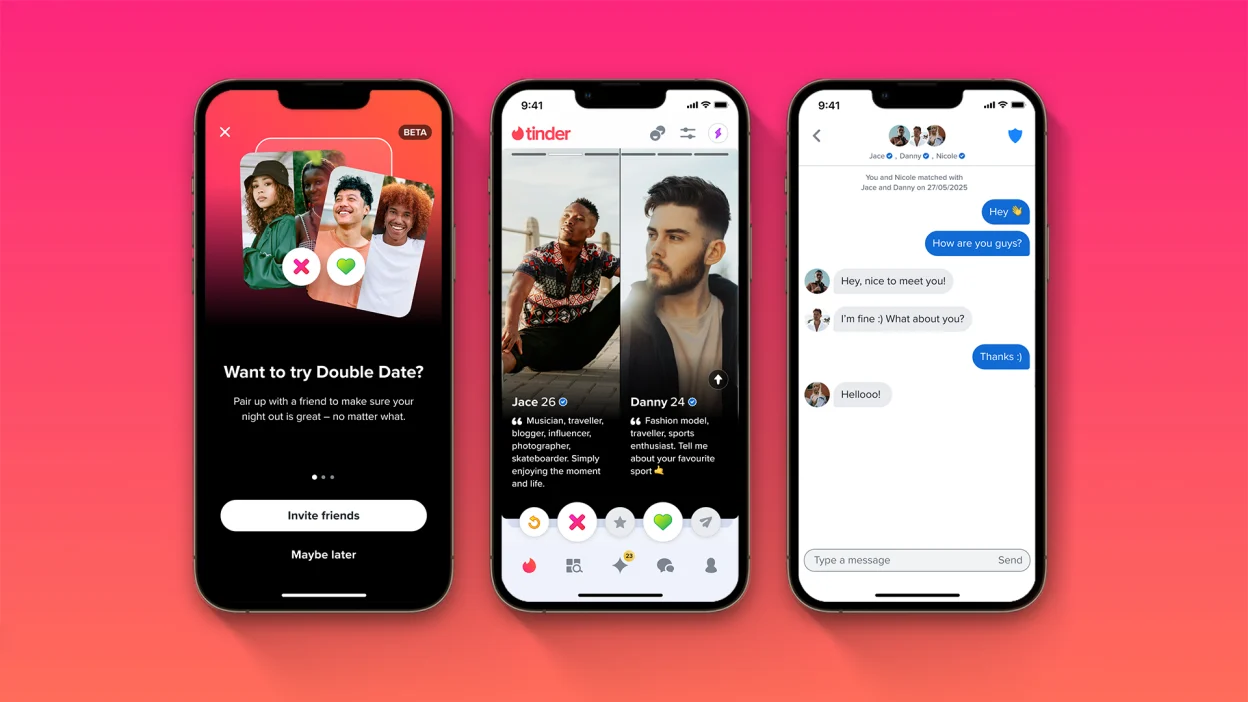
Platform demographics diverge sharply. SSRS found that among 18–29-year-old users, Tinder (73%) and Bumble (45%) dominate — while among users aged 50–64, Match leads at 45%, followed by Plenty of Fish (37%) and eHarmony (35%). The profile conventions, the expected length, and what reads as effort versus try-hard all shift accordingly.
Everyone Around You Is Biased
You send your profile to a friend. They see photos of a person they already like, so they say it looks good. They are not evaluating it the way a stranger with 400 other options and no context does. What you needed was "your third photo is nearly identical to your second, and your bio is a list." What you got was encouragement.
AI Is Already Everywhere — Often Used Badly
The behavioral shift has already happened. Mashable reported on Match data showing 300% more singles used AI to date in 2025 than in 2024. But the visible result has been a wave of profiles that look, as one observer put it, too perfect — AI-generated photos and eerily polished openers that blur the line between genuine presentation and digital illusion.
That's the failure mode: using AI to fabricate a person instead of to present the real one accurately. This is exactly what the Dating App Advisor was built for.
Why the AI Dating Profile Assistant Works Differently
Dating App Advisor is a profile editor, not a profile generator. It doesn't invent photos or manufacture a persona you'll have to maintain in person. It looks at what you already have, tells you which parts are underperforming and why, and helps you rebuild them into something that still survives a first date.
| Traditional Approach | AI Dating Profile Assistant |
|---|---|
| Apps give outcomes with no explanation | Ranked diagnosis of what's specifically failing |
| Friends offer polite, biased reassurance | Direct critique, including the photo you're attached to |
| Generic "best profile tips" articles | Feedback on your actual photos, bio, and prompts |
| AI-generated photos that look fabricated | Optimizes the real images and real person |
| One profile copy-pasted across all apps | Platform-calibrated for Tinder, Hinge, Bumble, Match |
| Change everything at once, learn nothing | Prioritized single-variable changes you can evaluate |
Photo Audits That Rank by Impact
Upload your lineup and get an assessment ordered by what matters most: lead photo strength, whether your face is immediately readable, how much redundancy exists across shots, whether any full-body image is present, and which photo should be cut entirely. You get a sequence, not a vague sense that something's off.
"Here are my six Hinge photos in current order. Tell me which one should lead, which one to delete, and what kind of photo I'm missing."
Bio Rewrites That Create Openings
Most bios fail the same way: they're a list. Hiking, travel, coffee, dogs. Nothing in that gives a stranger a specific thing to reply to. The assistant rewrites toward hooks — a concrete detail, an opinion, a small invitation — while keeping your actual voice intact.
"Here's my bio. It gets no replies. Rewrite it three different ways — one funny, one direct, one warm — and tell me which fits my photos best."
Positioning Around What Actually Matters
Aesthetics get all the attention, but SSRS data shows that among dating app users, sharing similar family values was the most-cited "very important" matching factor at 57% — dramatically ahead of income at 12%. Women cited it at 66% versus 49% of men. A profile that signals values clearly outperforms one that only optimizes for looks, because it filters for compatibility rather than volume.
Honest Feedback, Including the Part You Won't Like
Validation is easy to obtain and useless for improvement. If your favorite photo is the weakest one in the set, you'll be told plainly — with the reason and a replacement suggestion, not just criticism.
Human-Authentic, Not AI-Fabricated
Given how many profiles now read as machine-written, sounding like an actual person has become a competitive advantage rather than a baseline. The assistant deliberately preserves your idiosyncrasies instead of sanding them into generic polish.
Related Agents You'll Also Find Useful
A profile is one stage of a longer sequence. These agents cover the parts on either side of it.
Photography Coach
Since your lead photo carries more weight than everything else combined, the quality of the source images is a hard ceiling on how far editing can take you.
- Composition, lighting, and framing guidance for portrait shots
- Direct critique on photos you've already taken
- Practical direction for a friend shooting your lineup on a phone
Fashion Consultant
What you're wearing in your photos is a signal you're sending whether or not you intended it. Styling is one of the highest-leverage variables you fully control.
- Outfit evaluation specifically for profile photos and first dates
- Wardrobe building appropriate to your context and budget
- Culturally fluent style guidance across regions
Date Planner
Once the profile converts and a conversation turns into plans, execution becomes the variable that matters.
- Intent-driven date plans instead of defaulting to drinks nearby
- Venue psychology and multi-language local research
- Contingency planning for weather, timing, and conversational lulls
Dating Background Investigator
With AI-generated profiles now widespread, basic verification before meeting has become standard practice rather than paranoia.
- Social media presence and public information checks
- Consistency assessment across what someone has told you
- Red flag identification before an in-person meeting
Try the profile assistant free — no credit card required.
How It Works
Step 1: Share the Profile As It Currently Exists
All photos in their current order, your bio verbatim, every prompt answer, and which app it's on. Resist the urge to clean it up first — the underperforming version is the one worth diagnosing.
"Here's my complete Bumble profile as it stands right now. Six photos, current order, bio and prompts included. I get roughly three matches a week."
Step 2: Get a Ranked Diagnosis
You'll receive a prioritized breakdown: the single highest-impact change, then the next, then the rest. Not thirty simultaneous suggestions — an ordered list you can actually execute.
Step 3: Rebuild the Weakest Element First
Start at the top of the list. If it's the lead photo, work out which existing image should replace it or what you need to shoot. If it's the bio, iterate on drafts until the phrasing sounds like you rather than like a copywriter.
"That bio is better but too polished — it doesn't sound like how I talk. Make it shorter and a bit more casual."
Step 4: Change One Thing, Then Report Back
Run the new version for a week or two, then come back with results. Single-variable changes are the only ones that teach you anything, and the assistant adjusts strategy based on what actually moved.
"Swapped the lead photo like you suggested. Matches roughly doubled over ten days. What should I change next?"
Results & Use Cases
📸 The Profile Getting Almost No Matches
Scenario: Six photos, a three-line bio, months of consistent swiping, and a trickle of matches. No signal about which element is responsible.
Traditional Approach: Randomly shuffle photos, ask a friend who says it looks fine, or buy a boost that produces a temporary spike and zero learning.
Dating App Advisor: A structured audit identifies that the lead photo is a distant group shot, three images are near-duplicates in the same setting, and the bio lists interests without offering a single thing to reply to.
- Photo-by-photo assessment with a recommended reorder
- Bio rewritten around specific conversational hooks
- Clear identification of the one change likely to matter most
🎯 The Profile Attracting the Wrong People
Scenario: Matches are steady, but consistently with people looking for something entirely different from what you want.
Traditional Approach: Add "looking for something serious" to the bio and hope the filter works. It rarely does.
Dating App Advisor: Repositions the profile to signal values and intent through photo selection and prompt content rather than a single declarative line — given that family values rank as the top matching consideration for most users, this is where filtering actually happens.
- Photo selection that reflects lifestyle and priorities, not just appearance
- Prompt answers engineered to attract compatible people and deter mismatches
- Intent communicated through implication rather than a bio disclaimer
📱 Adapting One Profile Across Multiple Apps
Scenario: The same photos and bio copy-pasted to Tinder, Hinge, and Bumble. Results are wildly inconsistent and you don't know why.
Traditional Approach: Conclude that one app is simply better for you and delete the others, losing the audience you never actually reached.
Dating App Advisor: Adapts the same underlying material for each platform's conventions and demographics — Tinder skews younger and photo-first, Match skews significantly older, and Hinge rewards prompt specificity above almost everything else.
- Per-platform photo ordering and bio length adjustments
- Prompt strategy specific to Hinge's format
- Guidance on which apps match your age bracket and goals
🔁 Rebuilding After a Long Break
Scenario: Out of the dating world for six years. Norms have shifted, apps have changed, and your existing profile is visibly dated.
Traditional Approach: Recreate the old profile with newer photos and assume the same approach still works. It generally doesn't.
Dating App Advisor: Rebuilds from scratch against current conventions, recommends platforms aligned to your demographic — Match and eHarmony lead among users over 50, not Tinder — and sets realistic expectations for pacing.
- Full rebuild rather than a light refresh of dated material
- Platform recommendations matched to age bracket and intentions
- Calibrated expectations so early silence doesn't end the attempt
🤖 Avoiding the "Obviously AI" Profile
Scenario: You used a generator, and the result is smooth, polished, and completely characterless. It doesn't sound like you and you suspect people notice.
Traditional Approach: Keep it because it reads professionally, then discover in person that the version someone matched with doesn't exist.
Dating App Advisor: Strips out generic AI phrasing and rebuilds around specifics only you would write — which now stands out precisely because so much profile content has converged on the same polished sameness.
- Identifies the generic patterns that read as machine-written
- Preserves quirks and voice instead of sanding them smooth
- Keeps the profile consistent with who actually shows up to the date
Frequently Asked Questions
Is an AI dating profile assistant free?
Yes. Dating App Advisor is available on Jenova's free tier with all core features and limited monthly usage — no credit card required to start. Paid plans begin at $20/month and substantially increase usage limits while adding custom model selection. That's a fraction of what professional dating profile consultants and photographers typically charge.
Can it review my actual photos?
Yes. Upload your full lineup and you'll get direct assessment of lead photo strength, ordering, redundancy across shots, and what's missing. If the underlying image quality is the limiting factor, the Photography Coach covers composition and lighting in more depth.
Will it generate AI photos for my profile?
No — and that's deliberate. AI-generated dating photos have become widespread enough that observers now flag profiles that look "too perfect" as a recognizable pattern. Fabricated images also create an obvious problem the moment you meet someone. The assistant optimizes the real photos you have and tells you what to shoot next.
Does it work for Hinge, Tinder, and Bumble?
Yes, with different strategies for each. Platform demographics diverge substantially — SSRS data shows Tinder used by 73% of 18–29-year-old daters while Match leads among the 50–64 bracket at 45%. Profile length, tone, and prompt approach shift accordingly.
Is the feedback actually honest?
Yes, and that's the entire value. Polite reassurance is freely available and changes nothing. If your favorite photo is the weakest one, or your bio reads as a list of nouns, you'll be told directly — always paired with a specific fix rather than criticism alone.
Can I use it on my phone?
Yes. Jenova offers full feature parity across web, iOS, and Android with settings synced across devices. Since your photos already live on your phone, that's where most people run the audit.
Conclusion
Dating apps have become the primary entry point for modern relationships, with hundreds of millions of active users and over a billion downloads annually — yet they provide no feedback whatsoever on why a given profile underperforms. You iterate blindly while the people around you supply either reassurance or cynicism, and neither one changes the outcome.
An AI dating profile assistant supplies the missing layer: a specific, ranked, honest diagnosis of what's actually costing you matches, and a plan to fix it one variable at a time. Not a fabricated persona, not a set of generated photos — just an accurate outside read on the profile you already have.
If you've been swiping for months with results that don't reflect who you actually are, that's exactly the work this AI dating profile assistant was built for.
Try Dating App Advisor now. Explore more at Jenova.
For Developers: Dating App Advisor is available programmatically via the Jenova API — integrate profile analysis and optimization into your dating or social application with a single API call. Full documentation →