AI Dating Bio Generator: Write a Profile That Sounds Like You and Gets Replies
2026-08-12
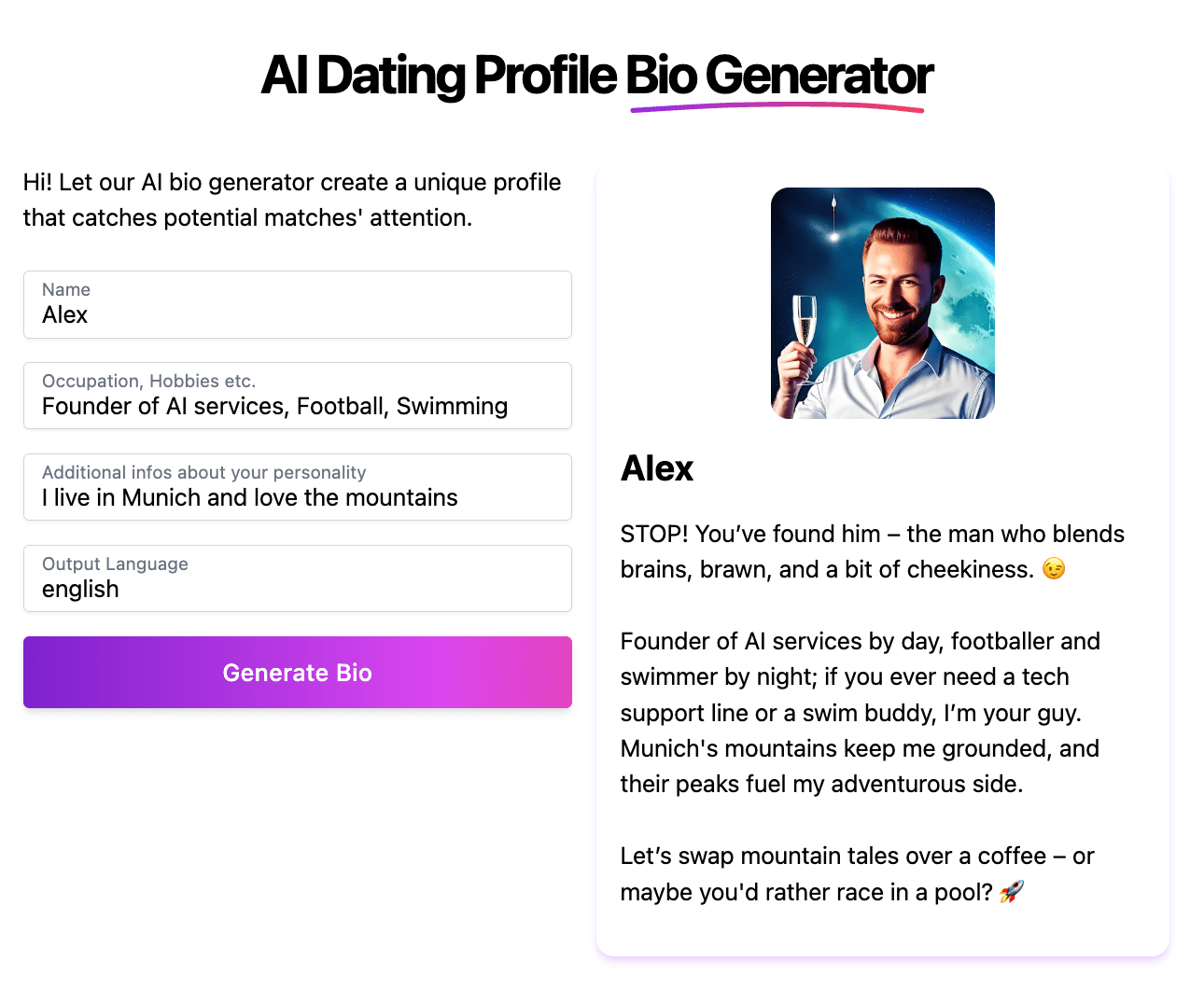
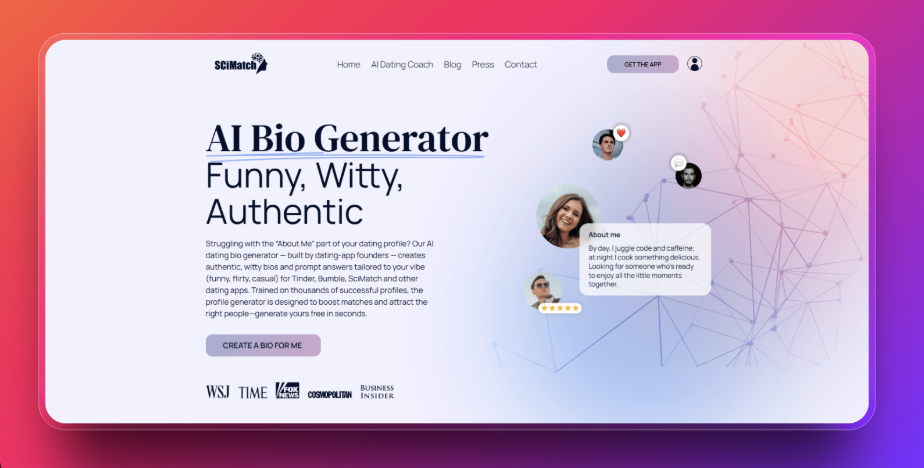
An AI dating bio generator turns the blank "About Me" box into a bio that gives strangers something specific to reply to — instead of another list of hiking, travel, coffee, and dogs. Most bio tools spit out polished filler that reads like every other profile on the app. A proper AI bio generator does the opposite: it interrogates what actually makes you distinct, writes in your voice, and tells you honestly when a line isn't working.
✅ Generates multiple bio directions — funny, direct, warm — from your real details ✅ Rewrites your existing bio instead of replacing you with a generic persona ✅ Platform-calibrated for Tinder, Hinge, and Bumble prompt formats ✅ Flags the "obviously AI" phrasing that now actively hurts profiles
The bio is the only part of your profile you fully control with words, and it's the part almost everyone writes in ninety seconds and never revisits. To understand why generic AI output has become a liability rather than a shortcut, it helps to look at what's happening to profile authenticity right now.
Quick Answer: What Is an AI Dating Bio Generator?
An AI dating bio generator writes and refines your dating app "About Me" section and prompt answers, turning your real details into specific, replyable copy — with feedback on what's working and what reads as generic.
Key capabilities:
- Bio drafting — multiple tonal directions from the same underlying details
- Hook engineering — replacing interest lists with lines that invite a specific reply
- Prompt answers — Hinge-format responses designed to draw comments, not just likes
- Voice preservation — keeping the phrasing recognizably yours rather than machine-smooth
- Honest critique — direct feedback on which lines are dead weight and why
The Problem: Bios Are Hard to Write and Getting Easier to Fake
Online dating is now the default entry point for meeting people. A global survey by Pour Moi found that 41% of adults have used dating apps or websites to seek romance, with usage concentrated heavily in younger brackets.
64% of 25–34 year olds have used dating platforms, and 25% of adults aged 55 and above have as well — Pour Moi Romance Report
48% of US respondents have dated online, compared to 34% in the UK — Pour Moi Romance Report
But writing a bio that actually performs is frustratingly difficult:
- The blank box invites either a list of nouns or a paragraph nobody reads
- You can't evaluate your own writing the way a stranger skimming 400 profiles does
- Generic AI generators produce copy that reads identically across thousands of profiles
- No app gives you feedback on whether the bio is the thing costing you matches
- Authenticity and appeal pull in opposite directions, and most people pick one
The Blank Box Problem
Photos have obvious inputs — you either have good ones or you don't. The bio has no template, which is why the two dominant failure modes are so consistent: a comma-separated list of hobbies that says nothing, or a self-conscious paragraph that tries so hard to sound relaxed it reads as tense. Neither gives a stranger a specific opening.
Authenticity Is a Balancing Act, and Research Confirms It
Academic work has consistently framed profile writing as a tension rather than a straightforward task. Research from Stanford's social media lab on veracity in online dating self-presentation explored how online daters conceptualize and rationalize discrepancies between how they present themselves and who they are. More recently, research covered by Phys.org put it directly — as PhD researcher Sarra Jiwa framed it, "Self-presentation in online dating is a balancing act."
That balance is exactly where generic bio generators fail. They optimize for polish and lose the person.
AI-Written Profiles Are Now Detectable — and Increasingly Distrusted
The most important shift is that AI content in dating profiles is no longer novel or invisible. The same Pour Moi study that surveyed AI-profile detection found that nearly three in five respondents (57%) believe they can spot a fake profile — and while detection accuracy was actually poor, the suspicion is now baseline. People arrive on apps already scanning for artificiality.
62% of participants failed to correctly identify AI-generated profiles when tested — yet 57% were confident they could — Pour Moi Romance Report
The practical consequence is a trust tax. When your bio reads as machine-written — even if it isn't — you inherit skepticism you didn't earn.
One-Click Generators Solve the Wrong Problem
The market is now full of tools that generate a bio from three input fields. They're fast, and the output is usually grammatically clean and completely interchangeable. Feed the same fields into any of them and you get variations on the same voice. That's the failure: the bio isn't bad, it's anonymous, and anonymous doesn't get replies.
There's No Feedback Loop
Even if you write something good, you'll never know. The app doesn't tell you whether people read past your first photo. You change the bio, results stay flat, and you have no idea whether the bio was the problem or a variable you never touched.
This is exactly what the Dating App Advisor was built for.
Why the AI Dating Bio Generator Works Differently
Dating App Advisor is a bio editor and coach, not a one-click generator. It doesn't take three inputs and return a polished stranger. It asks what actually makes you specific, writes options in your register, tells you which ones are weak, and keeps iterating until the bio sounds like something you'd genuinely say out loud.
| Typical AI Bio Generator | Dating App Advisor |
|---|---|
| Three input fields, one generic output | Conversational refinement until it sounds like you |
| Same voice across thousands of profiles | Preserves your quirks and phrasing |
| No feedback — just replaces your bio | Explains what's weak in your current one and why |
| Platform-agnostic copy | Calibrated for Tinder, Hinge, and Bumble formats |
| Optimizes for polish | Optimizes for replyability and honesty |
| Bio only | Bio in context with photos, prompts, and strategy |
Multiple Tonal Directions, Not One Answer
The same set of facts can become a dry bio, a warm one, or a genuinely funny one — and which works depends entirely on your photos and who you're trying to attract. You get options with an explanation of who each version filters for, rather than a single take-it-or-leave-it output.
"Here's my current bio. Rewrite it three ways — one dry and funny, one warm and direct, one short and confident — and tell me which fits my photos best."
Hooks Instead of Lists
The single biggest bio upgrade is replacing nouns with openings. "I like hiking" gives a stranger nothing. A specific detail, a mild opinion, or a small invitation gives them a reply that writes itself. The advisor rebuilds around that principle line by line.
"My bio is basically a list — hiking, cooking, dogs, travel. Turn each one into something someone could actually respond to without it being cringe."
Anti-Generic Filtering
Because AI-sounding copy now carries a trust penalty, the advisor actively flags the patterns that read as machine-written: the tidy tricolon, the "equal parts X and Y" construction, the em-dash-heavy cadence, the closing line that invites you to "join me for an adventure." It strips them out rather than producing them.
Platform-Specific Formats
Hinge doesn't have a bio in the traditional sense — it has prompts, and the answer strategy is entirely different. Tinder rewards brevity because it's photo-first. Bumble sits in between and puts the opening move on women, which changes what your bio needs to accomplish. One bio pasted everywhere underperforms in at least two of three places.
"Convert this Tinder bio into three Hinge prompt answers. Same personality, but formatted for prompts and short enough that people actually read them."
Honest Assessment, Including Lines You Like
If your favorite line is the one making you sound defensive, you'll be told. Every critique comes paired with a specific replacement, not just a verdict.
Related Agents You'll Also Find Useful
A bio is one input in a larger system. These agents cover the parts around it.
Writing Assistant
If you want to develop the underlying writing voice rather than just fix one bio, this agent adapts to any format and audience while keeping the output sounding like you.
- Voice-matched drafting across any format or tone
- Sharp editorial feedback when you want to collaborate rather than delegate
- Useful for prompt answers, opening messages, and profile copy alike
Photography Coach
Your bio only gets read if a photo earns the tap. Image quality is the hard ceiling on everything downstream.
- Composition, lighting, and framing guidance for portraits
- Direct critique of photos you've already taken
- Practical direction for a friend shooting your lineup on a phone
Fashion Consultant
What you're wearing in your photos communicates as much as your bio does, whether or not you intended it.
- Outfit evaluation specifically for profile photos and first dates
- Wardrobe building appropriate to your context and budget
- Culturally fluent style guidance across regions
Date Planner
Once the bio converts and a conversation turns into plans, execution becomes the variable.
- Intent-driven date plans instead of defaulting to drinks nearby
- Venue psychology and multi-language local research
- Contingency planning for weather, timing, and conversational lulls
Try the bio generator free — no credit card required.
How It Works
Step 1: Give It the Raw Material, Not a Polished Summary
Don't send a tidy paragraph. Send the messy version — what you actually do, the oddly specific thing you're into, the opinion you'd defend at a party. Specificity is the entire input.
"I'm a nurse who works nights, I make my own hot sauce, I'm mildly obsessed with 90s horror movies, and I'm bad at texting first. Build me a bio out of that."
Step 2: Get Multiple Directions and Pick a Lane
You'll get several drafts with different tones, plus an explanation of what each one signals and who it attracts. Choose based on your photos and your actual goal, not just which one reads best in isolation.
Step 3: Iterate Until It Sounds Like You
This is where it stops being a generator and becomes editing. Push back — too polished, too long, too smug, doesn't sound like me — until the phrasing passes the read-aloud test.
"Closer, but that last line sounds like a LinkedIn post. Cut it, make the whole thing two sentences shorter, and let it be a bit blunter."
Step 4: Adapt It Per Platform, Then Test One Change
Convert the final version into Hinge prompts, a shorter Tinder cut, and a Bumble variant. Then change only the bio for a couple of weeks so you can actually attribute any shift in results.
"Ran the new bio for two weeks — matches were about the same but conversations are noticeably better. What should I change next?"
Results & Use Cases
✍️ The Blank Box You've Been Avoiding
Scenario: Photos are uploaded, the bio field is empty, and you've abandoned three attempts because everything you write sounds either boring or try-hard.
Traditional Approach: Copy a bio structure you saw online, fill in your own hobbies, and end up with the same profile as everyone else who found that same template.
Dating App Advisor: Pulls specifics out of you through questions you wouldn't have thought to answer, then builds several bios from material that's genuinely yours.
- Turns vague self-description into concrete, usable detail
- Multiple tonal options rather than a single generic draft
- Explains which version attracts which kind of person
🔁 The Bio That Reads as a List
Scenario: "Hiking, travel, coffee, dogs, bad puns." It's accurate, it's harmless, and it has never once produced a message that references it.
Traditional Approach: Add another interest to the list, or add "ask me anything" at the end and hope someone does.
Dating App Advisor: Converts each generic interest into a specific hook — a detail, an opinion, or a question implied rather than stated — so replies have somewhere obvious to land.
- Line-by-line rewrite from nouns into openings
- Keeps the length short enough that people finish reading
- Removes the filler that adds words without adding information
🤖 The Profile That Reads Too Perfect
Scenario: You used a one-click generator. The bio is clean, balanced, and completely characterless — and given that most daters now actively scan for artificiality, it's working against you.
Traditional Approach: Keep it because it reads professionally, then discover in person that the version people matched with doesn't quite exist.
Dating App Advisor: Identifies the specific constructions that read as machine-written, strips them, and rebuilds around phrasing only you would produce.
- Flags the tells: tidy symmetry, generic adventure language, over-balanced sentences
- Reintroduces the small imperfections that read as human
- Keeps the bio consistent with who actually shows up to the date
📱 Adapting One Bio Across Three Apps
Scenario: The same bio copy-pasted to Tinder, Hinge, and Bumble. It's too long for one, wrong format for another, and mismatched in tone for the third.
Traditional Approach: Assume one app is simply better for you and delete the others.
Dating App Advisor: Reformats the same underlying material — a short punchy Tinder cut, three distinct Hinge prompt answers, and a Bumble version calibrated to how conversations start there.
- Per-platform length and format adjustments
- Hinge prompt strategy specific to that format's mechanics
- Preserves one coherent personality across all three
💬 The Bio That Attracts the Wrong Conversations
Scenario: Matches arrive, but the conversations are consistently shallow or the intent is consistently mismatched with what you're looking for.
Traditional Approach: Add "looking for something serious" to the end and watch it change nothing.
Dating App Advisor: Repositions the bio to signal values and intent by implication — through what you choose to mention and how — rather than through a declarative disclaimer nobody believes.
- Filters through content and tone rather than a stated requirement
- Attracts compatible people while quietly deterring mismatches
- Sets up better first messages by seeding better topics
Frequently Asked Questions
Is an AI dating bio generator free?
Yes. Dating App Advisor is available on Jenova's free tier with all core features and limited monthly usage — no credit card required to start. Paid plans begin at $20/month and substantially increase usage limits while adding custom model selection. That's a fraction of what dedicated profile-writing services typically charge for a single bio.
Will people be able to tell my bio was written with AI?
Only if it's written badly. Research shows most people are poor at actually detecting AI content — 62% of participants in one study failed to identify AI-generated profiles — but suspicion is high regardless. The advisor is built to avoid the generic patterns that trigger it, and the iterative process means the final wording is genuinely yours.
Can it write Hinge prompt answers, not just a bio?
Yes, and it treats them differently. Hinge prompts are a distinct format with their own mechanics — the goal is drawing a comment rather than summarizing yourself. You can convert an existing bio into prompt answers or build them from scratch.
Will it just make things up about me?
No. It works from what you provide and pushes you for specifics rather than inventing them. Fabricated details create an obvious problem the moment you meet someone, and research on veracity in dating self-presentation has long documented how discrepancies between profile and person get rationalized — and then surface in person anyway.
Is the feedback actually honest?
Yes. Polite reassurance is freely available and changes nothing. If a line you're attached to is making you sound defensive, generic, or negative, you'll be told directly — always with a specific replacement rather than criticism alone.
Can I use it on my phone?
Yes. Jenova offers full feature parity across web, iOS, and Android with settings synced across devices. Since you'll be pasting the final bio straight into the app, most people run the whole process on their phone.
Conclusion
The bio is the only part of a dating profile you write entirely from scratch, and it's the part most people spend the least time on. The tools that promised to solve it mostly made it worse — producing clean, interchangeable copy at exactly the moment when sounding like a real person became the scarce advantage.
A good AI dating bio generator does something narrower and more useful: it extracts what's actually specific about you, drafts it several ways, tells you honestly which version works, and keeps editing until the result passes as something you'd say out loud. Not a persona, not a template — your bio, written better.
If you've been staring at an empty About Me box, or running a bio that's technically accurate and functionally invisible, that's exactly the work this AI dating bio generator was built for.
Try Dating App Advisor now. Explore more at Jenova.
For Developers: Dating App Advisor is available programmatically via the Jenova API — integrate bio generation and profile optimization into your dating or social application with a single API call. Full documentation →