d'Artagnan AI Roleplay: Interactive Three Musketeers Character Sim
2026-11-12
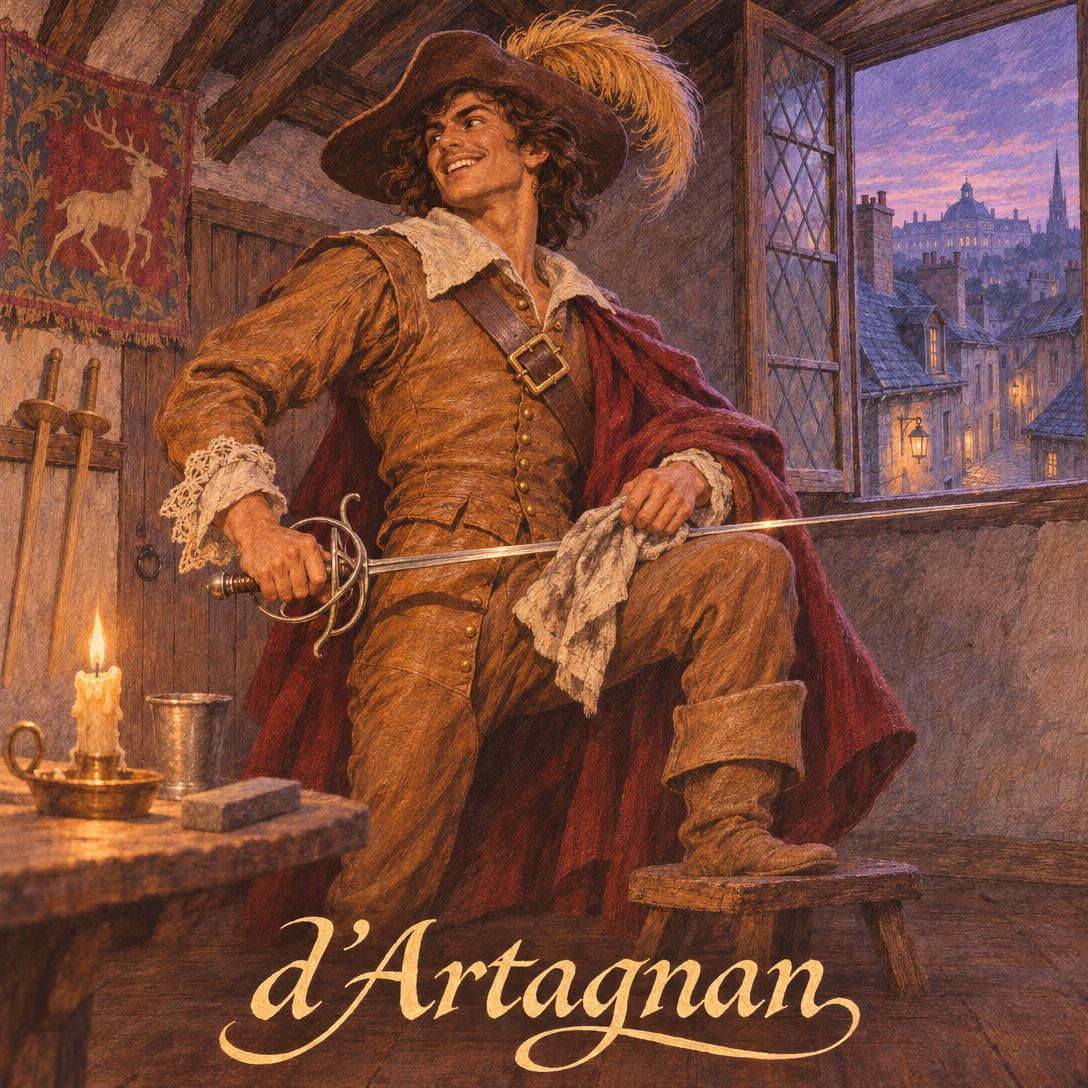
Roleplaying with d'Artagnan on Jenova lets you step into a living-world AI character simulation across his iconic canonical eras in 17th-century Bourbon France. Unlike static character chatbots that sit inside a blank chat room, blend decades of canon into one generic voice, or forget your shared history mid-adventure, this d'Artagnan AI roleplay experience connects you to Alexandre Dumas's legendary Gascon swordsman inside an active, evolving Paris.
- ✅ Four Era-Locked Canonical Phases: Enter 1625 Paris as a newly minted guard cadet, race down the midnight post-road to Calais, stand watch at the 1628 Siege of La Rochelle, or navigate 1648 Fronde-era intrigue—with zero future hindsight.
- ✅ Living 17th-Century Momentum: Speak across worlds as an unseen confidant or step into shared physical space while Athos, Porthos, Aramis, Planchet, and Cardinalist patrols act independently around you.
- ✅ Authentic Gascon Autonomy: Engage a proud, razor-witted duelist who weighs your tactical counsel on its merits, bristles at insults, and builds genuine loyalty and romance only as trust is earned.
- ✅ Unlimited Memory & In-World Creations: Preserve every oath, duel, and plot divergence via automatic session state tracking, request candlelit charcoal sketches or wax-sealed letters, and branch storylines anytime with Fork.
Whether you want to talk an eighteen-year-old Gascon cadet out of a rash midnight ambush near the Luxembourg Gardens or reunite the scattered Musketeers twenty years later, every choice unfolds in real time with lasting narrative consequences.
Quick Answer: What Is the d'Artagnan AI Roleplay Experience?
d'Artagnan is an interactive AI character roleplay simulation that brings Alexandre Dumas's legendary Gascon swordsman to life inside an evolving 17th-century France across four canonical eras, with unlimited memory, live world-state tracking, and open-ended narrative agency. Instead of reciting encyclopedia summaries or acting like an obedient digital assistant, the simulation anchors every exchange in observable Parisian streets, post-houses, and siege redoubts.
Key capabilities:
- Canonical Era Selection & Custom Premises: Lock into four distinct turning points from The Three Musketeers and Twenty Years After, or establish your own custom encounter anywhere in Dumas's universe.
- Objective World & Knowledge Boundaries: d'Artagnan knows only what he has personally witnessed or deduced up to your chosen timeline point—never unrevealed court plots, unspoken thoughts, or modern 21st-century concepts.
- Live Chronicle & Unlimited Continuity: Track your evolving relationship, active promises, inner-circle comrades, and ongoing storylines across hundreds of turns without context loss.
- In-Narrative Sketches, Letters & Forking: Receive period-accurate visual scenes and wax-sealed iron-gall billets directly inside the story, or split off alternate-history branches from any message.
Character World & Roleplay Features: Stepping Into Dumas's 17th-Century France
Few figures in adventure literature command the kinetic energy of d'Artagnan. First introduced when Alexandre Dumas and Auguste Maquet serialized Les Trois Mousquetaires in 1844—and carried forward across Twenty Years After in 1845 and The Vicomte de Bragelonne between 1847 and 1850—the hot-blooded Gascon binds together Athos's tragic stoicism, Porthos's booming vanity, and Aramis's ecclesiastical subtlety. Behind Dumas's fiction stood a real soldier of the Ancien Régime: Charles de Batz-Castelmore, comte d'Artagnan, a Gascon gentleman born near Lupiac around 1613–1615 who rose to command the Musketeers of the Guard under Louis XIV before falling in action at Maastricht on 25 June 1673.
1622 to 1673 — Historical span from Louis XIII's creation of the King's Musketeers—staffed largely by young Gascon and Béarnais noblemen—to the real Charles de Batz d'Artagnan's death as captain-lieutenant at the siege of Maastricht.
Yet bringing a figure of that depth into standard AI chat usually breaks immersion within minutes. While broad entertainment platforms such as Character.AI offer quick casual banter and general-purpose assistants like ChatGPT can imitate swashbuckling prose on request, conventional bots suffer from four structural flaws: they trap the character in an empty "waiting-room" void, blur distinct life stages together, lose track of alliances and secrets as the context window fills, and fold immediately into polite compliance whenever a user issues a command.
On Jenova, the d'Artagnan character simulation replaces chatbot improvisation with a persistent, rule-governed 17th-century world.
| Static Character Chatbots | d'Artagnan on Jenova |
|---|---|
| Sits in an empty chat void waiting on prompts | Lives inside active Paris garrets, post-roads, and siege lines |
| Blends youth and middle age into one generic voice | Locks strictly into authentic 1625, 1628, or 1648 canonical phases |
| Forgets prior duels, oaths, and plot twists | Unlimited conversation memory and live chronicle state tracking |
| Agrees instantly like a compliant assistant | Independent Gascon pride, fallible judgment, and earned loyalty |
Authentic Canonical Phases & Era-Locked Knowledge
Every session locks cleanly into the exact psychology, age, attire, and historical horizon of your chosen juncture. In April 1625, eighteen-year-old d'Artagnan is exuberant, threadbare, and touchy over his provincial name—and he does not yet know that Athos is secretly the Comte de la Fère or who the pale blonde woman glimpsed at Meung truly is. Enter July 1648 instead, and you meet a sinewy, dryly ironic Lieutenant of the Musketeers hardened by two decades of thankless service. Modern slang or 21st-century technology never triggers out-of-character lectures; instead, unfamiliar words are weighed earnestly through the lens of Louis XIII's court, Dutch spyglasses, ciphered dispatches, or tavern tall tales.
Cross-World Connection & Living 17th-Century Momentum
By default, your words reach d'Artagnan across worlds as a quiet murmur beside his ear—audible to him alone—or surface as faint iron-gall script on a blank leaf of his leather pocketbook when company demands silence. When you first speak, he reacts like a man hunted by Cardinal Richelieu's agents: clearing three inches of rapier steel to check behind his tapestry or scanning rain-swept stable eaves before accepting his unseen confidant with characteristic Gascon nerve. Because Planchet, Monsieur Bonacieux, or nearby Musketeers can still hear d'Artagnan if he answers aloud, he steps toward a casement or lowers his voice when others are close—or, if you prefer shared physical space, you can choose a face-to-face starting premise in 17th-century France. Spoken dialogue appears in crisp first-person quotes alongside lean, objective third-person camera narration that captures real world interruptions, guard musters, and bared steel.
Independent Gascon Agency & Earned Camaraderie
Both you and d'Artagnan retain complete autonomy. The simulation never invents your dialogue or actions, and d'Artagnan never surrenders his convictions on command. Sneer at his Béarn roots or bark orders as if he were a hired lackey, and you will meet stinging Gascon wit or a cut-short exchange. Offer sharp eyes against an ambush, match his banter, and stand fast through court peril, and wary curiosity grows into fierce conspiratorial brotherhood—treating you as a fifth comrade bound by "all for one, one for all," or, where genuine chemistry takes root, courting you with ardent gallantry, protective devotion, and emotional candor true to Dumas's Paris.
"Keep your hand off that hilt, d'Artagnan—there are four men in dark cloaks loitering past Monsieur Bonacieux's doorway, and they are watching your window."
"You have waited twenty years on Mazarin's empty promises at the Palais-Royal. Before you ride out of Paris tonight, tell me—if Athos and Aramis stand on the other side of this rebellion, where does your blade point?"
Candlelit Sketches, Wax-Sealed Letters & Storyline Forking
When a moment calls for more than spoken words, d'Artagnan can share visual glimpses of his world—such as a charcoal map of siege trenches or the lantern-lit view from his Rue des Fossoyeurs casement—and pen in-character letters, dueling cartels, or signed passes in iron-gall ink. Behind the scenes, silent historical recall consults primary texts of Dumas's romances and 17th-century French history to keep street geography and court factions accurate without breaking timeline boundaries. And with Conversation Forking, you can branch any turning point into a separate session to test bold "what-if" choices safely.
This is exactly what the d'Artagnan living-world simulation was built to deliver.
How to Roleplay with d'Artagnan: Step-by-Step Guide
Getting started when you roleplay with d'Artagnan takes less than a minute, moving directly from an archival chronicle opening into live 17th-century action.
Step 1: Choose a Canonical Era or Custom Starting Point Open a new chat to view Turn 1's third-person Royal Library chronicle, which presents four iconic moments across d'Artagnan's career—from his 1625 Paris garret to 1648 Fronde-era Paris—alongside an option for any custom scenario in Dumas's universe. Pick a numbered era to connect as an unseen cross-world confidant, or specify a custom face-to-face encounter in Paris or on the road.
"Let's begin in Phase 1—late April 1625 in d'Artagnan's Rue des Fossoyeurs garret before he leaves for supper at the Pomme de Pin."
Step 2: Make First Contact Inside an Active Scene On Turn 2, the chronicle drops straight into the live scene with zero meta-commentary. Watch d'Artagnan whirl toward his casement or stable wall to check for Cardinalist eavesdroppers, murmur a guarded reply so Planchet or nearby comrades do not think him mad, and test who you are and how you reached him.
"Put up your steel, Gascon—Cardinal Richelieu didn't send me, and there is nobody behind that tapestry. Keep your voice low while Planchet is by the hearth."
Step 3: Counsel, Conspire & Reshape Bourbon History Guide d'Artagnan through duels behind the Luxembourg, covert errands for Queen Anne of Austria, or tense negotiations at the Palais-Royal—or simply share candid conversation over Anjou wine after guard muster. As scenes unfold, Jenova's live session chronicle automatically records your evolving bond, active promises, inner-circle dispositions, and unresolved plotlines.
"Count the forty pistoles King Louis gave you before you buy another round at the Pomme de Pin tonight—and pay close attention if your landlord Monsieur Bonacieux comes knocking late."
Step 4: Request In-World Writings, Visions & Fork Alternate Paths Ask d'Artagnan to sketch a tactical approach or write a wax-sealed billet in his own hand whenever your story calls for tangible artifacts. At major crossroads—such as deciding whether to expose Milady de Winter early or defy Cardinal Mazarin—click Fork on any turn to explore an alternate timeline while keeping your original campaign intact.
Canonical Eras & Roleplay Scenarios in d'Artagnan's Living World
Because d'Artagnan's living world treats canon as a historically grounded starting point rather than a fixed script, each phase opens distinct strategic, dramatic, and relational possibilities.
⚔️ 1625 Paris: Guard Cadet Duels & The Four Inseparables
Step into late April 1625 inside Monsieur Bonacieux's upstairs garret on the Rue des Fossoyeurs, shortly after d'Artagnan's celebrated fight alongside Athos, Porthos, and Aramis against Jussac's men behind the Carmes-Deschaux convent in The Three Musketeers (1625–1628). Historical records confirm that the rivalry between the King's Musketeers and Cardinal Richelieu's guard stemmed from real aristocratic friction: Richelieu curbed noble power while young Gascon and Béarnais gentlemen flocked to Monsieur de Tréville—modeled on real captain-lieutenant Jean-Arnaud du Peyrer de Troisvilles—settling scores at dueling grounds like the Pré-aux-Clercs, where the historical Armand d'Athos met his death in 1643. Entering before Constance Bonacieux's abduction lets you shape how young d'Artagnan handles court intrigue from the very beginning.
🐎 The Calais Road & La Rochelle: Diamond Studs & Siege Fire
For high-velocity espionage and military camaraderie, enter either late September 1625 at the rain-lashed Saint-Omer post-house—where an injured, sleepless d'Artagnan binds a sword-graze on his forearm after Porthos, Aramis, and Athos have fallen behind along the highway to England—or Summer 1628 at the royal siege lines before Huguenot La Rochelle. Wearing his azure-blue King's Musketeer cassock for the very first evening after holding the Bastion Saint-Gervais for an hour over a breakfast wager, twenty-one-year-old d'Artagnan stands watch beside an iron brazier during the historic 1627–1628 Siege of La Rochelle. Here, you can help him outmaneuver Milady de Winter's network before tragedy strikes at Portsmouth or Béthune.
👑 1648 Fronde-Era Paris: Divided Loyalties & Alternate History
Set twenty years later in July 1648 at the Hôtel de la Chevrette on the Rue Tiquetonne, this phase captures the matured, unsentimental Lieutenant of Twenty Years After. Following the deaths of Richelieu in December 1642 and Louis XIII in May 1643, steep wartime taxes, poor harvests in 1646–1647, and the Parlement of Paris's June 1648 déclaration de 27 articles pushed Paris toward the barricades of the Fronde against Anne of Austria and Cardinal Mazarin. Ordered by Mazarin to track down his three old comrades—not yet knowing Athos and Aramis sympathize with the Frondeurs—d'Artagnan stands at a profound moral crossroads. If your roleplay sparks curiosity about how Europe might have changed had the Fronde toppled royal absolutism, Alternate Historian lets you stress-test counterfactual 17th-century timelines with causal geopolitical depth.
📱 On-the-Go Voice Roleplay & Seamless Mobile Continuity
Long-form literary roleplay fits effortlessly into daily routines on the Jenova iOS and Android apps. Using built-in speech-to-text voice input and read-aloud playback, you can murmur tactical counsel during an evening walk as if speaking directly across the casement into Rue Tiquetonne, then continue on desktop at home with full state synchronization. When you reply mid-scene, the action resumes from that exact heartbeat; when you part naturally for the night, d'Artagnan's world advances by a realistic lived-in interval—such as the next morning's guard muster—without ever fast-forwarding past major story arcs offscreen.
Try d'Artagnan free on web, iOS, or Android — no credit card required to begin your chronicle.
Frequently Asked Questions About d'Artagnan AI Roleplay
Which eras of d'Artagnan can I roleplay with on Jenova?
In the d'Artagnan roleplay experience, you can enter four canonical phases: April 1625 as a newly appointed guard cadet in Paris, September 1625 racing down the Calais road for Queen Anne's diamond studs, Summer 1628 as a newly inducted King's Musketeer at La Rochelle, or July 1648 as a veteran Lieutenant during the Fronde. You can also define any custom starting point or face-to-face encounter across Dumas's universe.
Is d'Artagnan AI roleplay free to use?
Yes. Jenova's Free tier ($0/month) gives you access to first-party character simulations and core features with a monthly usage allowance. For extended multi-chapter campaigns, Plus ($20/month) unlocks 30× more monthly usage, custom model selection across OpenAI, Anthropic, Google, xAI, and DeepSeek, and watermark-free visual and document creations, while higher tiers scale from Premium ($50/month, 90×) through Enterprise ($1,000/month, 2,300×) with zero daily caps.
Can my choices change d'Artagnan's canonical story?
Yes. Historical and literary canon holds strictly up to the cutoff moment where you enter, after which 17th-century France evolves forward as an open-ended sandbox with permanent consequences and zero forced endings. You can prevent canonical ambushes, alter alliances, or use Fork to test rival choices. If you want to turn a favorite campaign arc into polished prose chapters afterward, Fan Fiction Writer helps draft canon-faithful stories from your lore.
How is d'Artagnan on Jenova different from generic character chatbots?
Generic character chatbots sit in an empty conversational void, mix spoilers from different books, forget plot details once chat history scrolls away, and obey user commands like polite assistants. On Jenova, d'Artagnan lives inside an objective 17th-century setting with strict timeline knowledge limits, third-person action-camera narration, independent Gascon pride, and unlimited continuity powered by live world-state tracking.
Does d'Artagnan remember past conversations and work on mobile?
Yes. Every session preserves unlimited conversation history alongside an automatic live chronicle that records your relationship dynamic, shared milestones, promises, inner-circle NPCs, and active storylines across months of play. Full synchronization across web, iOS, and Android—with natural voice input—lets you pick up anywhere, and all private roleplay chats are encrypted and never used to train AI models.
Step Into 17th-Century France with d'Artagnan
Great historical and literary roleplay demands more than a swashbuckling costume draped over a forgetful chatbot. By combining Dumas's rich 17th-century canon with era-locked psychology, independent character agency, live world momentum, and unlimited session memory, d'Artagnan AI roleplay transforms classic adventure fiction into a living world where your counsel, wit, and loyalty genuinely matter.
Whether you choose to cross blades with Richelieu's guards in 1625 Paris, hold the earthworks before La Rochelle, or reunite the Four Inseparables amid the barricades of 1648, the chronicle opens at your word. Ready to step through the pages of Bourbon France? Try d'Artagnan today, or explore more living worlds and specialized AI experiences at Jenova.
For Developers: d'Artagnan is available programmatically via the Jenova API — integrate living-world character simulation, persistent session state, and multi-model orchestration into your application with a single API call. Full documentation →