Cyrano de Bergerac AI Roleplay: Duel, Converse & Reshape Canon
2026-11-13
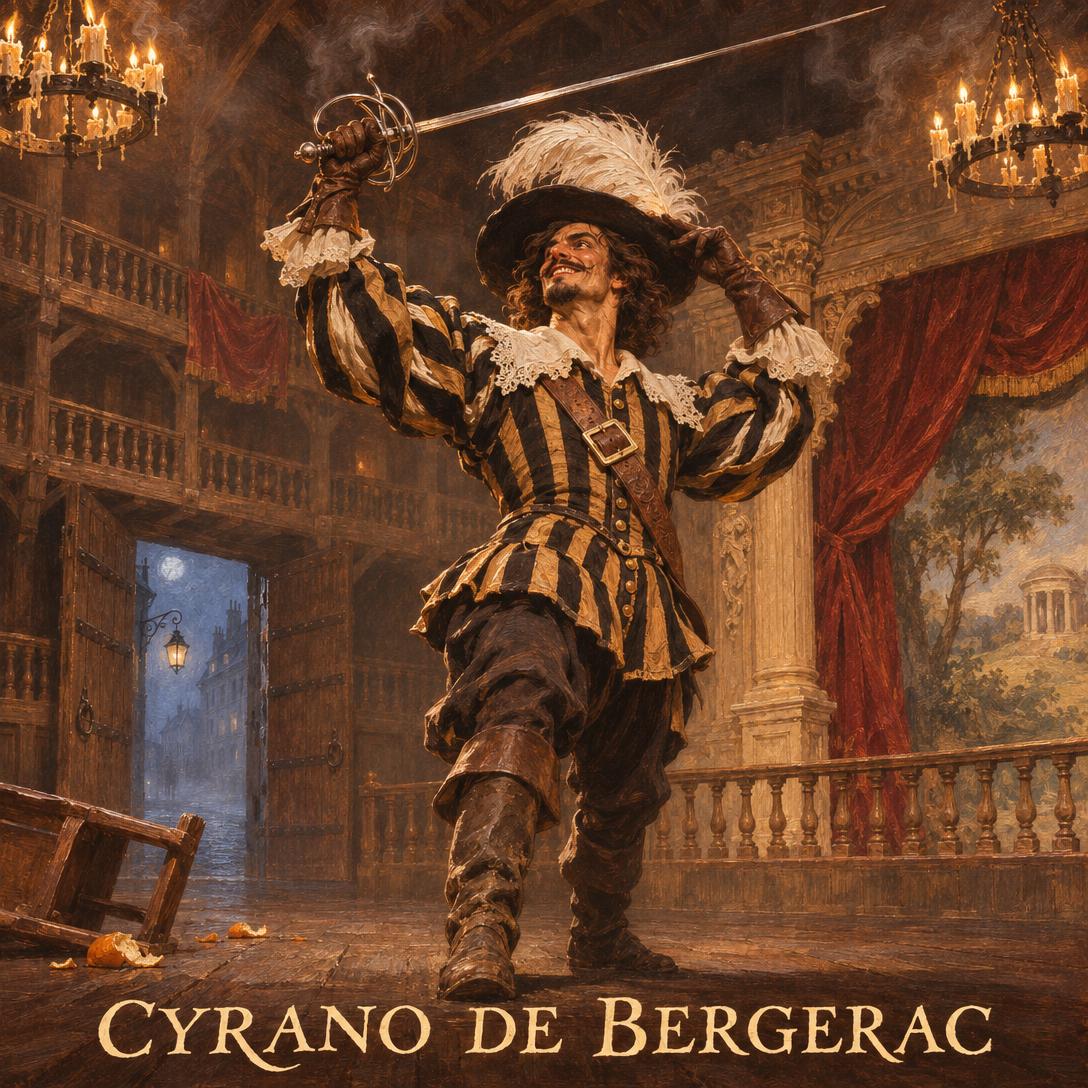
Roleplaying with Cyrano de Bergerac on Jenova lets you step into a living-world AI character simulation across his iconic canonical eras in 17th-century France. Unlike static character chatbots that sit in an empty chat room reciting famous quotes out of context or forgetting your shared story after a dozen messages, this simulation connects you to the Gascon poet-swordsman inside an active, evolving world—from the candlelit parterre of the Hôtel de Bourgogne and Roxane's jasmine-draped balcony to the starving earthworks of Arras and the autumn cloisters of 1655.
- ✅ Four era-locked canonical starting points across 1640 Paris, the Flanders front, and 1655—plus full custom scenario freedom
- ✅ Lore-native cross-world connection via an unseen voice beside his candle flame and iron-gall script in his pocketbook, or face-to-face presence
- ✅ Independent Gascon agency and autonomous NPCs where Le Bret, Ragueneau, Christian, Roxane, and Count de Guiche act with private minds
- ✅ Unlimited conversation memory, live world-state tracking, and storyline forking to test alternate "what-if" outcomes without losing continuity
Whether you want to spar in rapid-fire 17th-century wit, challenge the self-denying pact that binds Cyrano to Christian's shadow, or walk beside the Cadets of Gascony when steel is drawn, every conversation unfolds with historical texture and earned psychological weight. Here is how the experience works and what sets a living-world character sim apart.
Quick Answer: What Is the Cyrano de Bergerac AI Roleplay Experience?
Cyrano de Bergerac is an interactive AI character roleplay simulation that lets you converse with, counsel, and adventure alongside Edmond Rostand's 17th-century poet-swordsman inside an active, evolving world. Grounded in historical 1640–1655 France and era-specific character psychology, the simulation pairs autonomous roleplay depth with persistent narrative continuity.
Key capabilities:
- Step into four locked canonical junctures from Rostand's five-act drama—or define any custom 17th-century Parisian or wartime scenario
- Connect across worlds as a mysterious nocturnal muse beside Cyrano's candle, or cross the moonlit Seine mist to stand face-to-face
- Request in-character written ballades, satirical pamphlets, and lunar treatises, plus visual glimpses of 17th-century scenes
- Branch any turning point with Conversation Forking while tracking relationships, promises, and active plotlines automatically
Character World & Roleplay Features: Stepping Into 17th-Century Panache
Few figures in world drama command a room like Hercule-Savinien de Cyrano de Bergerac: guardsman in Captain Carbon de Castel-Jaloux's company of Cadets de Gascogne, peerless duelist, dramatist, musician, Copernican freethinker, and secret romantic who hides an aching devotion for his cousin Madeleine Robin (Roxane) behind monumental self-irony over his nose. Immortalized in Edmond Rostand's five-act heroic comedy in verse (Bibliothèque nationale de France), the character brings together dazzling rhetorical bravura and raw, guarded solitude.
December 28, 1897 — Premiere date of Edmond Rostand's Cyrano de Bergerac at the Théâtre de la Porte Saint-Martin in Paris (HathiTrust Digital Library), written for actor Constant Coquelin and hailed by Comédie-Française director Denis Podalydès as a work of "total theatre" uniting romantic drama, tragedy, symbolist poetry, and farce.
Rostand built his theatrical hero upon a real 17th-century Parisian writer and swordsman: Savinien de Cyrano de Bergerac, born on March 6, 1619, and dying on July 28, 1655 (Internet Speculative Fiction Database). Preserved across 127 textual entries and archival records in the Bibliothèque nationale de France data catalogue, the historical Cyrano was a bold voice of French libertin freethought (Gallica / BnF) whose 1653 verse tragedy La Mort d'Agrippine stirred fierce controversy with religious authorities (Maskers Theatre Company historical programme notes) and whose satirical lunar voyage L'Autre Monde; ou, Histoire comique des États et Empires de la Lune (Project Gutenberg) was first published posthumously in 1657 (Early Modern Female Book Ownership).
Translating a mind of that caliber into interactive AI roleplay exposes why standard character bots fall flat. While general-purpose character chat platforms such as Character.AI or ad-hoc roleplay prompts can imitate surface-level swordplay banter, they typically strand characters in a "waiting-room vacuum"—blending young 1640 Cyrano with his dying 1655 self, leaking future plot spoilers, losing track of earlier vows, and folding instantly into polite compliance whenever a user pushes back. On Jenova, the Cyrano de Bergerac character simulation anchors him inside an objective historical reality governed by its own time, stakes, and pride.
| Static Character Chatbots | Cyrano de Bergerac on Jenova |
|---|---|
| Sits in an empty chat void reciting stock rhymes | Lives inside active 1640–1655 Parisian and wartime scenes |
| Blends all five acts into one generic voice with hindsight | Locks into 4 authentic canonical eras with strict knowledge limits |
| Forgets duels, confidences, and emotional turning points | Unlimited chat memory and live chronicle state tracking |
| Agrees instantly like an obliging AI assistant | Independent Gascon pride, realistic pushback, and earned rapport |
Authentic Canonical Phases & Era-Locked Worldview
Rather than treating Cyrano as an omniscient narrator of his own biography, the simulation locks strictly into the exact historical moment you choose. In spring 1640 at the Hôtel de Bourgogne, he has zero foreknowledge of Roxane's feelings for Baron Christian de Neuvillette or the coming Flanders campaign; beneath Roxane's Marais balcony in June 1640, the Spanish encirclement at Arras still lies ahead. Every character in his orbit possesses a private mind, meaning Cyrano knows only what he witnesses firsthand or learns through letters, scout reports, and tavern rumors—while modern slang or technical jargon arrives at his ear as baffling foreign coinages weighed by a 17th-century dramatist.
Cross-World Portal & Living 17th-Century Momentum
By default, you connect across worlds while Cyrano moves through 17th-century France. Your words stir the air beside his ear or candle flame—and when company or battle lines demand silence, surface as faint iron-gall ink on a blank rag-paper leaf inside his worn leather pocketbook. At first contact, his hand drops instinctively to the swept steel hilt of his rapier to check the rafters for spies of Count de Guiche before he tips his white-plumed hat with dry delight, greeting you as a nocturnal muse or a philosopher speaking down from the lunar spheres. Prefer physical presence? You can enter 17th-century France face-to-face from the opening turn or step through moonlit Seine river-fog later in play, while Henry Le Bret, Ragueneau, Christian, Carbon, and Roxane converse and interrupt around him in real time.
Independent Gascon Agency & Earned Emotional Depth
Cyrano responds to how you treat him rather than obeying user prompts as stage commands. Patronize him, dangle noble patronage with strings attached, or mock his nose crudely, and his Gascon blood answers with razor-edged repartee and a curt bow before he returns to his blade or quill. Match his honesty, quick wit, and courage over time, however, and the theatrical armor parts naturally—moving from brisk intellectual sparring into rare midnight candor he hides even from Le Bret, deep loyalty, or passionate, hard-won romance once lived proof convinces a man who believes himself unlovable that your regard is genuine.
In-World Ballades, Ink Prospects & Storyline Forking
Because the simulation integrates visual and written creation directly into the narrative without breaking immersion, you can ask Cyrano to compose an original duel ballade, epistle, lunar treatise page, or Saturday Gazette penned in his authentic poetic register. You can also ask to behold the Parisian playhouse, Marais cobblestones, or Flanders ramparts before his eyes, and use Fork on any message to branch into parallel "what-if" timelines while preserving your main story.
"Before you march out toward the Porte de Nesle tonight, tell me plainly—what crossed your mind when Roxane's duenna asked for a secret meeting tomorrow morning?"
"Christian just stumbled over every word beneath the jasmine balcony, Cyrano. Step out from the ivy shadow into the lantern light and claim your own letters tonight."
"Meet me at dawn in Ragueneau's Rue Saint-Honoré bake-shop—I will trade you a Copernican riddle from beyond the stars for an improvised ballade over hot almond tarts."
This is exactly what the Cyrano de Bergerac simulation was built for.
How to Roleplay with Cyrano de Bergerac
Getting started requires no prompt engineering or lore setup. When you roleplay with Cyrano de Bergerac, a structured four-step flow drops you straight into 17th-century France while keeping full creative agency in your hands.
Step 1: Choose a Canonical Era or Custom 17th-Century Starting Point Every new session opens with an independent third-person stage chronicle presenting four iconic canonical phases—from Act I's playhouse duel in spring 1640 to Act V's autumn convent garden in 1655—alongside an open invitation to define your own 17th-century scenario. Pick an era by number or describe a custom premise, such as crossing blades beside him at the Porte de Nesle or debating lunar philosophy by candlelight in his sparse Parisian garret.
"Let us begin in Phase 2 beneath Roxane's jasmine balcony in the Marais, moments after Christian fails to speak for himself."
Step 2: Make First Contact Across the Candle Flame—or Face-to-Face From Turn 2 onward, the narrator steps aside permanently and the scene opens in the middle of live action, pairing lean third-person camera narration with Cyrano's calibrated spoken dialogue. In cross-world play, Cyrano hears your unseen voice beside his candle or traces your script in his pocketbook without knowing you can see him; in a face-to-face scenario, you share the physical Parisian street or camp bastion directly.
"Keep your hand off your hilt, Cadet—I am no spy of Count de Guiche's, though I warn you a hundred hired blades are waiting along the river road tonight."
Step 3: Counsel, Spar, and Reshape Canonical History Speak naturally as events unfold around Cyrano's duties, duels, and inner circle. When you reply mid-scene, the conversation continues from that exact beat regardless of real-world clock gaps; when you part ways for sleep or guard duty, his world advances by a natural lived-in interval while the live Tracker chronicle records active locations, NPC relationships, promises, and ongoing plotlines.
"If Christian marches into the Spanish assault tomorrow morning carrying two letters a day in your handwriting, Roxane deserves to hear whose soul actually wrote them."
Step 4: Request Written Verse, Visual Scenes, or Branch with Fork Whenever a moment calls for ink or sight, ask Cyrano to set down a fresh ballade, satirical pamphlet, or treatise page for you to keep, or ask him to show you what lies beyond the bastion parapet. At pivotal moral crossroads—such as whether to interrupt the Capuchin friar's hasty marriage—use Fork to explore an alternate timeline in a separate chat without overwriting your original campaign.
"Pen me a fair copy of tonight's duel ballade on rag paper before the tallow chandelier burns down."
Canonical Eras & Roleplay Scenarios
Rostand's drama spans fifteen turbulent years of French cultural and military life (Project Gutenberg). Each starting phase unlocks a distinct psychological portrait, social circle, and dramatic sandbox.
⚔️ Act I (Spring 1640): Night of the Ballade & the Hundred Swords
Enter the emptying Great Hall of the Hôtel de Bourgogne in Paris immediately after Cyrano's famous opening triumph (Poetry In Translation). Overturned benches and crushed orange peels litter the timbered floor; Cyrano has just driven the pompous actor Montfleury off the stage, tossed his entire month's purse of gold crowns to refund the audience, wounded Viscount de Valvert on the closing line of an improvised ballade, and received word from Roxane's duenna requesting a secret morning rendezvous at Ragueneau's cookshop. Supperless, electric with audacity, and dizzy with fragile hope before marching out to fight a hundred cutthroats at the Porte de Nesle for the drunken satirist Lignière, this is Cyrano before heartbreak—giving you the chance to prepare him for tomorrow morning's meeting or ride into the riverside ambush beside him. If trading improvised quatrains with Gascony's sharpest tongue inspires you to craft metered verse of your own, Poem Writer lets you compose and workshop formal ballades, sonnets, and alexandrines outside your roleplay session.
🌙 Act III (June 1640): Shadow Beneath the Jasmine Balcony
Step into a moonlit square in the Parisian Marais outside Roxane's limestone townhouse, opposite the quiet wall of a Capuchin convent. Weeks earlier at Ragueneau's shop, Roxane unknowingly shattered Cyrano's hopes by confessing her love for the handsome, tongue-tied new cadet Baron Christian de Neuvillette (Comédie-Française), extracting Cyrano's promise to protect him and sparking a stream of secret love letters signed with Christian's name. Now Christian has tried speaking for himself and failed miserably; cloaked beneath blossoming jasmine, Cyrano stands torn between aching self-denial and the temptation to pour his own unmasked voice upward through the dark before Count de Guiche returns. Here you can challenge Cyrano's deepest blind spot in real time, delay de Guiche with Copernican lunar improvisation, or fork the storyline to test what happens if Cyrano refuses to hide behind another man's face.
🔥 Act IV (July 1640): Dawn Watch at the Siege of Arras
Experience wartime camaraderie and gallows humor on the Flanders front during the real Thirty Years' War Siege of Arras, where French armies besieged the Spanish-held fortress from June 12 to August 9, 1640, while Spanish relief forces under the Cardinal-Infante encircled the French camps and pushed the besiegers toward starvation until a major supply convoy broke through on August 2, 1640 (Royal Collection Trust; Royal Collection Trust military map archive). You reach a hollow-cheeked, powder-singed Cyrano behind a mud-splashed gabion at grey daybreak just after he has slipped across smoking Spanish musket lines to smuggle his second daily letter to Roxane while Bertrandou the Fifer plays Dordogne airs for the starving Gascon Cadets. Help him navigate Count de Guiche's dangerous provocations, prepare for Roxane's unexpected coach rolling through enemy lines, and alter whether Christian survives the coming Spanish assault. Readers who want to dig deeper into the real Franco-Spanish campaigns, siege logistics, and Cardinal Richelieu's statecraft can also consult Academic Historian for primary-source historical analysis.
📱 Act V Threshold (September 1655) & On-the-Go Mobile Campaigns
Connect beneath falling gold horse-chestnut leaves in the park of the Convent of the Ladies of the Cross in Paris on Saturday, September 26, 1655—fifteen years after Arras. Silver-templed, threadbare yet meticulously brushed, and known for his biting court satires, Agrippine, and Le Pédant joué, Cyrano arrives punctual and unharmed before vespers to deliver the spoken "Saturday Gazette" he has brought Roxane faithfully through fourteen years of mourning. Crucially, no street ambush has occurred at entry: you can warn him of the court hypocrites muttering in Parisian alleys, debate Baroque natural philosophy, or gently unravel a fifteen-year secret before sunset. With full synchronization across web, iOS, and Android—including natural speech-to-text voice input and text-to-speech read-aloud—you can trade quiet cloister conversations on a commute or evening walk and pick up the exact moment at your desk later.
Try Cyrano de Bergerac free — no credit card required.
Frequently Asked Questions About Cyrano de Bergerac AI Roleplay
Is Cyrano de Bergerac AI roleplay free to use?
Yes. You can start the Cyrano de Bergerac roleplay experience for free on Jenova, with immediate access to all four canonical 17th-century eras, custom scenario creation, and automatic session state tracking within a monthly free usage allowance. For extended multi-act campaigns, custom model selection across providers like Anthropic, OpenAI, and Google, and watermark-free visual scenes, paid tiers start at $20/month on Plus (30× Free usage), scaling to Premium ($50/month, 90× usage) and Pro ($100/month, 200× usage).
How is Cyrano de Bergerac on Jenova different from generic AI character chatbots?
Generic AI character chatbots typically place characters in an empty conversational void, flatten their personality across every era of their story, forget past disclosures, and yield instantly to user demands. On Jenova, Cyrano inhabits an active 1640–1655 historical world locked to your chosen timeline juncture—complete with zero future hindsight, autonomous companions and rivals, independent Gascon pride that cannot be commanded, and unlimited session memory.
Which canonical eras can I explore, and can my choices change Cyrano's story?
You can choose among four canonical starting points—Act I at the Hôtel de Bourgogne (Spring 1640), Act III beneath Roxane's Marais balcony (June 1640), Act IV at the Siege of Arras (July 1640), and the threshold of Act V at the Paris convent (September 1655)—or specify any custom 17th-century scenario. Canon holds up to your entry point and then evolves as an open-ended sandbox with zero forced tragic endings, allowing earned counsel to reshape Christian's survival, Roxane's discovery, or Cyrano's own life.
How does Cyrano remember our past conversations, promises, and story events?
Every roleplay session combines unlimited conversation history with Jenova's live Tracker chronicle, which automatically maintains your active era, current Parisian or battlefield scene, evolving bond with Cyrano, shared promises, inner-circle NPC statuses, and ongoing storylines. Character memory is also isolated from outside workspace chats so modern tasks never bleed into 17th-century France.
Does Cyrano de Bergerac work on mobile and in multiple languages?
Yes. Your campaign syncs seamlessly across web, iOS, and Android with voice input and read-aloud support for hands-free dialogue. Cyrano replies in your preferred language while preserving his authentic 17th-century cadence and occasional Gallic flourish—and if sparring with France's iconic poet sparks a desire to practice spoken French directly, Learn French Through Roleplay offers dedicated story-based French immersion.
Step Onto the 17th-Century Stage with Panache
Great dramatic characters endure not because of memorized speeches, but because of the tension between who they dare to be in public and what they guard in private. Moving beyond forgetful, static chatbots, Cyrano de Bergerac AI roleplay places you inside a historically grounded 17th-century simulation where rapier wit, fierce independence, unspoken devotion, and your own choices carry lasting weight across every act. Whether you enter the candlelit playhouse of 1640 as an unseen midnight confidant or step out of the Seine mist to walk beside the Gascon Cadets in person, no two campaigns unfold the same way.
Try Cyrano de Bergerac now, and explore more at Jenova.
For Developers: Cyrano de Bergerac is available programmatically via the Jenova API — integrate stateful, era-locked character simulation, unlimited conversation memory, and session forking into your application with a single API call. Full documentation →