AI Customer Script: Write Professional Customer Service Scripts with AI (May 2026)
2026-05-21
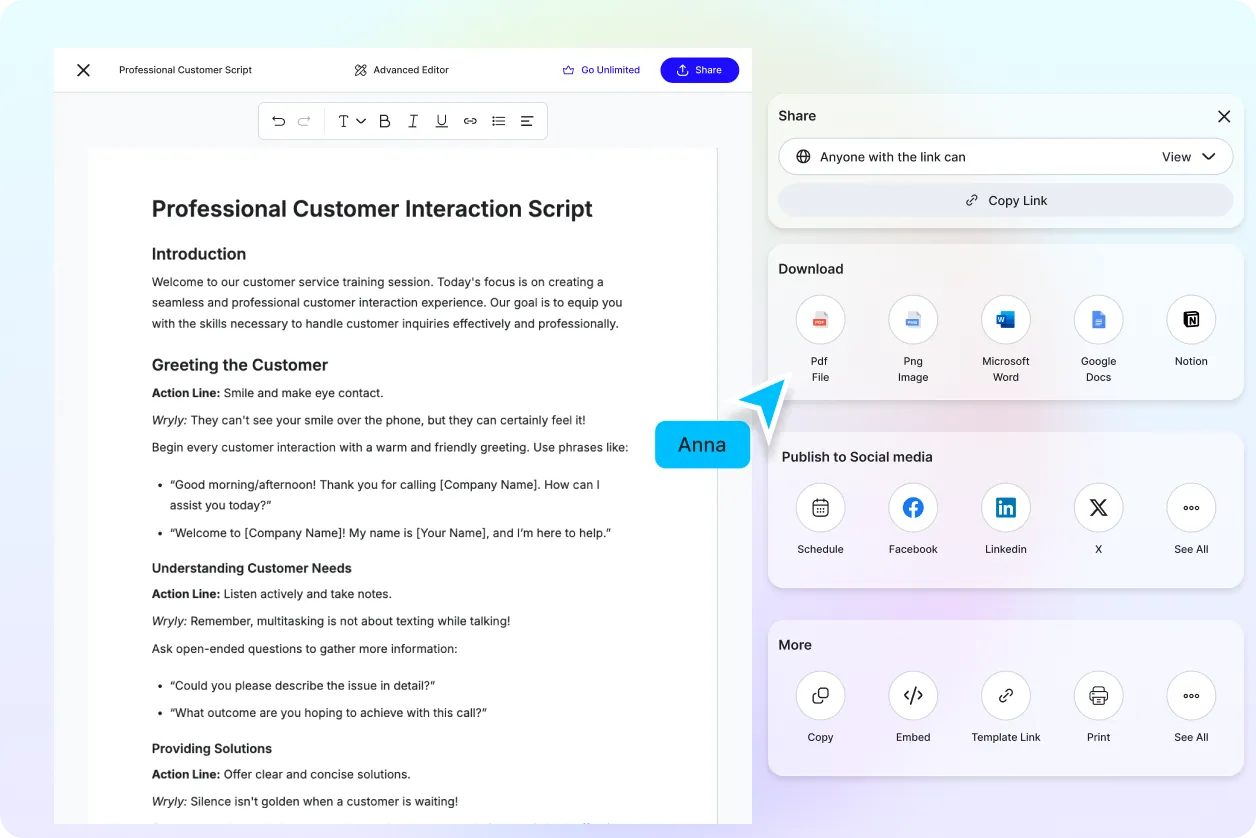
Every customer interaction follows a pattern — but most companies leave that pattern undocumented, inconsistent, or buried in a training binder nobody reads. In 2026, that inconsistency has real costs. The AI customer service market reached $12.06 billion in 2024 and is projected to hit $47.82 billion by 2030, growing at a 25.8% CAGR. Meanwhile, 80% of routine customer interactions are expected to be fully handled by AI in 2026, according to Gartner. But behind every AI chatbot and every human agent is the same requirement: a well-written script that defines how your brand sounds when a customer needs help.
An AI customer script generator doesn't just fill in a template. It builds complete, tone-matched scripts for phone calls, live chat, email responses, complaint handling, and onboarding conversations — adapted to your industry, customer persona, and brand voice. Platforms like Jenova take this further with a Writing Assistant that crafts scripts for any format and audience, a Sales Coach that builds objection-handling frameworks, and an Email Writer that generates customer-facing correspondence your reps can send immediately.
Whether you're a customer service manager building a training playbook, a startup founder writing your first support scripts, or a call center supervisor standardizing responses across a 200-agent floor — AI customer scripts in 2026 mean your team sounds professional, consistent, and on-brand from the first "How can I help you?" to the final resolution.
Quick Answer: What Is an AI Customer Script?
An AI customer script is a professionally written customer interaction guide — generated by artificial intelligence — that provides agents with structured dialogue, responses, and decision trees for handling customer conversations across phone, chat, email, and in-person channels.
- 📞 Generate complete call scripts with greetings, discovery questions, objection handling, and closing statements
- 💬 Build chat and email templates for FAQs, complaints, escalations, and follow-ups — try Jenova's Writing Assistant
- 🎯 Customize by scenario — onboarding, billing disputes, technical support, returns, upselling
- 🧠 Train new agents faster with structured scripts that encode your best practices and brand voice
The Problem: Why Most Customer Scripts Fail
Customer service scripts sound simple in theory — write down what agents should say, hand it over, done. In practice, the scripting problem is one of the most persistent operational challenges in customer-facing businesses.
Inconsistency Erodes Customer Trust
When every agent handles the same issue differently, customers notice. One agent offers a full refund; another insists on store credit. One greets warmly; another sounds robotic. According to Salesforce, connected data and consistent experiences are among the top customer service priorities for 2026, yet most organizations still rely on tribal knowledge and ad-hoc training rather than documented, standardized scripts.
64% of customers would prefer companies didn't use AI for customer service — not because they hate efficiency, but because poorly implemented automation gives wrong answers, loops endlessly, and makes reaching a human impossible. The same frustration applies to poorly written scripts that make human agents sound like bad bots.
Training Takes Too Long and Doesn't Stick
New agents require weeks of onboarding before they can handle calls independently. A Stanford HAI study found that AI assistance increased agent productivity by 14%, with the biggest impact on less experienced workers — precisely because structured guidance fills the competence gap faster than experience alone. Yet 60% of service workers don't know how to get the most value out of AI tools, and 55% don't know how to use the technology effectively. Better scripts — written by AI, customized for your workflows — solve both the human and the AI training problem simultaneously.
Script Creation Is a Bottleneck
Writing professional customer scripts manually is time-intensive work. A single comprehensive call flow — with branching logic for different customer responses, escalation triggers, compliance language, and closing sequences — can take a service designer days to produce. Multiply that across every product line, support tier, and communication channel, and most teams simply give up. They rely on bullet points, verbal coaching, and hope.
Why Jenova's AI Agents Solve Customer Scripting Differently
Generic AI writing tools (ChatGPT, Gemini) can produce a basic script outline. Dedicated template platforms (Template.net, HubSpot) offer fill-in-the-blank frameworks. But neither understands your business context — your product nuances, brand voice, escalation policies, competitive positioning, or the specific customer personas your agents encounter daily.
This is where Jenova provides a fundamentally different approach: specialized AI agents that generate customer scripts grounded in domain expertise — from sales objection handling to technical support workflows to complaint de-escalation — across multiple AI models, with persistent memory that learns your brand over time.
| Capability | Template Libraries | Generic AI Writers | Jenova AI Agents |
|---|---|---|---|
| Script generation | Fill-in-the-blank | Basic prompt → output | Context-aware, multi-scenario scripts with branching logic |
| Brand voice matching | Generic tone options | Inconsistent across sessions | Persistent memory learns your voice, terminology, and policies |
| Sales script support | Separate tools | Limited domain knowledge | Sales Coach — objection handling, role-play, deal coaching |
| Email/chat templates | Static templates | One-shot generation | Email Writer — learns your voice, generates send-ready correspondence |
| Training documentation | Not included | Manual assembly | Writing Assistant — full training playbooks, SOPs, and onboarding guides |
| Multilingual scripts | Limited languages | Translation quality varies | 13 dedicated language agents + 12 direct translators |
| Model flexibility | N/A | Single provider | GPT-5.4, Claude Opus 4.6, Gemini 3.1 Pro Preview, plus models from xAI and DeepSeek |
| Pricing | $15–$50/mo per tool | $20+/mo | Free tier available; Plus from $20/mo for all agents |
Persistent Memory = Consistent Brand Voice
Unlike one-shot script generators, Jenova agents remember your company's terminology, escalation policies, product catalog, and tone preferences across sessions. The script you generate for Q3's product launch is consistent with the one you wrote for Q2's billing update — without re-explaining your brand guidelines every time.
Domain-Specific Expertise
Customer scripts aren't just about words — they're about strategy. The Sales Coach understands objection psychology and closing techniques. The Negotiation Coach builds de-escalation frameworks for high-tension interactions. The Email Writer handles the written communication that follows every call. Each agent brings domain depth that template libraries can't match.
MCP Tool Integration
Connect Gmail, Google Drive, Notion, and Dropbox directly to your agents. Store generated scripts in your team's shared drive, distribute via email, or integrate into your Notion knowledge base — without copy-pasting between apps.
Specialized AI Agents for Customer Script Writing
Writing Assistant
Your primary script generation partner. This agent produces complete, structured customer interaction scripts for any channel — phone, chat, email, in-person — adapted to your industry, audience, and brand voice. From a simple FAQ response to a 15-page training playbook, it handles every format.
- ✅ Generate multi-scenario call scripts with greeting, discovery, resolution, and closing sequences
- ✅ Build branching decision trees for complaint handling, technical troubleshooting, and escalation
- ✅ Create training documentation with example dialogues, do's and don'ts, and role-play scenarios
- ✅ Adapt tone and complexity for different audiences — new hires, senior agents, managers
Sales Coach
Customer scripts aren't limited to support — sales conversations need structured guidance too. This agent builds outbound calling scripts, objection-handling frameworks, upselling sequences, and closing techniques tailored to your product and customer segment.
- ✅ Build cold call and warm call scripts with opening hooks and qualification questions
- ✅ Generate objection-handling matrices with responses for every common pushback
- ✅ Create upselling and cross-selling scripts triggered by specific customer signals
- ✅ Role-play simulations to test and refine scripts before live deployment
Email Writer
Every customer call generates follow-up correspondence — confirmation emails, escalation summaries, resolution notifications, and satisfaction surveys. This agent learns your voice and produces send-ready emails that extend your scripts into written communication.
- ✅ Draft follow-up emails after support calls with action items and next steps
- ✅ Write complaint acknowledgment and resolution emails with empathetic, professional tone
- ✅ Generate onboarding email sequences for new customers
- ✅ Create template libraries for recurring scenarios — returns, refunds, appointment confirmations
Public Speaking Coach
For customer-facing teams that present live — demos, webinars, in-person consultations — this agent helps craft the spoken scripts and delivery techniques that make presentations compelling. Think of it as the bridge between written scripts and live performance.
- ✅ Write demo scripts with audience engagement hooks and transition phrases
- ✅ Coach delivery — pacing, emphasis, tone modulation for phone and video interactions
- ✅ Build Q&A preparation guides for common customer questions during presentations
How It Works: From Blank Page to Deployment-Ready Script
Here's how to use Jenova's AI agents to generate, refine, and deploy professional customer scripts — step by step.
Step 1: Define Your Scenario
Open a conversation with the Writing Assistant and describe the interaction you need to script. Be specific about the channel, customer type, and desired outcome.
"Write a complete inbound call script for a SaaS company's billing support line. The agent needs to handle: subscription cancellation requests, payment failure inquiries, plan upgrade/downgrade questions, and refund requests. Our tone is professional but warm — we never say 'unfortunately' or 'I understand your frustration.' We always offer alternatives before processing cancellations."
The agent returns a structured script with sections for each scenario, including greeting, verification, resolution pathways, and closing — tailored to your specific instructions.
Step 2: Build Branching Logic
Real customer conversations don't follow a single path. Ask the agent to expand the script with conditional branches.
"Add a decision tree for the cancellation scenario. If the customer's reason is price, offer a 20% retention discount. If it's a feature gap, offer to escalate to product feedback. If they've already decided, process the cancellation gracefully and offer to pause instead of cancel."
Step 3: Generate Sales Scripts
Bring in the Sales Coach using the @mention feature for outbound or upselling scripts that require sales psychology.
"Write an upselling script for agents to use when a customer on our Basic plan contacts support. The trigger is when the customer asks about a feature only available on Pro. The script should educate, not pressure — explain the value, offer a free trial of Pro, and provide a one-click upgrade link."
Step 4: Create Follow-Up Templates
Use the Email Writer to generate the written correspondence that extends each call script.
"Write three follow-up email templates: (1) post-cancellation confirmation with re-activation instructions, (2) retention offer follow-up for customers who said they'd think about the 20% discount, and (3) escalation summary for product feedback cases. Match the tone of our call scripts."
Step 5: Compile the Training Playbook
Ask the Writing Assistant to compile all scripts, decision trees, and email templates into a comprehensive training document.
"Compile everything we've created into a Customer Service Training Playbook. Include: an introduction with our service philosophy, each call script with decision trees, email templates for each scenario, a 'phrases to use / phrases to avoid' reference sheet, and a quick-reference card agents can keep at their desk."
Step 6: Iterate with Memory
Jenova remembers your brand voice, product terminology, and scripting decisions across sessions. When you need to update scripts for a product launch, new pricing, or policy change — the agent picks up where you left off without re-explaining your entire brand framework.
Results & Use Cases
📊 Call Center Manager: Standardizing 200 Agents Overnight
Scenario: A BPO call center manager oversees 200 agents handling support for three different client brands. Each brand has different tone requirements, escalation policies, and product catalogs — but agents frequently mix up protocols, leading to compliance issues and client complaints.
Traditional Approach: Spend two weeks writing scripts manually for each brand, conduct classroom training sessions that agents forget within days, deal with ongoing quality issues until tribal knowledge spreads organically.
Jenova Solution: The Writing Assistant generates complete, brand-specific call scripts for all three clients in a single afternoon — each with distinct greetings, verification procedures, resolution pathways, and escalation triggers. The agent's persistent memory maintains each brand's voice separately. Scripts are exported as PDF training documents and pushed to the team's Notion knowledge base through MCP integration. New agent onboarding time drops from 3 weeks to 5 days.
💼 Startup Founder: Writing the First Customer Support Playbook
Scenario: A seed-stage startup with 500 paying customers has no formal support process. The founder and two team members handle all customer interactions ad hoc — answering emails from personal inboxes, taking calls without scripts, and making up refund policies on the spot. An investor asks, "What does your customer experience look like?" and the honest answer is: inconsistent.
Traditional Approach: Google "customer service script template," download a generic PDF, spend a weekend adapting it, realize it doesn't cover half the actual scenarios, abandon the project.
Jenova Solution: The founder describes the product, common customer issues, and desired brand voice to the Writing Assistant. Within an hour, the agent produces a complete support playbook: inbound scripts for the top 10 customer scenarios, email templates for follow-ups, a "phrases to use / phrases to avoid" guide, and an escalation policy framework. The Sales Coach adds upselling scripts for plan upgrades. The founder has a professional support operation — documented and deployable — before the next investor meeting.
📱 E-Commerce Team: Generating Multilingual Chat Scripts
Scenario: An e-commerce brand expanding into Southeast Asia needs live chat scripts in English, Thai, and Vietnamese. The current English scripts were written informally and don't translate well — cultural nuances, politeness registers, and local shopping behaviors require more than word-for-word translation.
Traditional Approach: Hire freelance translators, wait 2–3 weeks for delivery, discover that the translations sound stilted and miss cultural context, iterate for another week.
Jenova Solution: The Writing Assistant generates the English master scripts. The team then uses Jenova's Thai-English Translator and Vietnamese-English Translator for culturally adapted translations — maintaining the brand's warmth while adjusting formality levels and greeting conventions for each market. Deployed across all three markets in a single day.
📊 SaaS Company: Building an AI Chatbot Knowledge Base
Scenario: A SaaS company is deploying an AI chatbot for Tier 1 support but needs to write the knowledge base articles and response scripts that the chatbot will use. The quality of the chatbot depends entirely on the quality of its source scripts — and 70–85% of AI initiatives fail to meet expected outcomes, often because of poor training data.
Traditional Approach: Assign a support lead to write 150 knowledge base articles over 6 weeks. After week 2, they're behind on their regular tickets. The articles get written hastily, with inconsistent formatting and incomplete escalation paths. The chatbot launches with a 40% resolution rate.
Jenova Solution: The Writing Assistant generates structured, consistent knowledge base articles from the company's existing FAQ, help docs, and support ticket history. Each article follows a standardized format: problem statement, step-by-step resolution, escalation trigger, and related topics. The chatbot launches with a comprehensive, well-organized knowledge base — and the resolution rate starts at 70%+. When the product changes, the team updates scripts through the same agent, maintaining consistency across the entire knowledge base.
FAQ
What is an AI customer script?
An AI customer script is a professionally structured customer interaction guide generated by artificial intelligence. It includes dialogue for greetings, discovery questions, resolution pathways, objection handling, escalation triggers, and closing statements — tailored to specific channels (phone, chat, email) and scenarios (billing, complaints, onboarding, sales). Jenova's Writing Assistant generates complete, multi-scenario scripts from plain English descriptions of your business, products, and brand voice.
Can AI write scripts that sound natural, not robotic?
Yes — this is one of AI's biggest advantages over template libraries. Modern AI models generate conversational, human-sounding dialogue rather than stilted fill-in-the-blank responses. Jenova agents also learn your brand voice over time through persistent memory, so scripts maintain a consistent, natural tone across every scenario. The key is providing specific tone instructions — "warm but professional," "casual and helpful," "formal and compliance-aware" — rather than accepting generic defaults.
How is an AI customer script different from a chatbot?
A chatbot is automated software that directly interacts with customers. An AI customer script is a document that guides human agents (or trains chatbot systems) on what to say. Think of scripts as the source material — they define the language, logic, and brand voice that both human agents and AI chatbots use. Jenova's agents generate both: scripts for human teams and knowledge base content for chatbot training.
Can AI generate scripts in multiple languages?
Yes. Jenova offers 13 dedicated language learning agents and 12 direct translators — including Spanish, French, Japanese, Korean, Chinese, Thai, and Vietnamese. These agents don't just translate words — they adapt scripts for cultural nuances, politeness registers, and local communication conventions.
How much time does AI save on customer script creation?
A comprehensive call script with branching logic, multiple scenarios, and escalation pathways typically takes a service designer 2–5 days to write manually. With Jenova's Writing Assistant, the same output is generated in under an hour — including decision trees, email follow-up templates, and training documentation. Updates and revisions that would take half a day manually take minutes, since the agent already understands your brand context from previous sessions.
Is my company's data safe when generating scripts with AI?
On Jenova, your data is never used for model training, is encrypted in transit and at rest, and is never sold to advertisers. This is critical for companies generating scripts that contain proprietary pricing, internal escalation policies, or competitive positioning language. You control exactly what information you share in each conversation.
Conclusion
Customer scripts are the invisible infrastructure behind every great service interaction — and the invisible cause of every inconsistent, frustrating one. In 2026, with 80% of companies either using or planning AI for customer service and AI-powered interactions costing $0.25–$0.50 compared to $3.00–$6.00 for human agents, the quality of your scripts determines the quality of both your human and your AI-powered customer experience.
Where template libraries give you a starting point and generic AI gives you a rough draft, Jenova gives you the full scripting operation: a Writing Assistant that generates multi-scenario scripts with branching logic and brand-matched tone, a Sales Coach that builds objection-handling and upselling frameworks grounded in sales psychology, an Email Writer that extends every call script into polished follow-up correspondence, and a Public Speaking Coach that helps your team deliver scripts with confidence and clarity — all with persistent memory that keeps your brand voice consistent across every script, every channel, and every update.
Try any agent free — no credit card required. Start with the customer scenario you're handling most often and see how far one conversation takes you. Explore the full agent library at Jenova.