AI Cultivation Game Design: Plan Realms, Sects & Spirit Economies
2026-10-16
Game Designer Assistant helps you design an AI cultivation game. It turns loose xianxia ideas such as realms, spirit roots, sects, and heavenly tribulations into balanced systems, documented mechanics, and concept art.
As of October 2026, the cultivation genre ranges from hand-tuned idle games to AI-native text RPGs that generate a new world with every save. Most designers still keep a hundred-hour progression ladder coherent with scattered spreadsheets, wikis, and reference folders. This AI gives you one design partner that works through the systems, writes the documentation, and helps you visualize the world.
- ✅ Covers the full design loop: brainstorming, systems analysis, documentation, and concept art
- ✅ Knows genres and markets: understands cultivation conventions and the regional audiences they serve
- ✅ Keeps project context: your realm ladder, sect roster, and lore stay available as the project grows
- ✅ Works everywhere: free to start, on web, iOS, and Android
Cultivation games carry unusual design weight. Players expect dozens of realms, long-tail progression, and economies whose numbers grow without limit. The sections below cover why the genre is hard to build well and how an AI design partner fits into a real production workflow.
Quick Answer: What Is an AI Cultivation Game?
An AI cultivation game is a xianxia or wuxia game where AI generates or drives core content, such as worlds, sects, NPCs, or events, or where AI tools helped design its progression, economy, lore, and art. Game Designer Assistant is an AI partner built to design these games end to end.
Key capabilities:
- Realm-by-realm progression design, from Qi Condensation through Nascent Soul and beyond
- Economy and resource-loop analysis for spirit stones, pills, and artifacts
- Game design documents, sect rosters, and lore bibles
- Concept art and visual direction for characters, regions, and UI
Why Designing an AI Cultivation Game Is Hard
Generative AI is already standard in game studios. The open question is whether it produces games that hold together.
87% — of game developers report using AI agents in their workflows
$4.4 billion → $51.3 billion — AI in gaming market value in 2025, projected for 2033 at a 36.1% CAGR
Cultivation is one of the genres moving fastest:
- Simulators: AI Cultivation World Simulator casts players as the "Heavenly Dao" watching a world evolve on its own.
- Text RPGs: Indie projects like generate a fresh xianxia world for every save.
Academic research shows the same pattern:
45.3% — of 53 analyzed AI-native games are narrative adventures; RPGs are the next-largest group at 15.1%
But building a cultivation game that stays coherent for hundreds of hours is difficult:
- Progression math breaks at scale. Nine major realms with three to nine sub-stages each create breakthrough-rate and lifespan-cost curves that unravel quickly when untested.
- Economies inflate to absurd extremes. Idle cultivation games routinely push currencies into scientific notation, and every new sink or source shifts the whole balance.
- AI-driven worlds forget. The same AI-native games survey finds that persistent memory, world-state tracking, and long-term consequence management "remain fragile." In a cultivation game, an AI that forgets a sect feud or a stolen manual breaks causality.
- Players are skeptical. Quantic Foundry reports that over 85% of respondents in its gamer survey hold a negative attitude toward generative AI in video games. By contrast, MIDiA Research found 60% of gamers are neutral "as long as the game is good." How you use AI matters as much as whether you use it.
These gaps in structure, balance, and consistency are exactly what Game Designer Assistant was built for.
Why Game Designer Assistant for Cultivation Games
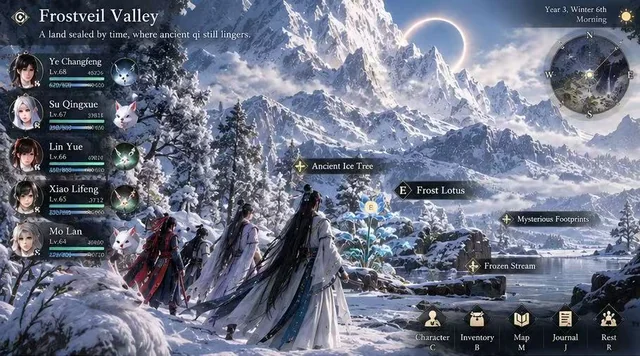
Game Designer Assistant treats your cultivation game as a set of interacting systems, not a pile of lore. You describe the fantasy, such as a frozen valley where ancient qi lingers, a sky realm of floating sect islands, or a mortal's climb toward immortality. It then breaks that fantasy into progression curves, resource loops, faction logic, and art direction you can actually build.
The key difference is that it reasons about consequences. It considers what happens to your economy when a new pill doubles breakthrough odds, or how a lifespan limit changes player motivation in the late game.
| Traditional Approach | Game Designer Assistant |
|---|---|
| Realm stats built by hand in spreadsheets, tested only after implementation | Progression curves proposed, explained, and stress-tested in conversation |
| Lore, sect rosters, and terminology spread across wikis and docs | One consistent world bible that grows with the project |
| Concept art waits on artist availability for early exploration | Concept art and visual direction generated during brainstorming |
| Market positioning guessed from competitor screenshots | Genre and regional market analysis built into design discussions |
| Balance problems found by players after launch | Exploits and inflation risks flagged at the design stage |
Realm Progression and Breakthrough Systems
The core of every cultivation game is the realm ladder. The assistant helps you define each realm's stat multipliers, breakthrough requirements, failure penalties, and pacing targets. It explains the tradeoffs: a steep wall at Foundation Establishment creates a memorable milestone but also a churn risk.
"Design a 9-realm cultivation ladder for a 60-hour RPG. Each realm needs 3 sub-stages, a breakthrough failure mechanic, and a lifespan cost that pressures players without punishing exploration."
Spirit Stone Economies That Survive Inflation
Idle and incremental cultivation games face a unique economy problem. In the sky-realm map below, the player holds Spirit Stones, a number with over 1,500 digits. At that scale, linear pricing is meaningless. You need logarithmic costs, prestige resets, or realm-gated currencies.
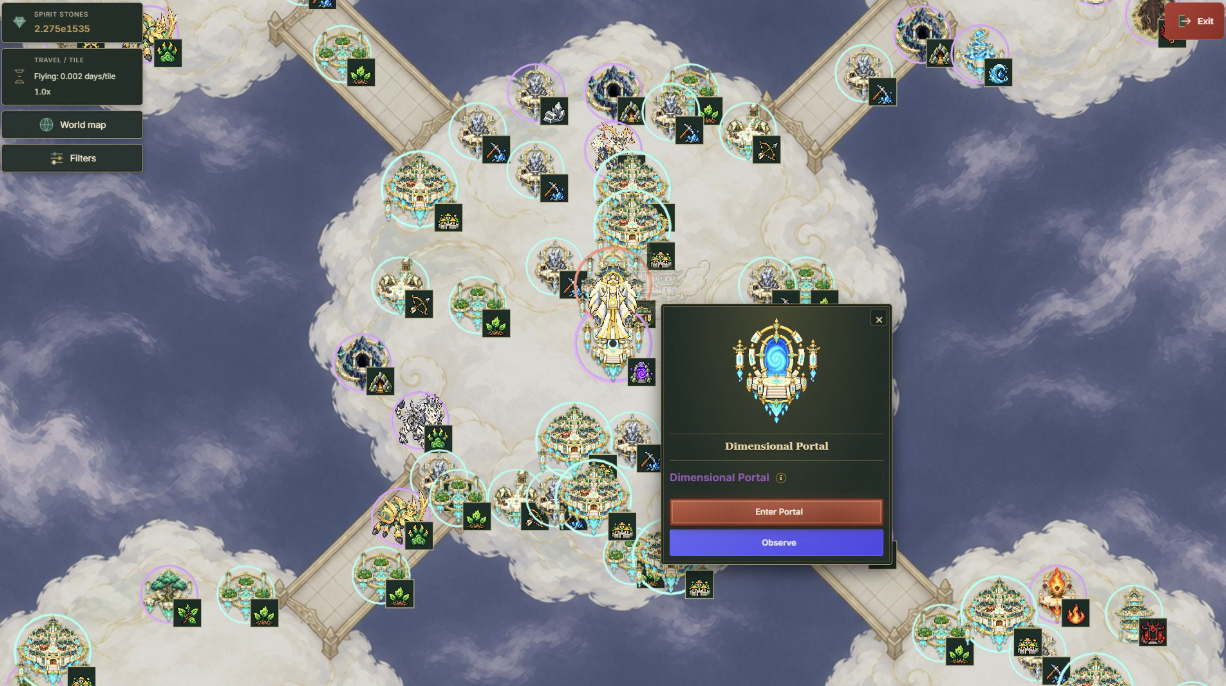
The assistant maps every source and sink, models how they scale across realms, and identifies where players will hoard, exploit, or stall.
"My idle cultivation game uses spirit stones for pills, formations, and portal travel. Players hit 1e300 by day five and nothing feels meaningful. Propose a prestige or currency-tier system that restores spending decisions."
Sects, Factions, and Living Worlds
Cultivation worlds run on politics: righteous sects, demonic cults, merchant clans, and hidden elders. The assistant designs faction relationships, reputation thresholds, and event triggers so the world reacts to player choices.
If you're building an AI-native game, it can also help define which world states must stay fixed and authored and which can be generated at runtime. That split addresses the memory and consistency problems the research highlights.
Concept Art and Visual Direction
Visual identity matters in a genre full of similar white robes and misty peaks. Morphic's game art pipeline guide recommends starting AI integration with the highest-effort, most repetitive stages, such as concept iteration and texture generation. It also advises setting quality standards before AI output moves downstream. The assistant generates concept art during brainstorming, so art direction develops alongside the systems instead of after them.
Documentation and Market Positioning
The assistant also turns your design decisions into documentation and positions the game for its audience:
- Documentation: GDDs, system specs, and feature briefs your team can work from
- Market analysis: Cultivation players in different markets expect different things, from the long-form web-novel pacing of Chinese xianxia to the shorter sessions common in Western idle games.
Related Agents You'll Also Find Useful
Cultivation games need more than systems design. These agents cover the next steps in your production workflow.
Writing Assistant
If you're also writing quest text, sect histories, or a protagonist's origin story, Writing Assistant adapts to your voice and the genre's conventions.
- Drafts lore entries, dialogue, and item descriptions in a consistent tone
- Gives editorial feedback on pacing and character arcs
- Matches existing writing samples so new content blends in
Prompt Generator
AI art pipelines live or die on prompt consistency. Prompt Generator writes high-quality prompts for image, video, and music models so your Frostveil Valley and your sky realm look like they belong to the same game.
- Builds reusable style prompts for characters, environments, and UI
- Supports iterative refinement when outputs drift off-model
- Covers music and ambient audio prompts for realm themes
C++ Coding Assistant
Once your design is locked, someone has to implement it. C++ Coding Assistant is fluent in modern C++, including templates, RAII, and C++17/20/23, which is relevant if your cultivation game runs on a C++ engine.
- Implements progression formulas and big-number economy math
- Reviews performance-critical simulation code
- Debugs save systems that track long-term world state
Try it free — no credit card required.
How to Design an AI Cultivation Game Step by Step
Step 1: Define Your Core Fantasy and Constraints
Open Game Designer Assistant and describe the game you want to make, including platform, session length, and target audience. Constraints like "mobile idle" versus "PC narrative RPG" change every downstream decision.
"I'm building a mobile idle cultivation game with 5-minute sessions and a 6-month live-ops plan. The fantasy is rebuilding a fallen sect in a sky realm. What core loop fits?"
Step 2: Build the Realm Ladder and Breakthrough Rules
Ask for a full realm progression with stat scaling, breakthrough costs, and failure states. Push back on anything that feels flat; the assistant explains its reasoning and revises.
"Show me breakthrough success rates for each sub-stage of Core Formation, and explain how pills and formations should modify them without trivializing the wall."
Step 3: Stress-Test the Economy and Loops
Describe every resource source and sink, then ask the assistant to find inflation points, dominant strategies, and dead currencies. This is where most cultivation games fail, and where catching problems early saves the most rework.
"Here are my 6 resources and 14 sinks. Simulate a highly engaged player's first 30 days and flag where the economy breaks."
Step 4: Visualize and Document
Generate concept art for key regions and characters, then turn your decisions into a GDD your team can build from.
"Create concept art for a frozen valley region where ancient qi lingers, then write the region's design brief: enemies, resources, and its realm gate."
Results & Use Cases
📊 Rebalancing an Idle Cultivation Economy
Scenario: A solo developer's idle cultivation game sees players reach late-game currency totals within a week, and retention drops sharply.
Traditional Approach: Days of spreadsheet iteration, patch-and-pray updates, and community backlash with each nerf.
Game Designer Assistant: It maps every spirit stone source and sink, identifies the compounding multiplier causing the runaway, and proposes a realm-tiered currency with a prestige reset.
- Root cause found before writing any code
- Migration plan for existing player balances
- Pacing targets tied to each realm
🏯 Building a Sect War System for a Narrative RPG
Scenario: A small studio wants rival sects that remember player betrayals across a 40-hour campaign.
Traditional Approach: Hand-authored branching flags that become unmanageable after a few dozen choices.
Game Designer Assistant: It designs a reputation model with authored anchor events and generated flavor. That way the AI never improvises facts the world depends on.
- Clear split between fixed world state and runtime generation
- Faction relationships documented in a single spec
- Lore entries handed off to Writing Assistant for final prose
📱 Designing Tribulation Events on Mobile
Scenario: A designer on a long commute wants to sketch the heavenly tribulation sequence for the Nascent Soul breakthrough.
Traditional Approach: Notes scattered across a phone app, rewritten at a desk later.
Game Designer Assistant: The designer dictates the idea by voice on mobile and gets a structured event breakdown with phases, lightning patterns, and failure consequences. The full context is waiting on desktop later.
- Ideas captured as usable specs, not loose notes
- Seamless handoff between phone and desktop
- Concept art generated on the spot for reference
🎨 Locking a Consistent Art Style
Scenario: An art lead using AI in a cultivation RPG pipeline struggles with regions that look like different games.
Traditional Approach: Repeated prompt guesswork and manual paintovers for every off-model output.
Game Designer Assistant: It defines the visual pillars for each realm, and Prompt Generator turns them into reusable style prompts.
- One visual language across snowfields, sky islands, and sect halls
- Quality standards set before assets go downstream
- Fewer paintover passes per asset
Frequently Asked Questions
What is an AI cultivation game?
An AI cultivation game is a xianxia or wuxia title where artificial intelligence plays a meaningful role. Either the AI generates worlds, NPCs, or events during play, or AI tools helped design its progression, economy, and art. Examples range from AI-driven text RPGs that create a new world each run to idle games built with AI-assisted art pipelines. The core loop of cultivating, breaking through realms, and gaining power stays the same.
Is Game Designer Assistant free to use?
Yes. Game Designer Assistant has a free tier with all core features and limited usage, which is enough to design a realm ladder or test an economy idea. Paid plans start at $20 per month for 30× the free usage. Higher tiers suit studios running continuous design sessions. Usage resets monthly with no daily caps.
Can AI balance a cultivation progression system?
AI can reliably model progression curves, flag inflation, and find dominant strategies before implementation. That is where most cultivation games break. It can't replace real playtesting, because player behavior always surprises designers. The most effective workflow uses an AI cultivation game designer to catch structural problems early, then validates the tuned numbers with real players.
Do players accept AI in cultivation games?
Player opinion is divided. MIDiA Research found 60% of gamers are neutral if the game is good, while Quantic Foundry reports strongly negative sentiment. Research on player attitudes suggests acceptance depends on where AI is used. Being transparent about its role helps.
How is an AI-native cultivation game different from one made with AI tools?
An AI-native game needs generative AI during play: researchers define it as a game whose core loop would collapse without the AI component. A game made with AI tools uses AI during development, for example for art or balancing, but plays the same as a traditionally authored game. Both are valid; they face different design risks.
Does Game Designer Assistant work on mobile?
Yes. It works on web, iOS, and Android with full feature parity and speech-to-text, so you can dictate design ideas on the go. Your conversations and project context sync across devices, so a tribulation sketched on your phone is ready to expand on desktop.
Conclusion
Cultivation games promise endless ascension, but delivering that promise takes work. You need progression curves that hold up across nine realms, economies that survive numbers with 1,500 digits, and worlds that remember what players did. Generative AI is already part of most studios' workflows. What separates a coherent AI cultivation game from a pile of generated content is disciplined system design.
Game Designer Assistant brings that discipline into one workspace. You get realm ladders, spirit stone economies, sect politics, concept art, and documentation, all built around your vision instead of a template. Whether you're making an idle sky-realm game, a narrative xianxia RPG, or an AI-native cultivation simulator, it helps you design smarter and catch problems before players do.
Try Game Designer Assistant now and start mapping your first realm. Explore more at Jenova.
For Developers: Game Designer Assistant is available programmatically via the Jenova API, so you can integrate AI-powered game systems design into your studio tools with a single API call. Full documentation →