AI C++ Coding Assistant: Templates, RAII & STL for Production
2026-08-27
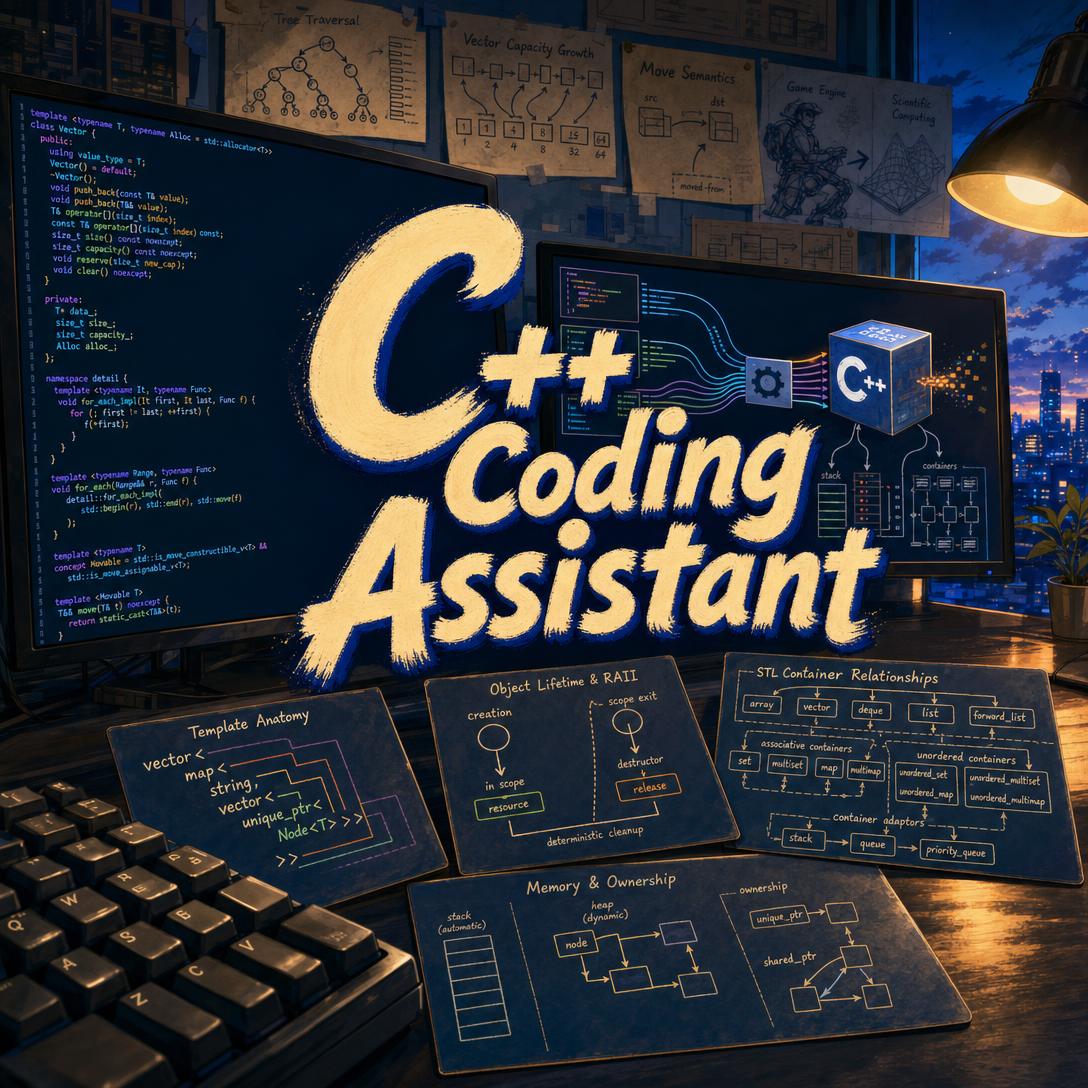
C++ Coding Assistant helps you ship modern, efficient C++ by writing production-grade code across templates, RAII, the STL, and C++17/20/23. While C++ rewards precision — and punishes lifetime bugs, undefined behavior, and outdated idioms — this AI provides standard-aware implementations, root-cause debugging, and build-system guidance you can drop into a real codebase.
✅ Writes idiomatic C++ with RAII, smart pointers, and const-correct APIs by default ✅ Diagnoses template errors, linker failures, and sanitizer reports at the root cause ✅ Tracks your standard, compiler, and dependencies so features match the toolchain you actually use ✅ Covers game engines, systems code, scientific computing, and CMake/vcpkg/Conan workflows
C++ is still the language behind engines, trading systems, embedded firmware, and high-performance numerics. The language also moves — concepts, ranges, coroutines, std::expected, and modules landed on uneven compiler timelines. To understand why a dedicated C++ partner matters, it helps to look at the constraints working developers face every week.
Quick Answer: What Is C++ Coding Assistant?
C++ Coding Assistant is an expert C++ development partner that writes modern, production-grade code across templates, RAII, STL, and C++17/20/23. It adapts to your standard, compiler, and project instead of dumping generic snippets.
Key capabilities:
- Modern language fluency from C++11 through C++23, including move semantics, concepts, ranges, and coroutines
- Resource-safe defaults: RAII,
unique_ptr/shared_ptr, no barenew/deletein application code - STL and Ranges-first design, plus concurrency primitives (
jthread, atomics, futures, latches) - Compiler-error tracing, sanitizer interpretation, CMake/vcpkg/Conan updates, and Google Test coverage
Why Modern C++ Still Slows Teams Down
C++ remains a first-choice language for performance-critical software, and many practitioners are deeply experienced. A 2024 Modern C++ DevOps survey found that 52% of respondents had 6–20 years of C++ experience, and 67% also used C++ for personal projects. Experience does not erase the cost of the language’s sharp edges.
But getting correct, portable, modern C++ into production is still frustratingly difficult:
- Memory-safety defects dominate real-world vulnerability data
- Compiler support for C++20/23 features is uneven across GCC, Clang, and MSVC
- Template diagnostics, ODR issues, and ABI breaks consume hours that never show up as “writing code”
- Dependency and build-system fragmentation (CMake + vcpkg or Conan, plus platform SDKs) creates a second project beside the actual product
~70% — of the CVEs Microsoft assigns each year continue to be memory safety issues
~70% — of Chromium’s serious security bugs are memory safety problems
CISA has been explicit: memory-unsafe code is not a theoretical concern. In its secure-by-design guidance, the agency notes that mitigations such as ASLR, sandboxing, and developer training have not removed the class of bug. Follow-on CISA material states that two-thirds of reported vulnerabilities in memory-unsafe languages still fall in this category. In June 2025, CISA and NSA restated that memory vulnerabilities pose serious risks to critical infrastructure.
That pressure shows up in day-to-day C++ work as dangling references, iterator invalidation, data races, and shared_ptr graphs that were never meant to be shared. Modern C++ — RAII, the Rule of Zero, string_view, span, and unique_ptr — reduces the surface area, but only if the code you merge actually uses those tools.
Standards churn is the other tax. C++23 compiler support is real, but not uniform: std::expected appears in GCC 12, Clang 16, and MSVC 19.33, while std::print needs GCC 14 and only partial libc++ support in Clang 17. Industry compiler roundups still describe C++23 as an evolving target on MSVC even as GCC 15 ships. Copy a “modern” snippet that assumes std::format or modules, and you can spend an afternoon proving your toolchain never had the feature.
Build and packaging remain a parallel skill set. Surveys and engineering write-ups through 2024 still treat vcpkg and Conan as the practical project-level package managers, not a solved problem. The 2025 ISO C++ developer survey was forwarded to the standards committee and vendors specifically to inform language evolution and tooling — a reminder that working C++ includes CMake presets, ABI pins, and sanitizer flags, not just syntax.
This is exactly what a specialized C++ partner was built for.
Why C++ Coding Assistant
C++ Coding Assistant is a standalone C++ development partner: it writes the function you asked for, traces the instantiation that actually failed, and keeps the result aligned with the standard and libraries you named. General-purpose chat models often emit C++11-shaped code with a C++20 comment on top, or regenerate an entire translation unit when you needed eight lines. This assistant defaults to the fixed section, RAII throughout, and a stated assumption when your standard is unspecified.
| Traditional Approach | C++ Coding Assistant |
|---|---|
| Snippets that compile on one compiler and warn on another | Code matched to your stated standard (C++17/20/23) and toolchain |
Manual new/delete, lock/unlock pairs, leaked handles | RAII types, unique_ptr by default, mutexes tied to lock guards |
| Page-long template errors treated as the bug | Instantiation-chain and overload-resolution tracing to the root cause |
Guessing whether std::expected or modules are available | Version-aware guidance; flags C++20+ features when your baseline is C++17 |
Rewriting the whole .cpp file for a one-function fix | Copy-paste-ready section with enough context to drop in place |
| Tests as an afterthought | Google Test (or Catch2) with fixtures, edge cases, and CTest hooks on request |
Standard-aware, not slogan-aware
Ask for C++17, and you get structured bindings, string_view, and optional — not concepts or std::print. Ask for C++20, and concepts replace SFINAE, ranges replace iterator soup, and std::span replaces pointer-plus-length pairs. If a feature is missing on your compiler, the assistant says so instead of handing you a diagnostic you cannot clear.
RAII, ownership, and no undefined behavior by default
Public APIs come out const-correct. Heap allocation uses unique_ptr unless shared ownership is real. Destructors stay noexcept. The assistant flags classic failure modes: moving from const, object slicing on polymorphic values, [&] captures that outlive the stack, and iterator invalidation after vector reallocation.
Templates, errors, and the build graph
When a constraint fails three headers deep, you get the corrected function and a short explanation of why the candidate was dropped — not a regenerated project. New libraries come with a note to update CMakeLists.txt, vcpkg.json, or conanfile.txt. That is the difference between a demo and something you can merge.
Example requests look like this:
"Refactor
TextureCache::loadto RAII withstd::unique_ptr, C++20, GCC 14, no exceptions in the hot path."
"Clang 18 fails this concept-constrained
ziphelper — fix only the function and explain the deduction failure."
"Add a CMake + vcpkg skeleton for a header-only library with Google Test and
-fsanitize=address,undefined."
If you also maintain C APIs, POSIX shims, or firmware that must stay in C99/C11, C Coding Assistant is the better fit for those translation units, while this C++ partner stays on the modern C++ side of the FFI boundary.
How It Works
Step 1: State the task and the constraints Name the standard, compiler, and what “done” means — a function fix, a new class, a sanitizer clean-up, or a CMake target. The more precise the baseline, the less you rewind later.
"C++20, Clang 18, libstdc++. Replace the raw loop in
normalize_sampleswithstd::rangesand keep the public ABI."
Step 2: Paste the failing unit, not the whole repo Drop the function, the error, or the sanitizer stack. This C++ development partner returns the modified section with the signature, class name, and includes you need to locate it — not a rewritten file you have to diff by hand.
"ASan reports heap-use-after-free in
Session::flush. Here is the class. Fix ownership; do not change the wire format."
Step 3: Review ownership, lifetime, and the hot path
Check smart-pointer choices, const, and whether a copy became a move. Ask why when the trade-off matters (small-string SSO vs. string_view, shared_ptr vs. a single owner, exceptions vs. std::expected on C++23).
Step 4: Lock tests and the build
Request Google Test cases for the happy path, empty inputs, and error paths, plus the add_test() / gtest_discover_tests() snippet. If a dependency was introduced, expect the CMake or vcpkg note in the same turn.
"Generate TEST_F fixtures for
ConfigParserincluding missing keys and duplicate sections; target gtest and CTest."
Step 5: Keep going in the same project context Subsequent messages remember the standard, libraries, and files you already established. Iterate on the renderer, the thread pool, or the Eigen wrapper without restating the stack every time.
Try it free — no credit card required.
Results & Use Cases
🎮 Custom engine module with RAII and STL
-
Scenario: You are adding a resource cache to a custom engine (or an Unreal module) that currently
news GPU buffers and forgets them on early-out paths. -
Traditional Approach: Trace every return, audit mutex unlocks, and hope a leak sanitizer run on Friday catches what code review missed.
-
C++ Coding Assistant: You get a cache typed around
unique_ptrcustom deleters, lock_guard-based maps, andstring_viewlookup keys — plus a note if your engine still compiles as C++17. -
Deterministic cleanup on exceptions and early returns
-
No shared ownership unless two systems truly co-own a resource
-
Algorithms/
emplaceinstead of hand-rolled loops that invalidate iterators
🧪 Numerical kernel with Eigen and a Python binding plan
-
Scenario: A research team needs a C++20 SIMD-friendly reduction, with a later pybind11 surface so notebooks can call it.
-
Traditional Approach: Prototype in a notebook, rewrite in C++, then discover alignment and lifetime bugs at the language boundary.
-
This assistant: Implements the kernel with
std::span, const-correct Eigen maps, and a clear ownership comment at the FFI edge. -
Hot-path code stays allocation-aware
-
Public headers stay minimal and constexpr-friendly where it helps
-
If you also need the Python wrapper scripts or packaging, Python Coding Assistant can take the binding and test harness while the C++ kernel stays in this thread
📱 Fix a template / linker error from your phone
-
Scenario: CI failed on
undefined reference/ a three-page Clang concept diagnostic while you are away from the workstation. You have the log and the function on mobile. -
Traditional Approach: Wait until you are back at the desktop, or paste 800 lines into a generic chatbot and receive a full-file rewrite you cannot apply from a phone.
-
The C++ partner: Returns the corrected function and the missing
inline/explicit-instantiation/target_link_librariesline, readable on iOS or Android with the same workspace you use on the desktop. -
Section-sized patches, not whole-repo dumps
-
Distinguishes compiler errors from linker and ODR failures
-
Works with full feature parity on web, iOS, and Android, including speech-to-text for dictating the next prompt on the move
Teams under memory-safe roadmap pressure sometimes split a codebase: keep proven C++ modules, write new isolation boundaries in a memory-safe language. If that is your plan, Rust Coding Assistant can own the Rust side (ownership, lifetimes, FFI) while this assistant keeps the C++ core on RAII and sanitizers rather than pretending C++ is memory-safe by default.
FAQ
Is C++ Coding Assistant free?
Yes. C++ Coding Assistant is available on a free tier with all core features and limited monthly usage. Paid plans start at $20/month (Plus) and scale through Premium, Pro, Max, Ultra, and Enterprise if you need more usage, custom model selection, or priority support. Usage resets on your billing date with no daily caps, so a heavy refactor week is not throttled mid-afternoon.
How is this different from a general AI chatbot or autocomplete?
General models often emit “C++-shaped” code: new/delete, C arrays, std::endl in tight loops, or C++23 APIs on a C++17 codebase. This assistant is scoped to C++ — templates, value categories, ABI, CMake, vcpkg/Conan, Unreal/Qt/Boost/Asio patterns — and defaults to the patched function rather than a rewritten file. It will flag undefined behavior instead of preserving a snippet that “works on my machine.”
Can C++ Coding Assistant use C++20 and C++23 features?
Yes, when they match your stated toolchain. Concepts, ranges, coroutines, std::format, std::span, and std::jthread are in scope for C++20; std::expected, std::print, std::mdspan, and deducing this are in scope for C++23. Because vendor support is still incomplete for some library pieces, you should name compiler and standard up front. If you do not, the assistant asks or states a conservative default before using C++20+ syntax.
Does C++ Coding Assistant work on mobile?
Yes. The same agent runs on web, iOS, and Android with synced settings and unlimited chat history. That is why the mobile CI-log scenario works: you can paste a diagnostic, get a drop-in function, and apply it later at the desktop without losing project context.
Will the code actually compile and stay production-grade?
The assistant targets clean compiles under reasonable warnings (-Wall -Wextra -Wpedantic or /W4), RAII resource management, const correctness, and no introduced UB. It cannot run your compiler from here, so you still build and run ASan/TSan/UBSan locally. Treat output as senior-engineer draft code: merge after your normal review, especially for concurrency and public headers.
Can it debug template errors, sanitizers, and CMake issues?
Yes. Paste the diagnostic. The assistant separates the noisy instantiation note from the constraint or deduction that failed, and returns only the corrected region. The same applies to ASan/TSan reports, missing target_link_libraries entries, and version conflicts (for example, a library that requires C++20 while your target is C++17).
Conclusion
C++ still delivers the performance and control that engines, systems software, and scientific codes require. It also concentrates risk in lifetimes, undefined behavior, and a standard library that outruns some toolchains. Memory-safety data from CISA and uneven C++23 support are not reasons to abandon the language — they are reasons to write modern C++ on purpose.
C++ Coding Assistant is the partner for that work: templates and concepts when you need them, RAII and STL when you should have been using them already, and section-sized fixes you can apply from a desktop or a phone. Try C++ Coding Assistant now. Explore more at Jenova.
For Developers: C++ Coding Assistant is available programmatically via the Jenova API — integrate modern C++ code generation, diagnostics, and standard-aware refactoring into your application with a single API call. Full documentation →