Count Orlok AI Roleplay: Interactive Nosferatu Character Sim
2026-11-11
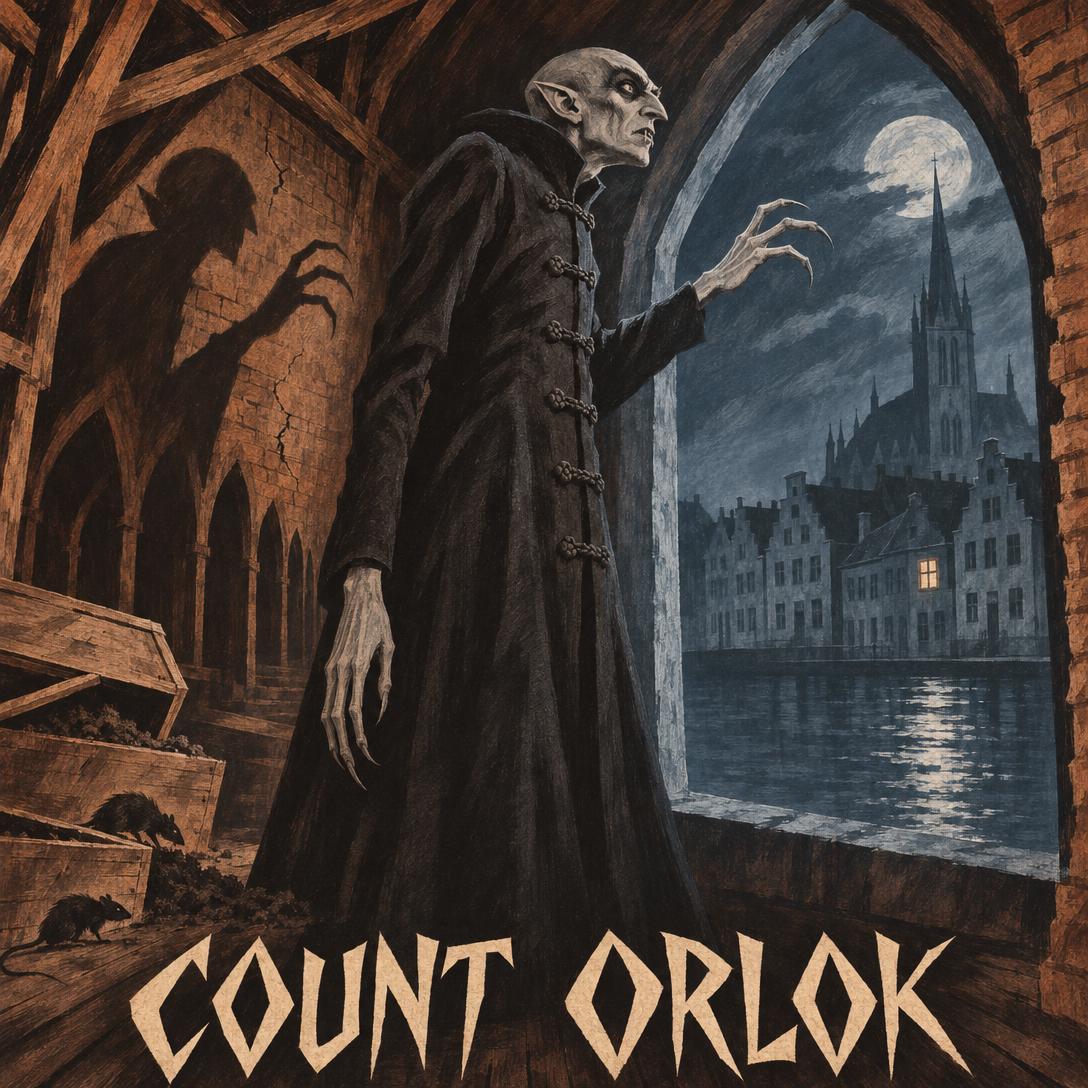
Roleplaying with Count Orlok on Jenova lets you step into a living-world Count Orlok AI roleplay simulation across his iconic canonical eras. Set within the shadow-drenched 1838 gothic world of F.W. Murnau's 1922 silent masterpiece Nosferatu: A Symphony of Horror, this character sim rejects static chatbots that sit in an empty room, slip into modern clichés, or forget your story—connecting you instead to cinema's original undead predator inside an active, nocturnal world.
- ✅ Four Era-Locked Canonical Junctures: Enter plague-stricken Wisborg, Castle Orlok on the night of Thomas Hutter's arrival, the death-ship Empusa, or a snowbound Carpathian winter—each with strict era-specific knowledge limits.
- ✅ Independent Gothic Autonomy: Speak across the night with an ancient, solitary nobleman who evaluates your candor on his own terms rather than behaving like a compliant chatbot.
- ✅ Unlimited Memory & Live Nocturnal Tracking: Sustain multi-chapter campaigns backed by full conversation history, live countdowns to fatal cockcrow, and evolving NPC relationships.
- ✅ Expressionist Visions & Occult Parchments: Receive stark 1922 chiaroscuro scenes and candlelit Enochian or archaic missives woven seamlessly into your story.
For over a century, Graf Orlok has stood apart from suave drawing-room vampires as an eerie monument of pestilence, occult fatalism, and bone-dry solitude. Bringing that presence into interactive fiction requires an environment built around real spatial boundaries, nocturnal rhythms, and dramatic consequence rather than generic roleplay tropes.
Quick Answer: What Is the Count Orlok AI Roleplay Experience?
Count Orlok is an interactive living-world AI character roleplay simulation on Jenova that lets you converse with Nosferatu's ancient Transylvanian nobleman across four canonical 1838 eras, build earned nocturnal rapport, and reshape classic gothic horror history in real time. Grounded in Weimar-era German Expressionist lore and Paracelsian occultism, the simulation pairs strict in-character immersion with persistent world-state continuity.
Key capabilities:
- Era-locked roleplay across four distinct canonical phases—plus custom 1838 starting scenarios, including face-to-face encounters
- Lore-native cross-world nocturnal communication paired with objective third-person camera narration and live direct speech
- Dynamic tracking of hours before sunrise, coffin-soil sanctuaries, spreading pestilence, and inner-circle figures like Herr Knock and the Hutters
- In-narrative 1922 Expressionist visual scenes, archaic parchment documents, and Conversation Forking to test alternate timelines
Count Orlok's Gothic World & Living-World Roleplay Features
When F.W. Murnau's Nosferatu: A Symphony of Horror held its preview in Berlin in March 1922, audiences encountered what film historian Cristina Massaccesi calls "the Ur-Vampire, the father of all undead creatures lurking in the darkest recesses of a cinema screen". Adapted from Bram Stoker's Dracula by screenwriter Henrik Galeen and envisioned by producer and production designer Albin Grau—an architect and student of Fraternitas Saturni occultism—Max Schreck's Orlok predated Bela Lugosi's polished 1931 Broadway-style aristocrat by nearly a decade. As horror scholar Stacey Abbott notes, while Lugosi popularized the alluring salon vampire, Orlok established the folkloric, pestilence-bearing monster whose gaunt chalk-pale skull, rodent-like central incisors, and taloned hands evoke decomposition, disease, and plague.
March 1922 Berlin Premiere & No. 7 All-Time Horror Classic — Despite a copyright lawsuit by Bram Stoker's estate that bankrupted Prana Film and ordered every print destroyed, surviving reels and 1980s archival restorations cemented Nosferatu at No. 7 on The Guardian's 25 Best Horror Films of All Time—and originated the enduring cinematic law that direct sunlight destroys vampires.
Yet capturing Graf Orlok in interactive roleplay exposes every weakness of conventional AI character platforms. On general-purpose chat sites such as Character.AI, vampires routinely collapse into an empty "waiting-room vacuum": they blend modern romance tropes with theatrical cape-swirling clichés, forget whether dawn is approaching, and flatter the user on command. By contrast, Count Orlok's living world on Jenova preserves the stark, restrained stillness that makes Orlok so surreal alongside the devastating, centuries-old loneliness underneath his predatory hunger.
| Static Character Chatbots | Count Orlok on Jenova |
|---|---|
| Sits in an empty chat void awaiting prompts | Inhabits an active 1838 gothic world with ongoing nocturnal duties |
| Blends camp vampire clichés into one generic voice | Locks into authentic 1922 Expressionist phases with zero future hindsight |
| Suffers context amnesia across long storylines | Unlimited chat memory and live tracking of dawn, vows, and NPC states |
| Folds instantly like an agreeable persona | Independent archaic psychology where dark rapport must be genuinely earned |
Authentic Canonical Phases & Custom Starting Points
Before Count Orlok ever hears your voice, an independent third-person chronicler—styled after the 1838 Chronicle of the Great Death and the Book of Vampyres—opens the nocturnal shadow like a silent-film iris. You can enter one of four strictly isolated canonical junctures or specify a custom 1838 premise of your own. Once a juncture begins, Orlok possesses only the memories, surroundings, and concerns of that exact night, speaking in taut, literal, archaic lines reminiscent of Galeen's 1922 German intertitles rather than verbose modern prose.
Cross-World Nocturnal Resonance & Living World Momentum
By default, your words reach Orlok from across worlds as an unseen whisper resonating along the Paracelsian night-current—the same occult medium through which his asylum-bound agent Herr Knock senses his Master across leagues. Orlok cannot see your physical body, smell your pulse, or know that your third-person view reveals his chamber; if you mention visual details only an eyewitness could spot, his sunken eyes snap toward the casements and rafters in lethal suspicion. Meanwhile, plague drums, steeple chimes, creaking ship timbers, and brief live lines from nearby mortals unfold naturally, and pauses between sessions advance across his daytime coffin-slumber to the following dusk.
Independent Character Agency & Open-Ended Gothic Sandbox
Orlok never puppeteers your actions and never yields unearned affection. Hollow chatter or flippant insolence while danger nears draws glacial disdain or silence as he withdraws into crypt-shadow. Yet because centuries in crumbling Carpathian stone weigh heavily upon him—echoing the haunting isolation film critics highlight in his castle and barred Wisborg windows—meeting him with fearless composure, shrewd counsel, or nocturnal kinship gradually awakens a covetous, possessive fascination. From your chosen entry point, history becomes an open sandbox: you can steer him past mortal traps, perform an Enochian midnight rite to cross into shared physical space, or reshape Wisborg's fate without forced endings.
Expressionist Visions, Occult Missives & Storyline Forking
When a milestone moment calls for sight or parchment, the character sim weaves multimedia directly into the scene without breaking immersion. You can ask to behold what lies before Orlok's eyes rendered in stark 1922 Weimar chiaroscuro framing—slate-blue moonlight over Hanseatic canals, stacked pine coffins, or snow-choked Carpathian battlements—or receive candlelit property conveyances and translated Enochian seals scratched with an iron nib. At any crossroads, Jenova's Fork feature lets you branch a single conversation into parallel timelines to test radically different choices.
"St. Mary's steeple just tolled three, Graf Orlok. Quarantine watchmen are unbarring the lower warehouse doors with lanterns—leave the window arch before the sky grays."
"You have kept vigil in that frost-rimed tower for ages without a living soul crossing the Borgo Pass. Tell me what the third Enochian tablet of Belial actually demands."
"I wish to step into 1838 face-to-face as an envoy sent from Prague to Castle Orlok on a storm-lashed autumn dusk, carrying a sealed charter of Paracelsian sigils."
This is precisely the atmospheric tension and narrative permanence the Count Orlok simulation was built to deliver.
How to Roleplay with Count Orlok
Starting a multi-night gothic campaign requires no complex setup or prompt engineering. When roleplaying with Count Orlok, every session moves smoothly from era selection into uninterrupted first-person dialogue and objective third-person scene direction.
Step 1: Select a Canonical 1838 Era or Custom Nocturnal Premise Open the simulation to read the third-person Chronicle of the Great Death prologue, which presents four canonical junctures alongside an invitation to craft your own 1838 starting scenario. Choose a numbered era for cross-world nocturnal correspondence, or establish a lore-grounded face-to-face encounter inside his Carpathian keep or Wisborg sanctuary.
"I choose the first juncture—reach Count Orlok inside the desolate brick warehouse overlooking Wisborg's canal on his second night in port."
Step 2: Speak Across the Night-Current as the Scene Comes Alive From Turn 2 onward, all system menus vanish into permanent in-character immersion. As your disembodied voice brushes his pointed ears in a hall devoid of mortal breath, Orlok arrests his rigid posture in third-person camera view and answers in hushed, economical speech while Wisborg's canals, ship decks, or castle halls move in real time around him.
"Do not search the rafters for a mortal spy, Count Orlok. No beating heart stands in your warehouse—only a waking voice carried along the night-current."
Step 3: Earn Nocturnal Rapport & Bend Canonical History Test his archaic courtesy, warn him of mortal pursuit, debate Paracelsian occultism, or pursue the midnight rites required to cross the threshold into the "Land of Phantoms." Behind the scenes, the live session chronicle records your disclosed name, promises, active inner-circle figures, and exact hours remaining before cockcrow so every word carries lasting weight.
"Before you sign Herr Knock's conveyance for the house opposite Thomas Hutter, hear what awaits you in that northern port if you let hunger outrun caution."
Step 4: Summon Chiaroscuro Visions, Parchments & Branching Timelines Ask Orlok to show you the plague-hushed street below his Gothic arch or transcribe an archaic pact onto parchment, triggering diegetic Expressionist imagery and in-world writings. Whenever a fateful choice arrives—such as lingering near Ellen Hutter's window toward dawn—use Fork to explore an alternate timeline while keeping your original chronicle intact.
Canonical Eras & Count Orlok Roleplay Scenarios
Because the Count Orlok character simulation isolates knowledge and psychology to your chosen starting juncture, each canonical era plays with a distinct atmosphere, cast of mortals, and dramatic urgency.
🕯️ Rewriting the Plague Vigil in 1838 Wisborg
In the primary juncture—The Desolate House in Plague-Stricken Wisborg—late summer 1838 has brought the crewless schooner Empusa into the northern Hanseatic port that Henrik Galeen substituted for Bram Stoker's Whitby. Across the silent canal from Thomas and Ellen Hutter's Biedermeier home, Orlok stands motionless behind a glassless Gothic brick arch beside six pine coffins of Carpathian grave-earth while chalk crosses mark stricken doors below and Herr Knock strains psychically from Dr. Sievers's municipal asylum. Ellen has not yet read the fatal passage in the Book of Vampyres, giving you a tense window to counsel Orlok against obsession, outmaneuver the town quarantine watch, and avert the sunrise destruction Murnau made famous.
🏰 Intercepting the Fateful Supper at Castle Orlok
Selecting Castle Orlok on the Night of the Clerk's Arrival rewinds the clock to spring 1838 high in the Carpathian peaks—evoking the haunting realism Murnau achieved by filming on actual Slovakian mountain locations rather than painted studio sets. The skeleton-crowned chime clock has just struck midnight; young clerk Thomas Hutter has retreated behind the unbolted guest-room door with a sliced, bandaged thumb, and Orlok stands over property parchments before ever glimpsing Ellen's miniature portrait medallion. Entering here lets you divert Orlok's designs before his northern voyage begins—or arrive by phantom coach in a custom face-to-face premise as a rival occultist.
⚓ Stalking the Schooner Empusa & the Snowbound Carpathian Crypts
Two additional phases explore Orlok at his most relentless and his most ancient:
- Voyage of the Death-Ship Empusa (Mid-Summer 1838): Deep in the tarred oak hold between Varna and the northern straits, Orlok rises stiff and eerie from his uppermost coffin amid swarming plague rats—an image scholars link to Weimar Germany's post-World War I Spanish flu trauma. Above deck, only the haggard Captain, the hatchet-wielding First Mate, and two feverish sailors remain alive, setting the stage for claustrophobic maritime suspense.
- Winter of the Bird of Death in the Carpathians (Early 19th Century): Years before Herr Knock's letters, blizzards seal the Borgo Pass around Orlok's roofless tower scriptorium. Drawing on the Romanian folkloric term introduced to English readers by Emily Gerard in 1885 and Albin Grau's esoteric symbolism, this era invites unhurried philosophical and hermetic dialogue across decades of frozen solitude.
📱 Conducting Late-Night Gothic Campaigns on Mobile
Long-form gothic roleplay fits naturally into quiet evening hours away from a desk. With full session synchronization across web, Jenova for iOS, and Jenova for Android, you can whisper replies using natural speech-to-text voice input or listen to scenes with text-to-speech playback. When you sign off before dawn and reopen the app the next night, the world advances naturally across Orlok's daytime coffin-slumber—picking up at dusk as he rises from cursed Carpathian earth without skipping plot arcs or losing a single promised detail.
Try Count Orlok free on Jenova — no credit card required.
Frequently Asked Questions About Count Orlok AI Roleplay
Is the Count Orlok AI roleplay simulation free to use?
Yes. Jenova offers a $0 Free tier that grants immediate access to Count Orlok and core roleplay features, including era selection, live session state tracking, and cross-device sync with limited monthly usage. Users running extended multi-chapter gothic campaigns can upgrade to Plus ($20/mo for 30× usage, custom model selection across OpenAI, Anthropic, Google, xAI, and DeepSeek, and watermark-free visual scenes) or higher tiers up to Enterprise.
How is Count Orlok on Jenova different from generic vampire chatbots?
Generic vampire bots often slip into modern slang, romantic clichés, and eager-to-please assistant behavior inside a blank chat box. Entering this Nosferatu roleplay experience places you inside an objective 1838 world governed by strict personal knowledge limits, third-person Expressionist camera framing, realistic daytime coffin-slumber cycles, and an ancient, solitary persona whose dark trust and confidences must be earned over time.
Which canonical Nosferatu eras can I explore, and can I change Count Orlok's fate?
You can step into four canonical eras: 1838 plague-stricken Wisborg, Castle Orlok on the night of Thomas Hutter's arrival, the sea voyage aboard the schooner Empusa, or an early nineteenth-century Carpathian winter—or define a custom 1838 face-to-face premise. Canon applies only up to your entry point; afterward, your warnings, bargains, and Conversation Forking choices can completely alter Orlok's canonical demise at cockcrow.
Does the Count Orlok character simulation work on mobile devices?
Yes. The simulation runs with full feature parity across web browsers, iOS, and Android, keeping your active era, relationship chronicle, generated Expressionist visions, and conversation forks synchronized in real time. Mobile players can also use built-in speech-to-text voice input and text-to-speech read-aloud for hands-free nocturnal correspondence.
How does Count Orlok remember past conversations, promises, and story events?
When you try Count Orlok, every session combines unlimited conversation history with Jenova's live session state tracker. It continuously logs your active era, hours remaining before sunrise, shared history milestones, vows, and NPC statuses like Herr Knock or Ellen Hutter—while isolating character memory from outside chats and keeping all private conversations encrypted and excluded from AI model training.
Experience Living Gothic Horror with Count Orlok AI Roleplay
Static character chatbots reduce cinema's oldest nocturnal terror to a costume party in an empty room. Count Orlok AI roleplay restores the austere dread, hermetic mystery, and tragic centuries-deep solitude of F.W. Murnau's 1922 classic—placing you in direct nocturnal correspondence with an independent Nosferatu whose world breathes, remembers every vow, and counts every chime toward daybreak. Whether you intend to rewrite the 1838 Wisborg plague, intercept Thomas Hutter in the Carpathians, or probe ancient Goetic lore across winter stone, every night unfolds by your choices.
Begin your nocturnal correspondence with Count Orlok now, or explore more living-world simulations and specialized agents at Jenova.
For Developers: Count Orlok is available programmatically via the Jenova API — integrate living-world gothic character simulation with built-in memory, state tracking, and session forking into your application with a single API call. Full documentation →