AI Conversation Starter: Openers That Actually Get Replies
2026-08-12
The Dating App Advisor works as your AI conversation starter — reading a profile, a bio, or a room, then generating openers built for that specific person instead of recycled one-liners. Starting a conversation is where most connections die, whether it's a match you never messaged or a networking event where you stood near the snacks. This AI removes the blank-page problem and gives you something worth sending.
✅ Personalized openers — built from actual profile details, not template lists ✅ Multiple tones on demand — playful, curious, direct, or warm ✅ Honest feedback — it tells you when your opener is lazy ✅ Works anywhere — dating apps, DMs, networking, group settings
To understand why AI conversation starters became genuinely useful rather than gimmicky, it helps to look at what actually happens to the average first message — and why so few of them ever get a reply.

Quick Answer: What Is an AI Conversation Starter?
An AI conversation starter is a tool that generates personalized opening messages or questions based on context — a dating profile, a bio, a shared interest, or a social setting — so you begin conversations that invite a real response instead of silence.
Key capabilities:
- Profile-based openers — reads specific details and builds a message only that person would receive
- Tone selection — generates the same opener in playful, sincere, witty, or direct registers
- Context adaptation — dating apps, professional networking, group settings, or reconnecting with someone
- Follow-up planning — anticipates likely replies so the second message isn't a dead end
The difference from a listicle of "100 conversation starters" is specificity. Generic questions signal zero effort, and effort is the entire signal being evaluated.
The Problem: Most First Messages Are Never Answered
Opening a conversation is a high-friction, low-feedback task. You get one attempt, you have seconds of attention, and when it fails you receive no explanation — just nothing. That combination makes it nearly impossible to improve through trial and error.
The volume problem makes it worse, and it hits people asymmetrically:
54% of women who recently used dating apps say they felt overwhelmed by the number of messages they received — Pew Research Center
64% of men report feeling insecure because of the lack of messages they received — Pew Research Center
39% of U.S. adults have used an online dating site or app, rising to 65% among adults aged 18–29 — SSRS Opinion Panel
But writing an opener that actually earns a reply is harder than it looks:
- The blank page freezes people. You reread the profile four times and still type "hey."
- Generic openers are instantly recognizable. Anything that could be copy-pasted to a hundred people reads as exactly that.
- No feedback loop exists. Silence doesn't tell you whether you were boring, too forward, or simply late.
- Interview mode kills momentum. A string of questions feels like a form, not a conversation.
- The stakes distort your judgment. The more you want the reply, the safer and blander your message becomes.
The Blank Page Problem
The hardest part of starting a conversation is rarely wit — it's the initial retrieval. Staring at an empty message box, most people default to the lowest-risk option available, which is also the most ignorable one. The result is a stream of interchangeable greetings that carry no information about who sent them.
An AI conversation starter solves this at the exact bottleneck: it gives you three viable directions in seconds, and picking beats generating when you're under pressure.
The Personalization Problem
Dating advice consistently converges on the same instruction: read their profile carefully, ask open-ended questions, and be playful rather than transactional. This is correct and nearly useless as advice, because knowing that you should personalize doesn't tell you how to turn "she's a pastry chef who hikes" into a message that lands.
Personalization is a writing problem, not an awareness problem. That's precisely the kind of task AI handles well.
The Matching Problem
Openers don't fail in a vacuum — they fail against a specific person's priorities. SSRS research found that among online daters, 57% cite shared family values as very important in matching with someone, followed by political beliefs (33%), religious or spiritual beliefs (31%), and hobbies and interests (30%). Age shifts this sharply: 48% of users aged 18–29 say being around the same age is very important, compared with just 15% of those 30 and older.
An opener that ignores what the other person actually cares about is a well-written message aimed at nobody.
The Fatigue Problem
Swipe fatigue has become significant enough to reshape the industry. As Axios reported, established apps and startups alike are deploying AI-assisted conversation starters and in-app assistants specifically "to overcome the swipe fatigue that's forced the online dating industry to innovate." Bumble has teased an AI assistant called Bee; new matchmaking services have removed swiping and profiles entirely.
The industry response confirms the diagnosis: the problem was never finding people. It was starting conversations with them.
This is exactly what the Dating App Advisor was built for.
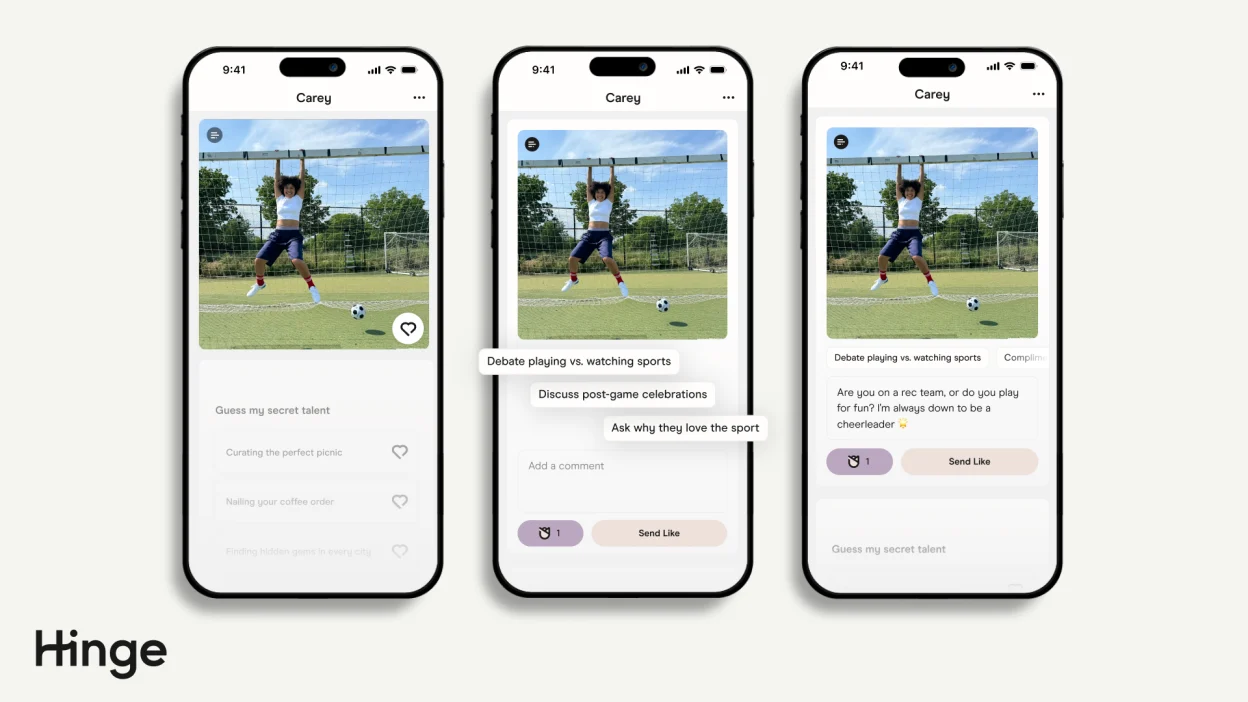
Why the Dating App Advisor Works as an AI Conversation Starter
The Dating App Advisor is built for profile optimization, conversation mastery, and first-date guidance, with honest feedback rather than flattery. As a conversation starter, it does something a template list structurally cannot: it reads the actual context and writes for one person.
| Traditional Approach | Dating App Advisor |
|---|---|
| Scroll a list of 100 generic openers | Openers written from the specific profile in front of you |
| Send "hey" and hope | Three tonal variations you can choose between in seconds |
| No idea why the message failed | Honest diagnosis of what read as low-effort or off-key |
| One opener, no plan for the reply | Second and third message mapped before you send |
| Same approach on every platform and context | Adapted to dating apps, networking, or in-person settings |
Openers Built From Real Details
Screenshot a profile and the advisor works from what's actually there — the prompt answer, the odd photo caption, the niche hobby. The output is a message that could only have been written after reading that profile, which is the single strongest signal you can send in a first message.
"Here's her profile. She's a pastry chef who hikes and says she hates small talk. Give me three openers — one playful, one curious, one slightly cocky."
Tone Calibration
The same idea lands completely differently depending on register. The advisor generates variations so you can pick the one that sounds like you, which matters enormously — an opener that doesn't match your natural voice collapses the moment you actually meet.
"That second one is funnier than how I actually talk. Rewrite it drier and shorter."
Beyond the First Message
Most opener advice stops at the opener, which is why so many conversations die on message three. The advisor plans the follow-up: what to do if she replies with one word, how to move from banter to a real thread, and when to stop chatting and propose meeting.
"She replied 'haha yeah.' Is this recoverable, and what do I send?"
Honest Assessment
The advisor will tell you when your draft is boring, when you're over-investing relative to the other person's energy, and when a match was never engaged to begin with. Flattery would defeat the purpose — improvement requires accurate diagnosis, including the uncomfortable parts.
Related Agents You'll Also Find Useful
Conversation starters are one link in a longer chain. These agents cover what comes before and after.
Date Planner
Once the opener works and the conversation moves, you need somewhere to go. The Date Planner builds intent-driven date plans using venue psychology and local research, so you're not defaulting to the same crowded bar.
- Intent-matched venue selection based on what you're actually going for
- Multi-language local research for current, real recommendations
- Contingency planning for weather, cancellations, and pacing
Relationship Advisor
When a conversation turns into something with stakes, the questions change from "what do I send" to "what do I actually want here." The Relationship Advisor offers practical guidance for romance, family, and friendships with honest perspective.
- Practical guidance for early-stage and established relationships
- Honest perspective rather than reflexive agreement
- Actionable advice for communication and conflict
Public Speaking Coach
Starting conversations in person — at conferences, mixers, or group settings — is a different skill from writing an opener. The Public Speaking Coach covers delivery, anxiety management, audience simulation, and Q&A prep.
- Anxiety management for high-pressure social situations
- Delivery coaching for tone, pacing, and presence
- Audience simulation to rehearse before the real thing
Personality Analyzer
If you want to understand why certain openers work for you and others feel forced, this agent synthesizes Big Five, MBTI, Enneagram, and attachment theory to surface patterns you haven't articulated yet.
- Deep integrative analysis across multiple frameworks
- Reveals communication patterns you may not notice
- Useful for identifying which conversational styles are authentically yours
Try the Dating App Advisor free — no credit card required.
How It Works: From Blank Box to Reply
Step 1: Share the Context
Screenshot the profile, paste the bio, or describe the situation. The more specific the input, the less generic the output. "She likes travel" produces a bad opener; her actual prompt answer produces a good one.
"Screenshot of her profile attached. We matched about an hour ago."
Step 2: Get Multiple Openers
You'll get several options across different tones rather than one prescribed script. Choosing is faster and safer than generating from scratch, and it keeps the message in your voice.
"Three openers please — funny, sincere, and one that references the photo without being obvious about it."
Step 3: Adjust Until It Sounds Like You
Tell the advisor what's off. Too long, too eager, too clever, wrong register — it rewrites. This step is where most of the value lives, because an opener that isn't yours creates a mismatch the moment you meet.
"Cut the second one in half and make it less try-hard."
Step 4: Plan the Follow-Up
Before you send, know what you'll do with an enthusiastic reply, a lukewarm one, and no reply at all. Conversations don't die at the opener nearly as often as they die at message four.
"If she gives me a short answer, what's the best pivot?"
Step 5: Bring the Results Back
Report what happened. Because the platform maintains persistent memory across sessions, patterns emerge over time — a habit of asking too many questions, a tendency to go flat after the first exchange, openers that consistently underperform in one specific way.
"Four of my last six openers got no reply. Look at all of them and tell me what they have in common."
Results & Use Cases
💬 Opening a Match You Actually Care About
Scenario: You matched with someone you're genuinely excited about and you have one shot at a first message.
Traditional Approach: Agonize for twenty minutes, ask a friend, send something safe and forgettable — or never send anything at all.
Dating App Advisor: Workshop it properly with several drafts, an honest read on which fits her specific profile, and a plan for likely replies.
- Multiple drafts with clear reasoning for each
- Built from actual profile details rather than templates
- Hands off cleanly to the Date Planner when it works
📱 Writing an Opener in Thirty Seconds on Mobile
Scenario: You're on the train, you just matched, and the window where she remembers swiping right is closing.
Traditional Approach: Send "hey" and join the pile of ignored messages.
Dating App Advisor: Screenshot from your phone, get three tailored openers in seconds, send the one that fits — with full feature parity across iOS, Android, and web.
- Works entirely from a screenshot, no retyping her bio
- Fast enough to use in the actual moment rather than hours later
- Personalization is the difference between a reply and silence
🤝 Starting Conversations at Networking Events
Scenario: A conference mixer where you know nobody and "so what do you do" already feels exhausted.
Traditional Approach: Hover near the food table, exchange three sentences with someone, leave with no new contacts.
Dating App Advisor: Prepare context-appropriate openers in advance, plus graceful exits and transitions from small talk to something real.
- Openers calibrated to professional rather than romantic contexts
- Transition strategies from small talk to substantive conversation
- Pairs well with the Public Speaking Coach for in-person delivery
🎯 Diagnosing a Pattern Across Many Failed Openers
Scenario: You get matches consistently but almost none reply, and you can't see what's wrong.
Traditional Approach: Blame the algorithm, blame the apps, or blame yourself — none of which is diagnostic.
Dating App Advisor: Bring in six failed openers at once. Cross-conversation memory surfaces the repeated behavior no single message reveals.
- Pattern recognition across many attempts rather than one-off fixes
- Remembers your style, goals, and past feedback between sessions
- Targets root causes instead of rewriting symptoms
Frequently Asked Questions
Is an AI conversation starter free to use?
Yes. The Dating App Advisor is available on Jenova's free tier with all core features and limited monthly usage — no credit card required. Paid plans start at $20/month for substantially higher usage limits and custom model selection. Usage resets monthly on your billing date, with the full limit available from day one rather than daily caps.
Are AI-generated conversation starters dishonest?
It depends on how you use them. Using AI to sharpen your own voice is comparable to rehearsing before a difficult conversation. The risk appears when AI substitutes for your personality rather than helping you express it — because the gap becomes obvious the moment you meet in person. Use it to learn what works, then internalize it.
Do AI conversation starters actually work better than generic openers?
They work better for one measurable reason: specificity. Dating advice consistently identifies reading the profile carefully and asking open-ended questions as the core of a good opener. An AI conversation starter executes that reliably in seconds, while most people execute it inconsistently under time pressure.
Can I use it for non-dating conversations?
Yes. The underlying skill — reading context and opening with something specific enough to earn a response — transfers directly to networking, cold outreach, reconnecting with old contacts, and group settings. The advisor adapts tone and framing to the situation rather than defaulting to romantic registers.
Which dating apps does it work with?
All of them. Conversations from Tinder, Bumble, Hinge, Match, or Instagram DMs all work. According to SSRS research, Tinder leads at 46% of users, followed by Plenty of Fish (29%), Bumble (26%), and Match (25%) — with sharp variation by age group. The advisor adjusts to the norms of whichever platform you're on.
Will it just tell me my openers are good?
No. Honest feedback is the design principle. The advisor will tell you when a draft is lazy, when you're over-investing relative to the other person's energy, or when a match was never engaged. Accurate diagnosis is the only path to improvement.
Conclusion
Starting a conversation fails for a structural reason: you get one attempt, no feedback, and a blank text box at the exact moment your judgment is worst. The volume asymmetry on dating apps makes it harsher still — over half of women report message overwhelm while the majority of men report the opposite problem. Generic openers disappear into that noise because they carry no information about the person who sent them.
An AI conversation starter fixes the specific bottleneck. Personalized openers built from real profile details, multiple tones so the message sounds like you, honest feedback when a draft isn't working, and cross-session memory that catches the patterns you can't see yourself. Better openers, more replies, and conversations that survive past message three.
Try the Dating App Advisor now and bring the match you've been staring at for three days. Explore the full agent library at Jenova.
For Developers: Dating App Advisor is available programmatically via the Jenova API — integrate personalized conversation starter generation into your dating or social application with a single API call. Full documentation →