AI Consumer Research: Faster Insights, Lower Cost, Better Decisions
2026-08-17
AI consumer research replaces slow, expensive survey cycles with always-on customer intelligence you can query the moment a decision needs making. Jenova brings this capability together in one place — a gallery of specialized AI agents that handle competitive monitoring, brand tracking, deep research synthesis, and strategy translation, so insight work stops being a quarterly event and becomes a daily habit.
✅ Research cycles compressed — analysis that historically took weeks now runs in hours ✅ Specialized agents, not generic chat — purpose-built for research, brand monitoring, and strategy ✅ Live web and social sourcing — Google, Reddit, YouTube, X, LinkedIn, TikTok, and Amazon ✅ Persistent memory — agents retain your category, competitors, and past findings across sessions
To understand why this shift matters so much, it helps to look at the economics insight teams have been living with. Traditional research has been constrained by panel costs, recruiting timelines, and reporting lag for decades — and those constraints quietly determined which business questions got answered and which ones never got asked at all.
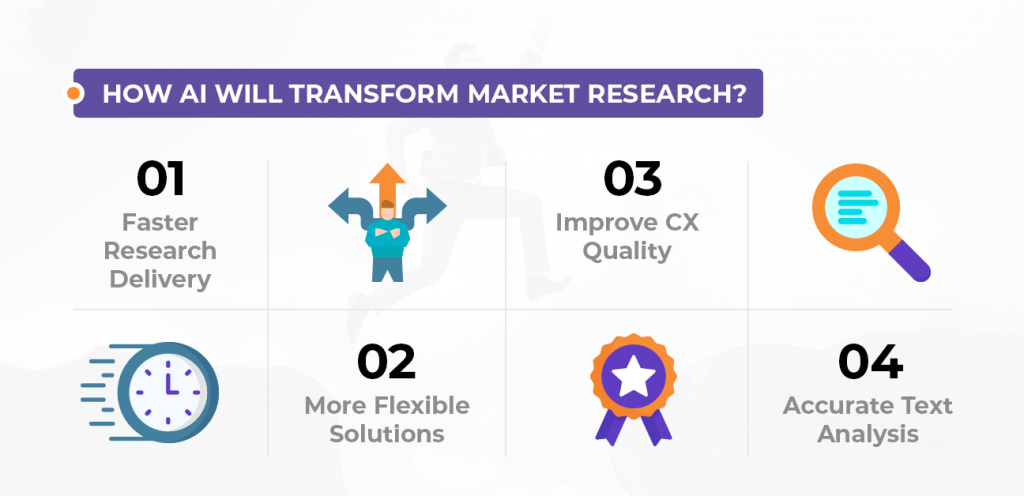
Quick Answer: What Is AI Consumer Research?
AI consumer research is the use of artificial intelligence — large language models, natural language processing, and autonomous agents — to collect, analyze, and interpret customer data, producing insights in hours rather than the weeks required by traditional survey and panel methods.
Key capabilities:
- Continuous market listening — track competitor moves, pricing shifts, and category conversation in real time with Brand Tracker
- Deep synthesis at scale — read hundreds of sources and produce cited, structured findings via Deep Research
- Unstructured text analysis — extract themes from reviews, transcripts, forums, and open-ended survey responses
- Insight-to-action translation — convert findings into positioning, messaging, and media plans with Marketing Strategist
The Problem: Why Traditional Consumer Research Falls Short
Consumer research has never been more important — and never harder to run at the pace modern business demands. The core issue is structural: the traditional research pipeline was designed for a world where product cycles measured in years, not weeks.
$140 billion — Annual global spend on market research, where software remains "little more than a rounding error"
**$40 billion each** — [Valuations of traditional human-driven consulting firms Gartner and McKinsey, versus $12.5B for Qualtrics and $6.4B for Medallia](https://a16z.com/ai-market-research/)
That imbalance tells the whole story: consumer understanding has been overwhelmingly a labor expense, not a software one. But accessing that understanding is frustratingly difficult:
- Panel recruitment and fielding stretch research timelines into weeks or months
- Costs are high enough that small bets and early ideas never get tested
- Insights arrive as static, packaged deliverables with no way to probe further
- Quarterly research cadence can't support daily operational decisions
- Panel composition introduces bias that's difficult to detect or correct
The Timeline Problem
The conventional research process runs sequentially: recruit a panel, field the survey, analyze results, build the report. Each stage adds latency. Most enterprises still rely on quarterly research to guide major launches, which means the insight informing a decision is often several weeks stale by the time it lands on a desk.
For fast-moving categories — consumer packaged goods, DTC, mobile apps, anything responsive to social trends — that lag is the difference between leading a trend and reacting to one.
The Cost Gate on Curiosity
Expense doesn't just make research slower; it changes which questions get asked. Because traditional research is expensive, small bets and early ideas often go untested, and consulting engagements "often took months, cost millions, and relied on expensive and biased panels."
The result is a research portfolio skewed entirely toward high-stakes launches. Positioning nuances, message variants, packaging tweaks, and early concept screens — the decisions made hundreds of times a year — proceed on instinct because commissioning research for each one is economically absurd.
The Static Deliverable Problem
Traditional survey results are "usually delivered to the buyer in packaged form, without much opportunity to revisit the process or dive deeper into the findings," according to analysis from a16z. A follow-up question means a new engagement.
This breaks the natural rhythm of inquiry. Real understanding is iterative — one answer generates three new questions — and a static PDF cannot participate in that loop.
The Unstructured Data Backlog
Most of what customers actually tell you is unstructured: reviews, support tickets, interview transcripts, social posts, open-ended survey text. Historically, mining this required manual coding — slow, expensive, and inconsistent between analysts. Gen AI's ability to synthesize information can summarize prior research, extract findings from interviews, and articulate takeaways far more rapidly than humans could, which is precisely why 62% of practitioners already using gen AI apply it to transcript synthesis.
The Trust and Privacy Constraint
Consumer research runs on consumer data — and consumers are increasingly attentive to how it's handled. The Boston Consulting Group found that for 75% of consumers in most countries, privacy of personal information remains a top issue, and people aged 18-24 are only slightly less cautious than older generations.
Research programs that ignore this face declining response quality and rising regulatory exposure. Approaches leaning on publicly available signal, aggregate patterns, and consented data are structurally better positioned than those built on aggressive personal data collection.
This is exactly what Jenova was built for.
The Jenova Solution: Specialized Agents for Consumer Intelligence
The AI consumer research market has fragmented into dozens of point tools — one for surveys, another for trend sensing, another for synthesis, another for profiling. The map below captures how crowded and specialized that landscape has become.
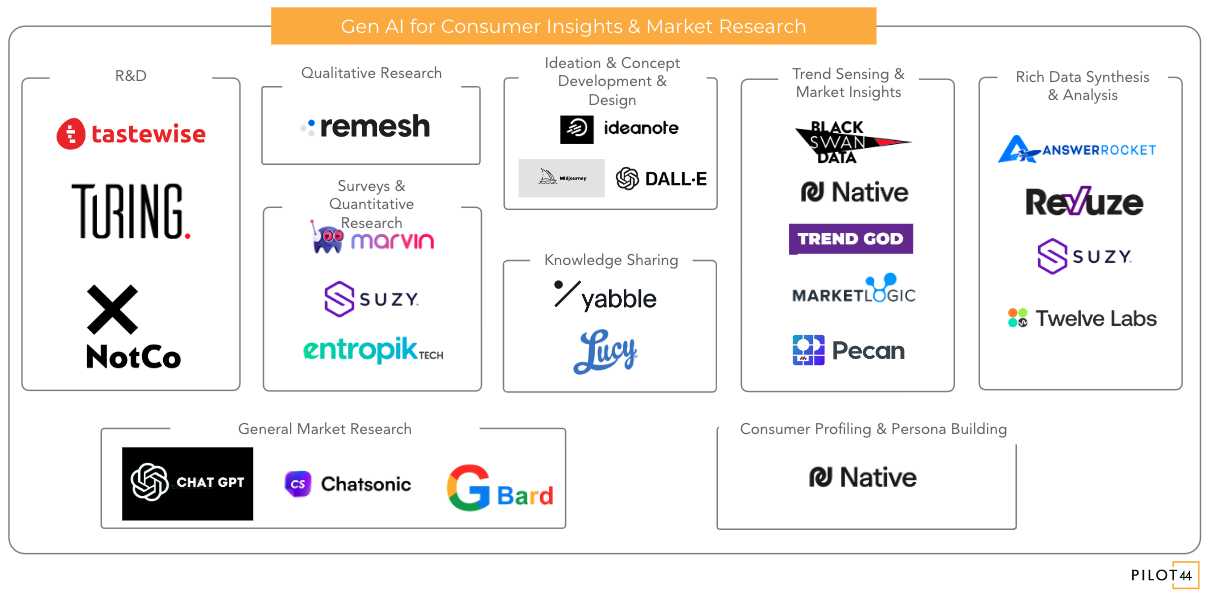
Adopting that stack means eight subscriptions, eight logins, eight learning curves — and no shared memory between them. Jenova takes a different approach: specialized expert agents that live in one workspace, share persistent memory, and can be brought into the same conversation when a question spans domains.
| Traditional Approach | Jenova |
|---|---|
| Weeks to recruit, field, and report | Findings synthesized in hours |
| Consulting engagement per question | Unlimited follow-up in one conversation |
| Static PDF deliverable | Interactive, queryable, memory-backed |
| Manual coding of unstructured text | Automated theme extraction across sources |
| Eight point tools, eight logins | One platform, agents that share context |
| Insight stops at the report | Agents carry findings into strategy and copy |
Continuous Market Listening
The biggest gain from AI consumer research is that listening never stops. Brand Tracker monitors mentions of your brand, product, or company across Google, Reddit, YouTube, X, LinkedIn, TikTok, and Amazon — capturing sentiment shifts, complaint clusters, and organic advocacy as they emerge rather than at the next quarterly checkpoint.
"Track mentions of our brand and our two closest competitors across Reddit and TikTok this month. Flag any recurring complaint themes."
For broader category questions, Real-Time Search runs cross-platform research across Google, Reddit, YouTube, GitHub, and Amazon in a single pass — useful when you need current signal on a trend, a competitor launch, or a shifting price point.
Deep Synthesis with Citations
Speed without rigor is a liability. Deep Research searches hundreds of sources and synthesizes findings with inline citations, producing reports you can defend in a boardroom because every claim traces back to something verifiable.
"Research how Gen Z consumers in Southeast Asia evaluate skincare purchases. Cover channels, price sensitivity, and influencer trust. Cite all sources."
This directly addresses the credibility problem that makes many teams wary of AI research. More than 70% of market research practitioners reported concerns about possible side effects of gen AI, including the potential for biased or inaccurate information. Citation-first synthesis lets you audit rather than trust blindly.
Academic and Behavioral Grounding
Consumer behavior questions often have published answers. Academic Researcher surfaces peer-reviewed literature on decision-making, pricing psychology, and category behavior — grounding your commercial hypotheses in established science instead of anecdote.
Turning Insight Into Strategy
Research only pays when it changes a decision. Marketing Strategist provides CMO-level guidance on media mix, channel strategy, budget allocation, and campaign planning, and it can consume your research findings directly rather than requiring a handoff.
For the commercial layer, Business Co-Pilot translates consumer insight into planning, financial modeling, and operational decisions — closing the gap between "we learned something" and "we did something about it."
Platform Capabilities That Compound
- Multi-model access — route work to the newest models from OpenAI, Anthropic, Google, DeepSeek, and xAI without vendor lock-in
- Persistent memory — agents remember your category, competitor set, brand voice, and prior findings across sessions
- Knowledge base attachments — upload past studies, transcripts, and CRM exports so responses are grounded in your own data
- MCP tool integration — connect Google Search, Scholar, Drive, Reddit, YouTube, Amazon, Notion, and any MCP-compliant server
- Custom agents — build a research agent with your methodology, tone, and source preferences baked in
Specialized AI Agents for Consumer Research
Different research questions need different expertise. These agents cover the full arc from raw signal to executed campaign.
🔍 Discovery & Monitoring
Brand Tracker — Your always-on listening post. Monitors brand, product, and competitor mentions across the platforms where consumer conversation actually happens, surfacing sentiment shifts before they become PR problems.
- Cross-platform coverage: Reddit, YouTube, X, LinkedIn, TikTok, Amazon, Google
- Recurring theme detection across mention volume
- Competitor mention benchmarking
Real-Time Search — Cross-platform research engine for fast, current answers. Ideal when you need to validate a trend or check a competitor claim in minutes.
- Simultaneous multi-source querying
- Up-to-date results, not training-data recall
- Strong for pricing, availability, and launch verification
📚 Analysis & Synthesis
Deep Research — Comprehensive research on any topic with rigorous inline citations. This is your replacement for the eight-week landscape study.
- Hundreds of sources synthesized per report
- Every claim traceable to a source
- Structured, actionable output rather than raw link dumps
Academic Researcher — Peer-reviewed grounding for behavioral and psychological questions underlying consumer choice.
- Scholarly literature retrieval and interpretation
- Methodology assessment
- Bridges academic findings to commercial application
📈 Strategy & Activation
Marketing Strategist — CMO-level advisor that turns consumer insight into channel, budget, and campaign decisions.
- Media mix and channel strategy
- Budget allocation modeling
- Campaign planning from startup to global brand scale
Business Co-Pilot — Operational chief of staff for translating market understanding into business planning and financial modeling.
- Market sizing validation
- Strategic planning grounded in research
- Cross-functional decision support
Product Copywriter — Converts consumer language directly into conversion copy for listings, landing pages, and ads.
- Uses actual customer vocabulary from research
- Marketplace and DTC listing optimization
- Message variant generation for testing
Social Media Content Generator — Turns insight into platform-native posts that reflect how your audience actually talks.
- Platform-specific formatting and tone
- Brand voice consistency
- Engagement-oriented hooks
🧠 Supporting Research Workflows
Sales Coach — Consumer research often surfaces objection patterns; this agent turns them into field-ready responses across B2B, B2C, retail, and e-commerce.
Startup Advisor — Brutally honest pressure-testing of market assumptions, forged alongside a16z, YC, and Sequoia thinking.
Business Plan Writer — Validates market sizing and surfaces blind spots when research feeds fundraising or lending materials.
Newsletter Generator — Packages recurring consumer intelligence into a scheduled internal briefing for stakeholders.
PDF Doc Generator — Formats findings into professional, distribution-ready research reports.
Try Jenova free — no credit card required.
How AI Consumer Research Works on Jenova
Step 1: Define Your Research Question
Start with the decision you're trying to make, not the data you want. The sharper the framing, the more useful the output. Open Deep Research and describe your category, audience, and the specific uncertainty you're resolving.
"We're launching a $28 refillable deodorant for urban millennials in the US. What are the primary purchase barriers for refillable personal care products in this segment?"
Step 2: Gather Signal Across Sources
Layer in live listening. Brand Tracker pulls organic consumer conversation from Reddit, TikTok, and Amazon reviews — the unfiltered opinion that surveys rarely capture because respondents self-edit.
"Analyze Amazon reviews and Reddit threads about refillable deodorant. What do people complain about most, and what language do satisfied buyers use?"
Step 3: Ground It in Your Own Data
Upload past studies, interview transcripts, CRM exports, or support ticket logs as a knowledge base. Agents then reason across both public signal and your proprietary data — the combination that produces genuinely differentiated insight rather than repackaged general knowledge.
"Cross-reference these 40 customer interview transcripts against the public review themes. Where do our existing customers diverge from the broader market?"
Step 4: Interrogate the Findings
This is where AI consumer research fundamentally differs from a commissioned report. Ask follow-ups. Challenge conclusions. Request the counterargument. Because agents retain full conversation context, each question builds on the last instead of starting cold.
"You said price is the top barrier. How confident are you in that ranking, and what evidence would contradict it?"
Step 5: Convert Insight to Action
Bring Marketing Strategist into the same conversation using the @ mention. It inherits the full research context and moves straight to positioning, channel selection, and budget recommendations — no briefing document required.
"@Marketing Strategist — based on everything above, recommend a launch channel mix and the three messages we should lead with."
Results & Use Cases
📊 Category Landscape Study Before a Product Launch
Scenario: A mid-size beverage brand is evaluating entry into functional sparkling water and needs to understand competitive positioning, consumer motivations, and pricing expectations.
Traditional Approach: Commission an agency study. Six to ten weeks for scoping, panel recruitment, fielding, and reporting. Five to six figures.
Jenova: Deep Research produces a cited landscape covering competitor positioning, consumer motivation clusters, and price-tier expectations in a single working session.
- Every finding traceable to a named source
- Follow-up questions answered instantly, not in a new engagement
- Findings hand off directly to Marketing Strategist for positioning work
💼 Always-On Competitive and Brand Monitoring
Scenario: A DTC skincare brand needs early warning when a competitor launches, when sentiment turns, or when a complaint theme starts compounding.
Traditional Approach: A quarterly brand health tracker plus a social listening subscription. Signal arrives weeks after the moment that mattered.
Jenova: Brand Tracker scans Reddit, TikTok, YouTube, X, LinkedIn, and Amazon on demand, and Newsletter Generator packages the output into a recurring internal briefing.
- Complaint themes surfaced while they're still small
- Competitor launches caught within days
- No separate listening platform subscription required
📱 Mobile Insight Capture in the Field
Scenario: A retail insights lead is walking store aisles doing shelf checks and wants to log observations and get instant category context without waiting to get back to a desk.
Traditional Approach: Photograph shelves, take notes, compile a deck the following week. Momentum and detail both decay.
Jenova: Full feature parity across iOS and Android means Real-Time Search is available in the aisle. Speech-to-text captures observations verbally; the session syncs to desktop automatically.
- Photograph a competitor shelf set and get instant analysis
- Voice-dictate field notes into the same conversation thread
- Everything syncs across devices with no manual transfer
🎯 Message Testing Before Media Spend
Scenario: A subscription meal-kit company has five positioning statements and needs to narrow to two before committing budget.
Traditional Approach: Concept testing with a recruited panel. Three to four weeks minimum, and the cost often exceeds the value of the decision.
Jenova: Research the audience's actual language with Deep Research, then use Product Copywriter to build variants grounded in that vocabulary and Marketing Strategist to pressure-test them against segment motivations.
- Decisions previously too small to research now get evidence behind them
- Copy built from real consumer phrasing rather than internal jargon
- Rapid iteration across variants in a single session
🧾 Synthesizing a Backlog of Qualitative Data
Scenario: An insights team has 18 months of interview transcripts, NPS verbatims, and support tickets that no one has had capacity to analyze.
Traditional Approach: Manual coding by analysts. Weeks of work, inconsistent between coders, and often abandoned partway.
Jenova: Upload the corpus as a knowledge base. Deep Research extracts recurring themes, tracks how they shift over time, and identifies the segments where each theme concentrates.
- Dormant data converted into usable insight
- Longitudinal theme tracking across the full time window
- Consistent methodology applied to every document
Frequently Asked Questions
Is AI consumer research accurate enough to make decisions on?
It depends on your accuracy threshold and the stakes involved. Many CMOs report being comfortable with outputs at least 70% as accurate as traditional consulting firms, especially since the data is cheaper, faster, and updated in real time. For high-stakes launches, use AI research to sharpen your hypotheses and reduce the scope of expensive primary research — not to replace it entirely.
How is Jenova different from using ChatGPT for market research?
General-purpose chatbots have no research methodology, no persistent memory of your category, and no built-in access to live consumer conversation. Jenova provides specialized agents built for specific research jobs — Brand Tracker for monitoring, Deep Research for cited synthesis — with memory that persists across sessions and tool access to Reddit, YouTube, Amazon, Google Scholar, and more.
Can AI replace surveys and focus groups entirely?
No, and it shouldn't. Synthetic data can't replicate the full depth and unpredictability of human behavior — only 31% of researchers rated the value of gen AI-produced data as "great". Treat AI consumer research as continuous intelligence that informs which questions deserve primary research investment, not as a wholesale substitute for talking to real people.
Is Jenova free to use?
Yes — the free tier includes all core features with limited monthly usage, no credit card required. Paid tiers start at $20/month and scale usage substantially while adding custom model selection. For current limits and plan details, check "Usage Limit" and "Subscribe" in the menu.
How does Jenova handle data privacy for consumer research?
Your data is never used to train public AI models, is encrypted in transit and at rest, and is not sold or shared with advertisers. This matters given that privacy of personal information remains a top issue for 75% of consumers in most countries — research programs handling customer data carry real obligations.
Does AI consumer research work for niche or B2B categories?
Yes, though the approach shifts. B2B audiences are notoriously hard to reach through conventional panels, which is why AI-assisted approaches have gained traction there. Deep Research is particularly effective for niche categories where published analysis is scattered across trade publications, forums, and technical sources rather than consolidated in syndicated reports.
Conclusion
For decades, consumer understanding has been rationed by cost and calendar. Panels took weeks, reports cost millions, and the questions too small to justify a study simply never got answered. AI consumer research collapses that constraint — not by eliminating rigor, but by making rigorous inquiry cheap enough to run continuously.
The competitive edge is no longer having research. It's having it fast enough to act on, with enough follow-up capacity to actually understand what it means. Teams that shift from quarterly studies to always-on consumer intelligence will simply make more informed decisions per quarter than those that don't.
Start with Deep Research for your next landscape question, add Brand Tracker for continuous monitoring, and route findings to Marketing Strategist so insight actually changes what you ship.
Explore the full agent library at Jenova.
For Developers: Every agent in this article is available programmatically via the Jenova API — build AI-powered consumer research and monitoring features into your own application with a single integration. Full documentation →