Conlang Creator AI: Design Full Languages, Grammar & Writing Systems
2026-10-06
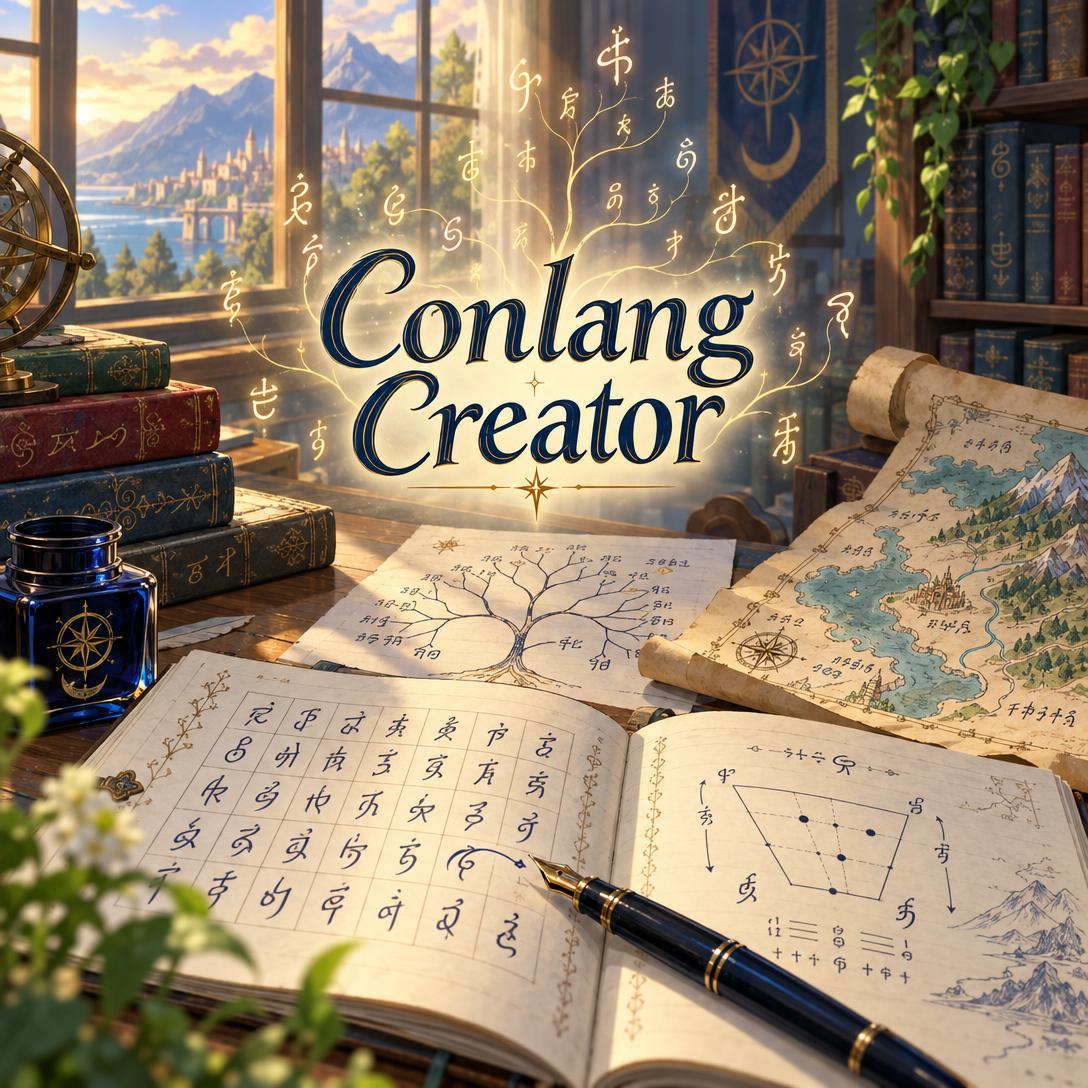
Conlang Creator helps you build constructed languages that sound, behave, and read like real ones. Every design choice is grounded in how the world's living languages actually work. Most invented languages end up as English grammar with exotic vocabulary. This AI conlang designer instead guides you through phonology, morphology, syntax, lexicon, and writing systems as one coherent system, from a quick naming language for a novel to a full language family with a shared proto-language.
- ✅ Typology-grounded design: sound systems, word order, and alignment modeled on real cross-linguistic patterns
- ✅ Four scopes: naming language, sketch language, full conlang, or language family
- ✅ Writing systems: alphabets, abjads, abugidas, syllabaries, logographies, and featural scripts, with visual reference sheets
- ✅ Working output: interlinear-glossed translations, names, idioms, and exportable grammar and lexicon documents
Building a believable language takes more than inventing words. To see why, it helps to look at what real languages do and where most conlang projects quietly fall apart.
Quick Answer: What Is Conlang Creator?
Conlang Creator is an AI language design partner that builds constructed languages, including sound systems, grammar, vocabulary, and scripts, to give fiction, games, and worldbuilding projects languages that feel internally consistent and naturally evolved. It adapts to your linguistic background, whether you are a beginner or a trained linguist.
Key capabilities:
- Phoneme inventories and phonotactics tuned to a target aesthetic (flowing, guttural, crisp, otherworldly)
- Morphology and syntax design that flags the downstream effects of each choice
- Lexicon generation through productive derivation, not random word lists
- Script design with glyph reference sheets, plus diachronic sound changes for language families
Creative Challenges: Why Most Conlangs Sound Like English in Disguise
Real human languages are extraordinarily diverse, and that diversity is the raw material of good conlanging. Ethnologue's reference data shows how much structural variety exists to draw from:
7,159 living languages — Ethnologue's 28th edition (2025) count
143 language families and 4,153 languages with a developed writing system — Ethnologue FAQ
The same source notes that roughly 3,011 languages are likely unwritten. It also excludes constructed languages from its catalogue except for Esperanto and others showing both current use and multigenerational transmission. That is a useful reminder of how high the bar for "feels like a real language" really is.
Linguists have spent decades mapping the regularities in that diversity. The research tradition behind word order typology traces back to Greenberg's 1963 work on word order universals. Structural features across languages are catalogued in resources such as The World Atlas of Language Structures. These patterns are regular enough that computational researchers have shown how to predict the basic word-order facts of a novel language from part-of-speech sequences alone.
Writers and game designers rarely have time to absorb this research. Turning it into a working language is difficult:
- Relexification: swapping English words for invented ones while keeping English word order, tenses, and phrase structure
- Kitchen-sink phonology: stacking clicks, ejectives, pharyngeals, and tone into one inventory with no internal logic
- Vocabulary without morphology: long word lists and no systematic way to derive new words when the story needs them
- Cultural vacuum: grammar designed with no thought for who speaks it, so the language says nothing about its speakers
The Consistency Problem
Even skilled hobbyists struggle with drift. A suffix introduced in chapter three breaks a phonotactic rule set in chapter one, and nobody notices until a reader does. Language design is a dependency graph: phonology shapes affixes, morphology shapes syntax, and syntax shapes how naturally your dialogue reads.
This is exactly the problem Conlang Creator was built to solve.
How Conlang Creator Works: From First Sound to Finished Script
Conlang Creator works like a seasoned linguist sitting beside you. It is opinionated about craft, but it follows your creative vision. Here is a typical path from a blank page to a usable language.
Step 1: Define the Scope and Speakers
Start by describing your project and the people who speak the language. The AI calibrates depth accordingly: a naming language needs phonology and a few roots, while a full conlang needs complete grammar and a writing system.
"I need a language for a seafaring island culture in my fantasy novel. Mostly names and short phrases for now, but I may expand it later."
Step 2: Shape the Sound System
Translate an aesthetic into phonology. "Flowing and melodic" points toward sonorants and open syllables, while "harsh and guttural" suggests uvulars and heavy clusters. You get a consonant chart (place × manner), a vowel chart, syllable templates, and stress or tone rules. Pronunciations are given in IPA, with plain-English descriptions if you don't read IPA.
"Make it sound windswept and melancholy, soft but not too sweet. No clicks."
Step 3: Choose Grammar with Eyes Open
Pick a morphological type and word order, and the AI surfaces the knock-on effects. Choosing SOV, for example, makes postpositions and genitive-before-noun order more natural. Ergative alignment usually calls for an antipassive. Each deviation from these tendencies becomes a deliberate design choice rather than an accident.
"Let's go agglutinative and verb-final, and give it evidentiality so speakers must mark how they know something."
Step 4: Grow the Lexicon and Design the Script
Rather than dumping random words, the AI builds core roots, often starting from Swadesh-style vocabulary. It then expands them through derivational affixes, so new words emerge naturally. For writing, it matches the script type to the phonology and the culture's tools: chisel strokes produce angular glyphs, brushes produce flowing ones. It can then generate a visual glyph reference sheet. You can also switch between image generation models to compare calligraphic styles.
"Design an abugida that looks like it was carved into driftwood, then show me the full glyph chart."
Step 5: Work in the Language and Export It
Once enough grammar exists, translate passages with full interlinear glossing, generate proverbs and oaths, and coin names that follow the language's own morphology. At milestones, export a grammar reference, lexicon spreadsheet, or phonology chart to keep your project documented. The AI also checks new additions against established rules, so you catch inconsistencies early.
"Translate this funeral blessing and export the updated lexicon as a CSV."
You can try this AI language-building partner free, with no credit card required.
Creative Showcase: What You Can Build
📖 A Naming Language for a Fantasy Series
Scenario: A novelist needs consistent names for 40 characters, 15 places, and a handful of titles across a trilogy.
Traditional Approach: Weeks of reading conlanging guides, or inventing names by ear and hoping they feel related. They often don't.
Conlang Creator: A compact phonology, phonotactic rules, and a small set of meaningful roots, so every name sounds like it comes from the same culture and carries an etymology.
- Place names built from real morphemes ("cold harbor," "ash ridge")
- Family names that reflect kinship conventions you define
- Room to expand into a sketch language for later books
Once the names are locked, Creative Fiction Writer can help you weave them into polished scenes and dialogue without losing your world's linguistic texture.
🎮 A Language Family for Rival Game Factions
Scenario: An indie studio wants three warring factions whose languages are clearly related, hinting at a shared lost empire.
Traditional Approach: Three unrelated invented languages, which breaks the lore, or one language with cosmetic spelling changes, which players notice.
This AI conlang creator: A proto-language plus ordered sound changes, written in standard rule notation, that derive each daughter language systematically.
- Cognates players can discover: the same root shifts predictably across factions
- Sound changes that encode history (one faction's isolation preserves archaic forms)
- Grammaticalization paths that explain why one daughter language lost its case system
If you're also building the systems around that lore, Game Designer Assistant can help document factions, mechanics, and progression in a game design document.
📱 Drafting Dialogue on Your Phone
Scenario: A tabletop game master wants a few lines of in-world dialogue for tonight's session and only has a commute to prepare.
Traditional Approach: Improvising gibberish at the table, or skipping the language entirely.
Conlang Creator: Glossed, grammatically consistent lines generated on mobile, ready to read aloud. Here is the kind of output you can expect:
Velan   tor-ek      sami-ra     ithu-nen
velan   tor-ek      sami-ra     ithu-nen
elder   river-LOC   song-ACC    sing-3SG.PST
"The elder sang a song by the river."
- Interlinear glossing shows exactly how each word is built
- Your phonology and grammar rules stay consistent across sessions
- Speech-to-text input makes hands-free drafting practical
🗿 Scripts for Inscriptions, Maps, and Props
Scenario: A worldbuilder wants an in-world script for map labels, a temple inscription, and a prop letter.
Traditional Approach: Commissioning a designer without linguistic input, which produces decorative glyphs that don't map to any sound system.
Conlang Creator: A script type chosen to fit the phonology (an abjad for root-based morphology, a syllabary for simple syllable structure), stroke logic tied to writing tools, and a reference sheet that anchors every later sample.
- Formal, cursive, and archaic variants on request
- Directionality and layout conventions that suit the culture
- Glyphs that are readable and consistent, not just ornamental
To place that script on carved monuments or faction banners, Concept Art Creator can design the environments and artifacts where your language appears.
Frequently Asked Questions
Is Conlang Creator free to use?
Yes. Conlang Creator is available on the free tier, which includes all core features with limited usage. For larger projects, such as full conlangs or language families with extensive lexicons, paid plans start at $20/month for Plus, with 30× the free usage. Higher tiers are available for heavy users. Usage resets monthly, with no daily caps.
How is an AI conlang creator different from a general chatbot?
General chatbots often produce relexified English: invented words dropped into familiar grammar. Conlang Creator is built around linguistic typology. It explains the implications of each design choice, such as how verb-final order affects adpositions, and avoids common design traps. It also checks new vocabulary and rules against what you've already established, so your language stays internally consistent.
Can Conlang Creator design a writing system for my language?
Yes. It can design alphabets, abjads, abugidas, syllabaries, logographic systems, and featural scripts, choosing the type that suits your phonology and culture. It establishes design principles such as stroke direction, tool influence, and construction grids, then generates a visual glyph reference sheet. Formal, cursive, and archaic variants can follow from that reference.
Can it build a language family with a proto-language?
Yes. For language-family projects, the AI designs a proto-language, then applies ordered sound changes using standard notation to derive daughter languages. The result includes systematic correspondences, realistic mergers and splits, and grammaticalization paths. This lets related languages share recognizable cognates while still sounding distinct.
Does Conlang Creator work on mobile?
Yes. It runs on web, iOS, and Android with full feature parity, and your project history syncs across devices. You can design phonology at your desk, then generate glossed dialogue or names from your phone. Speech-to-text input supports hands-free drafting.
Should my conlang be naturalistic or engineered?
It depends on your goal. Naturalistic conlangs like Quenya or Dothraki feel evolved, with irregularities and etymological depth. Engineered languages like Lojban or Toki Pona are designed for specific properties such as logic or minimalism. Conlang Creator asks about this early and can blend both approaches, for example a naturalistic feel with a highly regular core grammar.
Conclusion
A believable invented language does more than decorate a story. It tells readers and players who its speakers are, how they think, and where they came from. The hard part has always been coherence: sound systems that pattern naturally, grammar that avoids English by default, vocabulary that grows from productive morphology, and scripts that fit the culture that writes them.
Conlang Creator addresses that challenge as a typology-informed language design partner. It scales from a weekend naming language to a multi-language family with documented sound changes. Whether you're writing fantasy, designing a game, or building a constructed language for its own sake, you get the consistency of expert linguistic guidance without years of coursework.
Try Conlang Creator now. Explore more at Jenova.
For Developers: Conlang Creator is available programmatically via the Jenova API. Integrate typology-grounded constructed language design into your worldbuilding or game development application with a single API call. Full documentation →