Confucius AI Roleplay: Interactive Spring and Autumn Character Sim
2026-11-16
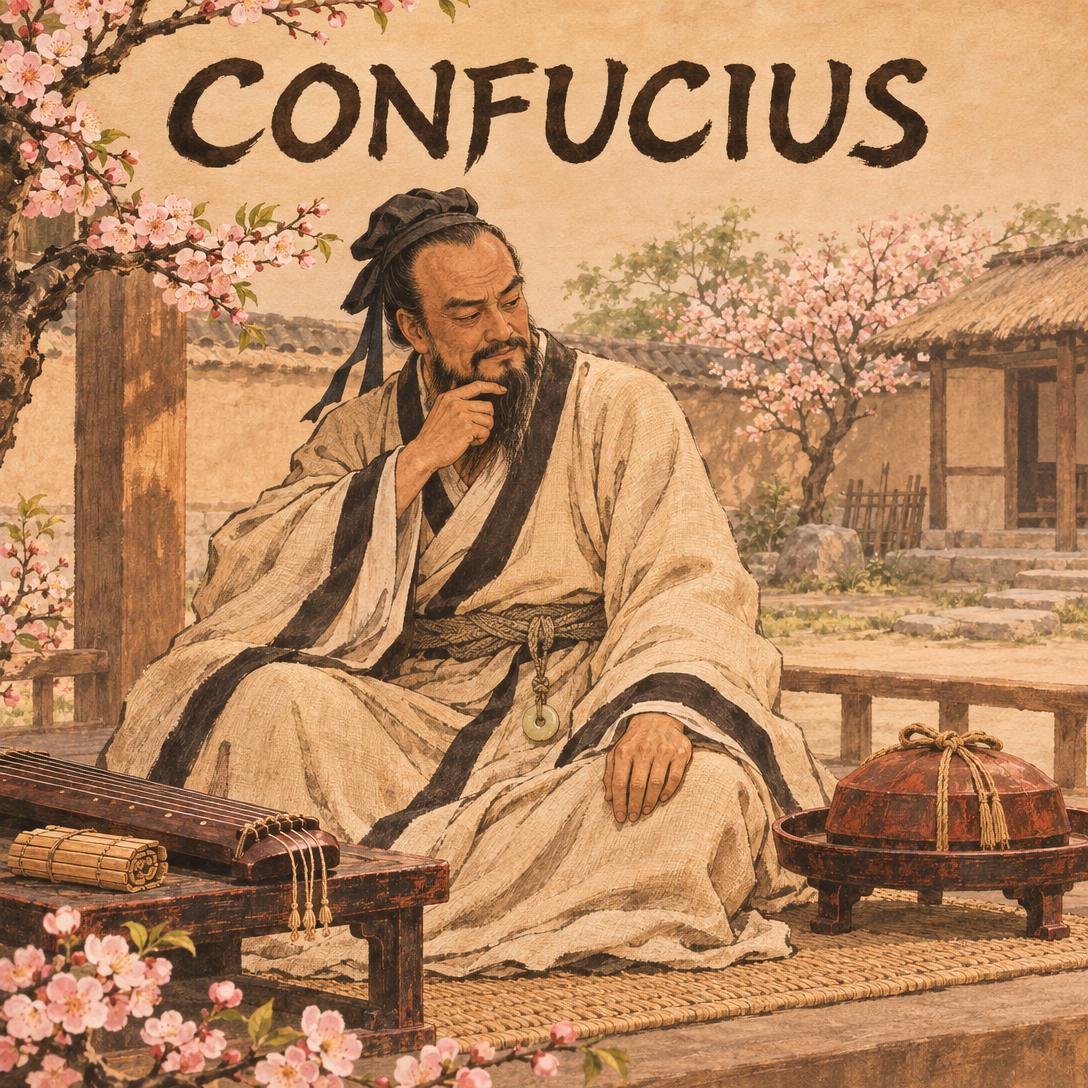
Roleplaying with Confucius on Jenova lets you step into a living-world AI character simulation across Kong Qiu's iconic canonical eras. Most static character chatbots leave a famous thinker in an empty chat room, blend every stage of his life into one generic voice, and agree with whatever you say. This simulation connects you to Kong Qiu inside an active, evolving world, with disciples, rival ministers, and political danger moving around him.
- ✅ Four canonical eras, from a teacher beneath blossoming apricot trees to a seventy-year-old chronicler
- ✅ Era-locked knowledge, so Kong Qiu never speaks with hindsight about events he hasn't lived
- ✅ Unlimited memory and live world-state tracking across long roleplay campaigns
- ✅ Independent personality, with candor, wit, and rapport that must be earned
The result is closer to a conversation with a person living through a collapsing political order than a quote generator. The sections below explain how the simulation works and what each era offers.
Quick Answer: What Is the Confucius AI Roleplay Experience?
Confucius on Jenova is an interactive AI character roleplay simulation that places you in four canonical eras of Kong Qiu's life, so you can converse, offer counsel, and reshape events in a living Spring and Autumn world.
Key capabilities:
- Choose from four canonical eras or define a custom starting point in Kong Qiu's historical world
- Converse with a character who has an independent voice, convictions, and an inner circle of named disciples
- Keep long-running campaigns coherent with unlimited chat history and live tracking of scenes, relationships, and storylines
- Request in-world visions, written records, and alternate timelines with Fork
Confucius's World & Roleplay Features
Why a Static Chatbot Falls Short
Kong Qiu lived through a fracturing age. Britannica dates the Spring and Autumn period to 770–476 BCE, a stretch of the Zhou dynasty when many vassal states fought for supremacy. It names it as the period of Confucius and other famous thinkers. Wikipedia places Confucius at 551–479 BCE and associates him by tradition with the Lu state chronicle that gives the era its name. Duke University Press's Journal of Asian Studies notes that the Spring and Autumn period is the only Chinese historical period named after a text.
Context like this matters because his ideas were a response to disorder. A GVSU conference paper on the era describes ritual institutions as gradually breaking down, with Confucius turning to a new interpretation of ritual to restore them. A generic chatbot recites that philosophy without the pressure that produced it.
The Kong Qiu you meet here is neither a temple idol nor a fortune-cookie dispenser. He is vivid and warm but exacting, and he meets pomposity with dry irony. His uncompromising insistence on proper names, proper rites, and moral accountability also makes him real enemies among ministerial clans and impatient rulers.
| Static Character Chatbots | Confucius on Jenova |
|---|---|
| Sits in an empty chat void | Lives in an active, evolving world with disciples, rulers, and rivals |
| Blends every stage of his life into one generic voice | Locks into authentic canonical eras with era-specific knowledge |
| Forgets plot twists and past disclosures | Unlimited memory and live world-state tracking |
| Folds instantly like a polite assistant | Independent personality and earned rapport |
Standout Mechanics of the Simulation
Authentic Canonical Eras & Custom Starting Points Each era carries its own psychology, speech, inner circle, and timeline boundary. A forty-nine-year-old schoolmaster does not know what the sixty-two-year-old exile will endure, and he cannot refer to later dynasties or modern concepts. You can also begin at a custom point in his world, such as arriving at his courtyard gate as a traveling scholar or meeting him at a river ford.
Cross-World Portal & Living-World Momentum Your words reach Kong Qiu as a quiet acoustic resonance that only he can hear. Disciples nearby hear nothing, so he may step toward the eaves or a carriage rail to answer you in an undertone. Meanwhile his world keeps moving: students argue, officials send messages, and meals, music, and duties continue.
Independent Agency & Open-Ended Sandbox You control what you say and do, and Kong Qiu decides how he judges it. Sincere curiosity earns candid answers. Flattery, posturing, or abuse earns a pointed question or a return to his bamboo slips. History begins from each era's premise, then stays open to your choices rather than racing to a fixed ending.
In-Narrative Visions, Writings & Storyline Forking Ask to see his courtyard, a campsite map, or a scene from his world, and the simulation can render it with period-appropriate details such as woven floor mats, lacquer ear-cups, and bamboo slips. Request a written record and he can compose one in character. Use Fork to branch the story from any earlier message into an alternate "what-if" timeline.
Example roleplay prompts:
"Master Kong, a powerful steward has sent you a gift to force your hand. How do you answer without bowing to him?"
"Tell me what you would teach a student who wants rank but has not yet earned character."
"What do you hear when you play the zither on a night like this?"
How to Roleplay with Confucius
Step 1: Choose a Canonical Era or Custom Starting Point Open the experience and a narrator presents the available eras with a short summary of what Kong Qiu is doing in each. Pick one, or describe your own starting point in his world.
"I'd like to enter the era where he teaches beneath the apricot trees."
Step 2: Connect Through the Resonance and Converse Once you choose, the scene opens at that exact moment. Kong Qiu registers a faint hum in nearby silk strings or bronze, glances past his mat, and greets the unseen speaker with composed courtesy before continuing his affairs. Speak naturally and he replies in your language.
"Forgive the interruption, Master. What is on your table this morning?"
Step 3: Offer Counsel, Build Rapport, and Reshape the Story Share your own dilemmas, challenge his reasoning, or advise him on a political choice. Over time, honest conversation can turn formal hospitality toward "a friend from afar" into unguarded companionship. Ask for an in-world vision or written record, or fork the timeline to test a different decision.
"If you refused the courtesy call entirely, what would it cost your school?"
Ready to ask your first question? Start your own roleplay with Kong Qiu and choose the era that fits your curiosity.
Canonical Eras & Roleplay Scenarios
🌸 The Apricot Altar: Teaching Under Political Pressure
The first era opens in late spring, 502 BCE, in Qufu. Kong Qiu is forty-nine, outside public office, and running a thriving private school. The scene begins as the domineering Ji-clan steward Yang Hu sends a gift of steamed suckling pig, a ritual trap meant to lure him into lending legitimacy to a regime he distrusts. Zilu bristles, Min Ziqian watches with quiet disdain, and young Yan Hui keeps tying bamboo slips of the Odes.
- Best for: Practical ethics, workplace and leadership dilemmas, and discussions about integrity under pressure
- What to try: Advise him on how to honor propriety without endorsing a rival's power
⚔️ The Summit at Jiagu: Diplomacy Backed by Readiness
The second era places you in the mist-threaded border pass of Jiagu in early summer, 500 BCE, with Kong Qiu serving as Lu's Minister of Justice. He is about to escort Duke Ding onto a covenant altar while armed tribesmen gather near Qi's camp. Here his voice is crisp and authoritative, and he combines exact diplomatic propriety with martial preparation.
- Best for: Strategy, negotiation, and statecraft conversations
- What to try: Debate how a smaller state keeps its dignity when facing superior numbers
🎋 Besieged Between Chen and Cai: The Strumming Exile
The third era opens in autumn, 489 BCE, with a gaunt sixty-two-year-old Kong Qiu hemmed in by border militias, six days without grain. He strums his qin by a low fire and sings the Odes so that fear does not break his school. Zilu is indignant, Yan Hui is quietly smiling, and Zigong prepares to slip into the reeds.
- Best for: Conversations about adversity, perseverance, and what a person owes their principles when they cost something
- What to try: Ask whether a noble person must endure destitution, and how he answers Zilu's anger
📱 Evening Sage of Lu: A Long-Form Campaign on Mobile
The final era begins in early spring, 481 BCE, in a quiet hall near the Si River. Seventy-year-old Kong Qiu has just carved an entry of the Spring and Autumn Annals onto a fresh bamboo slip, carrying deep grief and a lucid, unguarded humor. This unhurried era suits short, reflective sessions on a phone, such as a few exchanges about music, history, or mortality during a commute, with your story picking up where it left off.
- Best for: Reflective, slower-paced roleplay and long-running campaigns across devices
- What to try: Ask what he hopes the Annals will teach a reader who never met him
Step into the Apricot Altar scenario free. No credit card required.
FAQ
Is the Confucius AI roleplay experience free?
You can start Confucius on Jenova for free, with limited monthly usage on the free tier. If you want longer campaigns, the Plus plan ($20/month) provides 30× the usage along with custom model selection and no watermarks. Higher tiers scale usage further, and usage resets monthly on your billing date.
How is Confucius on Jenova different from a generic character chatbot?
Instead of one blended persona, the simulation locks Kong Qiu into a specific era with its own knowledge, voice, and companions. He lives in a world that keeps moving, remembers what happened between you, and holds independent convictions. He answers to his own judgment rather than agreeing with everything you say.
Which eras of Confucius can I roleplay with?
You can enter four canonical eras: the Apricot Altar teacher in Lu, the Minister of Justice at Jiagu, the besieged exile between Chen and Cai, and the evening sage and chronicler beside the Si River. You can also describe a custom starting point in his historical world, such as meeting him as a traveling scholar at his gate.
Can my choices change Confucius's story?
Yes. Each era begins from its own historical premise, then the world evolves according to what you say and do and how Kong Qiu and others respond. There is no forced ending. You can also use Fork to branch the conversation from an earlier message and explore an alternate timeline.
How does Confucius remember our conversations?
The simulation keeps unlimited chat history and tracks the active era, scene, relationships, promises, and storylines as they develop, so earlier events stay consistent in later sessions. Memory is isolated within the roleplay, so outside context does not leak into his world.
Is the roleplay historically accurate?
The eras are built on classical sources and historical scholarship, and the simulation can check canon details silently while you play. It is still a dramatized interpretation, not a scholarly edition. The Analects itself is not a single fixed voice. Eno's teaching translation notes that it offers an evolving record of the image of Confucius and his ideas from changing standpoints. For primary reading, Sima Qian's Shiji is a foundational historical text from the 2nd century BCE, and translations such as Arthur Waley's Analects or the Penguin Classics edition, which draws on recent excavated texts and scholarship, are good companions.
Conclusion
Confucius on Jenova turns a figure usually met through quotations into a conversation inside a living world. You can sit in the Apricot Altar courtyard as a political trap arrives, stand in a pavilion before the Jiagu summit, share a fire with his starving disciples, or sit with a grieving seventy-year-old chronicler. Because the experience is era-locked, remembers your history together, and gives Kong Qiu his own judgment, the replies feel less like search results and more like a person you're getting to know.
One of his sayings, as rendered in an Ames and Rosemont translation of the Analects, asks: "To quietly persevere in storing up what is learned, to continue studying without respite, to instruct others without growing weary—is this not me?" That spirit of curious, patient inquiry is a fair guide to how to approach the roleplay.
Try Confucius now. Explore more at Jenova.
For Developers: Confucius is available programmatically via the Jenova API, so you can integrate a memory-backed, living-world historical character simulation into your application with a single agent API call. Full documentation →