AI Competitor Research: Track Rivals, Gaps & Market Signals
2026-08-17
AI competitor research helps you monitor rivals continuously — pricing moves, content gaps, brand sentiment, backlink growth, and positioning shifts — without a dedicated analyst team. While most companies still audit competitors quarterly in a spreadsheet that goes stale within weeks, Jenova gives you specialist AI agents that pull live signals from search engines, Reddit, YouTube, LinkedIn, review platforms, and the open web, then synthesize them into decisions you can act on this week.
✅ Continuous monitoring across search, social, and review channels — not one-off snapshots ✅ Research-grade synthesis with inline citations, not unsourced summaries ✅ Persistent memory that tracks how competitor positioning shifts over time ✅ Specialist agents for SEO, brand, marketing, and business strategy in one platform
To understand why this matters, it helps to look at what has actually changed in the competitive landscape. Search behavior, buyer research habits, and the sheer volume of unstructured signal have all shifted faster than most research workflows have adapted — and the gap between what teams should know and what they actually track keeps widening.
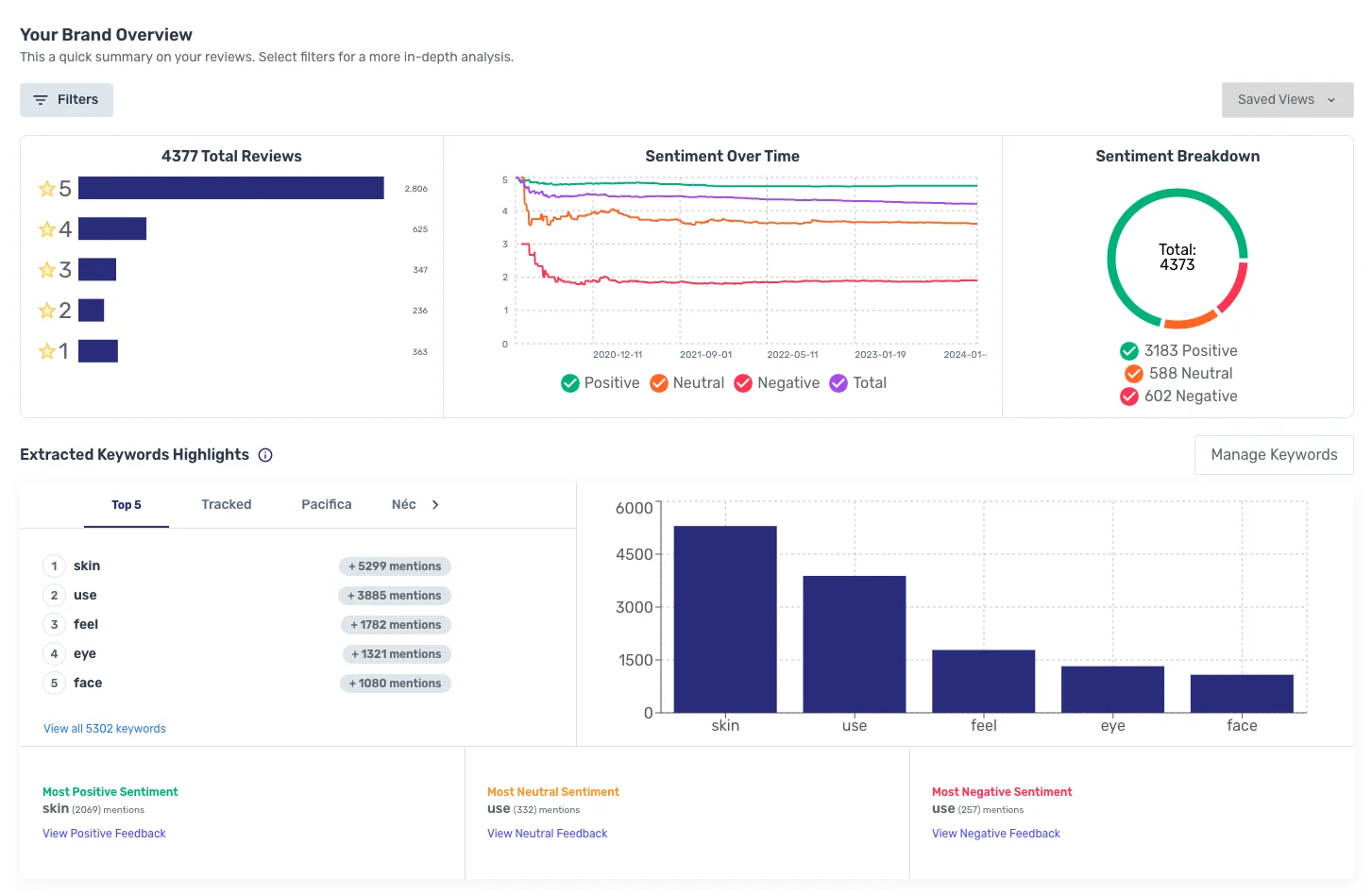
Quick Answer: What Is AI Competitor Research?
AI competitor research is the use of AI agents and tools to continuously gather, analyze, and synthesize competitor data — pricing, content, SEO performance, sentiment, and positioning — into actionable strategic insight. It replaces manual, periodic audits with always-on intelligence.
Key capabilities:
- Real-time competitor monitoring across search, social, forums, and review sites via Brand Tracker
- Deep multi-source research synthesis with rigorous citations through Deep Research
- Content and keyword gap analysis to find where rivals rank and you don't
- Strategic interpretation — turning raw competitor data into channel, pricing, and positioning decisions
The Problem: Competitor Research Breaks at Scale
Competitive intelligence has stopped being a quarterly exercise. Markets move weekly, competitors ship features constantly, and the signals that matter are scattered across dozens of channels that no single person can watch. The function itself is growing to match — CI team sizes have increased by 24% from previous years, reflecting how central this work has become to product, sales, and executive strategy.
But actually doing this research well is harder than ever:
- Data volume has outpaced human capacity — competitor signals now live across search results, forums, review platforms, video, and social simultaneously
- Most organizational data goes unused — the majority of it is unstructured and effectively invisible to manual analysis
- Search visibility itself is shifting — the rules for what "winning" looks like in organic search have changed
- Insights arrive too late — by the time a quarterly deck is finished, the competitor has already moved
- Tooling is fragmented — SEO data lives in one platform, sentiment in another, and neither talks to strategy
📉 Search Visibility Is Getting Harder to Read
Understanding a competitor's organic performance used to mean checking rankings. That signal has become far noisier.
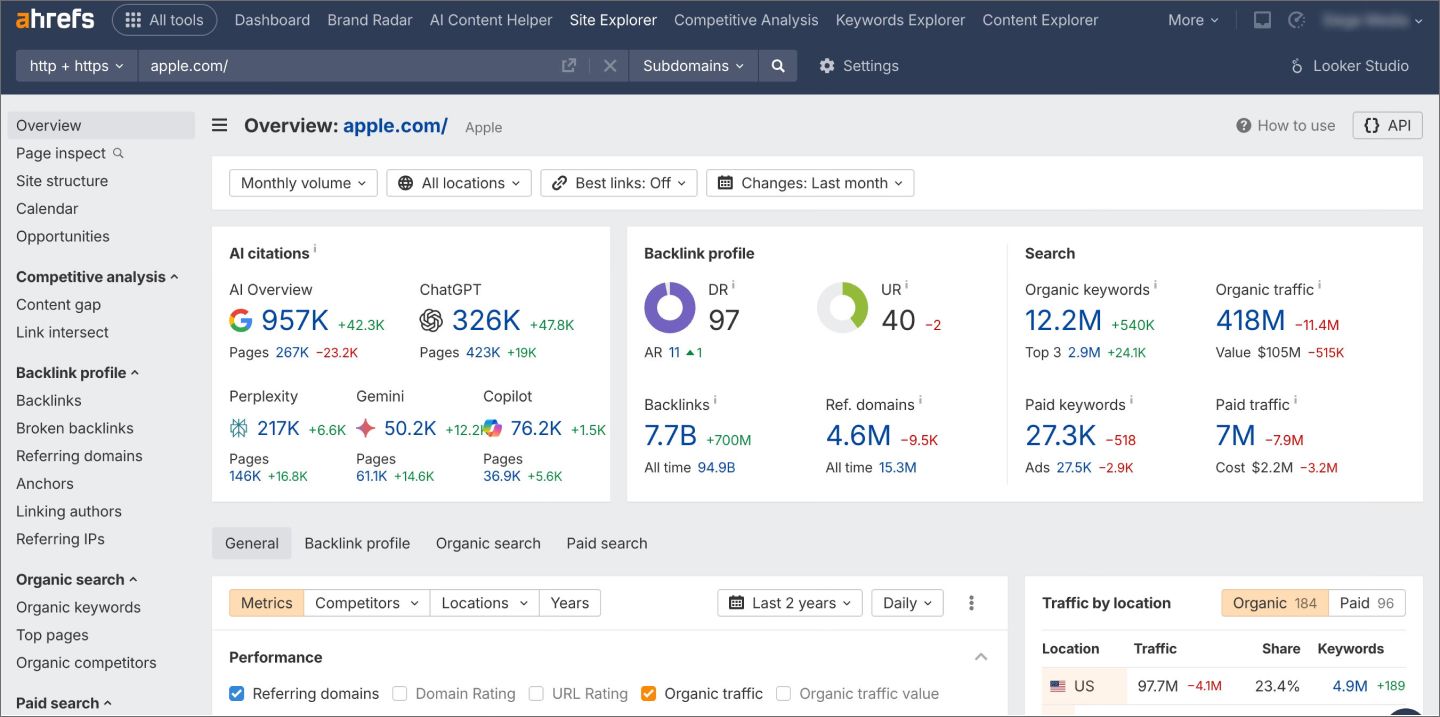
58% lower average click-through rate for the top-ranking organic page on queries with AI Overviews — Ahrefs SEO statistics
0.61% organic CTR on queries with Google AI Overviews as of September 2025, down 61% from 1.76% in June 2024 — Seer Interactive data via Ahrefs
96.55% of all pages get zero organic search traffic from Google — Ahrefs
A competitor ranking #1 may be capturing far less traffic than the position implies. Meanwhile, a competitor cited inside AI answers may be capturing demand that never shows up in a rank tracker at all. Research that only looks at position data now misses the majority of the picture.
🌐 Zero-Click Search Has Changed Where Demand Lands
61.5% of desktop searches and 34.4% of mobile searches result in no clicks — SparkToro data via Ahrefs
ChatGPT accounts for 77.97% of all AI referral traffic globally, with Perplexity driving 15.10% — SE Ranking data via Ahrefs
Competitor visibility now spans traditional SERPs and AI answer surfaces. Tracking one without the other produces a distorted read on who is actually winning attention in your category.
🗂️ Dark Data Hides the Signals That Matter Most
Around 90% of organizational data is unstructured and underused — customer transcripts, review text, forum threads, support logs. This is precisely where competitor weaknesses surface first: recurring complaints about a rival's product, emerging feature requests, churn triggers. Manual research almost never reaches it.
⏱️ Speed Is Now the Differentiator
Real-time data enrichment enables 25% faster decision-making and drives 30% higher revenue growth. The lag between a competitor's move and your response has become a measurable business cost, not an operational inconvenience.
🔀 Competition Is No Longer Category-Bound
Modern competitive intelligence has shifted toward holistic market and competitive intelligence — covering adjacent industries, regulatory shifts, and supply-chain dynamics. Companies compete across ecosystems now, not just against named rivals. Narrow competitor tracking misses the threats that arrive from outside the category.
This is exactly what Jenova was built for.
The Jenova Solution: Specialist Agents for Competitive Intelligence
The core problem with competitor research isn't a lack of data — it's that gathering, filtering, and interpreting it requires different kinds of expertise applied to different data sources. Jenova solves this with specialist AI agents, each built with deep domain knowledge for a specific slice of the research workflow, all sharing persistent memory across sessions.
| Traditional Approach | Jenova |
|---|---|
| Quarterly manual audits that go stale | Continuous monitoring you can re-run on demand |
| One generalist chatbot for every question | Specialist agents with domain-specific research methods |
| Findings scattered across docs and tabs | Persistent memory that tracks competitor movement over time |
| Unsourced AI summaries you can't verify | Rigorous inline citations back to original sources |
| Separate tools for SEO, sentiment, and strategy | One platform spanning research, analysis, and output |
The industry is moving in exactly this direction. Recent analysis shows a 76% year-over-year increase in AI adoption within CI teams, with 60% now using AI daily — and AI-driven workflows have moved beyond pilot programs into core capabilities delivering measurable value.
🔍 Live Multi-Source Monitoring
Brand Tracker searches Google, Reddit, YouTube, X, LinkedIn, TikTok, Amazon, and more for mentions of any brand, product, or company. Point it at a competitor instead of yourself and you get an unfiltered view of how the market actually talks about them.
"Track every mention of [competitor brand] across Reddit and YouTube from the last 90 days. Group by theme and flag recurring complaints."
📚 Research-Grade Synthesis With Citations
Deep Research searches hundreds of sources and synthesizes findings with rigorous inline citations, delivering comprehensive reports rather than surface summaries. This is the agent for full competitive landscape mapping — funding, positioning, pricing history, market entry patterns.
"Build a competitive landscape report on the top five players in project management software. Cover pricing tiers, target segments, recent product launches, and public positioning."
📡 Cross-Platform Real-Time Signal Capture
Real-Time Search queries Google, Reddit, YouTube, GitHub, Amazon, and more for up-to-date answers — useful when you need to verify a competitor claim, check whether a feature actually shipped, or confirm a pricing change today rather than last quarter.
🧭 Strategic Interpretation of the Data
Raw competitor data is not strategy. Marketing Strategist provides CMO-level guidance across media mix, channel strategy, and budget allocation — the layer that converts "here's what competitors are doing" into "here's what we should do differently." For venture-stage positioning calls, Startup Advisor delivers direct strategic guidance shaped by experience alongside a16z, YC, and Sequoia.
🧠 Persistent Memory Across Sessions
Competitor research compounds. Jenova agents retain unlimited conversation history and cross-session memory, so your competitive picture builds continuously — the agent remembers what a rival's pricing looked like three months ago and can flag the delta without you re-uploading context.
Specialized AI Agents for Competitor Research
Monitoring & Signal Collection
Brand Tracker — Expert brand monitoring analyst covering Google, Reddit, YouTube, X, LinkedIn, TikTok, Amazon, and beyond. Set it on competitor brands to surface sentiment shifts and complaint patterns before they show up in industry coverage.
- Cross-platform mention tracking in a single sweep
- Sentiment and theme clustering across sources
- Works equally well for your own brand and rivals'
Real-Time Search — Cross-platform research engine for fast verification when a competitive claim needs checking now.
- Google, Reddit, YouTube, GitHub, and Amazon coverage
- Natural-language querying, no operator syntax required
- Ideal for same-day fact-checking of competitor announcements
Deep Analysis & Reporting
Deep Research — Searches hundreds of sources and produces comprehensive, citation-backed reports. The workhorse for full landscape studies, category entry analysis, and board-level competitive briefings.
- Rigorous inline citations for every claim
- Multi-source synthesis across the open web
- Actionable report structure, not raw link dumps
Economics Analyst — Institutional-grade analysis covering macro, micro, trade, and policy, with mechanism tracing and scenario modeling for the market forces shaping your category.
- Data-driven scenario analysis
- Policy and regulatory impact assessment
- Adaptable to technical or executive audiences
Supply Chain Analyst — Supply chain intelligence across operations, geopolitics, and markets — critical when competitor advantage is rooted in sourcing or logistics rather than product.
- Real-time research across any industry or geography
- Scenario planning and quantitative analysis
- Surfaces structural cost advantages rivals rarely disclose
Strategy & Activation
Marketing Strategist — CMO-level advisor for translating competitive findings into channel strategy and budget allocation.
- Media mix and channel prioritization
- Campaign planning informed by competitor gaps
- Scales from early-stage startups to global brands
SEO Blog Generator — Expert SEO content writer producing research-backed, Google-optimized articles. The natural next step once gap analysis identifies which topics competitors own and you don't.
- Research-backed statistics with proper citations
- Structured for organic search performance
- Turns keyword gaps directly into publishable assets
Business Plan Writer — Pressure-tests strategy, validates market sizing, and surfaces blind spots — useful when competitive findings need to hold up in front of investors or a board.
Try Jenova free — no credit card required.
How AI Competitor Research Works
Step 1: Define Your Competitive Set
Name your direct rivals, adjacent players, and the emerging entrants you're watching. Give the agent context on your category and buyer so it filters for relevance rather than volume.
"I run a mid-market HR software company. My direct competitors are [A], [B], and [C]. I also want to watch two adjacent payroll platforms moving into our space."
Step 2: Collect Multi-Channel Signals
Deploy Brand Tracker across competitor names to capture what the market says in public — Reddit threads, YouTube reviews, LinkedIn commentary, marketplace feedback. This is where dark data becomes readable.
"Search Reddit and YouTube for discussions of [competitor] over the past six months. Identify the three most common complaints and the three most praised features."
Step 3: Run Deep Analysis on the Gaps
Hand the raw signals to Deep Research for structured synthesis: where competitors are strong, where they're exposed, and which claims are marketing versus reality.
"Cross-reference these complaint themes against [competitor]'s public roadmap and pricing page. Which weaknesses are they actively addressing and which are they ignoring?"
Step 4: Convert Findings Into Strategy
Bring Marketing Strategist into the same conversation using the @ mention — it inherits full context and turns the analysis into positioning, channel, and budget recommendations.
"Based on the competitive gaps identified above, recommend three positioning angles and the channels where we're most likely to win attention."
Step 5: Ship the Output
Publish against identified content gaps with SEO Blog Generator, or export the findings as a formatted briefing through PDF Doc Generator for stakeholder review.
Results & Use Cases
📊 SEO Gap Analysis for a Content Team
Scenario: A content lead needs to know which topics three competitors rank for that their own site doesn't cover at all.
Traditional Approach: Export keyword lists from a rank tracker, deduplicate manually in a spreadsheet, then spend days interpreting which gaps are actually worth pursuing.
Jenova: Deep Research maps the competitive content landscape with citations, and SEO Blog Generator turns prioritized gaps into publishable drafts in the same session.
- Identifies topic clusters competitors dominate, not just isolated keywords
- Accounts for the reality that 96.55% of pages get zero organic traffic — prioritizing viable targets over vanity terms
- Moves from analysis to published asset without switching tools
💼 Pre-Launch Competitive Positioning
Scenario: A product team is six weeks from launch and needs to know how three incumbents will position against them.
Traditional Approach: Commission an agency study, wait several weeks, receive a deck that's already partially outdated.
Jenova: Deep Research builds the landscape map, Startup Advisor pressure-tests the differentiation story, and Business Plan Writer validates the market sizing behind it.
- Full competitive picture assembled in a working session, not a quarter
- Honest pressure-testing rather than confirmation of existing assumptions
- Findings persist in memory for the next planning cycle
📱 Real-Time Response to a Competitor Announcement
Scenario: A rival announces aggressive pricing changes mid-week. Sales needs talking points before their next calls.
Traditional Approach: Scramble through the competitor's site, hunt for community reaction, draft messaging under pressure with incomplete information.
Jenova: Real-Time Search confirms exactly what changed, Brand Tracker captures market reaction across Reddit and social, and the analysis is available from a phone with full feature parity across web, iOS, and Android.
- Same-day turnaround from announcement to briefed sales team
- Community sentiment captured alongside the official announcement
- Full mobile capability — no waiting until you're back at a desk
🎯 Ongoing Brand and Sentiment Benchmarking
Scenario: A marketing lead needs a running comparison of how their brand sentiment tracks against two rivals across review platforms and forums.
Traditional Approach: Manually sample reviews each quarter, tally impressions subjectively, produce a directional guess.
Jenova: Brand Tracker monitors all three brands across the same channels on a repeatable cadence, and persistent memory preserves the historical baseline so trend direction is visible rather than inferred.
- Consistent methodology applied across all brands in the comparison
- Historical context retained without manual archiving
- Surfaces recurring complaint themes hidden in unstructured review text
Frequently Asked Questions
What is AI competitor research used for?
AI competitor research is used to monitor rival pricing, product launches, content strategy, SEO performance, and brand sentiment on an ongoing basis. Teams apply it to identify content and keyword gaps, prepare sales battlecards, inform positioning decisions, and detect competitive threats early. On Jenova, specialist agents handle each of these workflows rather than forcing one generalist tool to do everything.
Is AI competitor research accurate?
Accuracy depends entirely on sourcing. Agents like Deep Research synthesize findings with rigorous inline citations, so every claim traces back to an original source you can verify. Treat AI research as a rigorously sourced first draft that accelerates analysis — always confirm high-stakes claims, particularly competitor pricing and contractual details, against primary sources before acting.
Can AI replace a competitive intelligence analyst?
No — it changes what the analyst spends time on. Industry data shows CI teams are expanding, not shrinking, with team sizes up 24% while AI adoption climbs sharply. AI handles collection, summarization, and pattern detection at volume. Human analysts retain judgment, stakeholder context, and strategic recommendation — the work that actually moves decisions.
How is Jenova different from a single AI chatbot?
A general chatbot gives you one generalist across every task. Jenova provides specialist agents built with deep domain knowledge for specific workflows — Brand Tracker for monitoring, Deep Research for synthesis, Marketing Strategist for activation. You can bring multiple agents into one conversation with full shared context, and persistent memory means your competitive picture compounds across sessions.
Is Jenova free to use?
Yes. The free tier includes all core features with limited usage. Paid tiers start at $20/month and scale usage significantly while adding custom model selection. For current limits and plan details, check "Usage Limit" and "Subscribe" in the platform menu.
Does AI competitor research work on mobile?
Yes. Jenova offers full feature parity across web, iOS, and Android, with all settings synced across devices. That matters for competitive work specifically — competitor announcements don't wait for business hours, and you can run a full monitoring sweep from a phone the moment news breaks.
Turn Competitive Noise Into Strategic Advantage
Competitor research broke because the volume of relevant signal outgrew the capacity of manual workflows. Search visibility now spans traditional results and AI answer surfaces. The most revealing competitor data sits in unstructured review text and forum threads that quarterly audits never reach. And the window between a rival's move and an effective response keeps narrowing.
AI competitor research closes that gap — not by generating more summaries, but by applying specialist analysis to live, multi-source signal and carrying context forward across every session. Brand Tracker watches the market conversation. Deep Research builds the citation-backed picture. Marketing Strategist converts it into a plan. SEO Blog Generator ships the response.
Explore the full agent library at Jenova and start building competitive intelligence that keeps pace with your market.
For Developers: Every agent in this article is available programmatically via the Jenova API — build competitive monitoring and research capabilities into your own application with a single integration. Full documentation →