AI Compatibility Test: What It Measures and What It Actually Predicts
2026-08-12
The Personality Analyzer functions as a genuine AI compatibility test — synthesizing Big Five traits, MBTI, Enneagram, and attachment theory to map how two people actually fit together across values, communication, and conflict. Most compatibility quizzes score you on shared hobbies and produce a percentage that means nothing. This one works from the variables psychology research actually links to relationship satisfaction, and tells you where the friction will be rather than flattering you.
✅ Multi-framework analysis — Big Five, MBTI, Enneagram, and attachment theory synthesized, not a single quiz ✅ Values over hobbies — research consistently finds core values predict satisfaction while trait similarity barely does ✅ Honest friction mapping — identifies where you'll actually clash, not just where you overlap ✅ Conversational, not a form — it types you through discussion rather than 60 checkbox questions
To understand why most compatibility tests fail, it helps to look at what the research says actually predicts a lasting relationship — and how far that is from what a typical online quiz measures.

Quick Answer: What Is an AI Compatibility Test?
An AI compatibility test is an assessment that analyzes two people's personality traits, values, communication styles, and attachment patterns to identify where they align, where they'll clash, and how those differences are likely to play out over time.
Key capabilities:
- Multi-framework personality mapping — Big Five, MBTI, Enneagram, and attachment theory integrated rather than used in isolation
- Values alignment analysis — family, lifestyle, money, children, religion, and politics, which research links most strongly to satisfaction
- Communication style comparison — how each person expresses need, handles conflict, and repairs after an argument
- Friction forecasting — specific predictions about where differences become recurring problems
The distinction from a standard quiz is depth of reasoning. A quiz counts matching answers; an AI compatibility test interprets why a mismatch matters in one dimension and is irrelevant in another.
The Problem: Most Compatibility Tests Measure the Wrong Things
Compatibility testing has a credibility problem, and it's earned. The typical online test asks about favorite movies, ideal vacations, and morning-versus-night preferences, then returns an 87% score. None of those inputs have a demonstrated relationship to whether a couple stays together — but the output looks quantitative enough to be believed.
The research picture is considerably less flattering to the standard model:
Personality similarity plays a negligible role in explaining the life and relationship satisfaction of couples — National Institutes of Health
Couples with above-average language style matching during a four-minute speed date were more than three times as likely to both want future contact — Association for Psychological Science
Nearly 80% of couples whose writing style matched were still dating three months later, compared with roughly 54% of couples whose styles didn't align — Association for Psychological Science
But building a compatibility assessment that actually reflects this is difficult:
- The obvious variables are the weak ones. Shared hobbies and matching personality traits feel predictive and largely aren't.
- The strong variables are hard to self-report. Nobody accurately describes their own attachment style or conflict behavior on a multiple-choice form.
- Single frameworks are too narrow. An MBTI match tells you nothing about attachment; an attachment quiz tells you nothing about values.
- Scores create false precision. A number implies measurement where there's mostly interpretation.
- Novelty AI tools are flooding the space. Experts have warned that "AI situationships" could reshape dating, and the field increasingly asks whether AI should be understanding compatibility rather than performing it.
The Wrong-Variable Problem
The intuitive theory — that similar people get along better — is described in the research literature as exactly that: intuitive. Similar traits are assumed to promote compatibility and reduce friction. The evidence doesn't strongly support it. A Greater Good Science Center summary of recent research puts it plainly: when it comes to relationship happiness, your own personality appears to matter more than your partner's.
Meanwhile, analysis of the compatibility literature notes that similarity in core values — views on family, lifestyle, children, religion, and politics — carries far more weight than personality similarity, and that couples sharing few hobbies but possessing strong communication and mutual respect consistently outperform couples with overlapping interests and poor communication.
Almost no consumer compatibility test is built around that finding.
The Self-Report Problem
The variables that matter most are the ones people are worst at reporting. Ask someone whether they withdraw during conflict and most will say no. Ask them to describe an argument and the withdrawal shows up in the narrative within two sentences.
Checkbox tests capture what people believe about themselves. Conversational assessment captures what they actually do — which is why a static form is a structurally limited instrument for this particular job.
The Communication Blind Spot
Communication research is unusually consistent about its importance. A study of within-couple associations found that husbands and wives were more satisfied than was typical for them at times when positive communication was higher than normal — a within-person effect, meaning the same couple did better in periods of better communication.
And the language-style research is striking precisely because the participants weren't consciously doing anything. As lead researcher James Pennebaker noted of style matching, "we don't really make that decision; it just comes out of our mouths." Compatibility, in that sense, shows up in how people talk long before it shows up in what they agree about.
The Testing Rigor Problem
There's a useful analogy in software. Compatibility testing in engineering follows a disciplined sequence — define what environments you're testing against, establish explicit criteria, execute cases systematically, document every incompatibility rather than hiding it, then fix and retest before validating across a wider sample.
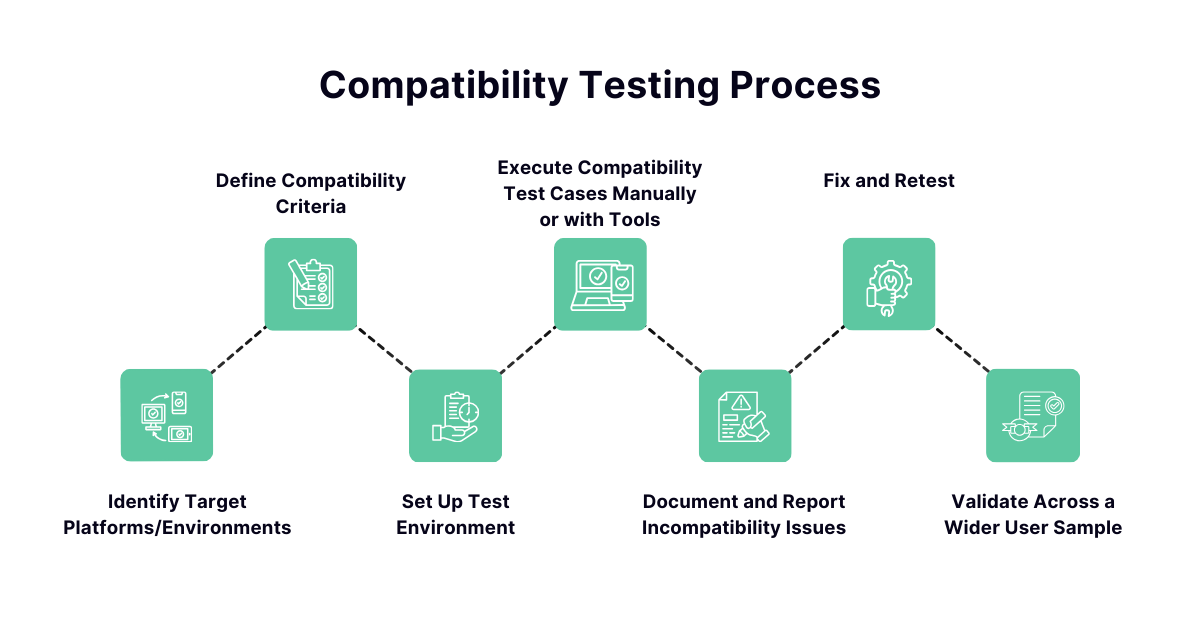
Consumer relationship quizzes skip nearly every one of those steps. They don't define criteria, don't document incompatibilities honestly, and never revisit the result. The rigor gap — not the concept — is what makes compatibility testing feel unserious.
This is exactly what the Personality Analyzer was built for.
Why the Personality Analyzer Works as an AI Compatibility Test
The Personality Analyzer is a deep integrative personality psychologist that synthesizes Big Five, MBTI, Enneagram, attachment theory, and more to reveal patterns you haven't articulated yet. Applied to two people, that integration is exactly what a compatibility assessment requires — because no single framework covers values, conflict behavior, and emotional regulation at once.
| Traditional Compatibility Quiz | Personality Analyzer |
|---|---|
| 40 checkbox questions about hobbies and preferences | Conversational assessment that surfaces behavior, not self-image |
| One framework in isolation (usually MBTI or a zodiac chart) | Big Five, MBTI, Enneagram, and attachment theory synthesized |
| A percentage score with no explanation | Dimension-by-dimension reasoning about why something matters |
| Emphasizes similarity | Emphasizes values alignment and communication, per the research |
| Hides friction to keep the result pleasant | Names the specific friction points and how they'll recur |
| One-time result, never revisited | Persistent memory across sessions to track patterns over time |
Values Before Traits
The analyzer prioritizes the dimensions with actual evidence behind them: how each person thinks about family, money, children, ambition, religion, and independence. Where two people diverge on a trait, it explains whether that divergence is decorative or load-bearing — because core values similarity carries substantially more weight than personality similarity in predicting satisfaction.
"Here's how each of us describes what we want life to look like in ten years. Where do these actually conflict, and where are we just using different words for the same thing?"
Communication and Conflict Mapping
Rather than asking "how do you handle conflict?", the analyzer works through actual described arguments and extracts the pattern: who escalates, who withdraws, who needs resolution immediately, and who needs distance first. Those two profiles interacting is where most compatibility questions are genuinely answered.
"Walk me through our last three arguments. What's the recurring structure, and which of us is driving it?"
Attachment as the Missing Layer
Attachment theory explains behavior that trait models can't — why one partner reads a delayed reply as abandonment while the other reads a check-in as pressure. Integrating it alongside Big Five and Enneagram produces a read that's substantially more useful than any of those frameworks alone.
"Based on everything I've described, what's my likely attachment style and how does it interact with hers?"
Honest Friction Reporting
The analyzer names the incompatibilities. A compatibility test that returns only good news is worthless, in the same way a test suite that reports zero failures on untested code is worthless. The value is in the documented issues — the specific, nameable places where two people will predictably grind against each other, and whether those are manageable or fundamental.
Related Agents You'll Also Find Useful
Compatibility assessment sits inside a longer sequence. These agents cover the stages on either side of it.
MBTI Personality Guide
If you want to go deep on type specifically — including relationship compatibility through a cognitive function lens — this agent handles conversational typing, mistype verification, and growth paths.
- Conversational typing rather than a self-report questionnaire
- Mistype verification, which matters because most people's self-assessed type is wrong
- Dedicated relationship compatibility analysis by type pairing
Relationship Advisor
A compatibility read tells you where the friction is. The Relationship Advisor helps you do something about it — practical guidance for romance, family, and friendships with honest perspective rather than reflexive validation.
- Actionable guidance for working through identified friction points
- Honest perspective when the answer isn't what you want to hear
- Support across romantic, family, and friendship dynamics
Dating App Advisor
If you're assessing compatibility before a relationship exists, the earlier problem is converting matches into real conversations. The Dating App Advisor covers profile optimization, conversation mastery, and first date guidance with honest feedback.
- Profile and conversation coaching that gets you to the assessment stage
- Honest diagnosis of why conversations stall
- Guidance on reading interest and timing the ask
Numerology Reader
For readers who approach compatibility through symbolic systems, this agent reads full charts across Pythagorean, Chaldean, Vedic, and Kabbalistic traditions, including compatibility synthesis across Life Path and karmic patterns.
- Multi-system numerological compatibility analysis
- Life Path, cycles, and karmic pattern synthesis
- A symbolic complement to the psychological assessment
Try the Personality Analyzer free — no credit card required.
How It Works: From Two Profiles to an Honest Read
Step 1: Establish Your Own Profile First
Before comparing anyone, the analyzer builds a picture of you through conversation — how you describe decisions, conflicts, and what you want. This takes longer than a quiz and produces something a quiz can't: a read on behavior rather than self-image.
"Ask me whatever you need to build an accurate profile. Be thorough and don't let me off easy on the vague answers."
Step 2: Add the Second Profile
Describe your partner as specifically as you can, or have them go through the same process directly. Two first-person profiles produce a substantially better result than one person's description of both people — self-report bias is real, but so is describing-your-partner bias.
"Here's how she describes herself, in her own words. Build her profile from this."
Step 3: Get the Dimensional Comparison
You'll get a breakdown across values, communication style, conflict behavior, attachment, emotional needs, and life direction — with reasoning about which gaps matter and which don't. No single percentage, because a single percentage collapses genuinely different situations into the same number.
"Compare us dimension by dimension. Tell me which differences are cosmetic and which are structural."
Step 4: Interrogate the Friction Points
This is where the value concentrates. Push on the specific incompatibilities: how they'll show up, whether they're workable, and what each person would need to change.
"You flagged our conflict styles as the main issue. Show me exactly how that plays out over a year and what would need to change."
Step 5: Revisit as Things Change
Compatibility isn't a fixed measurement. Because the platform maintains persistent memory across sessions, you can return after six months, describe what's actually happened, and get an updated read grounded in real evidence rather than the original prediction.
"Six months on. Here's what actually happened with the conflict pattern you flagged. Reassess."
Results & Use Cases
💑 Assessing an Early Relationship Before You're Deep In
Scenario: Three months in, going well, and you want an honest read before the emotional stakes make objectivity impossible.
Traditional Approach: Take a free online quiz together, get 91%, learn nothing, proceed on vibes.
Personality Analyzer: A dimensional assessment that names the specific friction points early, when they're still discussable rather than entrenched.
- Surfaces value mismatches before they become sunk-cost problems
- Distinguishes cosmetic differences from structural ones
- Frames findings as discussable rather than verdicts
🗣️ Diagnosing a Recurring Argument
Scenario: You have the same fight every six weeks in slightly different clothing, and neither of you can explain why.
Traditional Approach: Blame the surface topic — dishes, money, phone use — and fix nothing, because the topic was never the issue.
Personality Analyzer: Extracts the underlying pattern from the described arguments and maps it to attachment and conflict-style differences.
- Identifies the structure beneath the recurring surface topic
- Explains each person's behavior as coherent rather than malicious
- Cross-session memory tracks whether the pattern actually shifts
📱 Running a Compatibility Read From Your Phone
Scenario: You're between things, thinking about a relationship question, and want to work through it without booking anything.
Traditional Approach: Read three contradictory articles, take a quiz that asks about your favorite season, feel no clearer.
Personality Analyzer: A full conversational assessment from your phone with feature parity across iOS, Android, and web, plus everything saved for when you come back to it.
- Full assessment depth on mobile, not a reduced version
- Persistent history so you can resume rather than restart
- Available at the moment the question actually surfaces
🎯 Understanding Why Your Pattern Keeps Repeating
Scenario: Three relationships, three different people, same ending. Something systematic is happening and you can't see it from inside.
Traditional Approach: Conclude you have bad luck, or that everyone else is the problem.
Personality Analyzer: Analyzes across relationships rather than within one — the pattern lives in what you consistently select for and how you consistently respond.
- Cross-relationship pattern recognition rather than single-case analysis
- Integrates attachment theory, which is where repetition patterns usually originate
- Pairs naturally with the Relationship Advisor for what to do about it
Frequently Asked Questions
Is an AI compatibility test free to use?
Yes. The Personality Analyzer is available on Jenova's free tier with all core features and limited monthly usage — no credit card required. Paid plans start at $20/month for substantially higher usage limits and custom model selection. Usage resets monthly on your billing date with the full limit available from day one, rather than daily caps.
Are AI compatibility tests actually accurate?
They're as accurate as the variables they measure. Tests built on hobbies and personality similarity have weak predictive value — research finds personality similarity plays a negligible role in relationship satisfaction. Tests built on values alignment, communication style, and conflict behavior are on firmer ground. Treat any result as a structured hypothesis to discuss, not a verdict.
What does an AI compatibility test actually measure?
Core values (family, money, children, lifestyle, belief), communication and conflict style, attachment patterns, emotional needs, and long-term life direction. These are the dimensions with the strongest research support — similarity in core values consistently outperforms similarity in personality traits as a predictor of satisfaction.
Can it test compatibility if my partner won't participate?
Partially. You can build your own profile in depth and describe your partner as accurately as possible, which still yields useful analysis of your own patterns and likely friction points. But two first-person profiles produce a meaningfully better result — describing someone else always carries your interpretation with it.
Does it work for friendships and work relationships too?
Yes. The same frameworks — Big Five, Enneagram, communication style, conflict behavior — apply directly to friendships, co-founders, and working relationships. For type-specific dynamics, the MBTI Personality Guide offers deeper cognitive function analysis of any pairing.
Will it just tell me we're compatible?
No. Honest assessment is the design principle. The analyzer names the specific incompatibilities and explains how they'll surface over time. A compatibility test that only returns good news provides no information — the documented friction is the entire product.
Conclusion
Compatibility testing has a bad reputation because most of it measures the wrong variables. Shared hobbies feel predictive and aren't. Matching personality traits feel predictive and, according to the research, largely aren't either. Meanwhile the dimensions that do carry weight — core values, communication style, conflict behavior, attachment patterns — are precisely the ones a checkbox quiz can't capture, because people don't self-report them accurately.
A well-built AI compatibility test closes that gap. Multi-framework analysis instead of a single lens, values and communication weighted ahead of trait similarity, conversational assessment that surfaces behavior rather than self-image, honest documentation of friction rather than a flattering percentage, and persistent memory so the read can be revisited as the relationship actually develops. Better inputs, better questions, and a result you can act on rather than screenshot.
Try the Personality Analyzer now and bring the relationship question you've been circling. Explore the full agent library at Jenova.
For Developers: Personality Analyzer is available programmatically via the Jenova API — integrate multi-framework compatibility and personality assessment into your dating or wellness application with a single API call. Full documentation →