AI Company Valuation: Multiples, Metrics & Frameworks That Hold
2026-08-19
Getting an AI company valuation right means pricing three things at once: revenue quality, compute economics, and defensibility. The Fundamental Stock Analyst works through all three — running relative valuation, stress-testing revenue durability, and pulling real-time data from filings and analyst estimates so your multiple is anchored in evidence rather than narrative. AI valuations move faster and disperse wider than any software category before them, and the gap between an 8x and a 28x revenue multiple usually comes down to details a spreadsheet alone won't surface.
✅ Relative valuation against genuine comparables, not category averages ✅ Margin and unit-economics analysis built for compute-heavy businesses ✅ Real-time research across filings, estimates, and market sentiment ✅ Scenario testing so you know which assumptions actually move the number
To understand why AI valuation is harder than conventional software valuation, it helps to look at the market conditions creating the dispersion — record capital concentration, structurally lower gross margins, and a renewal cycle that is only now testing whether early revenue was real.
Quick Answer: What Is AI Company Valuation?
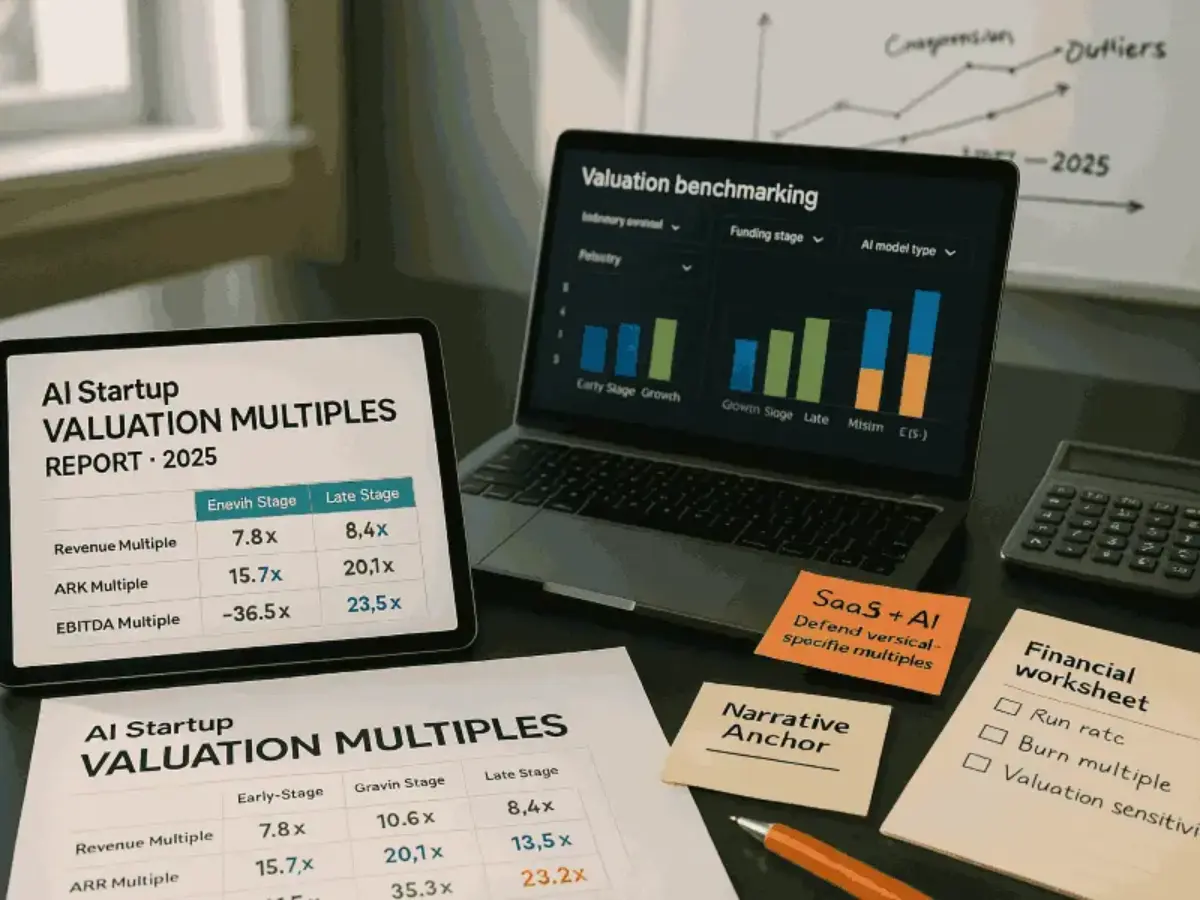
AI company valuation is the process of estimating an artificial intelligence business's economic worth by combining revenue multiples, discounted cash flow, and comparable transactions with AI-specific adjustments for compute costs, data defensibility, and revenue durability.
Key capabilities of a rigorous valuation process:
- Benchmark revenue and ARR multiples against genuinely comparable AI companies, adjusted for stage
- Model gross margin trajectory net of inference and compute costs
- Assess retention, engagement, and net dollar retention as proxies for revenue durability
- Stress-test the valuation against model commoditization and platform encroachment risk
- Triangulate DCF, comparable company analysis, and precedent transactions rather than relying on one method
The Problem: Why AI Valuations Are So Hard to Pin Down
AI has become the dominant destination for private capital, and the sheer weight of that capital has distorted the reference points valuers normally lean on. Crunchbase data shows investors poured $300 billion into 6,000 startups globally in Q1 2026, with AI capturing 80% of total global venture funding that quarter. Four of the five largest venture rounds ever recorded closed in that single quarter.
$242 billion — AI's share of Q1 2026 global venture funding, or 80% of all venture capital deployed
**$37 billion** — [Enterprise generative AI spend in 2025, up 3.2x from $11.5 billion in 2024](https://menlovc.com/perspective/2025-the-state-of-generative-ai-in-the-enterprise/)
But translating that market energy into a defensible number is frustratingly difficult:
- Comparable sets are thin, and the "AI" label spans wildly different business models
- Gross margins behave nothing like traditional SaaS
- Revenue can grow fast without being durable
- The moat question — data, workflow, or nothing — is often unanswerable from the outside
- Concentration means headline multiples are set by a handful of outlier deals
Compute Costs Break the SaaS Margin Assumption
Software valuation frameworks assume near-zero marginal cost to serve an additional customer. AI inverts that. Every query reruns the model and consumes GPU compute, so greater customer engagement raises the cost to serve. AI application companies average roughly 52% gross margins, with AI-specific features landing in the 50-60% range, against 80-90% for traditional SaaS.
That gap is not cosmetic. It changes how much runway a given funding round provides and how a valuation multiple should be interpreted. A 20x revenue multiple on a 52% gross margin business is not the same asset as a 20x multiple on an 85% gross margin business.
Fast Revenue Growth Is Not Evidence of Durability
AI-native startups are eight times more likely to reach $10 million ARR within 12 months than the average SaaS business. That statistic is frequently used to justify premium multiples — and frequently misread.
Speed of acquisition says little about retention. As one venture analysis puts it, a company reporting $10 million in run-rate ARR that loses 70% of cohorts at renewal hasn't built a $10 million business. Valuing early AI revenue at SaaS-equivalent multiples without cohort evidence is the most common error in the category.
The Comparables Problem
Standard valuation practice rests on comparable company analysis and precedent transactions. In AI, both are unstable. An infrastructure company, a vertical application, and a thin application-layer wrapper may all describe themselves in the same terms while carrying entirely different margin structures and defensibility profiles.
Analysis of business valuation approaches notes that traditional methods — market capitalization, discounted cash flow, and asset-based approaches — rely on historical financial data and market comparisons. AI companies frequently have short histories, negative EBITDA, and comparable sets drawn from a category that barely existed three years ago.
Platform Encroachment Risk Is Rarely Priced
Foundation model providers no longer sell API access exclusively. They build application-layer products in categories where they observe strong demand from their own API customers. The entity powering a startup's product may simultaneously be building a competing one.
This is a valuation input, not a footnote. A company whose entire product is a feature the model provider could ship deserves a materially different multiple than one holding proprietary data pipelines or system-of-record status.
Method Selection Materially Changes the Answer
There is no single correct approach. Practitioners generally blend discounted cash flow, comparable company analysis, precedent transactions, and IP-weighted models. Choosing only one — usually the most flattering — produces numbers that collapse under diligence.
This is exactly what the Fundamental Stock Analyst was built for.
The Solution: Valuing AI Companies With Evidence, Not Narrative
The Fundamental Stock Analyst approaches AI company valuation the way a disciplined equity research desk would: build the comparable set deliberately, adjust for the economics that make AI different, and pressure-test the result before committing to a number. It works across SEC filings, analyst estimates, and live market sentiment, so the inputs reflect current conditions rather than a stale benchmark report.
| Traditional Approach | Fundamental Stock Analyst |
|---|---|
| Apply a category-average revenue multiple | Build a comparable set matched on margin structure and business model |
| Treat gross margin as a fixed input | Model margin trajectory net of inference and compute costs |
| Accept ARR at face value | Interrogate retention, cohort behavior, and net dollar retention |
| Rely on a single valuation method | Triangulate DCF, comparables, and precedent transactions |
| Static point estimate | Scenario analysis showing which assumptions drive the range |
Relative Valuation Against a Real Comparable Set
Category averages are the enemy of accurate AI valuation. This AI-powered equity research tool constructs comparable sets based on what actually drives the multiple — revenue model, gross margin profile, customer concentration, and stage — rather than shared industry tagging.
"Build a comparable set for a vertical AI company doing $18M ARR at 61% gross margin serving healthcare systems, and derive a defensible EV/Revenue range."
Compute Economics and Margin Trajectory
Because AI margins can improve materially through workload routing and caching, the present margin is not the terminal margin. Companies reporting the strongest gross margins route most queries to smaller or fine-tuned models and escalate only complex tasks to frontier models. Prompt caching offers similar leverage — cache reads on Anthropic's Sonnet cost $0.30 per million tokens versus $3.00 for fresh input.
The analyst models that trajectory explicitly, separating structurally low margins from temporarily low margins. That distinction is often the single largest swing factor in the valuation.
"Model the gross margin path for an AI application company currently at 54%, assuming 60% of queries can be routed to smaller models within 18 months."
Revenue Durability and Retention Analysis
Net dollar retention, daily and monthly active users, session frequency, task success rate, and time to value together indicate whether revenue is durable or borrowed. Investors evaluating AI startups weight gross margin, growth quality, and engagement metrics as the foundational trio — and the Fundamental Stock Analyst builds the valuation around those inputs rather than treating them as commentary.
Business Model Assessment and Moat Testing
The staying-power question is whether model improvements make a company stronger or easier to replace. Companies that pass typically combine proprietary data access with deep workflow embedding, or vertical specialization with regulatory complexity. The analyst frames this as a discount-or-premium decision on the multiple, with the reasoning made explicit.
"Assess whether this company's data advantage is structural or incidental, and quantify the multiple impact either way."
Scenario Stress Testing
Point estimates hide fragility. The valuation is stress-tested across model commoditization, pricing compression, renewal-cycle churn, and platform encroachment — producing a range with named drivers rather than a single number with false precision.

Related Agents You'll Also Find Useful
Valuation rarely happens in isolation. These agents cover the adjacent work that surrounds an AI company valuation — market context, portfolio implications, and the founder-side view.
Startup Advisor — A serial founder turned VC perspective, forged alongside a16z, YC, and Sequoia. If you're on the founder side of the table, this is where you pressure-test the valuation story before investors do.
- Brutally honest assessment of your fundraising narrative and multiple justification
- Stage-appropriate strategic guidance for venture-scale companies
- Framing for how investors will read your metrics
Macro Strategist — Discount rates and risk appetite set the ceiling on every valuation. This agent supplies the cross-asset and policy context that determines whether multiples are expanding or compressing.
- Cross-asset synthesis and policy analysis
- Institutional-grade macro intelligence for professional investors
- Automated daily briefings on conditions affecting risk pricing
Portfolio Management Strategist — Once you've valued the company, the next question is position sizing. This institutional portfolio analyst handles allocation analysis, drift detection, and scenario stress tests.
- Risk assessment and concentration analysis for AI-heavy portfolios
- Scenario stress tests across market regimes
- Rebalancing recommendations grounded in allocation targets
Economics Analyst — For the structural questions underneath AI valuations: where compute cost curves are heading, how the sector's capital intensity resolves, and what that means for terminal assumptions.
- Mechanism tracing and scenario analysis
- Institutional-grade coverage across macro, micro, and policy
- Data-driven insight into sector-level economics
Try Jenova free — no credit card required.
How AI Company Valuation Works: Step by Step
Step 1: Define the Business Model Precisely
Before any multiple is applied, establish what kind of AI company this is: infrastructure, vertical application, horizontal application, or model provider. Pricing structure matters as much as category — token-based, subscription with usage caps, outcome-based, and hybrid models each carry different margin and predictability profiles.
"Classify this company's business model and pricing structure, then identify which valuation multiples are most appropriate."
Step 2: Build the Comparable Set
Assemble comparables matched on revenue model, gross margin, growth rate, and stage — not industry label. The Fundamental Stock Analyst pulls current data across filings and analyst estimates so the set reflects live pricing, and flags where the sample is too thin to support a tight range.
"Find comparable public and private companies for a horizontal AI application at $40M ARR growing 180% year over year."
Step 3: Adjust for AI-Specific Economics
Layer in the adjustments that generic frameworks miss: current and projected gross margin net of compute, inference cost per user cohort, data defensibility, workflow embedding depth, and platform encroachment exposure. Each adjustment should carry an explicit premium or discount to the base multiple.
"Apply AI-specific adjustments to a 12x base EV/Revenue multiple — the company has 55% gross margin, proprietary regulated-industry data, and deep ERP integration."
Step 4: Triangulate Across Methods
Run relative valuation, DCF where cash flows are forecastable, and precedent transactions in parallel. Where the three diverge sharply, the divergence itself is the finding — it usually points to an assumption doing more work than it should.
"Run DCF, comparables, and precedent transaction analysis on this company and explain where the three methods disagree and why."
Step 5: Stress-Test and Produce a Range
Convert the point estimate into a defensible range by testing the assumptions that matter: margin improvement failing to materialize, renewal-cycle churn, model commoditization, and competitive encroachment. Name the drivers behind the high and low ends.
Results & Use Cases
📊 Investor Diligence on a Series B AI Application
Scenario: An investor is evaluating a $25M Series B round in a vertical AI company claiming $12M ARR and requesting a 22x forward revenue multiple.
Traditional Approach: Two to three weeks of analyst time assembling comparables, building a model, and reconciling conflicting benchmark reports — often ending in a range too wide to act on.
Fundamental Stock Analyst: A structured valuation with a matched comparable set, margin-adjusted multiple, retention-based durability assessment, and a stress-tested range with named drivers — produced in a single working session.
- Comparable set built on economics, not category tags
- Explicit premium/discount reasoning for every adjustment
- Scenario range that survives investment committee questioning
💼 Founder Preparing a Fundraise
Scenario: A founder needs to justify a $200M pre-money valuation to a skeptical lead investor.
Traditional Approach: Cherry-pick favorable headline multiples from industry reports and hope the comparable-set question doesn't come up.
Fundamental Stock Analyst: A defensible valuation narrative anchored in the company's actual gross margin trajectory, retention cohorts, and moat evidence — with the weak points identified before the investor finds them. Pairing this with the Startup Advisor closes the loop between the number and the story.
- Pre-identified objections with prepared responses
- Margin improvement path modeled explicitly
- Multiple justified by company-specific evidence, not category momentum
📱 Rapid Screening on Mobile
Scenario: An investor sees a funding announcement during a commute and wants an immediate read on whether the implied multiple is defensible.
Traditional Approach: Bookmark it, forget it, or form an impression from a headline with no analysis behind it.
Fundamental Stock Analyst: A quick sanity check on the implied multiple against comparable economics, delivered on mobile with full feature parity — enough to decide whether the deal warrants real diligence.
- Instant implied-multiple assessment from announced round terms
- Flags where the number depends on heroic assumptions
- Full chat history syncs to desktop for deeper follow-up
🎯 Portfolio-Level AI Exposure Review
Scenario: A fund holds seven AI positions and wants to know whether valuations across the book have drifted beyond what fundamentals support.
Traditional Approach: Position-by-position manual review, typically done annually and often too late.
Fundamental Stock Analyst: Consistent valuation methodology applied across every holding, surfacing which positions carry the most multiple risk. Combined with the Portfolio Management Strategist, this becomes an allocation decision rather than an observation.
- Uniform methodology eliminates position-to-position inconsistency
- Identifies concentration in similarly-exposed business models
- Feeds directly into rebalancing analysis
Frequently Asked Questions
What revenue multiple should an AI company trade at?
There is no single correct multiple. Dispersion in AI is driven by gross margin structure, revenue durability, and defensibility — a company at 52% gross margin with weak retention and one at 75% with proprietary data are not comparable regardless of shared category. The right approach is to build a comparable set matched on economics, then apply explicit premiums and discounts. The Fundamental Stock Analyst constructs that set and documents each adjustment.
Why are AI gross margins lower than SaaS gross margins?
AI products pay real compute costs on every interaction. Traditional SaaS incurs almost nothing to serve one additional user, while AI application companies average roughly 52% gross margins because inference, data fees, and human-in-the-loop review all consume revenue. Margins can improve through model routing and caching, but the current margin should never be assumed to be the terminal margin without an explicit improvement path.
Which valuation method works best for AI companies?
No single method is sufficient. Practitioners blend discounted cash flow, comparable company analysis, precedent transactions, and IP-weighted models — and the disagreement between methods is often more informative than any one result. Where DCF and comparables diverge sharply, an assumption is usually carrying too much weight.
How do you value a pre-revenue or early-stage AI company?
With revenue multiples unavailable, the valuation shifts to qualitative drivers: proprietary data access, team, technical differentiation, and market timing, benchmarked against recent precedent rounds at the same stage. Early-stage AI valuations carry a documented premium over non-AI peers, but that premium reflects market conditions rather than company-specific fundamentals and should be treated as a starting point, not a conclusion.
Can AI tools actually perform business valuation?
AI handles the analytical heavy lifting — extracting and processing financial data, tracking market and industry trends in real time, and running scenario analysis far beyond spreadsheet capacity, while reducing the bias and calculation errors that distort manual work. Judgment on comparable selection and moat assessment still matters, which is why the Fundamental Stock Analyst surfaces its reasoning rather than returning a bare number.
Is the Fundamental Stock Analyst free to use?
Core features are available on the free tier with limited usage. Paid tiers increase usage limits substantially and add custom model selection. Check "Usage Limit" and "Subscribe" in the menu for current details on plans and allowances.
Conclusion
AI company valuation fails when it borrows SaaS assumptions wholesale. The category carries structurally different gross margins, revenue that grows fast without necessarily being durable, and competitive dynamics where the platform powering your product may become your competitor. Applying a category-average multiple to any of that produces a number that will not survive diligence.
Valuing an artificial intelligence business properly means doing four things well: building a comparable set matched on economics rather than labels, modeling the gross margin trajectory net of compute, testing revenue durability through retention and cohort behavior, and triangulating across DCF, comparables, and precedent transactions before committing to a range. Each of those steps is where AI valuation multiples are actually determined.
Try Fundamental Stock Analyst now — build a valuation you can defend line by line.
Explore more at Jenova.
For Developers: Fundamental Stock Analyst is available programmatically via the Jenova API — integrate equity research and valuation analysis into your fintech or investment application with a single API call. Full documentation →