AI Comic Strip Maker: Create Multi-Panel Comics From Your Ideas
2026-08-10
Comic Creator is your personal comic book artist for building complete stories — and it handles the short form beautifully, from a three-panel gag to a running strip series. It solves the thing that breaks every DIY attempt: keeping your characters recognizable panel to panel while the layout, expressions, and setting change around them. You bring the joke, the beat, or the moment; the AI handles the sequential art.
✅ Multi-panel output — three-panel strips, four-panel gags, full-page sequences ✅ Consistent characters across every panel and every strip in a series ✅ Flexible panel layouts — grids, wide establishing shots, stacked reaction beats ✅ Bold style range — newspaper strip, webcomic, anime-influenced, superhero parody
A comic strip looks like the easy tier of sequential art. It isn't. Three panels give you nowhere to hide — the timing has to be exact, the character has to be instantly readable, and the punchline has to land in the last frame. Understanding why short form is deceptively hard is the fastest route to seeing what an AI comic strip maker actually fixes.
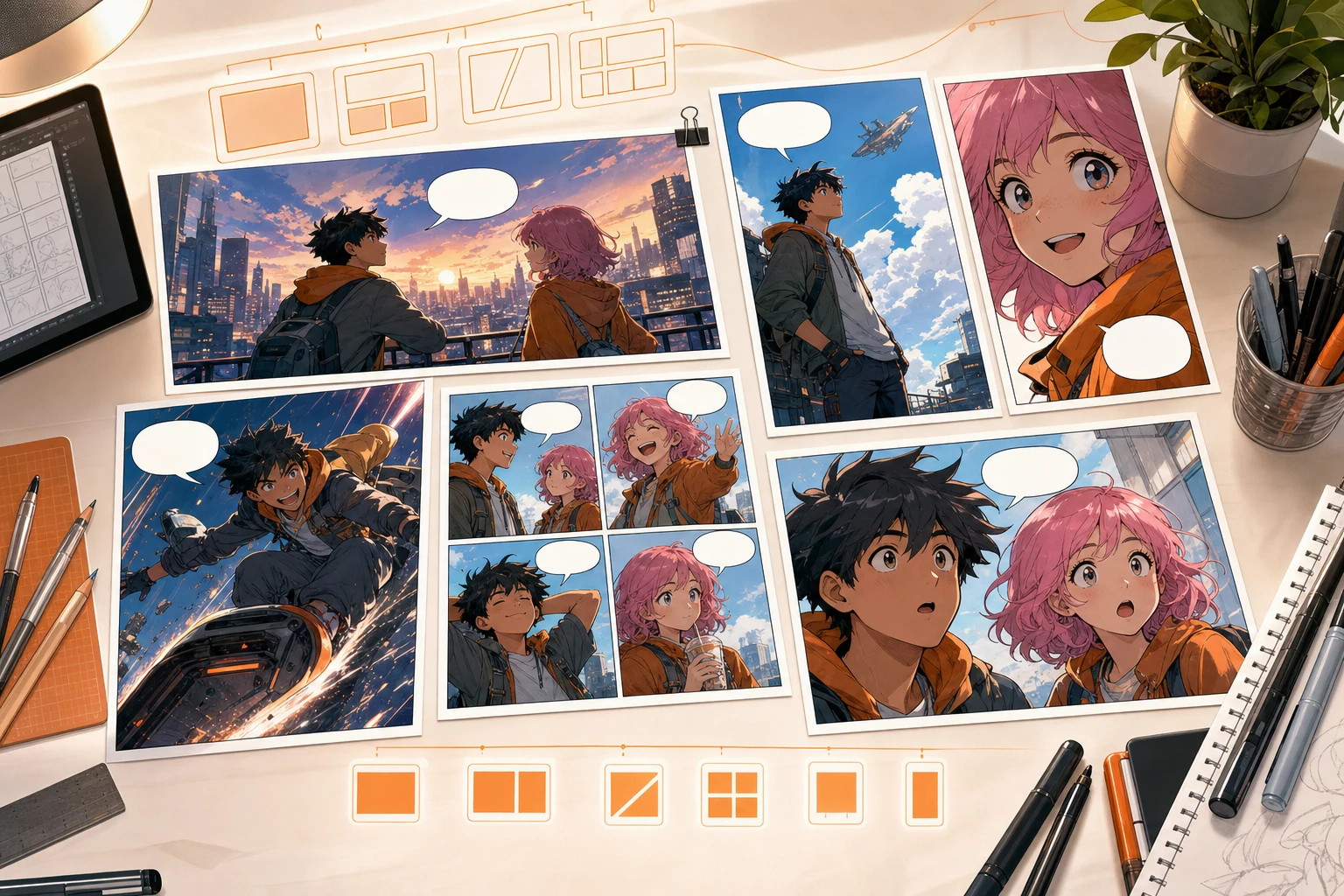
Quick Answer: What Is an AI Comic Strip Maker?
An AI comic strip maker is a tool that turns a written idea into a finished multi-panel comic — generating panel art, layout, dialogue placement, and consistent character designs across every frame in the sequence.
Key capabilities:
- Story and gag structure — setup, turn, and punchline timing with the Comic Creator
- Character consistency — the same face, build, and outfit in panel one and panel four
- Flexible panel layouts — grid strips, wide shots, stacked reactions, and full-page sequences
- Dialogue and lettering placement — speech bubbles positioned for natural reading flow
- Series continuity — recurring cast and style carried across strip after strip
The Problem: Why Comic Strips Are Harder Than They Look
The comics medium is in a growth cycle, but the traditional home of the comic strip has been collapsing underneath it.
One in five Canadians reported reading comics, manga, or graphic novels in 2024 — comics industry overview
Total North American comics and graphic novel sales reached approximately $2.08 billion in 2021 — comics industry sales data
Original graphic novel sales in the US have doubled since 2019 to 35 million books a year — second only to general fiction and romance in book sales
Meanwhile, the print strip pipeline that once made cartoonists famous has shrunk badly. Industry analysis is blunt about it: the era when comic strips were the "center of national daily conversation" has fractured, print newspapers are shrinking, and syndicated cartoonists have taken significant income losses. It has become "rare for a new feature to achieve massive success through the print pages."
The audience moved online. The publishing barrier dropped to zero. But actually making strips consistently is where it falls apart:
- Character consistency is the number one technical failure in any multi-panel work
- Panel timing is precision work — three or four frames leave no room for slack
- Volume kills momentum — a strip series needs new installments constantly
- Drawing skill gates everyone who has funny ideas but no art training
- Multi-tool AI workarounds are exhausting and still don't guarantee results
Character Consistency Is the Documented Failure Point
This is the wall everyone hits. Creators attempting AI comics have described the core issue directly — the
when using general-purpose image generators.The reason is structural. As one technical breakdown of AI comic workflows explains, most AI image generators are stateless — each generation is a new roll of the dice, and the model doesn't remember the character from panel one when creating panel two. Your hero's jawline shifts. The haircut changes. The jacket color drifts. In a four-panel strip, that's a quarter of your comic broken.
The DIY Workaround Is a Production Nightmare
Creators have responded by building elaborate multi-tool pipelines. The same analysis describes sprawling, complex charts mapping out multi-tool workflows — a prompt in one generator with a character reference tag, fed into a second tool with a control rig, then stitched together in an image editor.
That's ingenuity born of frustration. It's also three tools, a manual assembly step, and hours of work for a comic that should take minutes.
Panel Timing Is Precision Craft
A comic strip is a joke or a beat delivered in three or four frames. Panel one establishes. Panel two turns. Panel three lands. Get the gutter timing wrong and a funny idea reads flat. Get the panel sizing wrong and the reader's eye lands on the punchline before the setup. This is real craft, and it's invisible until it fails.
Volume Is What Actually Kills Strip Series
A strip series lives on regularity. Readers come back because there's something new. Solo creators who can draw well enough usually can't draw fast enough to sustain a schedule — and the ones who can sustain it typically burn out inside a year.
The Skill Gap Is Really a Comedy and Storytelling Gap
The frustrating part: the funniest people, the best observational writers, and the sharpest character voices are frequently the ones who cannot draw at all. Their bottleneck was never the idea.
This is exactly what the Comic Creator was built for.
Why Comic Creator
The Comic Creator functions as a full comic book artist collaborator — one that treats a three-panel strip with the same craft attention as a graphic novel page, because in short form, every panel is load-bearing.
| Traditional Strip Production | Comic Creator |
|---|---|
| Years of drawing training before your first readable strip | Start from an idea and produce a finished strip immediately |
| Characters drift between panels without rigid model sheets | Locked character references held across every panel and strip |
| Multi-tool AI pipelines with manual assembly | One conversation from concept to finished strip |
| Panel timing learned through hundreds of failed attempts | Sequential art grammar built into every layout |
| Hiring an artist per strip is economically impossible | Iterate freely at platform subscription cost |
| A regular publishing schedule burns out solo creators | Sustainable output at a repeatable pace |
Idea to Structure First
The Comic Creator shapes the beat before it draws anything. Setup, turn, punchline. Which panel carries the reveal. Whether the strip needs three panels or four. Where the silent beat goes. You can't compose a strip well without knowing which frame does the work.
"Three-panel strip: my character confidently explains why he doesn't need a map, then we cut to him upside down in a ditch. Help me nail the timing."
Character Consistency Across Every Panel
Design your cast once and their appearance carries forward — face structure, hair, outfit, build, signature expressions. The industry-standard fix for stateless generation is to define your character's visual DNA upfront and use that definition as a strict control for every subsequent image. That's the workflow, handled inside a single conversation instead of across three tools.
"Design my two leads: a guy with messy black hair in a grey hoodie and orange jacket, and a girl with curly pink hair in an orange coat. Lock these designs for the whole series."
Flexible Panel Layouts
Even panel grids for rhythmic comedy. A wide establishing panel followed by tight reaction shots. Stacked verticals for escalating chaos. Diagonal compositions for kinetic action. Panel size and gutter spacing used deliberately as timing devices, not defaults.
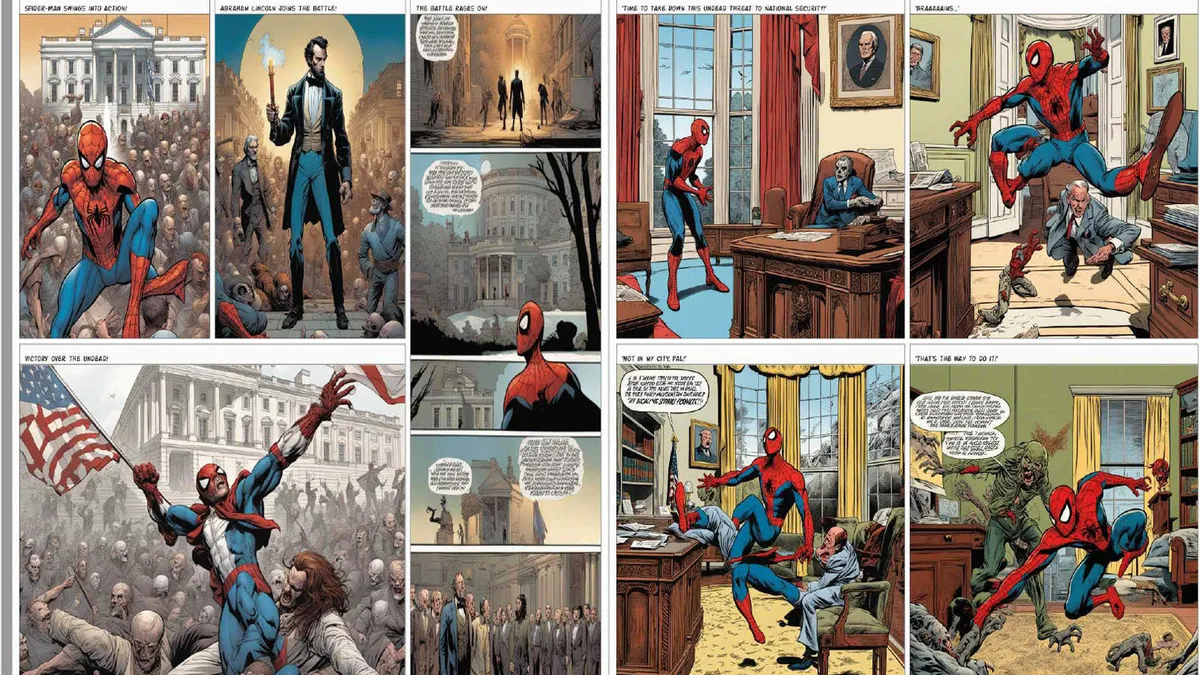
Bold Style Range
Clean newspaper-strip linework with flat color. Expressive webcomic style with loose brushwork. Anime-influenced with dynamic speed lines. Heavy-ink superhero parody. Whichever register you pick applies uniformly to the whole series.
Series Continuity
The same recurring cast, same visual world, same tone — strip after strip. This is where most tools collapse: remembering your character's design and running gags forty strips later is a memory problem, not an art problem. Unlimited chat history and persistent cross-session memory are what make an ongoing strip series practical.
Related Agents You'll Also Find Useful
Strips rarely stay strips. If your series takes off, these agents cover the work you'll hit within your first few months.
Webtoon Creator
If your strips are performing and readers want longer installments, vertical scroll is where the audience is. Webtoon is the world's largest digital comics platform with over 82 million monthly users, reaching an audience the traditional industry long overlooked.
- Vertical scroll rhythm and pacing built for phone screens
- Episode hooks and cliffhanger structure for serialized release
- Full-color consistency across 100+ episode sagas
Manga Creator
If your strip style leans Japanese — yonkoma four-panel gag strips are a whole tradition, with distinct panel conventions and screentone grammar.
- Manga-native visual storytelling and panel flow
- One-shots through 200+ page serialized epics
- Consistent art style across long-running arcs
Meme Generator
Strips and memes share distribution channels. If you're building an audience on social platforms, format-matched meme content is the fastest way to grow reach between strip drops.
- Expert format matching across template types
- Deep knowledge of meme history and template sourcing
- From classic image macros to current viral trends
Graphic Designer
Every strip series needs assets that aren't strips — a banner, a logo, merch graphics, and collection covers if you compile a book later.
- Series branding and logo treatment
- Social and promotional graphics
- Print-ready formatting for physical collections
Try the Comic Creator free — no credit card required.
How It Works
Step 1: Bring Your Idea
Start with whatever you have — a punchline, an observation, a character voice, or a scene you can picture. The AI shapes it into a strip structure with the right panel count for the beat.
"I have a joke about a guy who buys a plant and immediately starts negotiating with it. Turn this into a comic strip."
Step 2: Lock In Your Cast and Style
Design your characters and fix the visual register. This becomes the reference every future strip builds on, so strip fifty still matches strip one.
"Clean webcomic style, bright flat colors, expressive faces. Lead is late twenties, messy dark hair, always in the same green sweater. His plant is enormous and menacing. Lock this in."
Step 3: Set Your Panel Layout
Decide the panel count and arrangement based on the beat. Three panels for a clean gag, four for a slower build, a wide top panel for an establishing shot.
"Four panels this time. Make panel three a silent reaction shot — no dialogue at all — then the punchline in four."
Step 4: Generate and Refine
Produce the finished strip with art, layout, and dialogue placement. Then iterate — tighten a line, change an expression, adjust the timing.
"The punchline lands too soft. Make his expression more deadpan in panel four and cut the last three words of dialogue."
Step 5: Build the Series
Keep going. Cast, style, and running gags carry forward automatically — you aren't rebuilding your world every session.
"New strip, same cast. The plant has now taken over the couch and he's sleeping in the hallway."
Results & Use Cases
😄 The Funny Person Who Can't Draw
Scenario: Someone with genuinely good comedic timing wants to publish a weekly strip but has zero drawing ability.
Traditional Approach: Learn to draw for three years, hire an artist they can't afford, or abandon the idea entirely — which is what almost everyone does.
Comic Creator: Describe the beat, lock a cast, and produce finished strips on a regular schedule.
- Comedy judged on writing, not rendering ability
- Consistent characters readers actually recognize week to week
- A publishable strip in a single sitting instead of a multi-year skill investment
💼 The Brand and Content Marketer
Scenario: A company wants a recurring strip featuring a mascot character to make dry product content engaging on social.
Traditional Approach: Contract an illustrator on retainer, wait on revision cycles, and pay per strip indefinitely.
Comic Creator: Lock the mascot design once, then produce on-brand strips at content-calendar speed.
- Brand character stays visually identical across every post
- Fast turnaround when a strip needs to react to something current
- Full creative control without a per-asset commissioning cycle
📱 The Social-First Creator
Scenario: A creator wants to grow an audience by posting strips to social platforms and eventually move readers to a longer-form series.
Traditional Approach: Post inconsistently, lose algorithmic momentum, and watch the account stall.
Comic Creator + Webtoon Creator: Build the audience with regular short strips, then scale the same cast into a serialized vertical-scroll series.
- Consistent posting cadence, which platforms reward
- Cast and world reusable when scaling to long form
- Full feature parity on mobile — draft a strip on your phone, finish it anywhere
🏫 The Teacher Making Lessons Stick
Scenario: An educator wants short comic strips to explain a concept students keep misunderstanding.
Traditional Approach: No illustration budget, no drawing skill, no time to acquire either.
Comic Creator: Turn the concept into a three-panel strip with a recurring character students follow through the unit.
- Dense material delivered in a format students actually read
- Fast iteration when an explanation isn't landing
- Reusable cast across an entire course
🖊️ The Portfolio and Pitch Builder
Scenario: An aspiring cartoonist needs a body of consistent strips to pitch a series or build a following before approaching platforms.
Traditional Approach: Grind out a dozen strips over six months, with visible style drift between the first and the last.
Comic Creator: Produce a coherent set of strips in one unified style and voice.
- A complete portfolio instead of scattered one-offs
- Multiple art directions tested before committing
- Visual consistency that reads as professional
FAQ
Is the AI comic strip maker free to use?
Yes — Jenova offers a free tier with all core features and limited monthly usage, which is enough to design a cast and produce a batch of strips. Paid tiers start at $20/month and scale usage substantially for creators posting on a regular schedule. Usage resets monthly on your billing date with no daily caps, so you can produce a week of strips in one sitting.
Can AI keep characters consistent across every panel?
Yes — this is the core capability separating the Comic Creator from a general image generator. Standard AI generators are stateless, meaning the model doesn't remember the character from panel one when creating panel two. Character designs are locked as persistent references and carried forward using cross-session memory, so your cast holds across every panel and every strip in a series.
How many panels can a strip have?
Whatever the beat requires — three-panel gags, four-panel setups, six-panel sequences, or a full page. Panel count and arrangement are directed by you, and layout choices like panel width and gutter spacing are used deliberately to control timing rather than applied as a fixed template.
Do I need drawing skill to use it?
No. The workflow starts with your idea — the joke, the beat, the characters, described in plain language. The AI handles anatomy, expression, color, panel composition, and dialogue placement. Drawing knowledge helps if you want to direct specific visual choices, but it isn't a prerequisite for a finished strip.
Can I sell or monetize comic strips made with AI?
Monetization is possible, but copyright treatment of AI-generated imagery is evolving. The US Copyright Office has an active initiative examining copyright in AI-generated works, with Part 2 of its report addressing the copyrightability of generative AI outputs directly. Registration has been granted where there is sufficient human original authorship in the selection, arrangement, and coordination of AI-generated material, while purely AI-generated images without human-authored elements have been found ineligible. Your script, panel structure, character concepts, and creative direction are your own authorship. Outcomes are decided case by case — consult a legal professional before commercial publication at scale.
How is a comic strip different from a comic book or webtoon?
A strip is a short multi-panel sequence, usually three to six panels, delivering a single beat or gag. A comic book is a 20-to-30-page issue with a full narrative arc. A webtoon is a vertical-scroll episodic format built for phones. The Comic Creator covers strips through full graphic novel sagas, while the Webtoon Creator handles vertical scroll separately because its pacing grammar is fundamentally different.
Does it work on mobile?
Yes. Jenova has full feature parity across web, iOS, and Android with settings syncing across devices. Since most strip readers are on phones, being able to draft an idea on the same screen your audience uses is genuinely useful — write on your commute, refine on desktop later.
Conclusion
The barrier to making comic strips was never a shortage of good ideas. It was the drawing skill standing between a funny thought and a readable panel — and the character consistency problem that broke every AI shortcut, forcing creators into three-tool pipelines just to keep a face the same across four frames.
With the print strip pipeline shrinking and digital platforms drawing tens of millions of monthly readers, the creators who build an audience now are the ones who can publish consistently. An AI comic strip maker removes the production ceiling without removing your authorship: you still own the joke, the characters, the timing, and the voice. The AI executes the panels.
Whether you're launching a weekly strip, building a brand mascot series, turning lessons into something students finish, or finally drawing the comic you've been describing to friends for years — the tooling is no longer the reason it doesn't exist.
Try Comic Creator now. Explore more at Jenova.
For Developers: Comic Creator is available programmatically via the Jenova API — integrate multi-panel comic generation into your creative or social application with a single API call. Full documentation →