AI Comic Script Generator: Turn Story Ideas into Panel-Ready Scripts (March 2026)
2026-03-26
In March 2026, the comic script has become the single most important input in the AI comic creation pipeline — and the bottleneck most creators don't see coming. The global AI comic generator market reached USD 33 billion in 2025 and is projected to hit USD 271.06 billion by 2035 at a 23.44% CAGR (Precedence Research). The AI-generated comic book market is expanding from $1.52 billion in 2025 to $2.01 billion in 2026 at a 32.1% CAGR (Global Information, Inc.). Yet as AI handles more of the visual execution, the quality of the script — the panel descriptions, dialogue, pacing, and visual direction — determines whether the output looks professional or amateur.
Jenova's Comic Creator functions as a complete AI comic script generator and production engine in one: it develops your story concept into structured panel-by-panel scripts, writes dialogue, specifies camera angles and lighting, and then generates the visual pages from those scripts — all within a single conversational workflow. Pair it with the Creative Fiction Writer for deep narrative development, and you have an end-to-end system from blank page to finished comic.
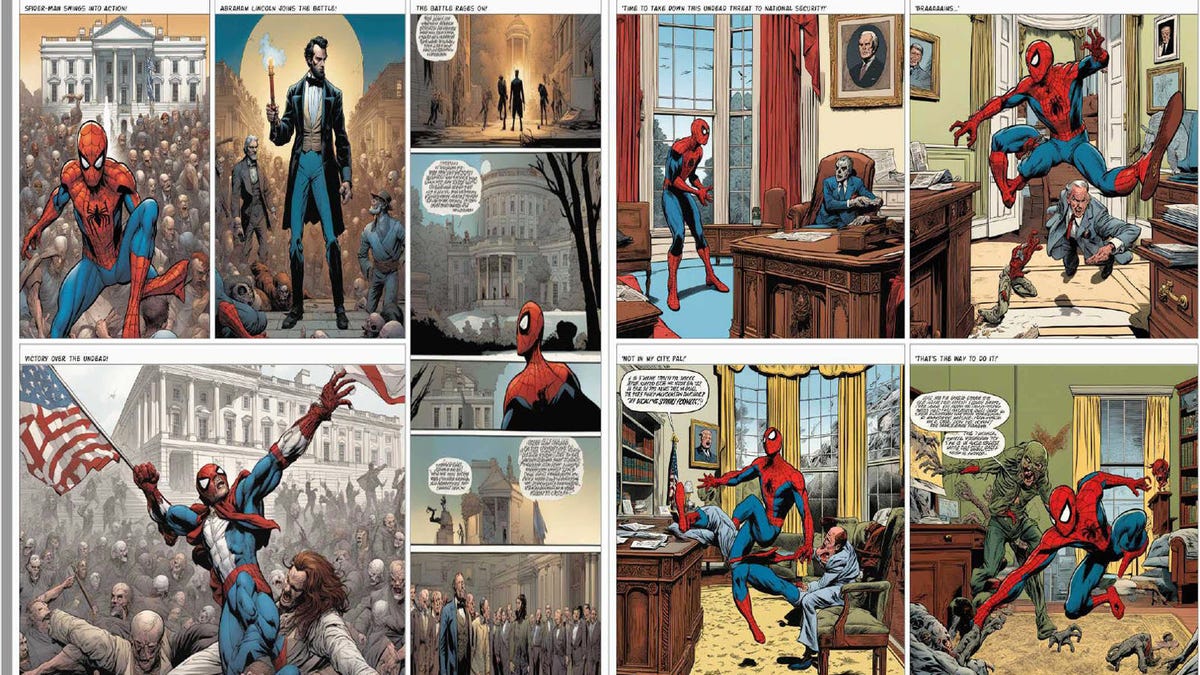
Quick Answer: What Is an AI Comic Script Generator?
An AI comic script generator is a tool that transforms story concepts, outlines, or prose narratives into structured comic book scripts — including page breakdowns, panel descriptions, dialogue, camera directions, and visual pacing notes — formatted for either human artists or AI comic generators to illustrate.
- Panel-by-panel scripting with camera angles, lighting, and emotional direction — the Comic Creator handles this conversationally
- Character voice consistency maintaining distinct dialogue patterns across entire projects
- Visual pacing intelligence that understands page-turn reveals, splash pages, and panel rhythm
- Script-to-art pipeline where the same agent generates both the script and the visual output
The Problem: Why Comic Scripting Is Harder Than It Looks
Despite the explosion of AI art tools making visual execution accessible, the scripting phase remains the primary creative bottleneck — and it's a fundamentally different skill from prose writing, screenwriting, or any other narrative form.
📐 Comic Scripts Are a Unique Format
As the Science Fiction and Fantasy Writers Association (SFWA) explained in their 2025 guide, comic scripting requires simultaneous attention to "collaboration, layout, and dialogue" — three disciplines that rarely overlap in other writing forms (SFWA). A comic script isn't a screenplay. It's a set of visual instructions that must specify what the reader sees in each panel, what they read in each speech bubble, and how the panels flow across the page to create narrative rhythm.
"Writing a comic script can be difficult. I thought it was easy." — Creator discussion in Connecting Comic Book Writers and Artists (Facebook)
🎯 The Visual Direction Gap
Comic editorial expert KN Editorial identified the core tension: writers must "be clear (but not too prescriptive) with art direction" while simultaneously "considering page turns" and "not forgetting characters' perspectives" (KN Editorial). Too vague, and the artist (or AI) has no direction. Too detailed, and you constrain the visual storytelling. This balance is particularly critical when scripting for AI generators, where the quality of the panel description directly determines the quality of the output.
🔄 The AI-Specific Scripting Challenge
As AI Magicx documented in their 2026 guide:
"The challenge is not generating a single good panel. It is generating dozens or hundreds of panels that look like they belong to the same comic — with consistent characters, consistent style, and appropriate compositions for the story being told." — AI Magicx
Traditional comic scripts assume a human artist who understands implied visual grammar. AI comic generators need explicit, structured instructions — shot types, lighting conditions, character expressions, background details — for every single panel. A script that works for a human penciler fails completely when fed to an AI system.
⏱️ Production Bottleneck at Scale
A single manga page can take a professional artist 4 to 10 hours to illustrate. A 20-page chapter represents 80 to 200 hours of work (AI Magicx). AI has compressed the art generation timeline dramatically — but the scripting phase hasn't kept pace. Creators who can generate pages in minutes still spend hours writing panel descriptions, and poorly structured scripts produce inconsistent, unusable output that wastes generation credits and time.
This is exactly what the Comic Creator was built for.
Why Comic Creator Is the Best AI Comic Script Generator
While standalone script generators like Scriptbadger or iCursor.ai can produce text-based comic scripts, they stop at the script — leaving you to manually transfer those descriptions into a separate AI image generator, manage character consistency yourself, and assemble pages in yet another tool. The Comic Creator eliminates this fragmented workflow by generating both the script and the visual output in a single, persistent conversation.
As Skywork's 2026 guide to AI comic generators noted, the industry has shifted from "horizontal platforms" to "vertical platforms" — from general-purpose tools to specialized workflows where "value is in creating intuitive, no-prompt UIs" rather than requiring prompt engineering skill (Skywork).
| Scripting Challenge | Standalone Script Generator | Comic Creator Solution |
|---|---|---|
| Script format | Text output only | Script + visual generation in one workflow |
| Character consistency | No visual tracking | Reference sheet system locks identity |
| Visual direction | Generic descriptions | AI-optimized panel descriptions with shot types |
| Dialogue | Basic text | Character-voiced dialogue with balloon placement |
| Pacing | Page-level suggestions | Panel-by-panel rhythm with page-turn awareness |
| Iteration | Re-write script, re-generate art | Adjust script and art in the same session |
| Project memory | Session-limited | Persistent state across sessions |
How the Script-to-Art Pipeline Works
The Comic Creator uses a three-phase scripting architecture that mirrors professional comic production methodology:
Phase 1 — Story Foundation You describe your concept in natural language. The AI develops it into a structured narrative with character profiles, plot beats, and thematic direction. This phase can be enhanced by working with the Creative Fiction Writer for deeper narrative development before visual production begins.
Phase 2 — Page-by-Page Scripting The AI breaks your story into pages, then panels. For each panel, it generates:
- Shot type (wide establishing, medium, close-up, extreme close-up, bird's eye, worm's eye)
- Character action (pose, expression, gesture)
- Background/environment (setting details, lighting, atmosphere)
- Dialogue and narration (speech bubbles, thought bubbles, caption boxes)
- Emotional direction (mood, tension level, visual weight)
Phase 3 — Visual Generation Using the structured script and loaded character reference sheets, the AI generates each page with consistent characters, appropriate panel layouts, and integrated dialogue — all informed by the script it just wrote.
Example Script Prompts
Here's what working with the Comic Creator as a script generator actually looks like:
"I want to create a 22-page noir detective comic. The protagonist is Detective Elena Vasquez — Latina, early 40s, sharp features, silver-streaked black hair pulled back tight, always wears a rumpled charcoal overcoat. She's investigating a series of disappearances in a waterfront district. The tone should feel like Brubaker's Criminal meets Chinatown. Start by scripting the first 5 pages."
The AI responds with a structured page-by-page script:
"Page 1, Panel 1 (full-page splash): Bird's-eye view of the waterfront district at night. Rain-slicked streets, neon signs reflecting on wet asphalt, fog rolling in from the harbor. A lone figure — Elena — walks toward camera, umbrella in one hand, case file in the other. Caption box: 'Three missing in six weeks. No bodies. No ransom demands. Just gone.' Noir style, heavy shadows, limited color palette — blues, grays, amber from streetlights."
"Page 2, Panel 1 (wide shot): Interior of a dive bar. Elena sits at the far end, nursing a whiskey. The bartender polishes a glass, watching her. Two dock workers argue in the background. Panel 2 (medium shot): Elena slides a photograph across the bar toward the bartender. Elena: 'Last person to see him alive says he was drinking here.' Panel 3 (close-up): The bartender's eyes flicker — recognition, then careful blankness. Bartender: 'Lot of people drink here.' Panel 4 (extreme close-up): Elena's hand on the photograph, finger tapping once. Elena: 'Not a lot of people disappear from here. Yet.'"
Multi-Model Advantage for Script Quality
The Comic Creator runs on Jenova's unified AI infrastructure — access to GPT-5.4 (OpenAI), Claude Opus 4.6 (Anthropic), Gemini 3.1 Pro Preview (Google), plus models from xAI and DeepSeek. Different models excel at different aspects of comic scripting: some produce sharper dialogue, others handle visual description with more cinematic precision, and others iterate faster on pacing adjustments. No vendor lock-in means you can switch based on what your current script needs.
Related Agents You'll Also Like
Creative Fiction Writer
The ideal pre-production partner for developing the narrative foundation that drives your comic scripts. Before you script a single panel, use the Creative Fiction Writer to build your world, develop character arcs, write dialogue, and establish the plot structure that will drive your visual storytelling.
- Deep story research with genre conventions and cultural references
- Character arc development and dialogue writing
- Scene-by-scene breakdowns optimized for comic adaptation
- Persistent story state tracking across sessions
Manga Creator
For creators working in Japanese manga styles. The Manga Creator applies the same script-to-art pipeline to manga-specific conventions — right-to-left reading flow, screentone integration, and five professional art style templates from Shonen to Chibi.
- Right-to-left panel flow with authentic manga reading rhythm
- Five professional style templates matching major manga traditions
- Screentone and halftone pattern integration
- Serialized story tracking across 200+ page epics
Webtoon Creator
Built for mobile-first vertical scroll storytelling. The Webtoon Creator scripts and generates episodes optimized for scroll rhythm, episode hooks, and full-color consistency — with platform presets for LINE Webtoon, Tapas, and Lezhin.
- Vertical scroll rhythm optimization for mobile reading
- Episode-based structure with built-in cliffhanger pacing
- Full-color consistency across entire seasons
- Platform-specific export presets
How It Works: From Story Concept to Scripted Comic
Step 1: Define Your Story Concept
Start with a natural language description of your story. You don't need a finished outline — the Comic Creator helps you develop the concept into a structured narrative. For deeper story development, work with the Creative Fiction Writer first.
"I want to create a sci-fi comic about a salvage crew that discovers a derelict generation ship. The crew is diverse — a cynical captain, a young engineer who's too curious for her own good, and a combat medic with a secret. The ship isn't as empty as it seems. Think Alien meets The Expanse. 6-issue miniseries."
Step 2: Develop Characters and Visual References
Before scripting any pages, establish your cast. The Comic Creator generates detailed character profiles that serve as both narrative guides and visual reference foundations.
"Create a character reference sheet for Captain Dara Osei: West African descent, late 40s, close-cropped gray hair, deep-set eyes with permanent skepticism, a prosthetic left hand (matte black, utilitarian — not sleek), wears a patched-up flight suit with too many pockets. Show front view, three-quarter view, profile, and expressions: weary authority, genuine concern, cold fury, rare amusement."
These references load automatically with every subsequent page generation, ensuring the script's character descriptions translate into visually consistent output.
Step 3: Script Page by Page
The AI generates structured scripts for each page, specifying panel count, shot types, dialogue, and visual direction. You review and adjust before visual generation.
"Script pages 1-3 of Issue 1. Open with the salvage crew approaching the derelict ship. Establish the scale — the ship is enormous, ancient, and wrong somehow. Build tension through the crew's reactions. End page 3 with the airlock opening."
The AI produces a detailed script with panel-by-panel breakdowns, then generates the visual pages from those scripts.
Step 4: Iterate on Script and Art Together
Review each page. Request changes to the script — adjust dialogue, change a camera angle, modify pacing — and the AI regenerates the visual output based on the revised script. This tight feedback loop between script and art is what separates the Comic Creator from tools that handle only one half of the pipeline.
Step 5: Scale Across Issues
With your characters established and your scripting style locked in, scale from single pages to full issues. The persistent project memory tracks your narrative position, character states, visual continuity, and plot threads — ensuring that scripts on page 100 maintain consistency with page 1.
Results & Use Cases
📚 Independent Comic Publishing
Scenario: Creating a 22-page single-issue comic for self-publishing on Amazon KDP
Traditional Approach: Write a full script (1-2 weeks), commission an artist ($1,100–$6,600), wait 2-4 months for delivery, manage revision cycles when the artist's interpretation doesn't match your vision.
With the Comic Creator: Develop your story concept, generate structured page-by-page scripts, produce all 22 pages with consistent characters and dynamic layouts, iterate in real-time when a panel doesn't match your intent. The personal/hobbyist segment already dominates the AI comic generator market with approximately 42.5% share (Precedence Research).
📱 Webtoon Serialization
Scenario: Launching a weekly webtoon series requiring consistent episode scripts
Traditional Approach: Write scripts weekly (4-8 hours per episode), hire a dedicated webtoon artist ($200–$500 per episode), maintain a grueling weekly schedule.
With the Webtoon Creator: Script and generate mobile-optimized vertical episodes with built-in hooks and consistent full-color art across entire seasons. The publishing & media segment is the fastest-growing application category in the AI comic generator market (Precedence Research).
🎓 Educational and Marketing Comics
Scenario: Transforming complex information into visual narratives for training or content marketing
Traditional Approach: Hire a scriptwriter and illustrator ($3,000–$10,000 per project), wait weeks for delivery, limited iteration.
With AI comic scripting: Educators and marketers convert dense material into visually engaging comic strips. The AI generates scripts that break complex topics into sequential visual explanations, then produces the illustrated pages. AI-based comic creation is increasingly used in education, "leveraging storytelling and engaging visuals to enhance learning" (Precedence Research).
💼 Crowdfunding and Pitch Materials
Scenario: Building a Kickstarter campaign for an original comic series
Traditional Approach: Commission sample pages ($500–$1,500) just for the pitch, with no guarantee of funding.
With the Comic Creator: Script and generate polished sample chapters, character turnarounds, and promotional art. Iterate based on feedback without additional illustration costs. The AI-generated comic book market is expanding at a 32.1% CAGR, reaching $2.01 billion in 2026 (Global Information, Inc.).
FAQ
What is the best AI comic script generator in 2026?
For creators who want an end-to-end workflow — from story concept through structured scripting to finished visual pages — Jenova's Comic Creator integrates script generation directly into the comic production pipeline with character reference sheets, persistent project memory, and multi-model AI access. For narrative development before scripting begins, the Creative Fiction Writer provides deep story research, character arc development, and dialogue writing. For manga-specific scripts, the Manga Creator handles Japanese visual storytelling conventions.
How is an AI comic script different from a regular screenplay?
A comic script specifies what happens in each individual panel, not each scene. It includes visual direction (camera angles, lighting, composition), dialogue placement (speech bubbles, caption boxes, thought bubbles), and pacing instructions (panel sizes, page-turn reveals). As the SFWA explains, comic scripting requires simultaneous attention to "collaboration, layout, and dialogue" — three disciplines that rarely overlap in other writing forms (SFWA).
Do I need writing experience to use an AI comic script generator?
No formal writing experience is required. The Comic Creator accepts natural language story concepts and develops them into structured comic scripts conversationally. You describe what you want to happen, and the AI handles the technical formatting — shot types, panel breakdowns, dialogue pacing, and visual direction. The text-to-comic segment led the AI comic generator market with approximately 52.3% share in 2025 precisely because of its accessibility (Precedence Research).
Is an AI comic script generator free to use?
The Comic Creator is available through Jenova with free access to core features and limited usage — sufficient for testing workflows and creating sample pages. For extended creation sessions and higher usage limits, paid plans start at $20/month. The free/freemium model holds approximately 62% share of the AI comic generator market, while the paid/subscription segment is growing fastest as creators demand professional-quality output (Precedence Research).
Can the AI generate both the script and the art?
Yes. This is the key differentiator of the Comic Creator compared to standalone script generators. The same agent develops your story concept into a structured script, then generates the visual pages from that script — with character reference sheets ensuring consistency across the entire project. You can also export just the script if you prefer to work with a human artist or a different visual tool.
What's the difference between an AI comic script generator and ChatGPT?
While ChatGPT can write comic scripts, it lacks the specialized comic production infrastructure: no character reference system, no panel layout generation, no speech bubble integration, no persistent project memory across sessions, and no visual output. The Comic Creator is purpose-built for sequential art — it understands comic-specific pacing, visual grammar, and the technical requirements of panel descriptions that produce consistent AI-generated artwork. As Skywork's 2026 analysis noted, the industry has shifted from general-purpose tools to "vertical platforms" with specialized workflows (Skywork).
Conclusion
The AI comic generator market's explosive growth — from USD 33 billion in 2025 to a projected USD 271.06 billion by 2035 (Precedence Research) — has compressed the art production timeline from months to minutes. But this acceleration has exposed the real bottleneck: the script. As AI handles more of the visual execution, the quality of the panel descriptions, dialogue, pacing, and visual direction determines whether the output is publication-ready or unusable.
The structured scripting approach — specifying shot types, emotional direction, character action, and dialogue for every panel — transforms AI comic generation from unpredictable experimentation into a reliable production pipeline. And with dedicated tools that integrate script generation directly into the visual production workflow, you don't need comic scripting experience to create professional results.
Try the Comic Creator for end-to-end comic scripting and production. Develop your narrative with the Creative Fiction Writer before visual production begins. For manga-specific scripts, the Manga Creator handles Japanese visual conventions, and the Webtoon Creator scripts mobile-first vertical episodes.
Explore the full agent library at Jenova.