AI Comic Builder: Create Professional Comics Without Drawing Skills (March 2026)
2026-03-26
In March 2026, the AI comic builder has evolved from a novelty experiment into a legitimate production tool — and the numbers prove it. The global AI comic generator market reached USD 33 billion in 2025 and is projected to hit USD 271.06 billion by 2035, expanding at a 23.44% CAGR (Precedence Research). Meanwhile, 61% of digital artists now use AI tools in their workflows, and 57% of comic publishers employ AI for production tasks like background rendering and coloring (Precedence Research).
Jenova's Comic Creator represents the story-first approach to AI comic building — a dedicated agent that understands Western comic grammar, manages character consistency across hundreds of panels, and handles everything from script development to final page layout. It's backed by format-specialized siblings for manga and webtoons, covering every major visual storytelling format.
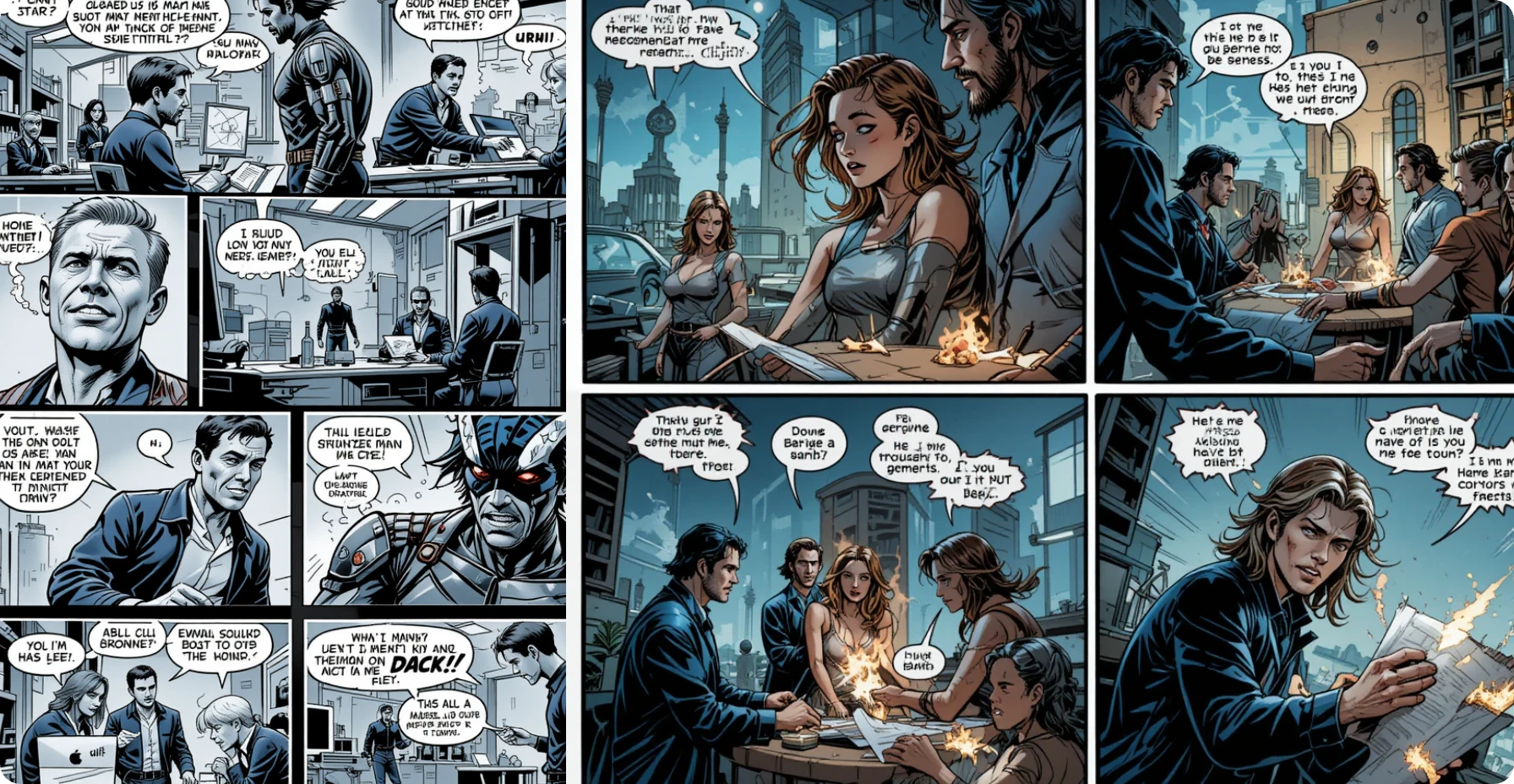
Quick Answer: What Is an AI Comic Builder?
An AI comic builder is a specialized tool that transforms text descriptions, scripts, or story concepts into complete, illustrated comic pages — including character designs, panel layouts, dialogue placement, and visual storytelling — without requiring drawing skills.
- Character consistency systems maintain identical appearances across hundreds of panels via reference sheets and identity embeddings — the Comic Creator handles this automatically
- Narrative-aware panel sequencing understands story beats, pacing, and visual flow for dynamic page composition
- Script-to-comic workflows convert text scripts into sequenced panels with appropriate framing and dialogue
- Multi-format output for traditional print, vertical scroll webtoons, and mobile-optimized panels
The Problem: Why Comic Creation Has Remained Out of Reach
Despite the comic book market reaching $17.69 billion in 2025 and projected to hit $27.01 billion by 2034 (LlamaGen), aspiring creators face barriers that have historically excluded independent voices from visual storytelling.
💰 Prohibitive Cost
Professional comic illustration typically costs $50–$300 per page. A standard 22-page comic runs $1,100–$6,600, and graphic novels can demand $5,000–$30,000 for artwork alone (LlamaGen). For independent creators bootstrapping their first project, these costs are simply out of reach.
🎨 Multidisciplinary Skill Demands
Comic creation traditionally requires mastery of character design, action choreography, background illustration, inking, coloring, lettering, and narrative construction. Solo creators face overwhelming workload and burnout. As attorney Gamal Hennessy, who specializes in working with comic book creators, told CNN: "When you're an independent publisher it takes you four times as long to put out a comic as if you're, like, Marvel, DC or Image" (CNN).
🔄 The Character Consistency Problem
Until 2025, if you asked for the "best AI character generator for consistent characters," the honest answer would have been: "None. You'll have to cobble together a workflow and hope for the best." — Skywork Analysis, 2026
Consistency across panels — maintaining identical facial features, clothing details, and proportions from one frame to the next — was the single biggest technical barrier. Over 60% of professionals using early AI art tools required extensive manual edits to fix character drift (LlamaGen).
📱 Format Fragmentation
Creators must reformat stories for print, webtoon, and mobile platforms, each requiring unique layouts and visual logic. A page designed for Western print doesn't translate to vertical scroll webtoons, and neither works natively on mobile screens.
This is exactly what the Comic Creator was built for.
Why Comic Creator Solves These Problems
Jenova's Comic Creator takes a fundamentally different approach from general-purpose image generators like Midjourney. While tools like Midjourney produce individual images that you must manually assemble into pages using separate software, the Comic Creator offers an end-to-end storytelling workflow — story generation, panel layouts, character management, dialogue integration, and persistent project state (Skywork).
| Challenge | Traditional Approach | Comic Creator Solution |
|---|---|---|
| Cost | $50–$300 per page | Unlimited page generation via subscription |
| Skills | Years of artistic training | Story-driven text interface |
| Timeline | Weeks/months per issue | Pages generated in minutes |
| Consistency | Manual tracking, frequent drift | Automated reference sheet system |
| Formats | Separate redesign per platform | Format-aware layout engine |
How Character Consistency Actually Works
The Comic Creator uses a reference image architecture. Before generating story pages, you create character reference sheets showing each character in neutral poses with locked-in visual details — eye color, hairstyle, clothing, distinguishing marks. These references are loaded with every subsequent page generation, ensuring visual consistency across your entire project, even across 200+ pages.
This is the same approach that industry reviews identify as the key breakthrough of 2025–2026: identity embeddings that create a mathematical "fingerprint" of each character, combined with structured prompting that separates character identity from scene-specific actions (Skywork).
Example Prompts
Here's what working with the Comic Creator actually looks like:
"Create a character reference sheet for Detective Mara Chen: East Asian woman, mid-30s, sharp jawline, short asymmetric black hair with silver streak on the left side, dark gray trench coat, small scar above right eyebrow. Show front view, three-quarter view, and profile."
"Generate a 4-panel page: Panel 1 — Mara enters a dimly lit warehouse, hand on holster, expression cautious. Panel 2 — Close-up of her face as she notices something on the ground. Panel 3 — Wide shot revealing scattered documents and an overturned chair. Panel 4 — Mara crouches to pick up a photograph, expression shifting to recognition."
"Create a full comic page in noir style: Mara confronts the informant in a rain-soaked alley. Dramatic lighting, high contrast shadows. Include dialogue: Mara says 'You told me he was dead.' Informant responds 'I told you what I was paid to tell you.'"
Multi-Model Advantage
Unlike single-model tools, the Comic Creator runs on Jenova's unified AI infrastructure — access to GPT-5.4 (OpenAI), Claude Opus 4.6 (Anthropic), Gemini 3.1 Pro Preview (Google), plus models from xAI and DeepSeek. No vendor lock-in. Switch between models based on whether you need stronger dialogue writing, more precise visual descriptions, or faster iteration.
Related Agents You'll Also Like
Manga Creator
Your dedicated mangaka for Japanese-style sequential art. The Manga Creator understands the unique grammar of manga — right-to-left reading flow, screentone integration, and the distinctive pacing that separates manga from Western comics.
- Right-to-left panel flow with proper reading order
- Screentone and halftone pattern integration
- Genre-specific styles from shōnen action to josei drama
- Serialized story tracking across 200+ page epics
Webtoon Creator
Built for mobile-first vertical scroll storytelling. The Webtoon Creator optimizes scroll rhythm, episode hooks, and full-color consistency across entire seasons — with platform presets for LINE Webtoon, Tapas, and Lezhin.
- Vertical scroll rhythm optimization for mobile reading
- Episode-based structure with built-in cliffhanger pacing
- Full-color consistency across entire seasons
- Platform-specific export presets
Creative Fiction Writer
The ideal pre-production partner. Before you generate a single panel, use the Creative Fiction Writer to develop your story outline, build character arcs, write dialogue, and establish the narrative structure that will drive your visual storytelling.
- Deep story research with genre conventions and cultural references
- Character arc development and dialogue writing
- Scene-by-scene breakdowns optimized for visual adaptation
- Persistent story state tracking across sessions
How It Works: From Blank Page to Finished Comic
Step 1: Develop Your Story
Start by outlining your narrative. You can work directly with the Comic Creator or develop your story first with the Creative Fiction Writer. Define your characters, their motivations, the central conflict, and the key story beats you want to hit.
"I want to create a 10-page noir detective comic. The protagonist is Detective Mara Chen investigating a cold case that connects to her own past. The story opens with her receiving an anonymous tip and ends with a cliffhanger reveal."
Step 2: Generate Character Reference Sheets
Before creating any story pages, establish your visual anchors. Generate reference sheets for each major character showing multiple angles, expressions, and outfit details. These sheets become the AI's "character bible" — referenced automatically in every subsequent panel.
"Generate a character reference sheet for the informant: thin Caucasian man, late 50s, receding gray hair, wire-rimmed glasses, rumpled beige suit, nervous demeanor. Show neutral expression, fearful expression, and speaking expression."
Step 3: Script Your Panels
Write panel-by-panel descriptions that separate character identity from scene-specific actions. The more structured your prompts, the more consistent your output. Include camera angles, lighting notes, and emotional beats.
Step 4: Generate, Review, and Iterate
The AI generates each page based on your descriptions, applying your character references automatically. Review each page for narrative pacing and visual clarity. Request targeted edits — adjust a facial expression, change a camera angle, modify lighting — without regenerating the entire page.
Step 5: Assemble and Export
Once your pages are complete, export in your target format. The Comic Creator supports traditional print layouts, and you can adapt your project for other formats using the Manga Creator or Webtoon Creator for format-specific optimization.
Results & Use Cases
📚 Independent Comic Publishing
Scenario: Creating a 22-page single-issue comic for self-publishing on Amazon KDP
Traditional Approach: Commission an artist ($1,100–$6,600), wait 2–4 months for delivery, manage revision cycles, handle lettering separately.
With the Comic Creator: Generate character reference sheets in your first session, produce all 22 pages with consistent characters and dynamic layouts, iterate based on feedback in real-time, export print-ready files. Total timeline: days, not months.
📱 Webtoon Serialization
Scenario: Launching a weekly webtoon series on LINE Webtoon or Tapas
Traditional Approach: Hire a dedicated webtoon artist ($200–$500 per episode), maintain a grueling weekly schedule, risk burnout and inconsistency across episodes.
With the Webtoon Creator: Produce mobile-optimized vertical episodes with built-in hooks and consistent full-color art across entire seasons. Maintain a sustainable weekly publishing cadence without the production bottleneck.
🎓 Education and Content Marketing
Scenario: Transforming complex information into visual narratives
Traditional Approach: Hire an illustrator for custom educational comics ($3,000–$10,000 per project), wait weeks for delivery.
With AI comic building: Educators convert dense lesson plans into visually engaging comic strips that improve student engagement and information retention. Marketers create branded comic content for social media — producing multiple variations for A/B testing in hours rather than weeks. The personal/hobbyist segment already dominates the AI comic generator market with approximately 42.5% share, while publishing and media is the fastest-growing segment (Precedence Research).
💼 Crowdfunding and Pitch Decks
Scenario: Building a Kickstarter campaign for an original comic series
Traditional Approach: Commission sample pages ($500–$1,500) just for the pitch, with no guarantee of funding.
With the Comic Creator: Generate campaign preview pages, produce polished sample chapters, create variant covers and promotional art — all before your campaign launches. Iterate based on backer feedback without additional illustration costs.
FAQ
What is the best AI comic builder in 2026?
The best AI comic builder depends on your specific needs. For story-first creators who want an end-to-end workflow — from narrative development through character consistency to finished pages — Jenova's Comic Creator offers a full-pipeline approach with access to frontier AI models. For manga-specific projects, the Manga Creator handles right-to-left flow and screentone integration. For webtoons, the Webtoon Creator optimizes vertical scroll rhythm and episode pacing.
Is an AI comic builder free to use?
The Comic Creator is available through Jenova with free access to core features and limited usage. For extended creation sessions and higher usage limits, paid plans start at $20/month. The free/freemium model dominates the AI comic generator market, holding approximately 62% share in 2025 (Precedence Research), though the paid/subscription segment is growing fastest as creators demand professional-quality output.
How does AI maintain character consistency across multiple pages?
The system uses a reference image architecture. You create character reference sheets before generating story pages, and these references are loaded with every subsequent generation. This approach uses identity embeddings — mathematical "fingerprints" of each character — combined with structured prompting that separates character identity from scene actions. The result is consistent visual identity across even 200+ page projects (Skywork).
Do I need drawing skills to use an AI comic builder?
No drawing skills are required. AI comic builders are specifically designed for writers, storytellers, educators, and creators who have compelling narratives but lack traditional artistic training. You direct the visual output through detailed text descriptions and iterative refinement — the AI handles all visual execution. The text-to-comic segment led the market with approximately 52.3% share in 2025 precisely because of its accessibility (Precedence Research).
Can I sell comics created with an AI comic builder?
Jenova allows commercial use of generated content on paid plans. However, publishing platforms and marketplaces may have their own policies regarding AI-generated content. For self-publishing on platforms like Amazon KDP, AI-generated content is generally permitted with proper disclosure. Always verify the terms of service for your target distribution platform.
What's the difference between an AI comic builder and Midjourney?
A dedicated AI comic builder like the Comic Creator offers an end-to-end storytelling workflow — story generation, panel layouts, character management, dialogue integration, and persistent project state. A general image generator like Midjourney only creates individual images. You must then use separate software like Canva or Photoshop to assemble them into comic pages, add lettering, and create layouts (Skywork). While Midjourney may produce higher raw image quality for individual panels, it lacks the storytelling infrastructure that makes comic production efficient.
Conclusion
The AI comic builder market's explosive growth — from USD 33 billion in 2025 to a projected USD 271.06 billion by 2035 (Precedence Research) — signals a fundamental shift in who gets to tell visual stories. What once required years of artistic training and thousands of dollars in illustration costs is now accessible to anyone with a story to tell.
The technical barriers have fallen. Character consistency is solved. Panel layouts are automated. Speech bubbles are integrated. The only remaining challenge is the creative one: What story do you want to tell?
Try the Comic Creator for Western comics, the Manga Creator for Japanese-style storytelling, or the Webtoon Creator for mobile-first vertical formats. Develop your narrative with the Creative Fiction Writer before visual production begins.
Explore the full agent library at Jenova.