AI College Interview Coach: Practice Admissions Interviews & Get Feedback
2026-08-20
An Interview Coach helps you walk into a college admissions interview prepared, composed, and specific by running unlimited mock interviews and giving you honest, structured feedback on every answer. Most applicants get one shot at an alumni or on-campus conversation with no meaningful practice beforehand — this AI gives you as many rehearsals as you need, at any hour, with critique that tells you what actually needs fixing.
✅ Unlimited mock interviews for behavioral, conversational, and program-specific formats ✅ Honest feedback on structure, specificity, and self-presentation — not empty encouragement ✅ Answer development for the questions every admissions interviewer asks ✅ Available free on web, iOS, and Android
To understand why this matters, it helps to look at what the admissions interview actually is, why so few students prepare properly for it, and what the research says about how nerves quietly sabotage otherwise strong candidates.
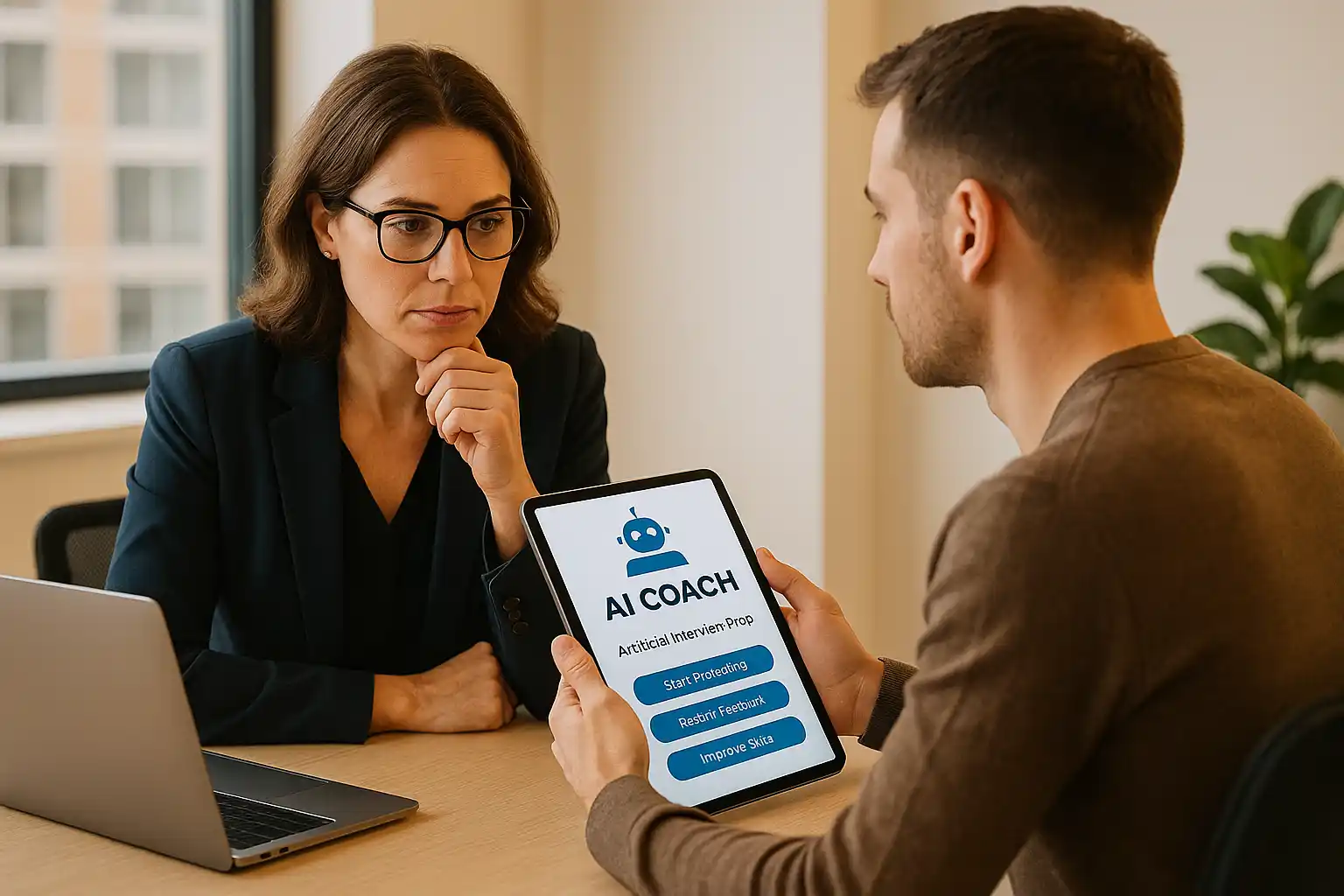
Quick Answer: What Is an AI College Interview Coach?
An AI college interview coach is a conversational AI that runs realistic mock admissions interviews, asks follow-up questions like a real interviewer, and gives structured feedback on your answers so you can rehearse until your responses are specific, confident, and natural.
Key capabilities:
- Simulates alumni, on-campus, and program-specific interview formats with realistic follow-ups
- Develops and refines answers to core questions like "Why this school?" and "Tell me about yourself"
- Diagnoses vague, rehearsed-sounding, or over-scripted responses and shows you how to fix them
- Builds a bank of concrete stories and examples you can draw on under pressure
- Prepares your own questions for the interviewer and coaches your follow-up etiquette
The Problem: Why Most Applicants Walk Into Interviews Underprepared
The admissions interview occupies a strange place in the application. It is rarely the deciding factor, but it is one of the very few moments where an applicant is evaluated as a person rather than a transcript. As IvyWise puts it, there are so few places in the college application process for a student's voice to be truly heard — the interview is a chance to share your story the way you want it heard.
The data helps explain why students under-invest in it:
Only 4.3% of colleges rated the interview as being of considerable importance in admission decisions for first-time freshmen, while 32.4% assigned it limited importance — NACAC, Factors in the Admission Decision, Fall 2023
That statistic gets misread constantly. Low average importance across all four-year colleges does not mean low importance at the specific schools that offer evaluative interviews — the ones where a written evaluation is added to your file. At those institutions, the conversation is part of the record.
But preparing for it well is genuinely difficult:
- You cannot practice a conversation alone. Reading a list of common questions is not rehearsal. Interviews are dynamic — the follow-up question is where students fall apart.
- Human mock interviewers are scarce and inconsistent. A counselor with hundreds of students, a parent who will not push back, or a friend who laughs through it are not substitutes for a rigorous interviewer.
- Feedback is usually too polite to be useful. The people closest to you are the least likely to tell you your answer sounded rehearsed or that you never actually answered the question.
- Anxiety degrades performance in measurable ways. And it does more damage than most students realize.
Interview Anxiety Is a Performance Problem, Not Just a Feeling
Research on interview anxiety identifies five distinct dimensions — communication anxiety, appearance anxiety, social anxiety, performance anxiety, and behavioral anxiety — each tied to a different aspect of the interview experience, from verbal delivery to physical reactions like a racing heart or sweaty palms, as documented in research published in the Journal of Business and Psychology.
The consequences are not abstract:
Interview anxiety has been found in past research to be negatively associated with interview scores — Powell et al., cited in Journal of Business and Psychology research
The same body of research found that anxious interviewees were more likely to engage in deceptive impression management — essentially, performing a version of themselves rather than being genuine. That is precisely the failure mode admissions interviewers are trained to notice.
Crucially, the research also points to the fix. A coaching intervention that increased interviewee knowledge about the specific type of interview and what is expected in answering those questions was found to be successful in improving interview performance. Familiarity reduces uncertainty. Uncertainty is what produces the anxiety.
The Authenticity Trap
Admissions professionals consistently emphasize authenticity — and at the 2025 NACAC annual conference in Columbus, Ohio, the rapid proliferation of artificial intelligence was a central topic alongside demographic shifts and evolving admissions requirements. IvyWise's own guidance warns students to avoid being too scripted or memorizing anything and to resist answering based on what they think the interviewer wants to hear.
This creates a real bind. Under-prepare and you ramble. Over-prepare and you sound like a recording. The narrow target is rehearsed enough to be fluent, loose enough to be human — and hitting it requires far more reps than most students get.
This is exactly what the Interview Coach was built for.
Why Interview Coach Works for Admissions Interviews
Interview Coach is a dedicated interview preparation partner built for behavioral, case, technical, and executive interview formats — a skill set that maps directly onto the college admissions conversation, which is fundamentally a behavioral interview with higher emotional stakes and a younger candidate.
Instead of reading tips, you run the interview. Repeatedly. And you get told the truth about how it went.
| Traditional Prep | Interview Coach |
|---|---|
| Reading a list of common questions | Live mock interviews with unscripted follow-ups |
| One rushed practice run with a busy counselor | Unlimited sessions, any time of day |
| Polite feedback from family and friends | Honest, specific critique on structure and substance |
| Generic advice that fits any school | Answers built around your actual profile and target schools |
| No way to measure improvement | Iterative refinement across repeated attempts |
| Anxiety compounded by unfamiliarity | Familiarity built through volume of realistic reps |
Realistic Mock Interviews With Real Follow-Ups
The value is not in the first question — it is in the second. When you say you love the school's research culture, a real interviewer asks which lab, and why. This AI does the same. Practicing the follow-up chain is what separates students who sound curious from students who sound coached.
"Run a full 20-minute mock alumni interview for a liberal arts college. I'm applying as a prospective environmental science major. Stay in character and ask follow-ups."
Answer Development, Not Answer Scripts
The coach helps you build a bank of concrete stories — the failed project, the club you rebuilt, the class that changed your mind — and shapes them into answers with structure and specificity. The goal is a set of reference points you can speak from naturally, not paragraphs you recite.
"Here's my answer to 'Why do you want to attend this university?' Tell me honestly what's generic about it and how to make it specific to me."
Honest Feedback on the Things Nobody Tells You
The Interview Coach is explicitly built to deliver honest feedback. That means it will tell you when an answer is vague, when you dodged the actual question, when your enthusiasm sounds performed, and when you spent ninety seconds on setup and ten on substance.
Preparing Your Own Questions
Nearly every admissions guide stresses coming prepared with intelligent questions — IvyWise recommends preparing a list based on your research, and Harvard College's own student guidance notes that the interview is as much for you as for your application, and that alumni interviewers generally want to talk. This AI helps you draft questions that reveal genuine research rather than questions answered on the admissions homepage.
Anxiety Management Through Volume
You cannot reason your way out of interview nerves, but you can dilute them with familiarity. Ten mock interviews make the eleventh conversation feel routine — which is exactly the mechanism the research on coaching interventions points to.
Related Agents You'll Also Find Useful
The interview rarely exists in isolation. If you are interviewing, you are likely deep in an application cycle with several moving parts. These agents handle the adjacent work.
College Admissions Consultant — An elite admissions advisor covering school selection, essay crafting, and timeline management with strategies tailored to your profile. Your interview answers should be consistent with the narrative in your application, and this agent helps you build that narrative in the first place.
- Personalized school list strategy based on your academic and extracurricular profile
- Essay development that establishes the story your interview will reinforce
- Application timeline management across early and regular deadlines
Public Speaking Coach — An elite public speaking coach covering delivery, anxiety management, audience simulation, and Q&A preparation. If your problem is not what you say but how you say it — pacing, filler words, freezing under a hard question — this is the more precise tool.
- Anxiety management techniques for high-stakes speaking situations
- Delivery coaching on pace, clarity, and vocal presence
- Q&A preparation for unpredictable questioning
SAT/ACT Tutor — Adaptive test prep with strategic guidance and accountability toward your target score. For students still building the testing side of the application while interview season approaches.
- Content mastery across all tested sections
- Adaptive teaching calibrated to your current level
- Score-targeted study planning
AP Exam Tutor — Expert coverage across all 40 AP subjects with diagnostics, rubric-based feedback, and exam strategy. Since strength of curriculum is one of the highest-weighted admission factors, AP performance carries real weight alongside your interview.
- Adaptive diagnostics to find weak areas fast
- Rubric-based feedback on free-response work
- Subject-specific exam strategy
Try Interview Coach free — no credit card required.
How It Works
Step 1: Tell the coach your situation
Open Interview Coach and describe the interview: which school, whether it is alumni or on-campus, evaluative or informational, your intended major, and your timeline. Context is what separates a generic mock from a useful one.
"I have an alumni interview in nine days for a mid-sized private research university. Prospective computer science major, first-generation applicant. Help me prepare."
Step 2: Run your first cold mock interview
Do this before any prep. A cold run exposes your actual baseline — where you ramble, where you go blank, which questions you have never genuinely considered. It will be uncomfortable. That is the point.
"Start a full mock interview now. Don't give me the questions in advance. Ask follow-ups when my answers are thin."
Step 3: Get feedback and rebuild your weakest answers
Ask for a breakdown of what worked and what did not. Then rebuild the weakest two or three answers with the coach — adding specific examples, cutting throat-clearing, and tightening structure.
"Which of my answers was weakest and why? Help me rebuild it with a concrete example from my background."
Step 4: Rehearse variations until the format feels routine
Run mocks with different interviewer personalities — the warm conversational alum, the terse one who takes notes, the one who asks an unexpected question about a book you mentioned. Variation builds adaptability.
"Run another mock, but this time play a reserved interviewer who gives no reaction and asks short follow-ups."
Step 5: Prepare your questions and your follow-up
Close the loop. Draft two or three questions that demonstrate real research, then prepare your thank-you note. IvyWise advises sending it within 24 hours of the interview, reviewed carefully for correctness.
"Help me write three questions that show I've actually researched this school's engineering program, plus a thank-you note template."

Results & Use Cases
🎓 The Evaluative Alumni Interview
Scenario: A senior is offered an evaluative alumni interview for an early decision application. The write-up goes into the admissions file.
Traditional Approach: One practice run with a parent, a skim of an online question list, and a hope that nerves hold. No exposure to follow-up questioning.
Interview Coach: Six to eight full mock interviews across ten days, each with unscripted follow-ups, plus targeted rebuilds of the three weakest answers using Interview Coach.
- The "Why this school?" answer moves from campus-brochure language to named programs and faculty
- Follow-up questions stop causing freezes because the pattern is familiar
- Answers stay conversational instead of memorized, which is what interviewers actually respond to
📱 Last-Minute Prep the Night Before
Scenario: A student learns on a Thursday evening that their interview is Saturday morning. No counselor availability, no time to arrange a human mock.
Traditional Approach: Panic-read blog posts at midnight and improvise.
Interview Coach: Two focused mock sessions from a phone — one Thursday night, one Friday — with full parity across mobile and web on Jenova.
- Immediate access with no scheduling required
- Prioritized prep on the four or five questions almost certain to come up
- Anxiety reduced through familiarity rather than cramming
🧭 The Applicant Who Sounds Over-Rehearsed
Scenario: A well-prepared student has memorized their answers and now sounds like they are reading a statement. Admissions guidance explicitly warns against exactly this.
Traditional Approach: No one tells them, because family and friends hear polish rather than performance.
Interview Coach: The coach flags scripted delivery directly and helps convert memorized paragraphs into loose talking points, with reps reinforcing natural delivery.
- Honest diagnosis of the over-scripting problem before the real interview
- Answers converted into flexible reference points instead of fixed text
- Delivery work extended with the Public Speaking Coach for pacing and filler-word control
🌍 The International or First-Generation Applicant
Scenario: A student with no family experience of U.S. admissions norms is unsure what tone to strike, how formal to be, or whether the interview is a test or a conversation.
Traditional Approach: Guesswork drawn from movies and forum threads, producing either excessive formality or misplaced casualness.
Interview Coach: Explicit coaching on format expectations and cultural norms, paired with repeated exposure that builds calibration — supported on the application side by the College Admissions Consultant.
- Clear explanation of what evaluative versus informational interviews mean in practice
- Norm calibration on tone, formality, and self-presentation
- Unlimited private practice without the social cost of getting it wrong in front of someone
FAQ
Is an AI college interview coach free?
Yes. Interview Coach is available on Jenova's free tier with all core features and limited monthly usage — enough for meaningful interview preparation. Paid tiers starting at $20/month increase usage substantially and add custom model selection. No credit card is required to start.
Can AI really replace a human mock interviewer?
It replaces the scarcity of one. A skilled human interviewer who knows you well is valuable, but most students cannot access one repeatedly. AI provides unlimited reps with consistent, honest feedback — and research on interview coaching suggests that increasing familiarity with the format and expectations is what drives improvement.
Do college admissions interviews actually matter?
It depends heavily on the school. NACAC data shows only 4.3% of four-year colleges rate the interview as considerably important overall, but at institutions offering evaluative interviews, a written assessment is added to your file. If a school labels its interview "strongly encouraged," treat it as consequential.
Will practicing with AI make me sound robotic?
Only if you memorize scripts — which is a preparation mistake, not an AI problem. The coach is designed to build flexible talking points and flag over-rehearsed delivery. Admissions guidance consistently warns against sounding memorized, and repeated varied practice is the standard remedy.
What questions should I prepare for?
Expect the core set: why this school, tell me about yourself, what you would contribute to campus, a challenge you have faced, and what you are reading or curious about. Practice the follow-ups to each, since that is where unprepared answers collapse.
Does it work on mobile?
Yes. Jenova has full feature parity across web, iOS, and Android, with settings synced across devices — so you can run a mock interview on your phone the night before and pick up the conversation on a laptop the next morning.
Conclusion
The college admissions interview is a small window with outsized emotional weight. You cannot control the interviewer, the questions, or how the conversation lands — but you can control how familiar the entire experience feels by the time you sit down. Research points clearly in one direction: anxiety hurts interview performance, and preparation that builds familiarity with format and expectations reduces it.
An AI college interview coach turns preparation from a single anxious rehearsal into a repeatable practice loop. Unlimited mock interviews. Honest feedback that friends and family will not give you. Answer development grounded in your actual life rather than generic templates. The reps that produce genuine fluency instead of memorized performance.
Try Interview Coach now and run your first mock interview tonight. Explore more at Jenova.
For Developers: Interview Coach is available programmatically via the Jenova API — integrate mock interview practice and structured answer feedback into your edtech application with a single API call. Full documentation →