AI College Essay Reviewer: Rubric-Based Feedback on Fit, Voice & Specificity
2026-08-19
The College Admissions Consultant gives you admissions-grade essay feedback by scoring your drafts against the same criteria readers actually use — specificity, school fit, genuine interest, and authenticity. Most students submit personal statements that have only been read by a parent and one overworked school counselor. An AI college essay reviewer changes that: unlimited drafts, line-level highlights, and a rubric breakdown that tells you exactly which paragraph is costing you the read.
✅ Rubric-scored feedback across specificity, fit, authenticity, and research quality ✅ Line-level highlights showing which phrases sound interchangeable ✅ Unlimited revision cycles — no hourly consultant billing ✅ Supplemental "Why Us" essay review with school-specific research
To understand why this matters, it helps to look at what's happening on the other side of the desk. Application volume is climbing, reader time per file is shrinking, and the essay is the one component you still fully control when deadlines close in.
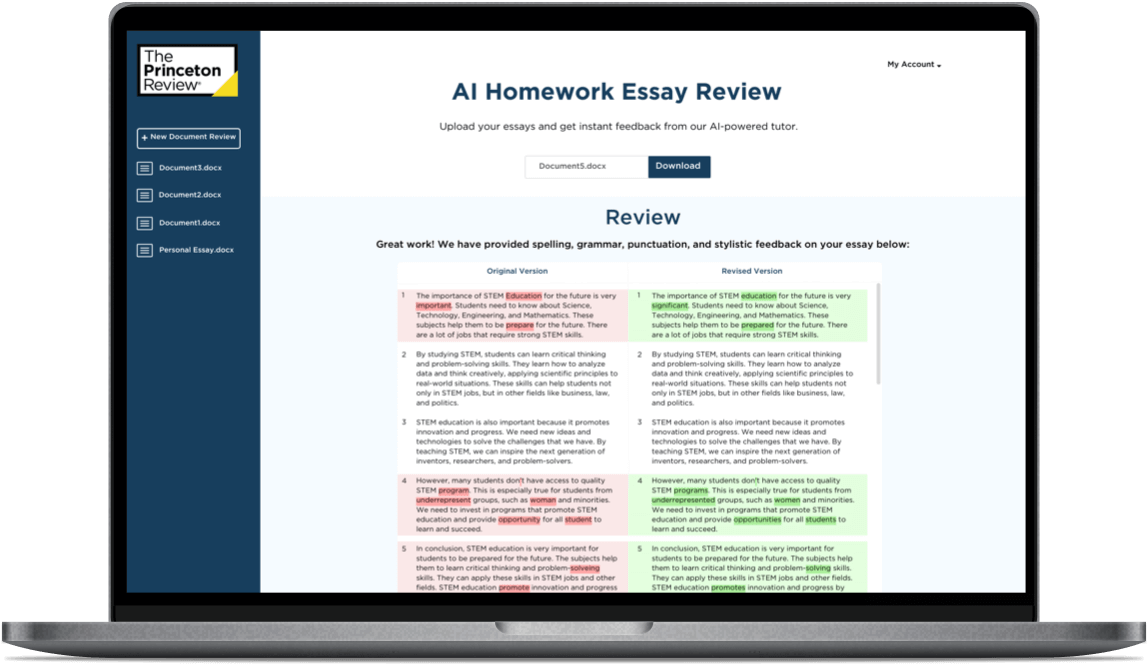
Quick Answer: What Is an AI College Essay Reviewer?
An AI college essay reviewer is a tool that analyzes your college application essays against admissions criteria — specificity, voice, school fit, and structure — and returns scored, line-level feedback you can act on before submitting. Unlike a grammar checker, it evaluates whether your essay actually reveals who you are.
Key capabilities:
- Rubric scoring across authenticity, specificity, fit demonstration, and genuine interest
- Sentence-level highlighting of generic, interchangeable, or vague passages
- School-specific supplemental essay review grounded in real research about each program
- Unlimited draft cycles with tracked improvement between versions
- Brainstorming and topic selection support before you write a single paragraph
The Problem: Great Students, Forgettable Essays
The personal statement carries outsized psychological weight for applicants and limited-but-real weight for readers. In NACAC survey data referenced by Forbes, the essay ranks below curriculum, grades, and character among factors colleges consider important — yet it remains the one place where a student's own voice enters the file.
And the pool keeps growing:
Applicants and applications through March 1, 2026 are up year-over-year, with applicants applying to slightly more schools on average — Common App Reports and Insights
First-generation applicants increased by 6% compared to the prior cycle, and applicants from below-median income ZIP codes grew by 8% — Common App Data Analytics and Research
But getting the essay right is genuinely difficult:
- No reliable feedback loop before the deadline
- No visibility into which sentences read as generic
- Supplemental essays that could be pasted into any school's portal
- Uncertainty about what "authentic voice" even means in practice
- Confusion about where AI assistance ends and academic dishonesty begins
You Get One Reader, Maybe Two
Harvard's own student-facing guidance is blunt about the revision requirement: "The Great Gatsby wasn't written in one draft… keep rewriting it until you're proud of it," and it explicitly recommends showing the draft to multiple people for different perspectives. That advice is sound. It's also unevenly available. Students at well-staffed private schools cycle through five readers; students elsewhere get one.
Nobody Tells You Which Sentence Is the Problem
"Make it more personal" is not actionable feedback. Neither is "this is good, maybe tighten it." What you need is the specific clause where your Northwestern supplement stopped being about Northwestern. Human readers rarely annotate at that resolution, because it's tedious and slow.
The Interchangeability Trap
This is the single most common failure in supplemental essays. You name a program, a professor, and a club — but swap the school name and the paragraph still works. Thyra Briggs of Harvey Mudd describes the ideal essay as "a snapshot into the student's world and what they care about — one that we wouldn't get from the rest of the application." Interchangeable detail fails that test.
The AI Boundary Is Genuinely Unclear
Students hear "don't use AI" and "everyone uses AI" in the same week. The Coalition for College guidance draws the line clearly: brainstorming, outlining, grammar checks, and revising sentences are appropriate — writing the essay, inventing experiences, or replacing your thinking is not. Their test is simple: can you explain why you chose the topic, what the story means to you, and why certain details mattered? If not, you've leaned too hard.
This is exactly what the College Admissions Consultant was built for — feedback that sharpens your thinking rather than replacing it.
Why the College Admissions Consultant
The College Admissions Consultant reads your draft the way a trained admissions reader would, then tells you precisely where it falls short. It doesn't ghostwrite. It diagnoses — scoring your essay against the criteria readers weigh, flagging the exact language that reads as filler, and pushing you to replace vague claims with the specific detail only you could write.
Grant Gosselin of Boston College frames the personal statement as "the opportunity for an applicant to be in the driver's seat." That framing matters here. The dedicated admissions advisor keeps you in the driver's seat and works the pedals of diagnosis, research, and revision strategy.
| Traditional Approach | College Admissions Consultant |
|---|---|
| One or two readers, if you're lucky | Unlimited reviews across every draft and every school |
| "Make it more personal" — no specifics | Sentence-level highlights on the exact weak phrases |
| Hourly consultant rates that cap your revisions | Full rubric breakdown on every submission |
| Generic advice about "showing your voice" | Scored authenticity, specificity, fit, and research quality |
| No way to research 12 schools' distinctives | School-specific research grounding every supplement |
Rubric Scoring That Names the Weakness
Instead of a holistic thumbs-up, you get a dimensional breakdown. An essay might score high on authenticity — your voice is genuinely yours — while specificity lags because you described "cutting-edge research" instead of naming the lab, the method, and why it changed how you think about your field. Those are different problems requiring different fixes, and a single overall grade hides that.
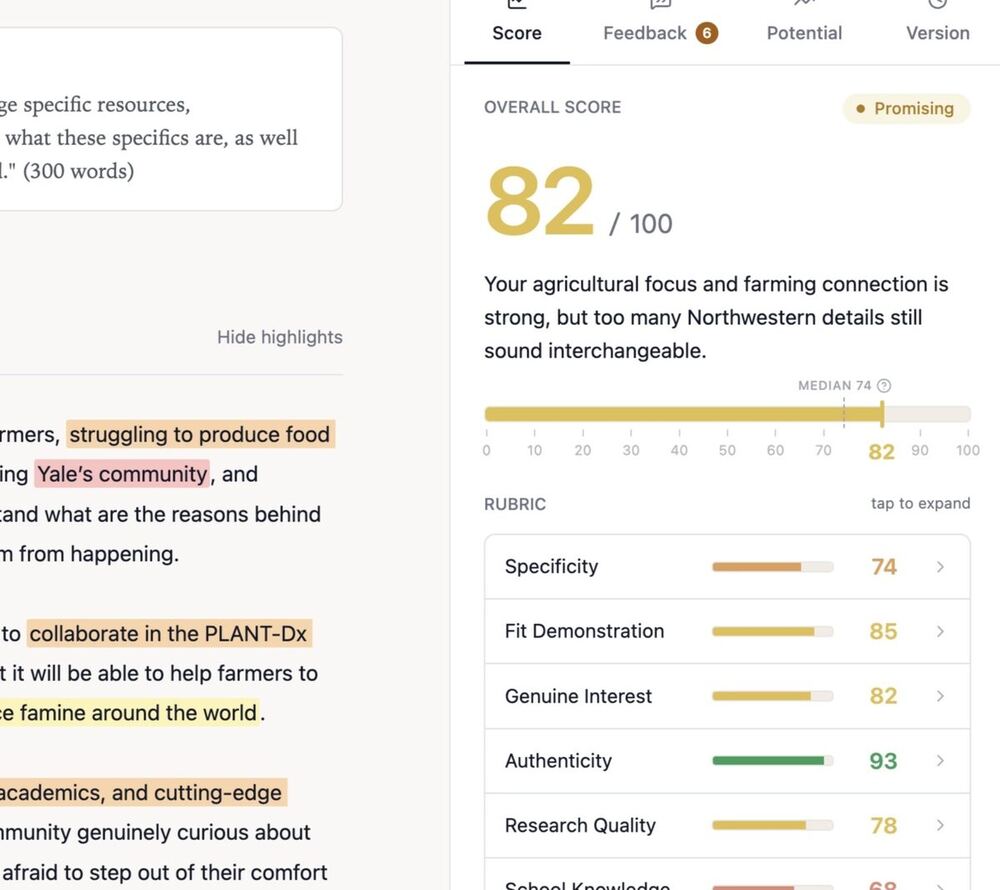
Highlighting the Interchangeable Phrases
The reviewer flags language that could belong to any applicant at any school — "collaborate on cutting-edge research," "a community of curious people," "step outside my comfort zone." Each highlight comes with a prompt pushing you toward the version only you could write.
"Review my Common App personal statement about my grandmother's bakery and tell me which paragraphs sound like they could have been written by any applicant."
School-Specific Supplement Research
For "Why Us" essays, the consultant researches the actual program — course sequences, research centers, distinctive academic structures — so your supplement references things a brochure wouldn't tell you.
"I'm writing Yale's 'Why Yale' supplement as a prospective agricultural science major. What specific programs, labs, or faculty should I be referencing?"
Voice Preservation Over Rewriting
Cornell research covered by the Cornell Chronicle found that AI tools write highly competent essays that don't sound like the student. The consultant is built around that finding: it identifies where your voice weakens and asks you to strengthen it, rather than substituting polished, anonymous prose.
"This paragraph feels flat but I don't want to lose my voice. What's making it flat, and what questions should I ask myself to fix it?"
Related Agents You'll Also Find Useful
Your essay is one piece of a much larger application. These agents cover the workflow steps immediately adjacent to it.
SAT/ACT Tutor — If you're still building your testing profile alongside essay drafting, this handles the other half of your application timeline with adaptive content mastery and score-targeted strategy.
- Diagnostic assessment against your target score band
- Section-specific drilling on your weakest question types
- Accountability structure across a multi-month prep window
AP Exam Tutor — Junior and senior year AP performance sits directly above the essay in admissions weighting. This agent covers all 40 AP subjects with rubric-based feedback.
- Adaptive diagnostics identifying content gaps before exam day
- Rubric-based feedback on free-response practice
- Study plans built around your actual exam calendar
Public Speaking Coach — Admissions interviews test the same authenticity your essay is trying to demonstrate. If your interview answers sound rehearsed, that undercuts the essay.
- Audience simulation and mock interview practice
- Anxiety management techniques for high-stakes conversations
- Q&A preparation for unpredictable follow-ups
Career Advisor — Essays that connect a major to a genuine trajectory read far more convincingly than essays asserting passion without direction.
- Career exploration frameworks that clarify your actual interests
- Real-time research into fields and their entry pathways
- Direct guidance connecting academic choices to outcomes
Try the College Admissions Consultant free — no credit card required.
How It Works
Step 1: Share Your Draft and Your Target Schools
Paste your essay or upload the document, then tell the consultant which schools you're applying to and what you're planning to study. Context changes everything — a paragraph that works for a liberal arts college may read as thin for an engineering program.
"Here's my Common App personal statement. I'm applying to Yale, Northwestern, and Cornell as a prospective plant science major."
Step 2: Review Your Rubric Breakdown
You'll get scored dimensions — specificity, fit demonstration, genuine interest, authenticity, research quality — plus an overall assessment. Look for the lowest score first. That's your highest-leverage revision.
Step 3: Work Through the Highlighted Passages
Every flagged phrase comes with a reason. Some are vague. Some are interchangeable. Some are strong and marked to protect during revision. Work through them one at a time, replacing generic claims with concrete detail.
"You flagged 'cutting-edge research' as generic. Help me figure out what I actually mean — I was thinking about the PLANT-Dx diagnostic work."
Step 4: Resubmit and Compare Versions
Run the revised draft back through. Score movement tells you whether the fix worked. Most essays need three to five cycles before every dimension reaches a defensible level.
"Here's draft three. Did the specificity score improve, and what's still the weakest section?"
Step 5: Repeat Across Every Supplement
Personal statement, "Why Us" supplements, activity descriptions, additional information — every written component benefits from the same treatment. This is where unlimited review actually matters, since a twelve-school list can mean thirty-plus individual essays.
Results & Use Cases
📊 The Interchangeable Supplement Fix
Scenario: A student writing "Why Northwestern" as a prospective agricultural science major, with a genuine farming background but generic school-specific detail.
Traditional Approach: Submit and hope. Or pay a consultant $200+ per hour to read one supplement, with no budget for the other eleven.
College Admissions Consultant: The admissions advisor flags that the farming connection is strong and authentic while the Northwestern references could describe any research university — then researches specific programs to replace them.
- Authenticity preserved; specificity rebuilt
- School research grounded in actual program structure
- Same treatment applied across all remaining supplements
💼 The First-Generation Applicant Without a Counselor
Scenario: A student at a public high school where one counselor serves 400 seniors, with no family experience navigating applications.
Traditional Approach: A single fifteen-minute review, if a slot is available before the deadline.
College Admissions Consultant: Unlimited reads at any hour, with explicit reasoning behind every note. Given that first-generation applicants grew 6% year-over-year, this access gap affects a large and growing share of the pool.
- No scheduling constraint, no hourly meter
- Feedback that explains the underlying principle, not just the fix
- Full-application guidance from school selection through timeline management
📱 The Deadline-Week Revision Sprint
Scenario: Six supplements due in four days, drafted quickly and never reviewed.
Traditional Approach: Self-edit at 1 a.m. with no external perspective and no consultant availability.
College Admissions Consultant: Batch review from your phone between classes, pr essays are weakest. Full feature parity across web, iOS, and Android means the workflow doesn't break because you're away from your laptop.
- Triage by score to spend limited time where it matters
- Mobile drafting and review with synced chat history
- Persistent memory of your profile across every session
🎯 The Pre-Writing Topic Decision
Scenario: A student stuck between three possible personal statement topics, unsure which has the most depth.
Traditional Approach: Pick one, write 650 words, discover in week three that it's flat.
College Admissions Consultant: Pressure-test each topic before committing. Harvard's guidance recommends brainstorming "a ton of ideas" and choosing something you won't get bored of — this makes that process structured instead of guesswork.
- Topic evaluation against reflective depth and distinctiveness
- Outline development before drafting begins
- Early identification of topics that collapse into cliché
Frequently Asked Questions
Is using an AI college essay reviewer allowed by colleges?
Reviewing is generally accepted; ghostwriting is not. The Coalition for College states that AI may be used for brainstorming, outlining, grammar checks, and sentence revision — as long as the ideas remain yours. It should not write the essay, invent experiences, or replace your thinking. Policies vary by institution, so review each school's application instructions.
How is this different from Grammarly or a spell checker?
Grammar tools evaluate mechanics. An AI college essay reviewer evaluates admissions criteria — whether your essay demonstrates fit, reads authentically, and contains detail specific enough that no other applicant could have written it. A grammatically flawless essay can still fail because every sentence sounds interchangeable. The College Admissions Consultant targets that failure mode directly.
Can it help with supplemental essays for specific schools?
Yes, and this is where the value compounds. Supplements require school-specific research most students don't have time to do across a full list. The consultant researches program structures, academic offerings, and institutional distinctives so your "Why Us" essays reference substance rather than reputation.
Will the feedback make my essay sound like everyone else's?
No — the reviewer is designed to prevent that. Cornell research found AI-written essays are competent but don't sound like the student. The consultant flags where your voice weakens and prompts you to strengthen it in your own words, rather than substituting polished, generic prose.
Is it free to use?
You can start free with core features and limited usage. Paid tiers begin at $20/month for substantially higher usage and model selection, which matters during application season when you're running dozens of essays through multiple revision cycles. Check "Subscribe" in the menu for current plan details.
How many revision cycles should I expect?
Most essays need three to five. The first pass usually surfaces structural issues; the second addresses specificity; later passes refine voice and closing impact. Because review is unlimited, the ceiling is your own patience rather than a billing cap.
Conclusion
The essay is the last component you fully control, and it's the only one where an admissions reader hears you directly. As application volume rises and readers spend less time per file, the difference between a forgettable draft and a memorable one comes down to specificity, authenticity, and the willingness to revise more times than feels comfortable.
An AI college essay reviewer closes the feedback gap that has always separated well-resourced applicants from everyone else. Not by writing for you — by showing you exactly which sentence is holding your essay back, and asking you to fix it in your own voice.
Try the College Admissions Consultant now and get rubric-scored feedback on your next draft. Explore more at Jenova.
For Developers: Rubric-based essay evaluation is available programmatically via the Jenova API — integrate admissions-grade writing feedback into your edtech application with a single API call. Full documentation →