AI College Deadline Tracker: Never Miss an Application Cutoff Again
2026-08-20
An AI college deadline tracker turns the chaos of application season into a single, manageable timeline — every Early Decision cutoff, essay draft, recommendation request, and scholarship deadline tracked in one place, with intelligent reminders that adapt as your list changes. Jenova delivers this through specialized AI agents that don't just store dates but actively plan your sequencing, review your essays, and prep you for tests along the way.
✅ Track deadlines across Common App, Coalition, and institutional portals in one workflow ✅ Get personalized timelines built around your school list, not a generic calendar ✅ Persistent memory means your AI remembers every school, essay, and decision ✅ Access specialized agents for admissions strategy, essays, test prep, and financial aid
Application season is not one deadline — it is dozens of interlocking ones, each with its own portal, format, and supporting materials. To understand why students consistently lose ground here, it helps to look at what the current process actually demands of a seventeen-year-old.
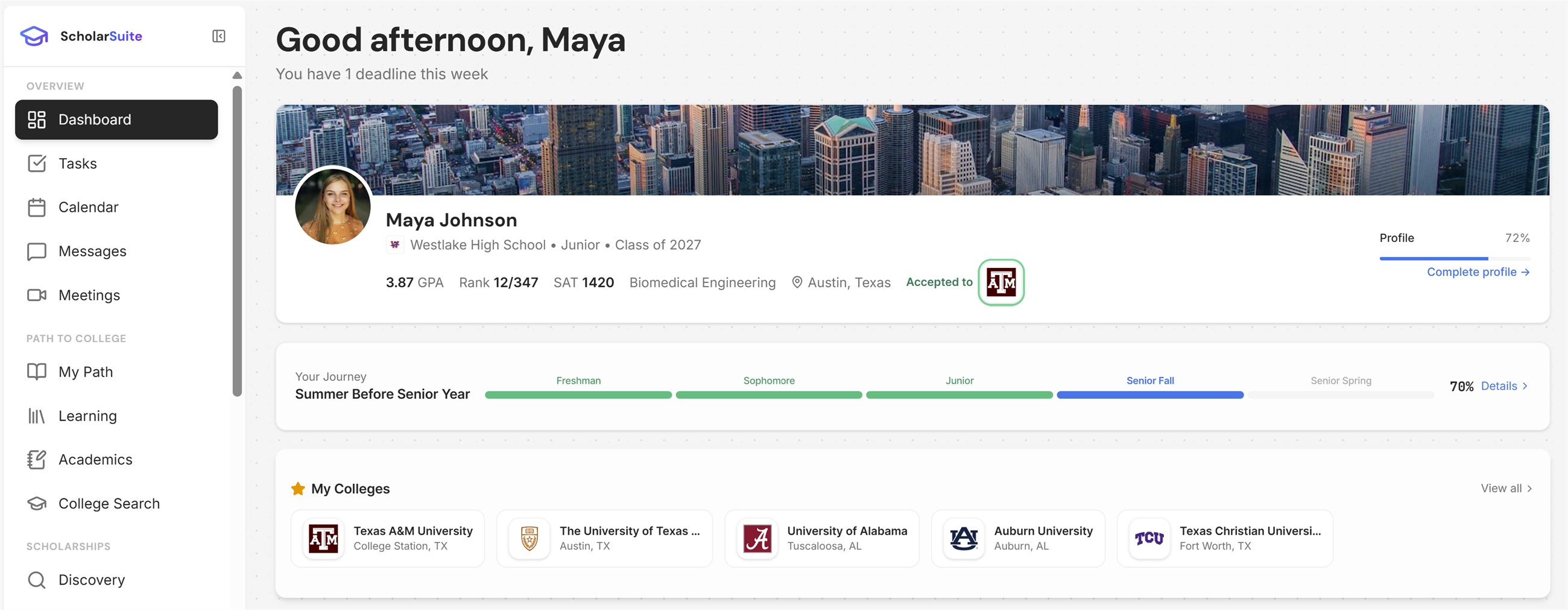
Quick Answer: What Is an AI College Deadline Tracker?
An AI college deadline tracker is a system that organizes every college application deadline, supporting document, and task into a personalized timeline, then uses AI to prioritize, remind, and adapt as your school list and progress change.
Unlike a static spreadsheet, an AI-driven tracker understands the relationships between tasks — that a recommendation letter needs three weeks of lead time, that an Early Action submission changes your December workload, that a supplemental essay for one school can be adapted for another.
Key capabilities:
- Build a deadline map across Early Decision, Early Action, Regular Decision, and Rolling admissions cycles
- Sequence essay drafting, testing, and recommendation requests backward from each cutoff
- Track application platform differences (Common App vs. Coalition vs. institutional portals)
- Surface scholarship and financial aid deadlines alongside admissions dates
- Retain full context across sessions so nothing needs re-explaining
The Problem: Why Application Deadlines Break Students
The volume alone is staggering. According to Common App data reported by Inside Higher Ed, application counts have continued climbing year over year — and the increase is driven not by more students, but by each student applying to more schools.
9,188,630 applications from 1,401,214 first-year applicants through a single February 1 deadline checkpoint — Common App deadline update
A 2% increase in applicants but a 5% rise in total applications in the same cycle — Common App reports and insights
That ratio is the entire problem in one statistic. More applications per student means more deadlines, more supplemental essays, more portals, and more moving parts — without any corresponding increase in the hours available to manage them.
But tracking all of this is genuinely difficult:
- Deadlines are fragmented across three or more application platforms
- Supporting materials (transcripts, recommendations, test scores) have their own hidden lead times
- Scholarship and financial aid cutoffs rarely align with admissions deadlines
- Early Decision commitments create cascading consequences for every other application
- The workload peaks during first-semester senior year, alongside coursework and exams
Deadline Fragmentation Across Platforms
A typical applicant does not use one system. Some schools accept the Common App, some the Coalition Application, and some require their own institutional portal. Each has different submission mechanics, different fee structures, and different confirmation processes. A student applying to fifteen schools may be managing three separate logins and three separate definitions of "submitted."
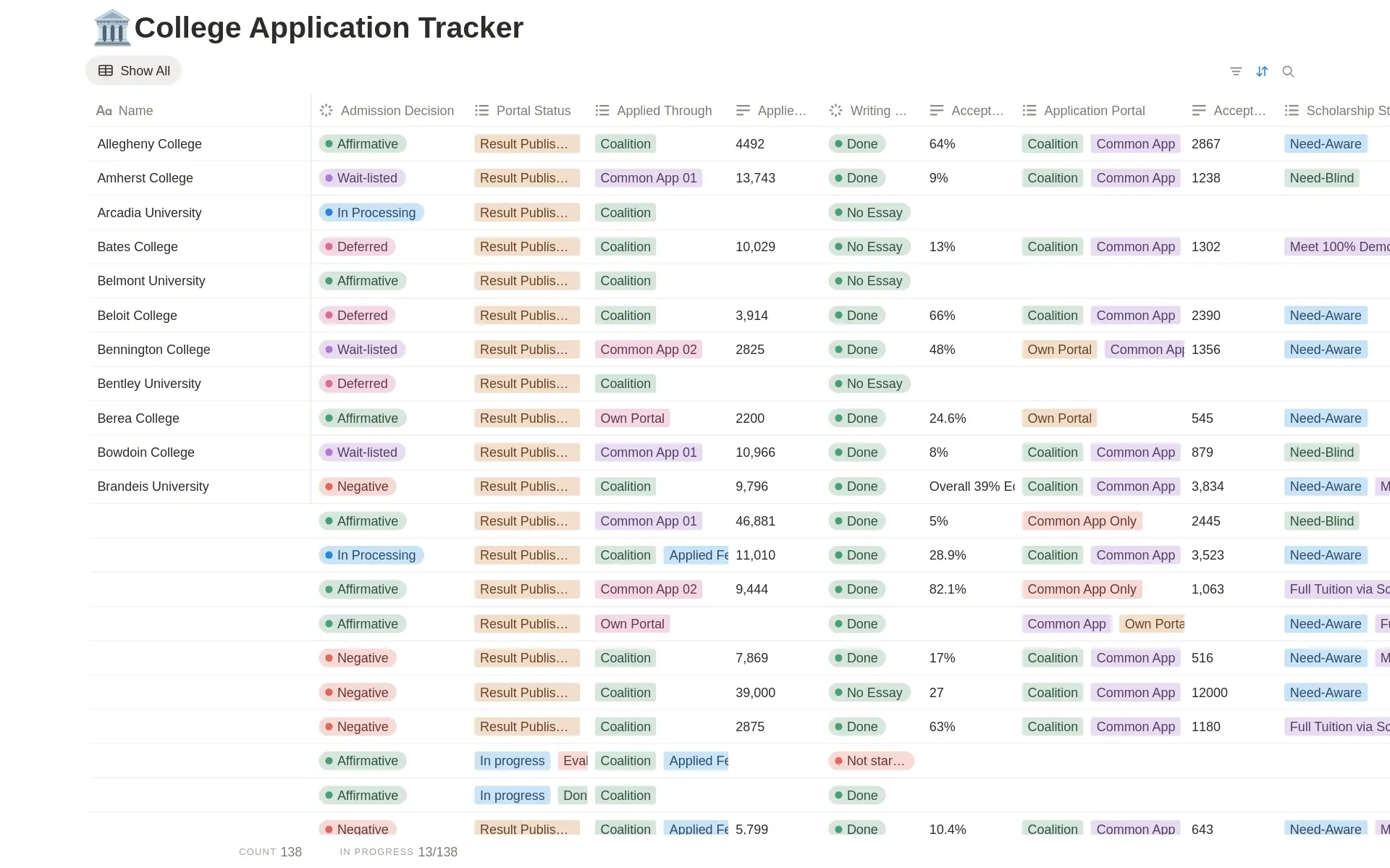
The tracker above illustrates the scale honestly: 138 institutions, each with a distinct decision status, application route, and financial aid classification. Maintaining that manually is a data entry job, not a strategy job — and it consumes the hours that should be going toward essays.
Hidden Lead Times on Supporting Materials
The application deadline is not the real deadline. Recommendation letters need to be requested weeks in advance. Official transcripts require registrar processing. Test scores need send time. Students routinely discover these dependencies too late, when the visible deadline is already inside the required lead time.
Misaligned Financial Aid Cutoffs
Admissions deadlines and aid deadlines are separate systems that rarely share a calendar. Affordability is already the single largest stressor in the process — in an EAB survey of nearly 6,000 high school students, 29% named affordability as the most stressful aspect of the college search. Missing an aid deadline on an accepted application is one of the most costly errors in the entire cycle.
The Compounding Stress Load
This is not merely an inconvenience. Research reported by Higher Ed Dive found that over half of students rank college applications as their most stressful academic experience — with the burden falling unevenly, at 60% of Black students and 61% of Hispanic students compared to 42% of white students.
The same EAB research found that the search process creates a feedback loop: stress degrades the quality of application work, and poor-quality work generates more stress. A deadline system that reduces cognitive load is not a productivity nicety — it directly protects the quality of the work.
This is exactly what Jenova's agent ecosystem was built for.
The Jenova Solution: AI Agents That Manage the Full Timeline
A tracker that only stores dates solves the smallest part of the problem. What students actually need is a system that knows what to do next and why it matters now. Jenova approaches this with specialized AI agents — each with deep domain expertise — that share persistent memory across your entire application journey.
| Traditional Approach | Jenova |
|---|---|
| Spreadsheet you must manually update | Agents that track context and surface next actions |
| Deadlines stored as flat dates | Backward-planned timelines with lead times built in |
| Separate tools for essays, testing, and aid | Specialized agents across every application function |
| Generic advice from static resources | Strategy personalized to your profile and school list |
| Context lost between sessions | Persistent memory retains your entire application history |
| One tool, one narrow function | Cross-domain agents that hand off work naturally |
Strategic Timeline Management
The College Admissions Consultant handles the core deadline architecture — school selection, essay crafting, and timeline management, with personalized strategies mapped to your profile. Rather than listing dates, it sequences them: which essays to draft first, when to request recommendations, how an Early Decision choice reshapes your December.
"I'm applying to 12 schools with 4 Early Action deadlines in November. Build me a backward-planned timeline starting from today, including recommendation letter lead times and supplemental essay drafts."
Test Prep Integrated Into the Calendar
Standardized testing has returned as a decisive factor at many institutions, according to AcceptU's admissions trend analysis. That means test dates are deadlines too — and score-send timing needs to sit inside the same timeline as everything else.
The SAT/ACT Tutor provides adaptive coaching, content mastery, and accountability toward a target score. For students taking Advanced Placement exams in the same window, the AP Exam Tutor covers all 40 AP subjects with rubric-based feedback and study planning.
Essay and Writing Support
Supplemental essays are the highest-effort, lowest-visibility part of the workload. The Essay Writer and Writing Assistant support drafting, structural revision, and voice consistency across a portfolio of essays — critical when you are adapting one core narrative across a dozen prompts.
Research and Verification
Deadline information changes. Policies shift. The Real-Time Search agent runs cross-platform research across Google, Reddit, YouTube, and more — useful for verifying current deadline policies, reading recent applicant experiences, and confirming testing requirements before you commit to a plan.
Platform Capabilities That Matter Here
- Persistent memory — your school list, essay drafts, test scores, and decisions carry across every session, indefinitely
- Multi-model access — always-current models from OpenAI, Anthropic, Google, DeepSeek, and xAI without switching accounts
- MCP tool integration — connect Google Calendar, Gmail, Drive, and Search so deadlines live where you already work
- Custom agents — build a tracker agent with your exact school list as a private knowledge base
- Full mobile parity — web, iOS, and Android with synced state, so a deadline check is always thirty seconds away
Specialized AI Agents for College Application Season
Admissions Strategy
College Admissions Consultant — Your primary deadline and strategy agent. Handles school selection, essay planning, and timeline construction with strategies tailored to your academic profile and goals.
- Backward-planned application calendars from each target deadline
- School list balancing across reach, target, and likely categories
- Essay strategy across Common App and supplemental prompts
Career Advisor — Useful upstream of the application itself. Major selection and career direction shape your school list, which in turn determines your deadline map.
- Career exploration frameworks grounded in real-time labor research
- Major-to-outcome pathway analysis
- Direct guidance on program fit
Testing and Academic Preparation
SAT/ACT Tutor — Adaptive test prep with accountability structures built in, so test dates integrate with your application timeline rather than competing with it.
- Diagnostic-driven study planning toward a target score
- Section-level content mastery
- Test-day strategy and pacing
AP Exam Tutor — Coverage across all 40 AP subjects, with adaptive diagnostics and rubric-based feedback.
- Subject-specific study plans
- Practice questions calibrated to exam format
- Score-maximizing exam strategy
Math Tutor — Adaptive, Socratic instruction from arithmetic through abstract algebra, exam-aware throughout.
Writing and Communication
Essay Writer — Drafting and revision support across your entire essay portfolio.
Writing Assistant — Line-level editing, structural feedback, and voice consistency.
Public Speaking Coach — Interview preparation, including audience simulation and Q&A drilling for alumni and admissions interviews.
Research and Organization
Real-Time Search — Verify deadlines, policies, and requirements against current sources.
Reddit Search — Surface real applicant experiences from r/ApplyingToCollege and related communities.
PDF Generator and Word Doc Generator — Export your deadline tracker, essay drafts, or school comparison sheets into shareable, professionally formatted documents for counselors and parents.
Try Jenova free — no credit card required.
How It Works: Building Your AI Deadline Tracker
Step 1: Load Your School List
Open a session with the College Admissions Consultant and provide your target schools, application types, and any deadlines you already know. Upload a spreadsheet if you have one — file attachments become part of the agent's working context.
"Here's my list of 14 schools. Four are Early Action, one is Early Decision, the rest are Regular Decision. Confirm the application platform for each and flag any I've mislabeled."
Step 2: Build the Backward-Planned Timeline
Ask for a working-backward schedule rather than a date list. This is where AI planning outperforms a spreadsheet — the agent accounts for lead times on materials you don't control.
"Build a week-by-week plan from today through my final Regular Decision deadline. Include recommendation letter request dates, transcript ordering, essay draft milestones, and score-send deadlines."
Step 3: Layer In Testing and Aid Deadlines
Bring the SAT/ACT Tutor into the same workflow using the @ mention feature — it receives your full conversation context, including your timeline, and can place test dates and prep blocks into the existing plan without you re-explaining anything.
"@SAT/ACT Tutor — given the timeline above, when should I take my final SAT sitting, and what does the prep schedule look like between now and then?"
Step 4: Track Progress and Adapt
Because memory persists across sessions, you can return weekly and simply ask what's next. As schools get added or dropped, the timeline updates rather than being rebuilt.
"I added two schools and dropped one. Update my timeline and tell me what's changed about my November workload."
Step 5: Export and Share
Use the PDF Generator to produce a clean tracker document for your counselor, or connect Google Calendar through the platform's tool integrations so deadlines appear in the calendar you already check.
Results & Use Cases
📊 The High-Volume Applicant
Scenario: A student applying to 18 schools across Common App, Coalition, and two institutional portals.
Traditional Approach: A manually maintained spreadsheet, updated inconsistently, with no automatic alerting. Hours per week spent on data entry rather than essay quality.
Jenova: The College Admissions Consultant maintains the full deadline map in persistent memory and answers "what's due next" in one query.
- Single source of truth across all application platforms
- Supplemental essay overlap identified so one strong narrative serves multiple prompts
- Weekly check-ins replace continuous manual tracking
💼 The Early Decision Strategist
Scenario: A student weighing a binding Early Decision commitment against comparing aid offers.
Traditional Approach: Generic online articles about ED tradeoffs, with no application to the student's specific financial situation or school list.
Jenova: Real-Time Search pulls current policy and applicant reporting; the College Admissions Consultant models how an ED choice reshapes the entire downstream timeline.
- Understand exactly what December looks like under each scenario
- Contingency timeline prepared in advance for a deferral or denial
- Aid deadline implications surfaced before the commitment is made
📱 The Mobile Check-In
Scenario: A junior between classes wants to confirm whether a recommendation request is overdue.
Traditional Approach: Open a laptop, find the spreadsheet, cross-reference dates, hope it was updated recently.
Jenova: Full feature parity on iOS and Android with synced state — ask the question, get the answer in seconds.
- Voice-to-text input for hands-free queries
- Same persistent memory across web and mobile
- Deadline check completed in under thirty seconds
🎯 The Test-and-Apply Overlap
Scenario: A senior sitting for a final SAT in the same month as four Early Action deadlines.
Traditional Approach: Two competing schedules with no coordination, resulting in under-prepared testing or rushed applications.
Jenova: SAT/ACT Tutor and College Admissions Consultant operate in the same session with shared context.
- Prep blocks scheduled around application milestones, not on top of them
- Score-send timing verified against each school's deadline
- Realistic workload assessment before the month begins
Frequently Asked Questions
Is an AI college deadline tracker free to use?
Yes. Jenova's Free tier includes access to all core features and every agent in the library, with limited monthly usage. Most students building an initial deadline map and checking in weekly can operate within the free allowance. Paid tiers start at $20/month for substantially higher usage limits and custom model selection. Check "Subscribe" in the menu for current details.
How is this different from a spreadsheet or the Common App dashboard?
A spreadsheet stores dates but cannot plan. The Common App dashboard tracks only Common App schools. An AI tracker built on Jenova works backward from each deadline to schedule the dependent tasks — recommendation requests, transcript orders, essay drafts — and spans every application platform in one place.
Can it track scholarship and financial aid deadlines too?
Yes. Aid deadlines are frequently separate from admissions deadlines and are among the most commonly missed. The College Admissions Consultant can incorporate scholarship and aid cutoffs into the same master timeline so both sets of dates are visible together.
Will it remember my school list between sessions?
Yes. Jenova provides unlimited chat history and persistent cross-session memory. Your school list, essay drafts, test scores, and prior decisions remain available without re-explaining context. You can also attach documents and knowledge bases for grounded, specific responses.
Does it work on mobile?
Full feature parity across web, iOS, and Android, with all settings and history synced. Speech-to-text is available for voice input, which makes quick deadline checks practical between classes.
Can I build a custom agent just for my applications?
Yes. Custom agents can be created in minutes with your own instructions, preferred model, and a private knowledge base — meaning you can load your exact school list and requirements, then interact with an agent purpose-built around your applications.
Conclusion
Application volume keeps rising while the hours available to each student stay fixed. That arithmetic is why deadlines get missed — not carelessness, but a coordination problem that spreadsheets were never designed to solve. An AI college deadline tracker changes the equation by handling the sequencing, the lead times, and the cross-platform bookkeeping, so your attention goes to the parts of the application that actually differentiate you.
Start with the College Admissions Consultant to build your timeline, bring in the SAT/ACT Tutor for testing, and use the Essay Writer for your drafts — all with shared context and persistent memory.
Explore the full agent library at Jenova.
For Developers: Every agent in this article is available programmatically via the Jenova API — build AI-powered admissions, deadline tracking, and student planning features into your application with a single integration. Full documentation →