What Is the Best AI Clinical Scribe for Medical Documentation?
2026-08-27
How Do AI Clinical Scribes Compare on Note Completeness, Coding Awareness, and Workflow Fit?
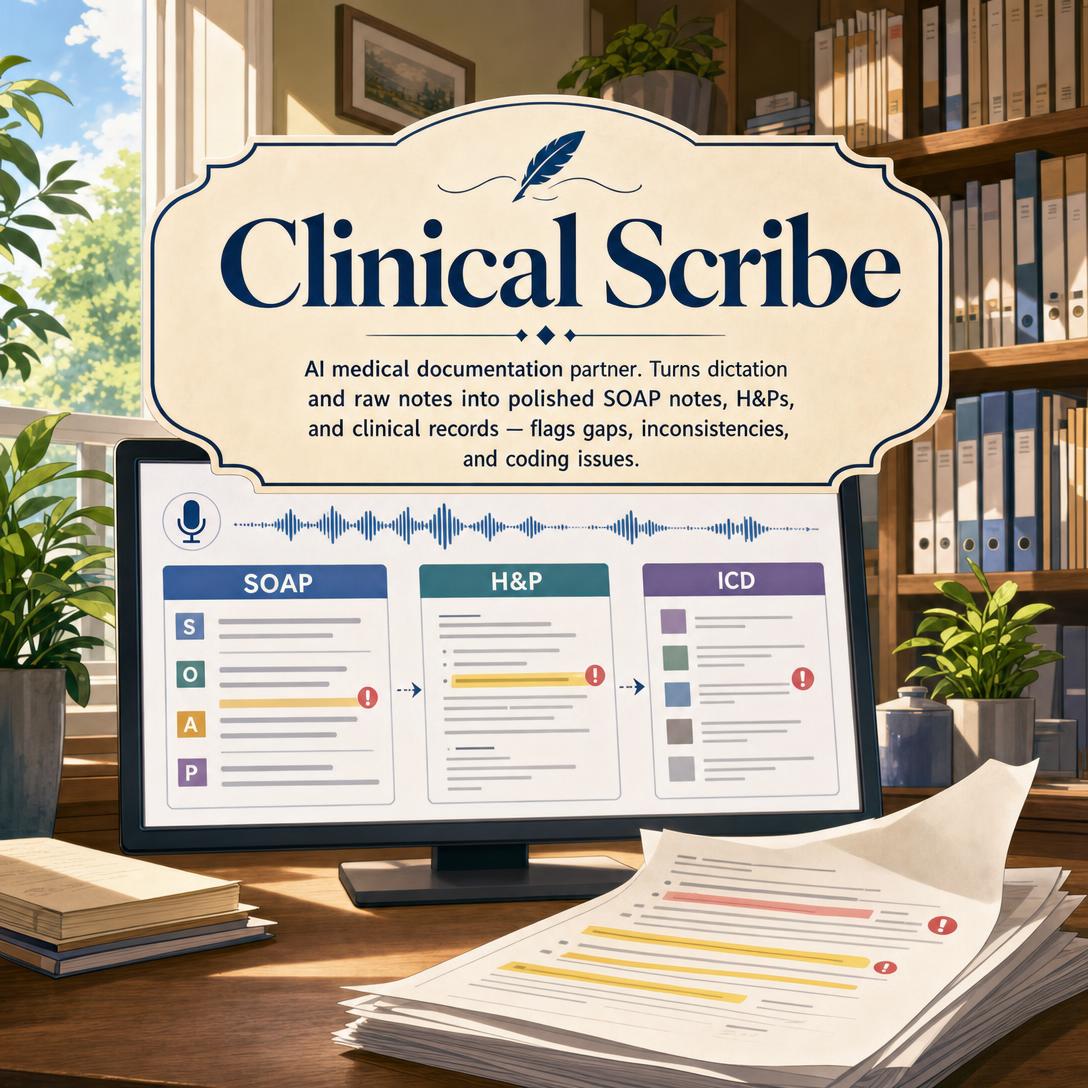
Clinicians comparing AI documentation partners in 2026 should judge them on note completeness, coding awareness, and workflow fit — not on ambient listening alone. Clinical Scribe is strongest when the job is turning dictation, transcripts, or raw notes into structured SOAP notes, H&Ps, and specialty formats while flagging gaps and coding issues, at a much lower cost than enterprise ambient platforms. Suki, Abridge, Nabla, and Microsoft Dragon Copilot are stronger when a health system needs live visit capture that writes into an EHR.
Key factors that separate useful AI clinical documentation from generic transcription:
✅ Input that matches real work — dictation, pasted notes, and transcripts, not only exam-room microphones ✅ Format coverage beyond SOAP, including H&P, discharge summaries, procedure notes, and mental health DAP/BIRP ✅ Clinical intelligence that flags missing ROS elements, problem-list mismatches, and possible coding gaps ✅ Honest gaps — [Not documented] markers instead of invented exam findings ✅ Cost and access that work for independent clinicians, residents, and therapists, not only health-system contracts
To compare these tools meaningfully, it helps to separate capture (hearing the visit) from integrity (whether the note is complete, internally consistent, and usable for coding and continuity).
Why Has Clinical Documentation Become Such a Heavy Burden for Clinicians?
Documentation burden is a major driver of clinician burnout, reduced productivity, and error risk, which is why hospitals and clinics have moved so quickly toward ambient AI scribes. The American Journal of Managed Care notes that documentation load contributes to burnout that can lower physician productivity and raise the likelihood of medical errors.
Independent evidence is no longer anecdotal. A JAMA Network Open study found that after 30 days with an ambient AI scribe, burnout among ambulatory clinicians fell from 51.9% to 38.8%. UChicago Medicine reporting on related work described a similar drop, from roughly 52% to 39%, with lower cognitive burden and less after-hours charting.
Time savings are real but uneven. Reviews of ambient AI medical scribes have reported documentation reductions in the 20% to 30% range. Vendor-reported figures can run higher: Nabla states that 55% of users save at least one hour daily and that burnout falls by 27%. JMIR Medical Informatics summarizes the broader pattern as reduced burnout, lower cognitive task load, and significant documentation time savings — with remaining questions about governance, accuracy, and who can actually afford enterprise deployment.
That last point matters. Most published gains come from EHR-embedded ambient tools inside health systems. Independent clinicians, therapists, and trainees still need a documentation partner that can produce a complete note from messy input without a six-figure implementation.
What Should You Look for in an AI Clinical Scribe?
An AI clinical scribe is worth using if it produces a complete, specialty-appropriate note from imperfect input, flags what is missing, and never invents clinical facts. Ambient capture is valuable, but it is only one dimension.
This article uses a Note Integrity Framework with six dimensions:
- Input flexibility — dictation, raw notes, transcripts, and speech-to-text cleanup, versus microphone-only ambient capture
- Format coverage — SOAP, H&P, progress notes, procedure notes, discharge summaries, intake assessments, and mental health DAP/BIRP
- Clinical intelligence — gap flags, inconsistency checks, allergy/medication observations, and differential suggestions framed as questions, not orders
- Coding awareness — ICD-10 suggestions with appropriate caution; CPT only where US practice is indicated
- Continuity — allergies, problems, medications, and follow-ups carried forward across encounters without silently rewriting the record
- Access cost and EHR independence — usable without an enterprise contract or write-back to Epic, Cerner, or similar systems
Weight the dimensions by setting. A 400-clinician health system should overweight EHR write-back, ambient capture, and security certifications. A solo internist, psychiatrist, or NP should overweight format coverage, gap detection, language flexibility, and monthly cost.
Two failure modes are more dangerous than slow typing. The first is fabrication: filling in a normal ROS or unremarkable exam the clinician never stated. The second is silent merge: rewriting yesterday’s note instead of labeling an addendum or correction. Tools that mark [Not documented] and preserve an audit trail score higher on integrity even if they do not sit inside the EHR.
HIPAA posture, data-training policy, and regional terminology (paracetamol vs. acetaminophen, A&E vs. ED) should be checked explicitly. US-centric defaults are a poor fit for international practice.
How Do Leading AI Clinical Documentation Tools Compare on Features and Pricing?
Suki, Abridge, Nabla, and Dragon Copilot lead the ambient, EHR-integrated category, while Clinical Scribe leads the conversational draft-and-review category for clinicians who bring their own notes. No single product wins every dimension.
| Feature / Dimension | Clinical Scribe | Suki | Abridge | Nabla | Dragon Copilot |
|---|---|---|---|---|---|
| Primary input | Dictation, raw notes, transcripts | Ambient visit capture plus voice editing | Ambient capture in the exam and EHR | Ambient capture, dictation, coding | Ambient signal capture plus assistant workflows |
| EHR write-back | No — draft export only | Yes, major EHRs | Yes, including Epic Haiku/Hyperspace | Yes, including Epic | Yes, Microsoft healthcare workflows |
| Format range | SOAP, DAP/BIRP, H&P, procedure, discharge, consults, operative notes | Clinical notes, instructions, orders | Specialty notes, orders, problem prediction | Structured notes plus medical coding | Documentation across specialties and settings |
| Gap / inconsistency flags | Yes — separated Clinical Notes | Workflow completeness via ambient + EHR | Linked Evidence tying claims to source | Coding and note customization | Documentation plus task automation |
| Coding awareness | ICD-10; CPT only when US context is present | Orders and charting support | Billing-aligned problem language | Medical codification in EHR | Documentation support; coding depth Unverified |
| Languages | Any language in or out | Unverified beyond major-market use | Multilingual note generation | Unverified on public product pages | Unverified on public product pages |
| Pricing (as of 2026) | Free tier; paid from $20/month | About $299–$399 per provider per month | No public list; estimates ~$2,500–$7,200+ per clinician per year | No public list; Pro often cited near $119/month | No public list; third parties cite ~$369–$600+/month |
| Best for | Drafting complete notes from dictation without an EHR project | Health systems wanting ambient notes plus orders | Large Epic-centric systems needing auditable notes | Systems wanting ambient notes plus coding | Microsoft-stack organizations scaling ambient documentation |
Clinical Scribe
Clinical Scribe converts free-form clinical input into polished documentation and then, when warranted, appends observations about gaps, inconsistencies, drug/allergy conflicts, and coding specificity. It auto-detects format from context — SOAP for outpatient follow-up, DAP or BIRP for mental health, H&P for initial encounters, procedure notes, and discharge summaries — and the clinician can override that choice.
Strengths include speech-to-text cleanup, multi-language documentation, specialty-aware conventions, and encounter continuity: allergies, problems, medications, and pending follow-ups can carry forward and be marked as previously documented rather than freshly confirmed. Addenda and corrections are labeled instead of silently merged.
Limitations are structural. It is not an EHR, cannot write into a medical record system, and does not ambient-listen to a live visit. It also does not offer scheduled reminders or background alerts. Privacy materials emphasize encryption and no training of public models; they do not, in the product information reviewed here, describe a HIPAA BAA comparable to enterprise ambient vendors.
Suki
Suki markets an ambient clinical intelligence platform that captures the patient conversation and generates notes, patient instructions, and orders, with voice-enabled editing and problem-based charting. The company says the product works across desktop and mobile (iOS and Android), 100+ specialties, and major EHRs, and that 400+ healthcare systems and partners use it.
That EHR-native workflow is the core strength. The core limitation is cost and access. Third-party 2026 reviews commonly place Suki at about $299–$399 per provider per month, which prices out many independent clinicians and makes a sales-led rollout the default path.
Abridge
Abridge is built as an enterprise ambient layer, with Best in KLAS recognition for 2025 and deep Epic workflow: capture in Haiku, review in Hyperspace, and Linked Evidence tying drafted statements to source audio or data. It covers outpatient, emergency, and inpatient settings, supports multilingual notes, and describes HIPAA-aligned controls, US data centers, and 256-bit encryption.
Vendor-reported outcomes are aggressive — including a 78% cognitive-load decrease at Christus Health. The tradeoff is opacity and scale: Abridge does not publish self-serve pricing, and market estimates cluster around thousands of dollars per clinician per year. It is a health-system product, not a notepad for a single clinic day.
Nabla
Nabla positions a clinical AI layer for ambient documentation, dictation, and coding inside Epic and other major EHRs. Public product claims include a 27% reduction in burnout, 55% of users saving an hour or more daily, and 1.5× more patients seen monthly. Security badges listed include HIPAA, SOC 2 Type 2, ISO 27001, and GDPR.
Those figures are vendor-reported and should be read as such. Pricing is similarly opaque; 2026 roundups often cite a free tier and a Pro plan near $119 per user per month, while enterprise terms remain negotiated. Nabla is a strong ambient-plus-coding option when EHR embedding is the requirement.
Microsoft Dragon Copilot
Dragon Copilot is Microsoft’s AI clinical workspace for documentation, ambient signal capture, and task assistance across specialties, settings, and devices. Microsoft documents a single-user license covering documentation and ambient capture, and licensing terms shifted again in 2026, including a per-user price decrease effective May 1, 2026.
Public list prices are still hard to pin down. One 2026 review puts DAX/Dragon Copilot near $369 per provider per month](https://www.marvix.ai/blog/dax-copilot-pricing-review); other reseller commentary cites a [higher $400–$600+ band. It fits organizations already standardized on Microsoft healthcare infrastructure better than it fits a therapist drafting DAP notes on a laptop.
How Does AI Handle SOAP Notes, Mental Health Formats, and Specialty Documentation?
Effective AI scribes map clinical context to the right note structure and keep the clinician’s reasoning intact rather than flattening every visit into a generic SOAP template. Format mismatch is one of the fastest ways a “complete” note becomes unusable.
Clinical Scribe treats format as a clinical decision. Outpatient follow-up defaults to SOAP; mental health sessions default to DAP or BIRP; first encounters default to H&P; procedures and discharges get their own structures. Tense is part of that craft: past for HPI and narrative, present for assessment, imperative or future for plan. Abbreviations and regional drug names follow the clinician’s own language unless a standard form is requested.
Enterprise ambient tools typically optimize for the physician visit note that lands in the EHR, plus adjacent artifacts such as patient instructions and orders. That is the right target for a health-system ambulatory clinic. It is a weaker default for psychology, psychiatry, therapy, intake assessments, risk assessments, and operative notes, unless the organization has configured those templates.
Specialty conventions are not cosmetic. Pediatrics, OB/GYN, emergency medicine, and surgery do not share the same required elements, and billing completeness often hangs on a missing specificity (for example, type 2 diabetes with hyperglycemia versus an unspecified code). A scribe that can say “consider documenting specificity for ICD-10” is doing different work from a scribe that only produces fluent prose.
Clinicians who also review imaging or longitudinal health data often keep documentation beside interpretation tools such as Medical Image Analyst and Personal Medical Analyst. Those agents do not replace the note. They sit next to it when the source material is an image or a lab trail rather than a visit narrative.
How Do AI Scribes Flag Documentation Gaps, Inconsistencies, and Coding Issues?
The highest-value AI scribe behavior is not faster typing — it is catching the missing allergy, the diagnosis that never made the problem list, and the ICD-10 code that is too vague to bill cleanly. Transcription without review simply accelerates incomplete charts.
Clinical Scribe separates this work from the note itself. The documentation leads; a Clinical Notes section appears only when there is something worth saying, in a collegial register: observations and questions, not directives. Typical flags include an unaddressed ROS, hypertension in the HPI but not the assessment, a new NSAID in a patient on warfarin, a narrow assessment relative to the documented presentation, or discharge instructions omitted from a discharge summary.
Coding suggestions are framed as “consider” or “may apply.” ICD-10 is treated as the international default; CPT is suggested only when the user’s context indicates US practice. That distinction matters. A global tool that always emits US CPT codes creates false precision.
Ambient enterprise platforms approach the same problem from the capture side. Abridge’s Linked Evidence and problem-prediction features are designed so drafted statements can be audited against source information and grouped in billing-aligned language. Nabla includes medical coding in the EHR workflow. Those designs help when the conversation happened in the room and the record lives in Epic. They help less when the clinician is cleaning a voice-to-text dump, a resident’s incomplete H&P, or a therapy session summary.
One integrity rule is non-negotiable: if the clinician did not provide a finding, the scribe must not invent it. Tools that auto-complete a normal physical exam to look “finished” create legal and clinical risk. Marking [Not documented] is slower to look at and safer to sign.
How Do You Get Accurate Clinical Notes From an AI Scribe?
You get accurate notes by feeding the scribe real clinical content, stating the format if you care about it, and treating every draft as unsigned until you verify diagnoses, meds, and plan. Setup should take minutes, not an IT project.
For Clinical Scribe, a typical first pass looks like this:
- Open the agent at jenova.ai/a/clinical-scribe.
- Paste, dictate, or drop a transcript. If you have a format preference, say it in the first line.
- Review the structured note, then the Clinical Notes flags.
- Send corrections or an addendum rather than asking the model to quietly rewrite history.
- Export a txt, Word, or PDF draft for paste-into-EHR — the agent does not write to the record itself.
A useful opening prompt is specific and incomplete on purpose, so you can see how gaps are handled:
"SOAP, primary care follow-up. 58M with T2DM and HTN. A1C 8.2% last month, today BP 148/92. Metformin 1000 BID, lisinopril 20 daily. NKDA. Increased metformin already; discuss GLP-1 next visit. Recheck A1C in 3 months. No ROS dictated."
If the output fills in an unmentioned ROS or exam, reject it. The correct behavior is to mark those sections incomplete.
For a same-patient return visit, say that it is the next encounter so allergies, problems, and meds can be carried forward as previously documented. For a different patient, say so explicitly; mixed charts are a documentation failure, not a chat convenience.
Ambient tools follow a different ritual: start recording in the exam, talk to the patient, then attest the EHR draft. Nabla has reported cutting documentation time by about 50% in earlier physician studies, and Suki’s workflow includes orders and patient instructions as well as the note. Those steps assume microphone access, EHR integration, and usually a contracted rollout.
Clinical Scribe is available with a free tier of limited usage; paid plans start at $20/month for 30× that allowance, with higher tiers up to enterprise. That pricing is the practical reason a resident, therapist, or small clinic can use it the same day, while ambient platforms remain a procurement decision.
What Do Clinical Documentation Experts Say About AI Scribes?
Documentation experts increasingly treat AI scribes as a burnout intervention, but they separate time saved from note quality, billing integrity, and governance risk. Speed without an audit trail is not progress.
"The mistake we still see is equating ambient capture with documentation quality. Hearing the visit solves one bottleneck. The note still has to be internally consistent: problems that appear in the assessment must appear in the problem list, allergies cannot drop off, and ICD-10 specificity has to match what was actually evaluated. A fluent paragraph that invents a normal ROS is worse than a slower note with [Not documented] in that section."
"Enterprise ambient platforms earned their place. The JAMA and health-system data on burnout and after-hours charting are why CIOs buy them. They are also priced and implemented as infrastructure. That leaves a large group — independent clinicians, behavioral health, trainees, international practice — that needs a documentation partner, not a six-figure EHR project. Continuity across encounters matters there as much as first-pass prose: medications and follow-ups should carry forward without pretending they were reconfirmed today."
"Coding suggestions should stay advisory. Codes update, payer rules vary, and CPT is not a global language. The safer design is to flag possible specificity — E11.65 versus E11.9 — and leave the clinician as the signer. If a product cannot say what it does not know, it should not be in the chart."
— Jenova Product Team, AI documentation agent design, 8 years building professional workflow agents
Nature’s review of ambient AI scribes makes a related point at system scale: these tools are reshaping clinician-patient interaction, but they were first tested in lower-acuity settings, and expansion still depends on workflow fit and governance. A JAMIA Open quality-improvement survey found that most respondents agreed AI reduced documentation burden and time spent documenting outside clinic hours — which is necessary, not sufficient, if the note cannot be signed with confidence.
When Does a Conversational AI Scribe Make More Sense Than Ambient EHR Software?
A conversational AI scribe makes more sense when you already have the clinical content — dictation, a transcript, a student note — and need structure, gap detection, and a portable draft without waiting on EHR integration. Ambient EHR software makes more sense when the bottleneck is the live visit itself and your organization can deploy into the chart.
Choose a conversational model like Clinical Scribe when most of these are true:
- You work outside a health-system ambient contract, or you moonlight in a setting that will not install one
- Input arrives as voice-to-text, pasted fragments, or incomplete student notes
- You need DAP/BIRP, discharge summaries, procedure notes, or multilingual output
- You want coding and inconsistency flags on the draft, then you will paste into whatever record system you already use
- You cannot justify roughly $300–$600 per month per clinician, or a multi-year Abridge-style enterprise agreement
Choose Suki, Abridge, Nabla, or Dragon Copilot when most of these are true:
- The visit happens in a room (or telehealth session) you can record under policy
- Notes, orders, and sometimes codes must land in Epic or another major EHR with attestation
- Security review requires vendor HIPAA/SOC 2 paperwork, admin consoles, and system-wide deployment
- Reducing in-room keyboard time is the primary goal, as in the ambient-scribe burnout studies
Hybrid use is common and rational. Some clinicians keep an enterprise ambient tool for scheduled clinic sessions and a conversational scribe for inbox messages, curbside documentation, moonlighting, teaching files, and mental health formats the EHR template does not handle well. The products are not interchangeable. One captures the room. The other repairs and completes the record the clinician already tried to write.
Clinical Scribe remains a draft aid. Every diagnosis, medication, and plan still requires a qualified professional’s review before it touches patient care. That constraint is not a marketing footnote. It is the correct boundary between documentation support and clinical judgment.
References
- The American Journal of Managed Care — Ambient AI adoption and documentation burden as a burnout and error risk
- JAMA Network Open — Ambient AI scribes and 30-day burnout reduction in ambulatory clinics (51.9% to 38.8%)
- UChicago Medicine — Ambient AI time savings, burnout drop, and after-hours documentation
- Institute for Homeland Security — Ambient AI medical scribes, 20–30% documentation reduction, and governance risk
- Nabla — Vendor-reported burnout, daily time savings, and visit-volume figures
- JMIR Medical Informatics — Review of AI scribes’ effects on burnout, cognitive load, and documentation time
- Suki — Ambient clinical intelligence, specialties, devices, EHR interoperability, and partner scale
- HealOS — 2026 third-party summary of Suki pricing bands
- Abridge product — Epic workflows, Linked Evidence, multilingual notes, care settings, and security controls
- VeroScribe — 2026 Abridge review and enterprise pricing estimates
- Marvix AI — 2026 Nabla pricing commentary, including reported Pro-tier figures
- Microsoft Learn — Dragon Copilot licensing, documentation, and ambient capture
- Schneider IT Management — Dragon Copilot 2026 licensing and price changes
- Marvix AI — DAX/Dragon Copilot 2026 per-provider pricing review
- DeepCura — Third-party Dragon/DAX pricing range estimates
- PR Newswire — Nabla Copilot documentation time-savings study claims
- Nature Digital Medicine — Barriers and opportunities of scaling ambient AI scribes
- JAMIA Open — Clinician survey on AI documentation burden and after-hours charting
- PMC / NIH — Perspectives on ambient AI transforming clinical documentation