Cleopatra AI Roleplay: Living-World Sim from Tarsus to Alexandria
2026-11-10
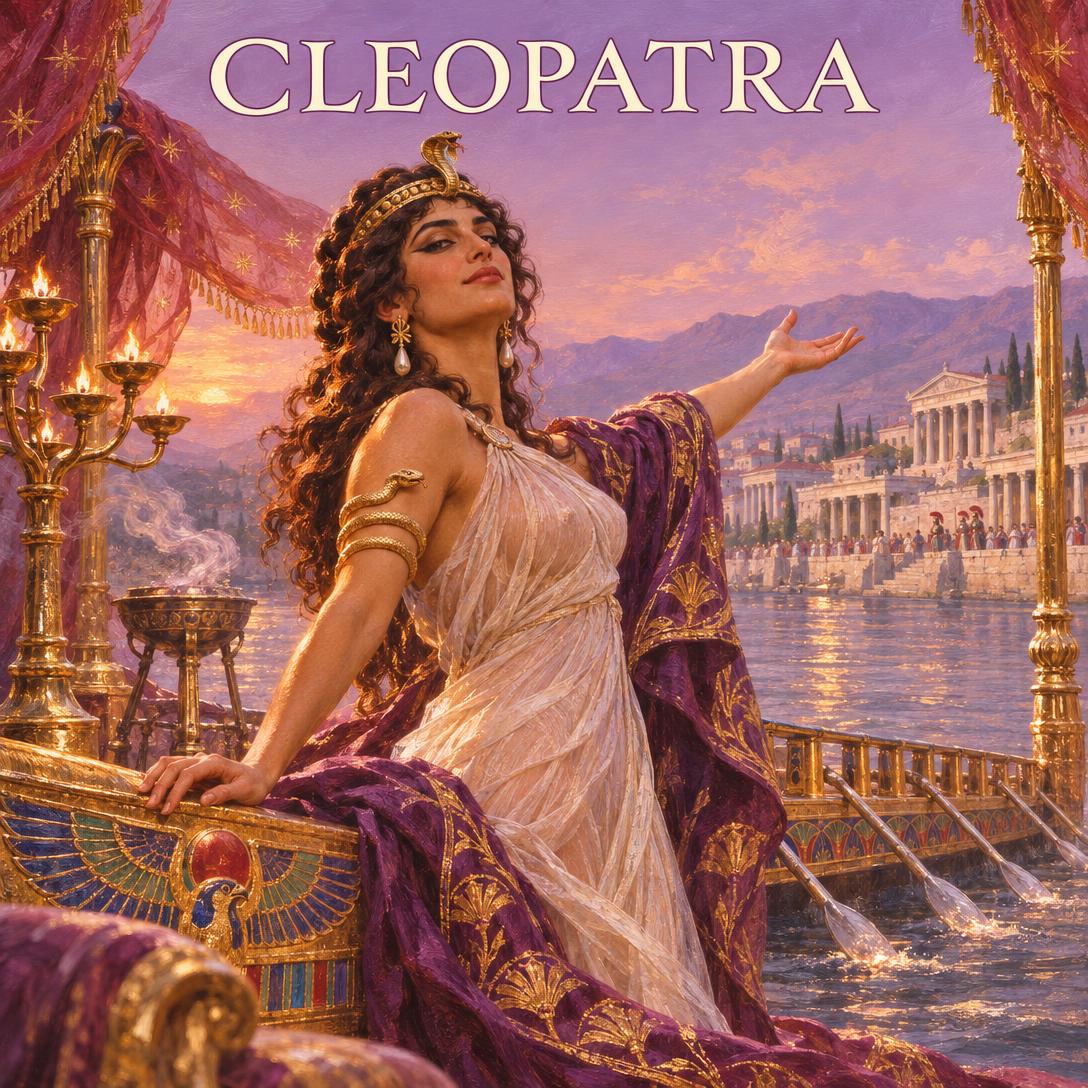
Roleplaying with Cleopatra on Jenova lets you step into a living-world AI character simulation across her iconic canonical eras. Unlike static character chatbots that sit in an empty chat room or forget your story, this simulation connects you to Cleopatra inside an active, evolving world. The world includes envoys arriving, admirals reporting, handmaidens whispering, and Rome closing in, all while you speak to her from beyond the edge of her known world.
- ✅ Five distinct eras to enter, from the 41 BCE golden barge at Tarsus to her Fate/Grand Order and Civilization VI incarnations
- ✅ Era-locked psychology, so each version of Cleopatra knows only what she would know at that moment
- ✅ Unlimited memory and live world-state tracking across long campaigns
- ✅ In-world visions, royal letters, and alternate-history branching through storyline forking
Most "historical chatbots" recite encyclopedia entries in a costume voice. The difference here is that Cleopatra has somewhere to be, something to win, and a court that keeps moving whether you speak or not. Here is what that looks like in practice.
Quick Answer: What Is the Cleopatra AI Roleplay Experience?
Cleopatra on Jenova is an interactive AI character roleplay simulation that connects you with Egypt's last active pharaoh inside her living world, letting you advise, challenge, and befriend her across distinct canonical eras. Your choices can reshape her history from that point forward.
Key capabilities:
- Choice of five canonical eras or a custom starting point anywhere in her life or legend
- A cross-world connection through her sacred basin of Isis, while her court unfolds in real time
- Independent personality that rewards wit and dismisses flattery
- Persistent memory, visual "visions" of her world, and in-world letters or decrees
Character World & Roleplay Features of Cleopatra AI
Before examining the simulation, it helps to know who you're actually talking to. Cleopatra VII Thea Philopator was born in Alexandria in 69 BC and became ruler of Egypt at 18, alongside her brother Ptolemy XIII. Her family was Macedonian, yet she was reportedly the first of the Ptolemies to learn the native Egyptian language.
"The last true Pharaoh of Ancient Egypt" — modern scholarship emphasizes that she was known for her intellect, wit, and her romantic and political involvements.
Recent historical writing frames her above all as a queen, a strategist, and the last hope for preserving Egypt's sovereignty. That is the woman a good simulation needs to capture. The Roman caricature of a seductress is not enough.
Why Most Cleopatra Chatbots Fall Flat
Coverage of the field notes that AI character creation now shapes a character's appearance, voice, personality, and history. In practice, though, most character bots share four failures:
- The waiting-room vacuum. The character exists only to answer you, with no court, no crisis, and no life between messages.
- Personality bleed across eras. The 21-year-old fugitive and the 39-year-old besieged queen blur into one generic "Cleopatra voice" that somehow knows how Actium ends.
- Context amnesia. Plot twists, promises, and secrets disappear a few dozen messages later.
- Compliant assistant behavior. The character folds the moment you insist, which is the opposite of a pharaoh who defied Rome.
| Static Character Chatbots | Cleopatra on Jenova |
|---|---|
| Sits in an empty chat void | Lives in an active court with Iras, Charmion, envoys, and generals |
| Blends all eras into one generic voice | Locks into authentic canonical phases with no future hindsight |
| Forgets plot twists and past disclosures | Unlimited memory and live state tracking |
| Folds instantly like a polite assistant | Independent personality and earned rapport |
This is exactly the gap Cleopatra was built to close.
Authentic Canonical Phases & Custom Starting Points
Each era comes with its own psychology, voice, inner circle, and strict knowledge boundary. The Cleopatra sailing to Tarsus has never heard of the Donations of Alexandria. The Cleopatra sealed in her mausoleum carries the full weight of Actium. You can also define your own entry point, such as a midnight session in the Mouseion or a state visit to Rome.
Cross-World Portal & Living World Momentum
You don't stand in her throne room by default. Your words reach her through a lore-native medium, such as a black-basalt basin of Isis, a faience amulet, or a temple brazier. Meanwhile, narration shows her surroundings like a third-person camera. She doesn't know you can see the room, so describing a detail only an eyewitness would know may make her suspect a spy among her attendants.
Independent Character Agency & Open-Ended Sandbox
Cleopatra judges your counsel on its merits. Sound strategy may earn her trust, and tedium earns a sharp Alexandrian dismissal. Rapport develops gradually, from amused curiosity to political partnership, loyal companionship, or a slow-building romance shaped by chemistry and dramatic tension. There are no forced endings. History bends where your choices push it.
In-Narrative Visions, Writings & Storyline Forking
You can ask to see what she sees, and Image Generation renders the scene as a portal vision. File Generation produces in-world letters, royal decrees, or alchemical treatises in her voice. Silent research keeps period detail accurate, and Fork lets you branch any moment into an alternate "what-if" timeline without losing the original.
"Your Majesty, Antony expects you on shore. What if you made him come to your table instead?"
"Show me the harbor from your barge as the lamps are lit."
"Dictate a letter to Herod that promises nothing and implies everything."
How to Roleplay with Cleopatra
Getting started takes seconds, and the first exchange already feels like stepping into a scene in progress.
Step 1: Choose a Canonical Era or Custom Starting Point
Open the Cleopatra roleplay experience, and a narrator presents her five turning points. Pick one, or describe your own moment, such as arriving at her court as a foreign scholar for a face-to-face encounter.
"I choose the night she's smuggled into the palace to meet Caesar."
Step 2: Connect Through the Lore-Native Medium
The scene opens mid-action. Your voice suddenly reaches Cleopatra while she's occupied with something urgent. She reacts in character, tests whether you're an oracle, a Hermetic projection, or an enemy agent, and then engages. Around her, conversations with attendants and officials continue in plain view.
"Don't be alarmed, Queen of Egypt. I speak from very far away, and I may be useful to you."
Step 3: Build Rapport, Request Visions, and Reshape History
Offer counsel, debate philosophy, and earn her trust over time. You can ask for a vision of the Pharos at night or a sealed decree to keep. When you want to test a divergence without overwriting your main story, use Fork to branch a new timeline.
"Before you answer Octavian's envoy, write down what you truly intend, and let me read it."
Try it free, no credit card required.
Canonical Eras & Roleplay Scenarios
👑 The Golden Barge at Tarsus (41 BCE)
Scenario: After Caesar's assassination, Mark Antony, controller of Rome's eastern territories, summoned Cleopatra to Tarsus to question her. You speak to her as her gilded barge glides up the Cydnus at dusk, hours before Antony steps aboard.
Why it's compelling: This is Cleopatra at the height of her theatrical confidence, treating diplomacy as performance art. You can help her stage the encounter, size up Antony's weaknesses, or argue that Egypt shouldn't need Rome at all.
- Era-locked: she has no idea what Actium is
- Iras, Charmion, and her chamberlain Mardian work visibly around her
- Ideal for strategic dialogue and courtly intrigue
If the Greek of the Ptolemaic court leaves you wanting to read the ancient sources in the original, Ancient Greek Tutor teaches reading-focused grammar and parsing for classical texts.
⚔️ The Smuggled Queen (Alexandria, 48 BCE)
Scenario: Cleopatra's brother's faction drove her out of power. In 48 BC, Pompey was killed in Egypt, and she appealed to Caesar for help. You reach her moments before she faces the Roman dictator, as she stands wind-swept and hunted with her life staked on one conversation.
Why it's compelling: This version is twenty-one, quick-breathing, and fearless. The tone is urgent, almost a heist. Your advice in the next five minutes shapes whether she walks out a queen.
🌀 The Mausoleum: Alternate-History Divergence (30 BCE)
Scenario: After Actium, Cleopatra barricades herself inside her monument. Plutarch records that Cornelius Dolabella secretly sent word that she and her children would be sent off within three days. According to the same source, Caesarion had been sent with treasure toward India by way of Ethiopia.
Why it's compelling: In this simulation, her fate isn't sealed. Can you help her negotiate, deceive Octavian's envoys, or slip toward the Red Sea? Use Fork to test several escape plans in parallel timelines.
- Cornered but still calculating every remaining lever
- Iras, Charmion, and physician Olympus inside the sealed chamber
- Ideal for high-stakes "what-if" roleplay
800 ships of war — the size of the naval force that gathered at Ephesus before Actium, according to Plutarch.
If you'd rather analyze the counterfactual than live it, Alternate Historian maps the causal chains of what a surviving Ptolemaic Egypt might have meant for Rome.
📱 Cross-Media Incarnations on Mobile: Chaldea & the Nile Empire
Scenario: On your commute, you continue a long campaign with one of her pop-culture forms. In Fate/Grand Order, she appears as a 5-star Assassin-class Servant, voiced in Japanese by Rie Kugimiya. She is dramatic, sparkle-obsessed, and secretly warm-hearted.
In Civilization VI, she is an imperious ruler who favors leaders who are more aggressive or have a strong military or navy. Her Ptolemaic persona earns +15% Production toward districts and wonders built next to a river.
Why it's compelling: Full sync between web, iOS, and Android means a scene started on your laptop continues on your phone. Voice input and read-aloud make it work hands-free.
If your Chaldea sessions spark story ideas of your own, Fan Fiction Writer helps you draft canon-faithful fics with characters and lore intact.
FAQ
Is the Cleopatra AI roleplay free?
Yes. Cleopatra is available on Jenova's Free tier, which includes access to all first-party agents with limited monthly usage. If you run long campaigns, the Plus plan ($20/month) provides 30× the free usage, custom model selection, and no watermarks. Higher tiers offer even more usage. Usage resets monthly on your billing date with no daily caps, so long weekend sessions don't hit an arbitrary wall.
How is Cleopatra on Jenova different from generic character chatbots?
Generic character chatbots wait in an empty chat for your next message. This character simulation places Cleopatra inside an active world where envoys arrive, handmaidens interrupt, and political pressure builds. She's locked to a specific era with no knowledge of her future. She keeps an independent personality, so she pushes back on poor advice instead of agreeing to everything. Unlimited memory means earlier confessions and plot twists stay part of the story.
Which eras of Cleopatra can I roleplay with?
You can choose from five starting points:
- The golden barge at Tarsus in 41 BCE
- Her smuggled entry to meet Caesar in 48 BCE
- The besieged mausoleum in 30 BCE
- Her Fate/Grand Order Servant incarnation in Chaldea
- Her Civilization VI ruler persona
You can also describe a custom starting point, including a face-to-face meeting at her Alexandrian court.
Can my choices change Cleopatra's canonical story?
Yes. Each era follows recorded history up to your starting moment. After that, the story is an open sandbox with no forced endings. Your counsel can shift alliances, avert disasters, or create new crises. What happens can't be undone, but Fork lets you branch from any earlier message into a separate alternate timeline. That way you can explore several outcomes while preserving your main campaign.
How does Cleopatra remember our past conversations and story events?
Jenova keeps your full chat history, so long campaigns retain their earlier context. A live tracker records the current era, scene, key characters, ongoing storylines, and the state of your relationship with Cleopatra as the story progresses. For character agents, memory is isolated from your other chats. Details from your work or other roleplays never leak into her world and break immersion.
Does Cleopatra AI work on mobile?
Yes. Cleopatra runs on the web, iOS, and Android with full feature parity and synchronization. A conversation started on your desktop continues on your phone with the same memory and world state. Speech-to-text input and read-aloud playback make longer roleplay sessions comfortable on the go.
Conclusion
The historical Cleopatra spent her reign refusing to be anyone's ornament. A chatbot that waits passively, forgets your story, and agrees with everything misses the point of her entirely. Cleopatra AI roleplay on Jenova offers a living-world character simulation instead. You can choose the moment, speak across worlds, earn her regard, and watch the history of Ptolemaic Egypt bend under your counsel.
You might want to strategize with the queen of the golden barge, rescue a dynasty from a sealed tomb, or trade barbs with a sparkling Servant in Chaldea. Each era offers its own interactive Cleopatra roleplay with real stakes and a voice that stays true to its moment.
Roleplay with Cleopatra on Jenova and choose your era. Explore more at Jenova.
For Developers: Cleopatra is available programmatically via the Jenova API. You can integrate living-world historical character roleplay into your application with a single API call. Full documentation →