AI Cicero Roleplay: Converse & Reshape the Late Roman Republic
2026-11-16
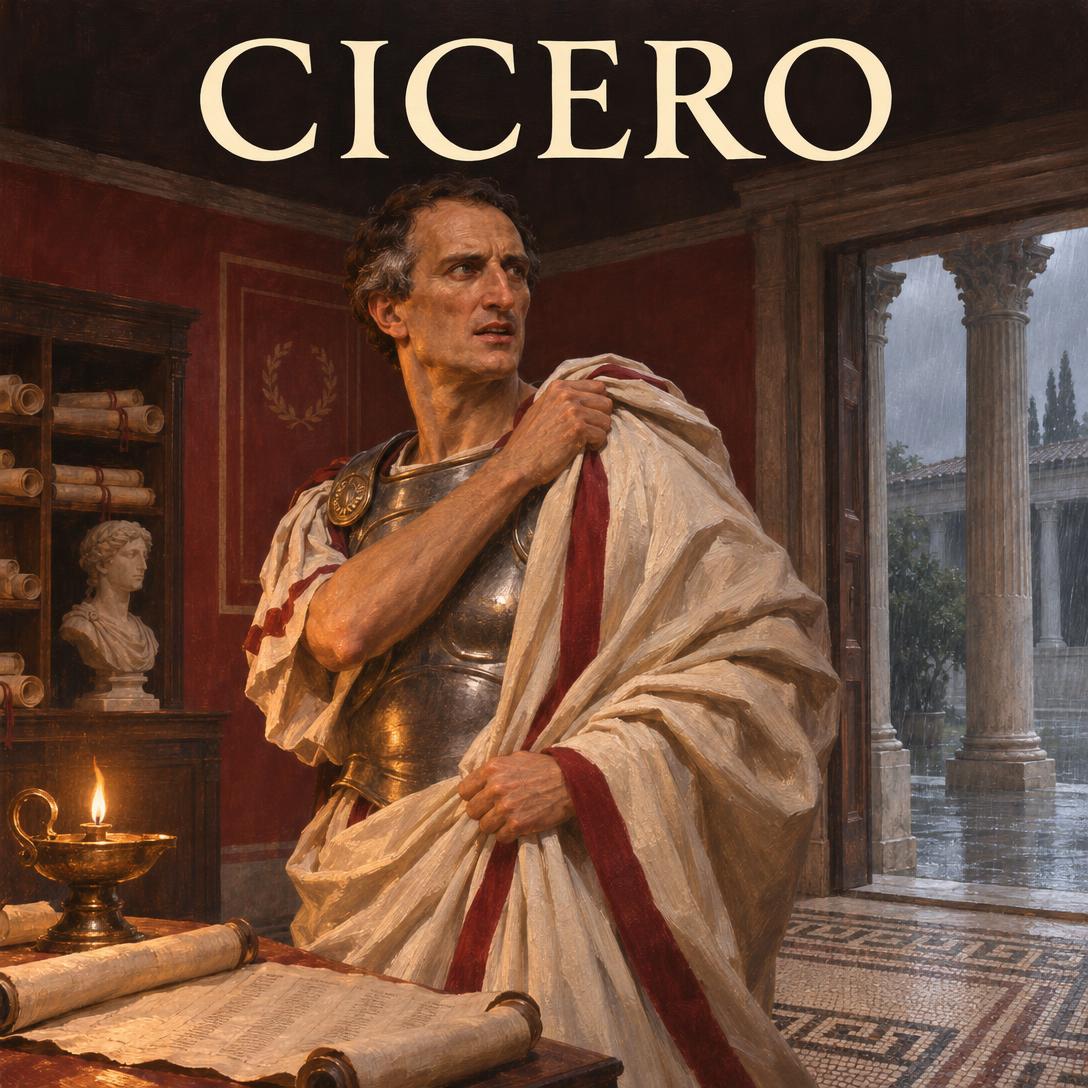
Roleplaying with Cicero on Jenova puts you inside a living-world AI character simulation of Rome's greatest orator, across the iconic eras of his career. Most character chatbots leave their subject waiting in an empty chat room, blend every decade of his life into one generic voice, and forget what you told them an hour ago. This AI character roleplay connects you to Marcus Tullius Cicero inside an active, evolving Republic, where senators interrupt, couriers arrive with bad news, and your counsel can change what happens next.
- ✅ Five canonical eras, from the young prosecutor to the white-haired lion of the Philippics
- ✅ Era-locked psychology and knowledge, with no future hindsight leaking into the past
- ✅ Unlimited memory and live world-state tracking across long campaigns
- ✅ Fork any moment into an alternate "what-if" timeline
The sections below cover what the experience is, how it works, and which scenarios are worth playing first.
Quick Answer: What Is Cicero AI Roleplay?
Cicero is an interactive AI character roleplay simulation that lets you speak with Marcus Tullius Cicero inside five authentic eras of the late Roman Republic, building a lasting relationship while your choices shape the story.
Key capabilities:
- Choose a canonical era or define your own starting point in Cicero's Rome
- Converse with an era-locked Cicero who has his own duties, convictions, and blind spots
- Request in-world visual scenes and dictated letters, speeches, or treatises
- Fork the storyline to explore alternate histories without losing your original campaign
Cicero's World & Roleplay Features
Who Cicero Was, and Why He Suits Roleplay
Britannica records that Cicero was born in 106 BCE at Arpinum and died on December 7, 43 BCE at Formiae. He was a Roman statesman, lawyer, scholar, and writer. His life spans a collapsing Republic, which gives roleplay unusual range. He prosecutes in packed courts, governs a province, survives civil war, mourns a daughter, and finally confronts a warlord from the Rostra.
His own correspondence makes him unusually easy to characterize. Britannica notes that his letters are a primary historical source of unparalleled value for the late Roman Republic. In the Letters to Atticus, he is quick, vain, funny, anxious, and confiding. In one letter he tells his friend that it is not so much the news that gives him pleasure as Atticus's letters. That intimate, urbane register is the voice you meet in private conversation, while his public thunder is reserved for speeches and political fights.
Static Chatbots vs. a Living-World Simulation
Generic character bots tend to fail in the same ways. The Cicero simulation is built to avoid them:
| Static Character Chatbots | Cicero on Jenova |
|---|---|
| Sits in an empty chat void | Lives in an active, evolving Roman world |
| Blends all eras into one generic voice | Locks into authentic canonical phases |
| Forgets plot twists and past disclosures | Unlimited memory and live state tracking |
| Folds instantly like a polite helper | Independent personality and earned rapport |
Research on generative AI suggests that it can significantly lower the barriers to creating engaging simulations. The harder part is keeping a historical figure consistent over time, which is what the mechanics below address.
Standout Mechanics
Authentic Canonical Phases & Custom Starting Points Each era has its own psychology, voice, inner circle, and knowledge horizon. The thirty-six-year-old prosecutor knows nothing of the consulship. The anguished proconsul of the civil war knows nothing of the Philippics. You can also write your own starting point, such as a face-to-face meeting as a foreign guest in Rome.
A Lore-Native Connection & Living World Momentum By default, your words reach Cicero as an unseen voice at his shoulder, or as faint script surfacing on his private wax notebook when attendants stand too close. He tests the phenomenon with an Academic Skeptic's dry wit. Meanwhile his world keeps moving: clerks interrupt, couriers arrive, and the Senate waits. The simulation does not revolve around you.
Independent Agency & an Open Sandbox Cicero weighs your advice through first-century BCE logic. He interrogates claims, resists flattery, and cuts down boorish behavior with the same irony he used on his courtroom enemies. As candor and loyalty accumulate, he can come to treat you as a true confidant, the kind of "second self" he found in Atticus. Events follow the chosen era up to your entry, then evolve freely, with no forced ending.
Visions, Writings & Storyline Forking You can ask to see what lies before his eyes, such as a rain-gray Forum or a lamp-lit study, and request dictated letters, speeches, or short treatises in his voice. Fork lets you branch any moment into a new timeline.
Example roleplay prompts:
"Cicero, before you walk into the Senate this morning, what do you most fear they will do?"
"Tell me honestly: which of your own speeches are you proudest of, and which do you secretly wince at?"
"If you could dictate one letter to Atticus right now, what would it say?"
This is exactly what the Cicero AI character simulation was built for.
How to Roleplay with Cicero
Step 1: Choose an era or define a custom starting point Pick one of the five canonical phases, or describe your own scenario in late-Republican Rome. A custom start can be as specific as a face-to-face encounter on a particular day.
"I'd like to start with the courtroom against Verres."
Step 2: Connect and let his world unfold The scene opens mid-action. Cicero reacts to the unseen voice or the script on his wax tablet, checks who is nearby, and answers. Keep talking and the world moves with you, with interruptions from family, clerks, rivals, and messengers.
"Your secretary just walked in. Does he know you're talking to someone?"
Step 3: Offer counsel, build trust, and reshape history Debate strategy, ask about philosophy, request a visual scene or a written speech, and watch how Cicero responds. If you want a different outcome, use Fork to branch an alternate "what-if" timeline from an earlier message.
"Fork this moment: what if you accept Caesar's offer instead?"
Your campaign lives on web, iOS, and Android with full synchronization, so a conversation started at your desk can continue on your phone.
Canonical Eras & Roleplay Scenarios
⚖️ The Prosecutor Who Challenged the Courts
The setup: In 70 BCE, Cicero prosecutes the former governor of Sicily in the open-air extortion court beside the Temple of Castor. According to a chronology of the case, Sicilians sought Cicero out to prosecute Gaius Verres, who had governed the island from 73 to 71 BCE. The Verrine Orations survive, and the Loeb edition preserves his appeals on behalf of Rome's Sicilian allies.
What you can do:
- Press him on how to stage a bold, fast opening against an opponent with more money and polish
- Test his witness strategy as nervous Sicilian envoys wait for their turn
- Watch a hungry thirty-six-year-old outsider try to prove himself
Why it works: This era gives you the quicksilver Cicero, young and audacious and eager to break the established order.
🏛️ The Consul and the Conspiracy
The setup: In 63 BCE, Cicero is consul and Rome faces a plot led by Catiline. The Catilinarian Orations run through four speeches, and the Loeb introduction notes that after the conspirators were caught, Cicero went to the Forum and reported to the people in the Third Speech. The simulation opens at dawn, with armed young knights at his threshold, before he ascends to the emergency Senate session.
What you can do:
- Advise him on how to force a conspirator to reveal himself without provoking unlawful bloodshed
- Share the pressure of a man who knows the nobility may let a self-made consul take all the blame
- Ask him how a republic should treat citizens accused of treason
Why it works: This is the high-stakes, sleepless Cicero, with his pride and fear on display.
📱 A Philosopher's Conversation on Your Commute
The setup: After the civil war and his daughter's death, Cicero retreats to his villa at Tusculum, quieter and gentler than before. Britannica notes that he studied philosophy under the Epicurean Phaedrus, the Stoic Diodotus, and the Academic Philo, so he is well prepared to cross-examine your ideas.
What you can do on mobile:
- Start a ten-minute conversation about grief, duty, or what makes a good life
- Describe a modern institution and let him probe its justice and its blind spots
- Resume the same conversation later with his memory of your earlier exchanges intact
Why it works: The slower pace suits short, reflective sessions, and the emotional range shows how much depth a character simulation can have.
⚔️ The Last Stand of a Free Republic
The setup: In the final era, a white-haired Cicero stands before the Senate and the Rostra, rallying the Republic against Mark Antony. The Philippics are collected in the Loeb Classical Library's Cicero series. Britannica adds that Cicero was not involved in the conspiracy to kill Caesar on March 15, 44 BCE.
What you can do:
- Counsel him on how much to trust Caesar's young heir
- Test the "what-if": fork the story and see whether a different alliance changes the Republic's fate
- Ask him to dictate a speech draft, then critique it together
Why it works: It is the most politically volatile era, and your choices matter most here.
FAQ
Is Cicero AI roleplay free?
You can use Cicero free with limited monthly usage. Upgrading to Plus ($20/month) gives 30× the usage, custom model selection, and no watermarks, and higher tiers scale usage further. Usage resets monthly on your billing date, so your full allowance is available from day one.
How is Cicero different from generic character chatbots?
Generic chatbots usually answer from a single flattened persona. This AI character roleplay locks Cicero to a specific era, so his knowledge, mood, and inner circle match that moment. He has his own agenda and responds to your counsel with skepticism. His world also keeps moving, so scenes include interruptions and news, not just replies.
Which eras of Cicero can I roleplay with?
There are five canonical phases: the rising advocate prosecuting Verres, the consul facing the Catilinarian conspiracy, the divided statesman between Caesar and Pompey, the grieving philosopher at Tusculum, and the orator of the Philippics. You can also write a custom starting point anywhere in the late Republic.
Can my choices change Cicero's story?
Yes. The simulation follows historical conditions up to your entry point and then evolves freely, with no forced ending. Your counsel, your tone, and the choices you propose can shift how Cicero acts and what happens around him. Use Fork to branch any moment into an alternate timeline while keeping the original.
Does Cicero work on mobile?
Yes. Cicero is available on web, iOS, and Android with full synchronization, so you can start a scene on one device and continue on another. Your conversation history, world state, and relationship progress travel with you.
How does Cicero remember our past conversations?
The experience keeps unlimited chat history and tracks world state, such as the active era, location, key figures, and plot threads, as the story develops. Cicero retains what you have confided, promised, and decided together. Persistent cross-session memory is isolated within character simulations, so outside context does not bleed into the Roman world.
Conclusion
Most people meet Cicero as a name in a textbook or a speech in a Latin class. A living-world AI roleplay changes that. You can stand beside him on the morning he faces a conspiracy and argue with him at his villa while he mourns. You can also fork the story to find out what the Republic might have become.
Whether you are drawn by history, philosophy, rhetoric, or storytelling, roleplay with Cicero on Jenova and see how an AI character simulation can bring one of antiquity's most human voices to life. Explore more at Jenova.
For Developers: Cicero is available programmatically via the Jenova Agent API — integrate stateful, memory-backed historical character roleplay into your application with a single API call. Full documentation →