AI Choice Consequence Generator: Map Choices to Outcomes
2026-09-09
Game Designer Assistant helps you turn one realistic challenge into mapped choices and consequences you can teach, playtest, or ship. While designers in September 2026 still draw arrows that never become usable scenes, this AI provides Challenge-Choice-Consequence trees with feedback into the next decision.
- ✅ Challenge framing that puts a learner, player, or teammate in a specific bind
- ✅ Distinct Choice A, B, and C paths — not three versions of the same yes
- ✅ Consequence text that shows what changed, who noticed, and what happens next
- ✅ Feedback loops so each outcome becomes the next challenge instead of a dead end
To understand why this matters, look at how most “branching” work actually fails: the choice is written, the consequence is not, and the tree cannot be run.
Quick Answer: What Is a Choice Consequence Generator?
A choice consequence generator is an AI design tool that maps a realistic challenge to distinct options and the outcomes those options create. It produces a 3C tree — Challenge, Choice, Consequence — you can use in training, interactive stories, or strategy drills.
Key capabilities:
- Convert a workplace, story, or game bind into three non-overlapping options
- Write consequences that teach judgment instead of labeling answers “correct”
- Attach feedback or a follow-on challenge so the tree keeps moving
- Export a structure you can drop into e-learning, a table, or a decision briefing
The Problem With Choices That Have No Consequences
Scenario-based learning works because people practice judgment in context, not because a slide says they should. Situated learning theory holds that knowledge sticks when it is used in authentic situations. A National University of Singapore e-lesson built on that idea asked students to pick a course of action and immediately see what followed.
82.3% — students rated those interactive scenarios engaging or very engaging
95.3% — found the same lesson somewhat useful or very useful
Leadership teams feel the same gap. 49.5% of CEOs rank leadership development as their top headache, yet most development still describes good judgment instead of forcing a choice under pressure.
But building that practice is frustratingly difficult:
- Whiteboards show forks; they do not write what each fork does
- Multiple-choice quizzes reward recall, not the cost of a bad call
- Authors write three options that are really one right answer and two traps
- Trees explode when every consequence opens a unique world instead of a next challenge
- Simulations promised for “later” never leave the outline
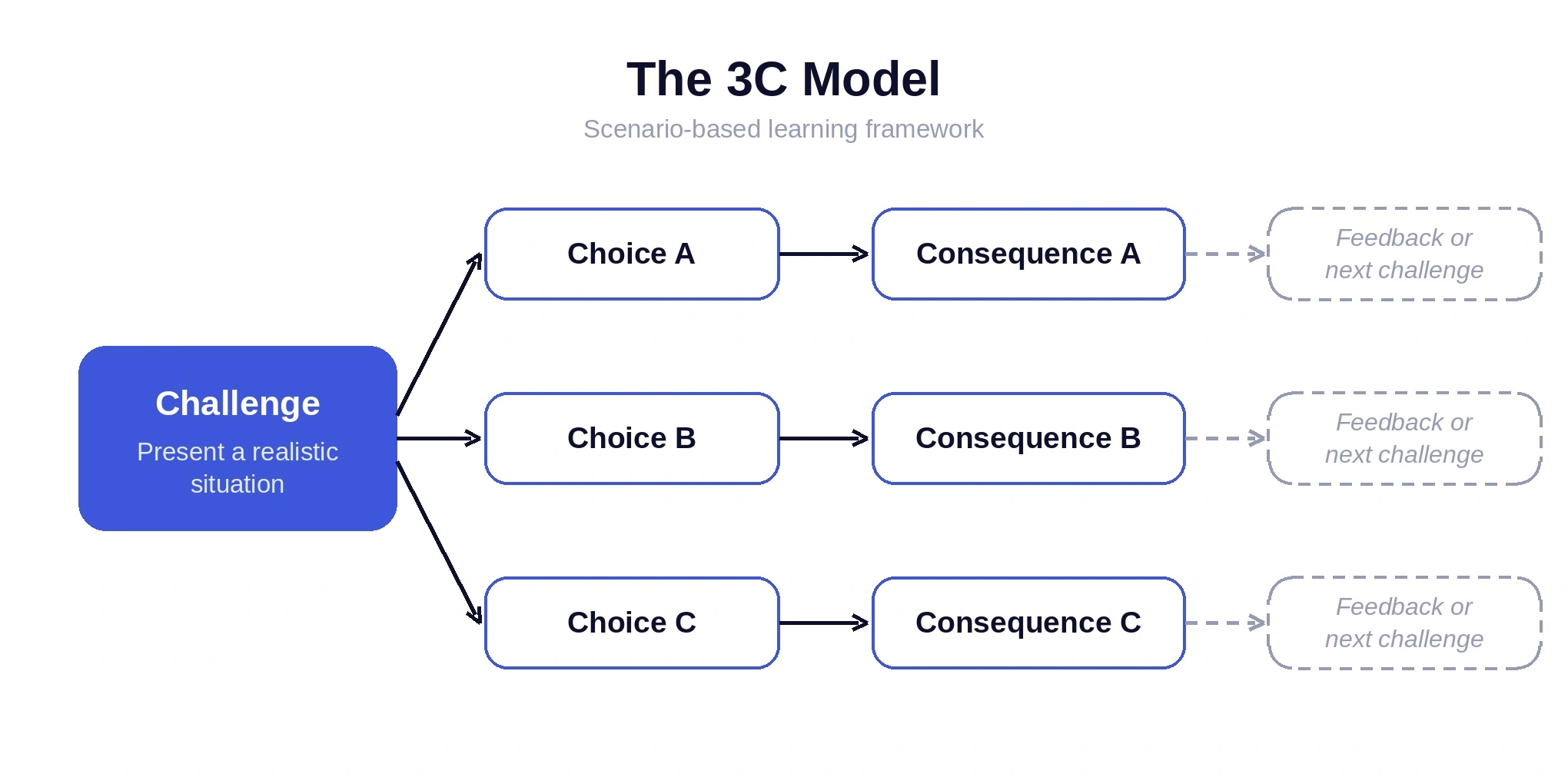
The 3C model is the missing production unit. Present a realistic situation. Offer Choice A, B, and C. Show Consequence A, B, and C. Then send the learner into feedback or the next challenge. Instructional designers use that pattern because students can replay paths and compare outcomes without real-world harm. Workplace simulations work the same way: the choice returns a result immediately, good or bad.
A generator that only lists options is a prompt. A choice consequence generator has to finish the sentence.
This is exactly what this AI was built for.
Why Game Designer Assistant
Game Designer Assistant is a standalone design partner that builds choice-consequence trees from a brief: who is deciding, what is at stake, and what “good” looks like if the path is messy. You describe the bind. It returns a challenge, three real options, consequences that change the state of the world, and a hook into the next decision.
Examining branching design shows why that unit matters. A decision tree is a structured way to trace options to outcomes under uncertainty. Online tree makers help teams see consistent choices. They still need someone to write the human part — the pressure, the tradeoff, the person who gets hurt if you stall.
| Traditional Approach | Game Designer Assistant |
|---|---|
| A quiz with one “correct” radio button | Three defensible choices with different costs |
| A flowchart of arrows and empty boxes | Challenge text, options, and consequence copy in one pass |
| Punishing the “wrong” click | Outcomes that teach what changed and why |
| A unique ending for every click | Feedback into the next challenge so scope stays playable |
| Hours of unused branches | A 3C spine you can run, trim, or deepen the same day |
Challenges that feel like work, not riddles
A usable challenge is specific. The budget is due Friday. The NPC is already in the room. The candidate just lied about a metric. Vague “what would you do?” prompts produce vague trees. Ask the AI for a situation a real person could be in this week, with a clock, a witness, and a resource limit.
Choices that actually diverge
Choice A, B, and C fail when B is “do A, but nicer.” Demand mutually exclusive tactics: escalate, delay, or reframe; disclose, stall, or transfer; attack, sneak, or bargain. Role-play research finds that walking those paths helps people identify moral issues and negotiate practical solutions, which only happens if the options are not disguised duplicates.
Consequences that change the next scene
A consequence is not a score. It is a new state: trust dropped, a door closed, a rumor started, a quarter slipped. Simulating imagined futures does not just inform a choice — it can change how people feel about the options. Write that feeling into the node. Then loop: Consequence B becomes Challenge 2.
"Build a choice consequence generator tree for a hospital charge nurse. Challenge: two patients need the last ICU bed. Give three real options, a distinct consequence for each, and a feedback line into the next staffing decision."
"Turn this product-launch bind into a 3C scenario: ship with known bugs, delay the keynote, or silently narrow scope. Consequences must change customer trust, not just a pass/fail label."
Related Agents You'll Also Find Useful
If you are mapping choices to consequences, you will usually need dialogue, a live rehearsal, or a hiring drill in the same month. These agents sit next to the tree.
Negotiation Coach
Workplace 3C trees die when the “talk path” is a single bullet. Use this coach when Consequence B is a conversation — salary, vendor terms, a stalled deal — and you need strategy, counters, and a role-play that reacts to what you actually said.
- Strategy sessions that turn a node into a preparation playbook
- Role-play simulations where each concession creates a new consequence
- Assessments that show which default (fight, freeze, fold) your tree currently rewards
Interview Coach
Behavioral interviews are choice-consequence drills. If your tree trains managers to hire, this agent builds the question, the follow-up, and the fail state when the candidate dodges.
- Behavioral and case prompts mapped to what you are actually selecting for
- Mock practice with honest feedback on the choice the interviewer just made
- Revisions when a “good” answer still produces a bad downstream hire
Film Screenwriter
Decision nodes fail when the consequence is a paragraph of exposition. This agent writes the beat: who speaks, what the room does, and the “are you sure?” pause before Choice C.
- Structure and dialogue at the fork, not after it
- Short scenes you can paste into an e-learning screen or a table read
- Tone matching so Consequence A does not feel like a different story
Try Game Designer Assistant free — no credit card required.
How It Works
Step 1: Name the decision-maker and the clock
State who chooses, what they stand to lose, and when the window closes. A one-paragraph brief beats a 20-page competency model. If this is compliance training, say what “done well” looks like in the field, not on the quiz.
"I need a choice consequence generator for store managers. Challenge: a loyal employee is stealing overtime. The regional review is in 48 hours. Write the challenge in second person."
Step 2: Force three non-overlapping choices
Ask for Choice A, B, and C as tactics, not moods. Escalate / document / ignore is a tree. “Be assertive / be somewhat assertive / be unassertive” is a lecture. Scenario-based learning only trains problem-solving when the options resemble real work.
"Give three mutually exclusive options. None may be the disguised right answer. Each must be something a competent manager might actually try."
Step 3: Write consequences as new world-state, then loop
For each choice, require: what changed, who noticed, and the next challenge. Branched simulations keep the storyline under control by adapting after the decision, not by writing a novel per click. Cap the first draft at three layers.
"For each consequence, start the next challenge in the same location with one new constraint. Do not open a second department."
Step 4: Stress-test the tree with three personalities
Have the AI walk the same map as a cautious person, a political person, and a blunt person. Merge nodes that share a room. Flag any “consequence” that is only praise or only shame.
"Play this tree as a conflict-avoidant lead, a metrics-obsessed lead, and a values-first lead. Tell me which choices are fake."
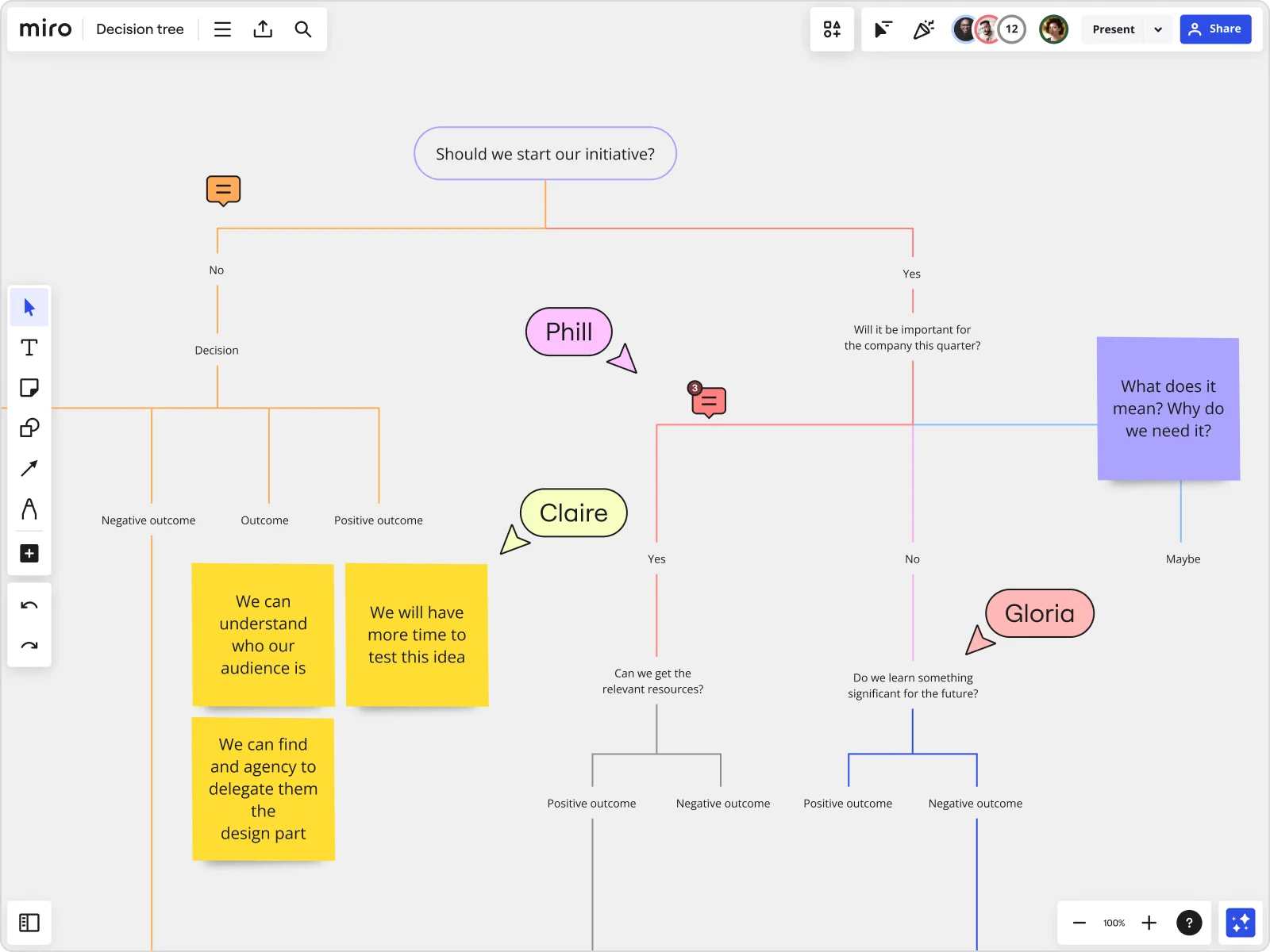
Visual trees are useful for seeing forks — start the initiative or not, fund it this quarter or wait, learn something or walk away. They are not the generator. If a sticky note cannot be read as a consequence in one sentence, the branch is not ready for a learner.
Results & Use Cases
📊 L&D scenario that survives the LMS
-
Scenario: You need an assertive-communication lesson that is not a PDF of “I-statements.”
-
Traditional Approach: A linear video plus a five-question quiz people screenshot.
-
Game Designer Assistant: A 3C tree: interrupt a peer in a meeting, wait and email later, or pull them aside — each with a relationship cost and a next challenge.
-
Replayable paths instead of one “correct” clip
-
Feedback that names the misconception, matching how interactive e-lessons clarify workplace nuances
-
A spine you can hand to facilitation for live role-play after the click-through
💼 Sales enablement without a fake happy path
-
Scenario: Reps freeze when a champion goes dark two days before signature.
-
Traditional Approach: A playbook slide that says “create urgency.”
-
This AI: Choice A call the economic buyer, Choice B offer a discount, Choice C wait — with consequences for margin, trust, and forecast.
-
Options a real rep would consider, including the unwise one
-
Pair the talk-path nodes with Negotiation Coach so the conversation is not a single skill check
-
Optional fourth layer only if the first three already reconvene at “renewal risk”
📱 Mobile rewrite between sessions
-
Scenario: Tomorrow’s workshop lost a case study and you are on a train.
-
Traditional Approach: You cancel the branch activity or lecture instead.
-
Your design partner: From a phone, you paste the old case and get a three-choice tree, then dictate tighter consequence lines.
-
Feature parity across web, iOS, and Android, including speech-to-text
-
Persistent chat memory so the same cohort’s villains and constraints stay attached
-
A compact tree you can screenshot onto a slide before you lose signal
🎯 Hiring managers who keep choosing charm
-
Scenario: Interviewers advance candidates who interview well and fail in week six.
-
Traditional Approach: A rubric nobody uses after the first question.
-
Interview-plus-tree workflow: A 3C challenge — the candidate’s metric looks inflated — with choices to probe, ignore, or end early.
-
Consequences written as downstream team cost, not as “gotcha” scoring
-
Follow-up questions generated with Interview Coach
-
A shared tree so every interviewer is not inventing a private standard
FAQ
What is a choice consequence generator?
A choice consequence generator is a tool that turns one challenge into distinct options and the outcomes those options create. Unlike a brainstorm list, it encodes Challenge → Choice A/B/C → Consequence A/B/C, then loops into feedback or the next challenge. An AI version drafts that map from a short brief so you can edit nodes instead of inventing the structure.
Is an AI choice consequence generator free?
Game Designer Assistant is available on Jenova’s Free plan, which includes core features with limited monthly usage and no credit card. Paid tiers raise usage if you run many trees or long playtest chats. You can generate a first 3C scenario on the free tier, then deepen the same conversation as the course or story continues.
How is a choice consequence generator different from a decision tree template?
A template gives you boxes and arrows. A choice consequence generator writes the human content of those boxes: the bind, the real options, and what changes after each pick. Visual trees help teams stay consistent; they still fail when every sticky note says “positive outcome” with no state change. Use the template to check topology. Use the generator to write the scene.
Can I use a choice consequence generator for training, not just games?
Yes. Specify the role, the risk, and the policy constraint. Scenario-based learning is already used in medical and professional training because learners interact with simulated situations. Immersive simulations have been shown to beat paper-and-pencil or discussion-only formats for practicing leadership judgment. Ask for pedagogical feedback lines, not loot tables.
Does a choice consequence generator work on mobile?
Yes. Jenova runs with full feature parity on web, iOS, and Android, including speech-to-text if you would rather talk a challenge through on a walk than type a brief. Campaign or course memory stays on the chat, so a commute pass can extend yesterday’s tree instead of starting over.
How do I keep choice-consequence trees from exploding?
Cap depth, reconverge early, and treat extras as optional. Three choices per challenge and three layers is enough for a first module. Reuse the same room, team, or customer across paths. If two consequences need unique sets, they are probably two courses. When a crisis exceeds someone’s ability to search options and simulate futures, decision quality collapses — which is also what happens to authors who write a new world for every click.
Conclusion
A choice consequence generator exists to finish the work most branching tools start: not just listing options, but showing what those options cost. Learners remember judgment they practiced. Teams stall when the tree is arrows without outcomes. Writers stall when every fork demands a new setting.
Game Designer Assistant maps Challenge to Choice to Consequence — then back into the next challenge — so the tree is teachable, playable, and small enough to ship. Build the 3C spine, write the talk path, rehearse the hard node, and stop pretending a flowchart is a lesson.
Try Game Designer Assistant now. Explore more at Jenova.
For Developers: Game Designer Assistant is available programmatically via the Jenova API — integrate choice-consequence generation into your LMS, training app, or interactive-story pipeline with a single API call. Full documentation →