What Is the Best AI Chinese Zodiac Reader?
2026-09-09
What Separates a Full Chinese Zodiac Reading From a Year-Animal Personality Quiz?
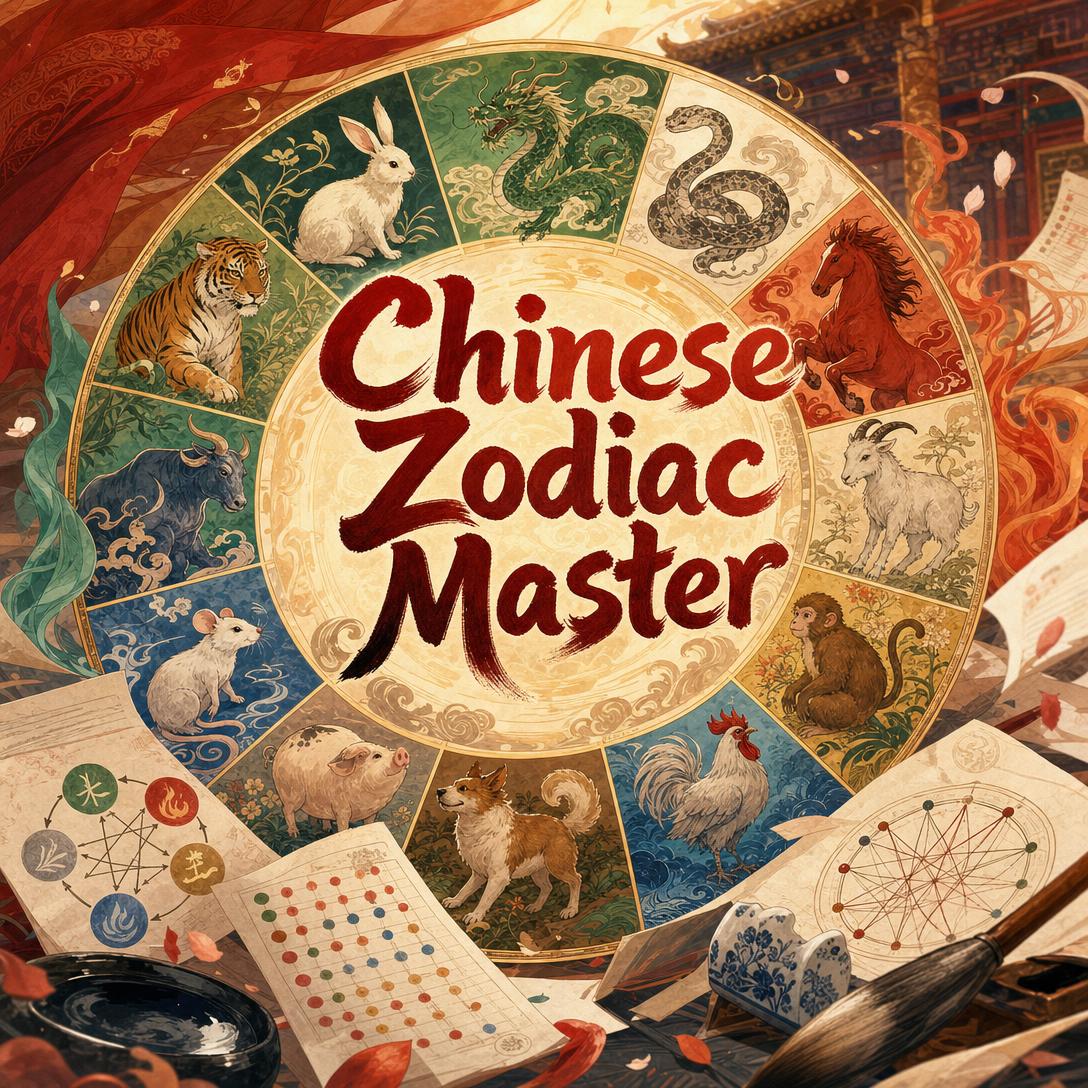
A useful AI Chinese zodiac reader in 2026 does more than map a birth year to one of twelve animals. The stronger options — notably Jenova’s Chinese Zodiac Master, alongside reference sites such as China Highlights, Travel China Guide, and AstroNidan — differ on whether they treat 生肖 (shengxiao) as a living system of elements, inner animals, and annual Tai Sui dynamics, or as a personality quiz.
Key factors that separate a culturally grounded reading from a year-animal quiz:
✅ Year-boundary accuracy at Chinese New Year (春节), not January 1 — late January and early February births are the most common source of a wrong animal
✅ The sixty-year animal-element cycle (六十甲子), so a Metal Horse is not read as a generic Horse
✅ Outer, inner, and secret animals when month and hour are known, rather than a single public face
✅ Compatibility as Six Harmonies (六合), Three Harmonies (三合), clashes, harms, and punishments — not one “best match” list
✅ Annual modeling of 犯太岁 (offending Tai Sui) and 本命年 (Ben Ming Nian), especially in a Fire Horse year
To compare these tools meaningfully, it helps to establish what a complete 生肖 reading actually requires — and where static calculators stop.
Why Are People Turning to AI for Chinese Zodiac Guidance in 2026?
People are turning to AI for Chinese zodiac guidance in 2026 because this is a Fire Horse year — a combination that returns only once every 60 years — and year-animal quizzes cannot answer the questions that actually come up: Tai Sui offense, Ben Ming Nian, and layered compatibility. The Smithsonian notes that Lunar New Year 2026 begins on February 17, opening a Horse year associated with hard work, bravery, and resilience.
National Geographic describes the Fire Horse as amplifying stamina, independence, and speed, while also warning that Horse years favor decisive action and can punish impulsiveness. Sinologist Xiaohuan Zhao has tied Bing-Wu (Fire Horse) years to a tradition of social disruption; the previous Fire Horse year was 1966. That mix of opportunity and volatility is exactly what annual 生肖 counsel is for.
Cultural demand is not new. Dragon years still carry prestige as the only mythical animal, and parents have historically timed births around auspicious signs. The 2024 Wood Dragon year showed the limits of that belief as a demographic switch: Singapore recorded about 30,800 resident births versus 30,500 in 2023, with total fertility still at 0.97. Astrology can shape decisions without guaranteeing outcomes — which is why a good reader explains dynamics, not destiny slogans.
AI fits this moment because the system is rule-dense: twelve animals, five elements, yin/yang polarity, solar-term month animals, two-hour secret animals, and several compatibility grammars. A conversation that remembers your Metal Horse profile and last year’s Snake-year forecast is more useful than a page that only says Horses are “outgoing.”
What Should You Look for in an AI Chinese Zodiac Reader?
You should look for calendar fidelity first, then elemental resolution, then whether the tool can synthesize compatibility and annual dynamics instead of printing a trait list. We used a Six-Layer Shengxiao Test: year-boundary accuracy, 60-year elemental cycle, three-animal architecture, compatibility grammar, Tai Sui/Ben Ming Nian modeling, and cultural practice (remedies, naming, folklore).
Calendar fidelity is the highest-weighted layer. The Chinese year does not begin on January 1. AstroNidan correctly notes that Chinese New Year typically falls between January 21 and February 20, yet many calculators still assign the animal by Gregorian year. Anyone born in that window can receive the wrong sign, which then corrupts compatibility and Tai Sui status.
Elemental resolution is next. Traditional Chinese element theory assigns Metal, Wood, Water, Fire, and Earth across the sexagenary cycle. A Water Tiger and a Metal Tiger share an archetype but not a temperament. Tools that stop at “Tiger” are leaving half the chart unread.
Three-animal architecture separates a reading from a quiz. Year animal is the outer face; month animal is the emotional core; hour animal is the hidden self. Without at least an invitation to add month and hour, the tool is describing a generation, not a person.
Compatibility grammar should name relationship types. Travel China Guide groups signs into four trinities and notes that signs four years apart tend to harmonize, while signs six years apart sit in opposition. That is a start. A complete reader also distinguishes 六合 (natural complementarity) from 六害 (slow erosion) and 三刑 (repeating karmic friction).
Annual modeling matters more in 2026 than another personality paragraph. Horses are in Ben Ming Nian; several other signs offend Tai Sui by clash, punishment, harm, or break. Remedies — red cloth gifted by someone else, 拜太岁, charity, caution with first-half-year upheaval — belong in the reading, not in a separate folklore article.
Cultural practice is the layer most Western horoscope apps skip: the Great Race origin story, regional variants (Vietnamese Cat, Japanese Boar), and naming radicals tied to diet, habitat, and clash animals. Depth here is a trust signal. It is also where a reader should admit scope: 生肖 is not BaZi (八字).
How Do Popular Chinese Zodiac Tools Compare on Depth and Year-Boundary Accuracy?
Jenova’s Chinese Zodiac Master is strongest for layered, conversational 生肖 work, while China Highlights and Travel China Guide remain better as free lookup charts, and AstroNidan is strongest for instant year-element identification. None of them replace a lineage-trained master for family 合婚, and several popular calculators still fail the January/February boundary test.
| Feature / Dimension | China Highlights | Chinese Zodiac Master | AstroNidan | Travel China Guide |
|---|---|---|---|---|
| Year-boundary handling | Explains lunisolar custom; lookup by sign | Defaults to Chinese New Year; can use 立春; checks exact New Year dates for Jan/Feb births | Uses Gregorian year for simplicity | Year-animal charts |
| Three-animal profile | Year sign | Outer (year), inner (month), secret (hour) | Year sign plus element and yin/yang | Year sign |
| Compatibility model | Most/least compatible lists per sign | Six Harmonies, Three Harmonies, clashes, harms, punishments, destructions, plus elements | Best-match lists by animal | Best / so-so / worst chart; four trinity groups |
| Tai Sui / Ben Ming Nian | General sign pages | Five offense types, remedies, Ben Ming Nian cycle | Lucky attributes, not a full annual offense map | Links to Ben Ming Nian explainers |
| Follow-up memory | Static pages | Cross-session memory of profiles and pairs | Instant, one-shot calculator | Static pages |
| Pricing (as of 2026) | Free website | Free tier; Plus from $20/month | Free, no registration | Free website |
| Best for | Quick marriage-match lookup | Personal, compatibility, and annual synthesis | Fast animal-element ID | Chart-based trinity overview |
China Highlights
China Highlights is strong as a public compatibility encyclopedia. It states that zodiac matching is commonly checked before marriage in China and publishes most- and least-compatible partners for each of the twelve signs — for example, Horse with Tiger, Goat, or Dog as favorable, and Rat, Ox, or Snake as difficult.
That structure is easy to cite and easy to scan. The limitation is flattening: lists treat year animals as complete people, with little elemental coloring and no inner/secret animals. It is a reference table, not a reading that can say a couple clashes by year but harmonizes by month.
AstroNidan
AstroNidan is built for speed. Enter a birth date and it returns animal, element, yin/yang, lucky numbers, and colors, with no time or location required. It also explains the 60-year cycle and the generating logic of Wood, Fire, Earth, Metal, and Water.
Its documented trade-off is calendar method: the calculator uses the Gregorian year for simplicity. For a birth on February 8, that can assign the new animal before Chinese New Year has occurred. The tool is honest about this; users who need a personal Tai Sui verdict should not stop there.
Travel China Guide
Travel China Guide’s compatibility chart is one of the clearer free maps of best, middling, and worst matches, plus the four groups of three (Rat-Dragon-Monkey; Ox-Snake-Rooster; Tiger-Horse-Dog; Rabbit-Goat-Pig). It also states the spacing rule: four years apart tends toward compatibility, six years apart toward opposition.
That is pedagogically useful. It is not synthesized. A Horse-Rat pair is “worst match” on the chart; a full reading would still ask whether inner animals, generating elements, or family versus romance context change the advice. The site is a guidebook, not a practitioner.
Chinese Fortune Calendar
Chinese Fortune Calendar goes beyond year animals by scoring stem-branch relationships and advertising 216,000 combinations. That is closer to Chinese astrology’s real combinatorial density than a 12×12 love grid.
The limitation is opacity. The site contrasts a “Magic Love Match” with a “Fast Love Match” and reports that users found the faster method more accurate — a reminder that a bigger formula is not automatically a better interpretation. It also does not teach Six Harms versus Six Clashes in plain language.
Chinese Zodiac Master
Chinese Zodiac Master is built as a practitioner conversation, not a lookup table. It assigns the year animal and year element, then — when month and hour are available — layers inner and secret animals and reads the tensions among them. Compatibility is named by classical relationship type, then modified by generating (相生) or overcoming (相克) elements.
Honest limits remain. It does not calculate BaZi Day Master, Ten Gods, or Luck Pillars. It cannot book a temple 拜太岁 or replace an elder conducting 合婚 for a family. Inner and secret animals stay blank without month and hour. It also cannot auto-run a forecast every Lunar New Year; the user has to return.
How Do Outer, Inner, and Secret Animals Change What a Reading Can Tell You?
Outer, inner, and secret animals change a reading by splitting public persona, private emotion, and hidden self, so two people with the same year sign can live entirely different charts. The year animal (年) is what colleagues meet; the month animal (月) is who a partner lives with; the hour animal (时) is who appears in crisis or deep trust.
Examining year-only tools shows the cost of this omission. A Yang Fire Horse looks like the Adventurer: energetic, independent, impatient. If the inner animal is Rabbit, the private self is diplomatic and conflict-avoidant. If the secret animal is Ox, the crisis self is stubborn and duty-bound. That person is not “a Horse.” They are a public sprinter with a private diplomat and a hidden ox.
The interpretive rules are specific:
- All three identical concentrates the archetype — strengths and shadow both amplify
- Conflicting animals create productive tension (Tiger outer, Rabbit inner: bold in public, gentle in private)
- Long-term partners often fall in love with the outer animal and then live with the inner one
- The secret animal can surprise even the native; it is not a party-trick extra
Month boundaries follow solar terms (节气), roughly February 4–March 5 for Tiger through January 6–February 3 for Ox, shifting a day or two each year. Hour animals run in two-hour branches, from Rat at 23:00–01:00 to Pig at 21:00–23:00. A serious AI reader asks for these details without turning the first message into an interrogation — and it should refuse to invent them.
This is also why “what’s my sign?” is the wrong first question. The better prompt is birth year plus, if known, date and time. Without that, the ethical output is a year-element sketch labeled as incomplete, not a fake inner animal.
How Should Compatibility Be Read Beyond Best-and-Worst Match Lists?
Compatibility should be read as stacked relationship types plus elemental weather, not as a single green or red score. China Highlights and Travel China Guide are useful for the popular most/least lists and the four trinity groups; they are weaker when a couple is both “bad on paper” and stable in practice.
A full 生肖 grammar includes at least six layers:
- Six Harmonies (六合): Rat-Ox, Tiger-Pig, Rabbit-Dog, Dragon-Rooster, Snake-Monkey, Horse-Goat — instinctive complementarity
- Three Harmonies (三合): Monkey-Rat-Dragon (Water), Tiger-Horse-Dog (Fire), Pig-Rabbit-Goat (Wood), Snake-Rooster-Ox (Metal)
- Six Clashes (六冲): opposites six years apart, such as Rat-Horse — high friction, high growth potential
- Six Harms (六害): slower trust erosion (Rat-Goat, Ox-Horse, Tiger-Snake, and others)
- Three Punishments (三刑): repeating patterns, including Tiger-Snake-Monkey “ingratitude” friction
- Six Destructions (六破): milder disruption, often louder in annual Tai Sui than in marriage itself
PureWow’s popular summary of the four groups — go-getters, strategists, idealists, peacemakers — matches the classical trinities and is fine as a memory aid. It becomes misleading if “Horse and Rat are incompatible” is treated as a verdict. Clashes are not curses. They describe force-versus-force energy that becomes destructive only when neither side yields.
Elemental weather can reverse the mood of an animal pair. A Six Harmony couple with overcoming elements has deep affinity and chronic tension. A clash couple whose inner animals form a Harmony can look turbulent in public and bonded at home. Romance, business, and family also weight the same axes differently: a Dragon-Rooster 六合 that thrives in a company may feel chilly as a marriage if both need the spotlight.
When month and hour are known for both people, six interaction axes appear (outer↔outer, outer↔inner, inner↔inner, and so on). Year-only calculators cannot see that map. That is the practical gap between a love-match widget and a reading.
How Do Tai Sui and Ben Ming Nian Shape an Annual Zodiac Forecast?
Tai Sui and Ben Ming Nian shape an annual forecast by naming how your sign meets the year’s ruling animal — same sign, clash, punishment, harm, or break — rather than issuing a generic lucky/unlucky stamp. In 2026 the ruling animal is Horse, and China Highlights frames the Fire Horse year as one of optimism and opportunity, which is incomplete counsel for people whose relationship to Horse is an offense.
The offense types are not interchangeable:
| Type | Chinese | Relationship to the year animal | Typical texture |
|---|---|---|---|
| Value | 值太岁 | Same sign (Ben Ming Nian) | Instability, amplified luck and misfortune |
| Clash | 冲太岁 | Six Clashes | Direct confrontation; loudest |
| Punishment | 刑太岁 | Three Punishments | Repeating obstacles, karmic echo |
| Harm | 害太岁 | Six Harms | Subtle setbacks, interpersonal static |
| Break | 破太岁 | Six Destructions | Plans unraveling, disrupted timing |
Ben Ming Nian recurs every 12 years. The first, around age 12, is usually mild; 24, 36, 48, 60, and 72 carry more weight, with age 60 (花甲) closing a full sixty-year cycle. Tradition treats it as heightened karmic traffic, not a year to freeze. Common practices include wearing red gifted by someone else, keeping a lower profile, temple prayer to Tai Sui, charitable acts, and caution with major moves in the first half of the year.
Travel China Guide’s Horse portrait — enthusiastic, outgoing, strong in action, sometimes impatient — describes the year’s weather. A forecast should then personalize it: Horses themselves are in 值太岁; Rats are in the classic Horse clash; other signs meet punishment, harm, or break. Favorable currents often run through the year’s Six Harmony partner (Goat) and Fire trinity allies (Tiger, Dog), plus signs whose elements generate the year’s Fire.
Jonathan H. X. Lee’s gloss of the idiom “when the horse arrives, success arrives” captures the yang, mobile tone of Horse years. An AI reader that only repeats that proverb, without mapping the user’s offense type, is doing festival copy, not 生肖.
How Do You Get a Meaningful Personalized Reading From an AI Zodiac Master?
You get a meaningful reading by giving a birth year (and, if possible, full date and time), asking for a specific job — profile, compatibility, or annual forecast — and correcting January/February boundaries before anything else. General education (“what are the twelve animals?”) can start without data; a personal reading cannot.
For Chinese Zodiac Master, the flow is short:
- Open the agent at jenova.ai/a/chinese-zodiac-master
- Give the minimum identity data. Birth year is required; date and time unlock inner and secret animals
- Name the task: character portrait, couple reading, 2026 Tai Sui, or naming radicals for a child
- Add context the tradition actually uses: romance versus business, whether you prefer 春节 or 立春 as the year boundary
Useful opening prompts:
"I was born on February 8, 1990, around 9 p.m. Confirm my animal against Chinese New Year that year, then read outer, inner, and secret animals."
"I'm a Metal Horse and my partner is a Water Rat. Read romantic compatibility across Harmonies, clashes, harms, and elements — not a single score."
"It's the Fire Horse year. Do I offend Tai Sui, and if so which type? Give remedies without softening the warning."
For China Highlights or Travel China Guide, the how-to is different: identify both year animals, then look up the published most/least lists or the best/so-so/worst chart. That is enough for a first filter and not enough for a couple with mixed inner animals.
For AstroNidan, enter the birth date, record animal plus element, then manually check whether you were born between January 21 and February 20. If you were, verify the exact Lunar New Year date before trusting the result.
Users who want Four Pillars math — Day Master, Ten Gods, Luck Pillars — should not force 生肖 to impersonate BaZi. That work sits with a BaZi practitioner such as Jenova’s Chinese Fortune Teller. Spatial timing and household remedies are a Feng Shui Advisor question. Hexagram counsel for a decision is closer to the I Ching Oracle. Adjacent systems help; mixing them silently does not.
What Do Chinese Metaphysics Practitioners Say About AI Zodiac Readings?
Practitioners and cultural historians tend to agree on two points: the animal-element cycle is a serious traditional system, and reducing it to twelve personality types wastes it. AI is well suited to the first and constantly tempted by the second.
"Most public 'Chinese zodiac' queries stop at the year animal, which is the equivalent of reading only a sun sign. The interpretive jump happens when you add the year element, then the inner and secret animals, then the specific relationship type — 六合 versus 六冲 versus 六害. Those words are not synonyms for good and bad. A clash can be the most alive relationship in the room if both people can yield. A harm can look polite for years while trust thins."
"Year boundaries are the quiet accuracy crisis. A large share of people born in late January or early February are assigned the wrong animal by Gregorian calculators. That single error cascades into the wrong Tai Sui status, the wrong Ben Ming Nian, and the wrong compatibility map. If a tool cannot explain 春节 versus 立春, it is not ready to advise on a Fire Horse year."
"In 2026 the demand is for annual dynamics, not another paragraph about Horses being free-spirited. Horses are in 本命年. Clash, punishment, and harm signs need different counsel and different remedies. An honest reader says when offense means growth-through-friction and when it means keep your head down until summer."
"AI is strongest as a patient interpreter of a closed traditional grammar, with memory across sessions. It is weakest when the user actually wanted BaZi luck pillars, a temple ritual, or a family 合婚 conducted by relatives. Those are different crafts, and blurring them is how these tools lose trust."
— Jenova Product Team, specialists in East Asian metaphysical systems and conversational agent design
That stance matches what cultural explainers already emphasize from another angle: the zodiac has shaped East Asian life for centuries as a lunisolar, elemental calendar, not as a party-game mascot. Folklore roundups still retell the Great Race — Rat on the Ox’s back, Cat left behind — because the origin story encodes character, not just ranking. A reader that never reaches those layers will sound like every other quiz.
When Is Chinese Zodiac the Right System — and When Should You Use BaZi Instead?
Chinese zodiac is the right system when you want archetypal character, animal-to-animal relationship grammar, yearly Tai Sui weather, Ben Ming Nian practices, or naming radicals; BaZi is the right system when you need a birth-time chart with stems, branches, Day Master, and luck cycles. Confusing the two is the most common way an AI “Chinese astrology” session goes off the rails.
Shengxiao is a twelve-animal, sixty-year cultural operating system. It is excellent at questions such as “How does my Horse year-element meet this Fire Horse year?” or “Is this pair a 六合 with overcoming elements?” It is the language of New Year, red underwear, and marriage matching conversations that start with 属马 versus 属鼠.
BaZi (Four Pillars of Destiny) is a different instrument. It uses year, month, day, and hour pillars, Ten Gods, and Luck Pillars. Two Dragons can have unrelated BaZi charts. If the question is “When does my wealth luck turn?” or “What is my Day Master?”, a zodiac reader should decline and point to a BaZi practitioner rather than improvise pillars.
A practical split:
- Use 生肖 for identity, compatibility texture, annual offense, festival timing, and child-naming radicals (diet, habitat, dignity, harmony/clash animals, supporting element)
- Use BaZi for structural destiny timing and finer elemental balance of a natal chart
- Use both only with the boundary named: the Horse is the outer year animal; the Four Pillars may tell a different day-level story
Western natal astrology is a third map — month-scale sun signs versus year-scale animals, four elements versus five. They can sit side by side. They should not be averaged into one “you are a Leo Horse” mash-up without saying what each system is actually measuring.
The best AI Chinese zodiac reader, then, is not the one with the longest trait list. It is the one that keeps 生肖 internally consistent, flags January/February births, reads three animals when the data exist, and knows when to stop.
References
- China Highlights — Chinese zodiac compatibility lists and marriage-matching custom
- Travel China Guide — Compatibility chart, four trinity groups, and spacing rules
- AstroNidan — Free Chinese zodiac calculator, 60-year cycle, and Gregorian-year method
- National Geographic — 2026 Year of the Fire Horse, 60-year elemental cycle, and cultural commentary
- Smithsonian — 2026 Year of the Fire Horse and Lunar New Year date
- The Star — 2024 Dragon year births and Singapore fertility rate
- Penn Museum — Five elements associated with Chinese zodiac years
- Chinese Fortune Calendar — Stem-branch love-match combinations
- China Highlights — Year of the Horse 2026 Fire Horse outlook
- Travel China Guide — Year of the Horse personality portrait
- PureWow — Popular grouping of Chinese zodiac compatibility trinities
- Hindustan Times — Folklore and origin stories of the Chinese zodiac signs