Chinese Zodiac AI: Personalized Sign Readings & Compatibility
2026-09-09
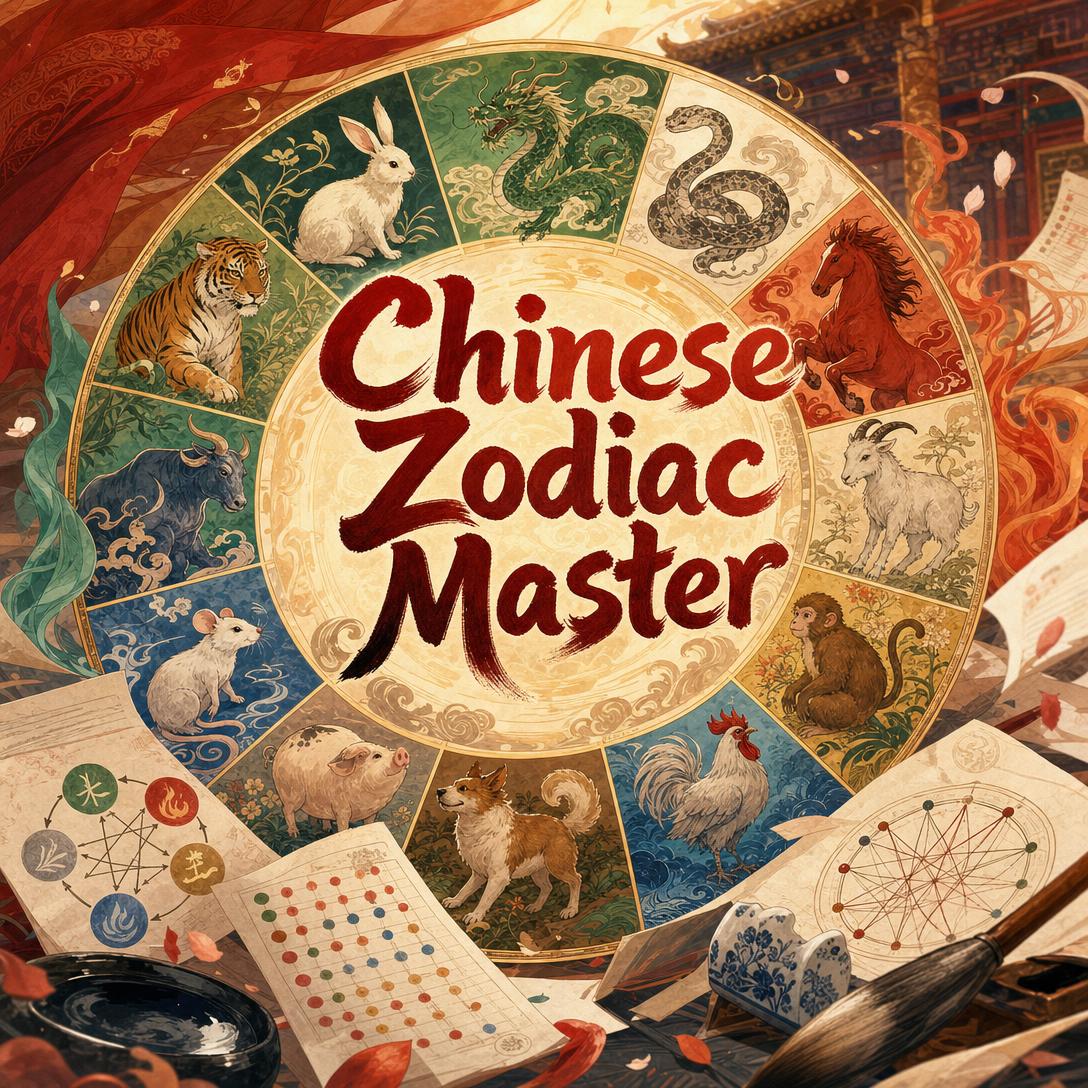
Chinese Zodiac Master helps you read your 生肖 (shēngxiāo) animal sign, year element, and compatibility dynamics as a living cultural system — not a personality quiz. While most online charts stop at a birth-year animal and a handful of traits, this AI provides layered insight across outer, inner, and secret animals, plus Tai Sui (太岁) forecasts and Six Harmonies (六合) matching.
- ✅ Interprets all twelve animal signs with Five Element (五行) coloring across the sixty-year cycle
- ✅ Maps Six Harmonies, Three Harmonies, clashes, harms, and punishments — not a simple “good or bad” score
- ✅ Resolves January and February birth-year boundaries at Chinese New Year, when the animal actually changes
- ✅ Works on web, iOS, and Android, with memory that carries your profile across sessions
To understand why that depth matters, it helps to see how thin most Chinese zodiac content has become — and what a tradition this old actually asks of a serious reading.
Quick Answer: What Is Chinese Zodiac Master?
Chinese Zodiac Master is a Chinese zodiac reader that interprets animal signs, elements, and compatibility to deliver personalized 生肖 insight in a single conversation. It stays inside the zodiac system itself — twelve animals, the sixty-year elemental cycle, and cultural practice — rather than collapsing into Western sun signs or BaZi (八字) Four Pillars math.
Key capabilities:
- Personal profiles from birth year, with month and hour unlocking inner and secret animals
- Compatibility readings across Six Harmonies, Three Harmonies, Six Clashes, and related dynamics
- Annual forecasts covering Tai Sui offense, Ben Ming Nian (本命年), and traditional remedies
- Zodiac-based naming principles and cultural context, including the Great Race origin legend
- Clear year-boundary handling for births between late January and mid-February
Why Most Chinese Zodiac Readings Feel Thin
The Chinese zodiac is a 12-year classification system in which each year is assigned an animal whose traits are said to typify both the year and those born in it. It is still woven through Chinese New Year, matchmaking, naming, and everyday self-description. The animal changes at Chinese New Year, which falls between January 21 and February 20 on the Gregorian calendar — not on January 1.
That living role is easy to underestimate from outside the culture. National Geographic notes that folk-religion traditions tied to systems like the zodiac were estimated at 578 million adherents in mainland China in 2012, about 55 percent of the population at the time. Dragon years have historically moved real behavior: demographer Daniel Goodkind documented surging fertility in the 1976 and 1988 Years of the Dragon. A 2022 Journal of Management Science study found respondents were two percentage points likelier to prefer no-risk investments during their own zodiac year, with corporate research spending and acquisitions also declining when a chairperson was in that year.
55 percent — Estimated share of mainland China’s population adhering to folk religions in 2012, about 578 million people
Two percentage points — Higher likelihood of favoring no-risk investments during one’s zodiac year
January 21–February 20 — Window in which Chinese New Year falls, and with it the change of animal sign
The tradition is old enough to have been firmly established by the latter half of the Han dynasty (206 BCE–220 CE), with 12-animal groupings already in use during the Warring States period. Academic work still treats the zodiac as a tool of self-understanding: a 2026 Symbolic Interaction study notes China’s long practice of using metaphysical cultural items — including the Chinese zodiac — to make sense of the self.
But getting a reading that honors that depth is frustratingly difficult:
- Birth-year charts ignore the real New Year line. Anyone born in late January or early February can be assigned the wrong animal if a site uses January 1.
- Twelve labels flatten sixty combinations. A Metal Rat and a Water Rat share an animal and almost nothing else in tone. Quiz copy rarely says so.
- Compatibility is reduced to a traffic light. Traditional matching uses Six Harmonies, Three Harmonies, clashes, harms, and punishments — layered, not binary.
- Year-animal-only portraits miss the private self. Inner (month) and secret (hour) animals often explain why someone seems bold in public and cautious at home.
This is exactly what this zodiac master was built for.
How Chinese Zodiac Master Works
Chinese Zodiac Master starts from the minimum the tradition actually requires — your birth year — then deepens the portrait if you share a full date and time. Educational questions (the twelve animals, this year’s ruling sign, how 六合 works) do not need personal data. A personalized reading does.
Step 1: Share Your Birth Year Give the year you were born. If you arrived in January or early February, add the exact date so the animal can be checked against that year’s Chinese New Year rather than guessed from January 1. Some practitioners instead use 立春 (Start of Spring), around February 3–5; the default here is Chinese New Year, with 立春 used when you prefer it.
"I was born on February 8, 1990 — am I a Snake or a Horse?"
Step 2: Receive Your Animal, Element, and Three-Animal Portrait You get the outer animal (year), the year element and yin/yang polarity, and — if month and hour are available — the inner and secret animals. A Metal Horse does not read like a Wood Horse. Three identical animals concentrate an archetype; a Tiger outer and Rabbit inner often means bold in public, gentle in private. As Britannica notes, the animal cycle also intersects with wuxing — wood, fire, earth, metal, and water — producing combinations such as wood snake or metal monkey.
"Born 1988, June, around 9 p.m. Give me the three-animal reading."
Step 3: Ask for Compatibility, a Year Forecast, or Naming Guidance Name the other person’s year (and date if you have it) for a relationship, family, or business reading. Ask what this year asks of your sign. For a child, request zodiac-based naming principles — radicals tied to diet, habitat, dignity, harmony animals, and element — framed as traditional guidance, not a substitute for family preference.
"I’m a 1992 Water Monkey. How do I match with a 1990 Horse, and what does this Fire Horse year ask of me?"
Step 4: Sit With Tension Instead of a Slogan Clashes are not automatic deal-breakers. They mark high-energy pairs that can be passionate and productive when both sides yield. Ben Ming Nian is treated as amplified karmic weather — luck and difficulty both louder — with traditional remedies such as gifted red clothing, jade, and 拜太岁 (paying respects to Tai Sui) offered as cultural practice, not panic.
If you also want a Four Pillars reading — Day Master, Ten Gods, Luck Pillars — that is a different system. Chinese Fortune Teller is the BaZi (八字) practitioner for that work; this reader will not pretend year-animal 生肖 is Four Pillars math.
Try the AI reader free — no credit card required.
Results & Use Cases
🔮 A Full Personal Profile, Not a Trait List
Scenario: You know you are “a Dragon,” and every quiz repeats ambitious, lucky, and proud. You want the elemental coloring and the private layers.
Traditional Approach: A festival poster or a one-page chart. No year-boundary check, no inner animal, no synthesis of public face versus private core.
Chinese Zodiac Master: A 1988 Earth Dragon is not a 2012 Water Dragon. With month and hour, the reading can show a Dragon face, a Snake inner life, and a secret animal that only appears under stress or deep trust — the pattern people actually live with.
- Distinguishes archetype from box: traits shift with year element and the other two animals
- Explains productive tension (bold outside, careful inside) instead of calling you inconsistent
- Connects career tendencies to element and animal without turning them into destiny mandates
💕 Compatibility That Survives Real Life
Scenario: You are weighing a relationship or a business partnership. Internet charts say your signs “clash,” so you are supposed to walk away.
Traditional Approach: A single-cell compatibility table. Rat–Horse is “bad.” Dragon–Rooster is “good.” No elemental layer, no inner-animal offset, no distinction between romance and a company cofounder.
This 生肖 reading: Six Harmonies pairs (Rat–Ox, Tiger–Pig, Rabbit–Dog, Dragon–Rooster, Snake–Monkey, Horse–Goat) are the deepest natural affinities. Three Harmonies trinities describe alliances. Six Clashes name friction that can still be transformative. A couple who clash by year animal may harmonize by inner animal — stormy surface, durable bond underneath.
- Leads with the relationship dynamic, not two disconnected horoscopes
- Separates romantic, family, and business matching when the context changes
- Treats harms and punishments as patterns to navigate, not curses
If you are also reading the face as a map of character — Five Officers, Twelve Palaces, Five Elements in 面相 — Face Reader sits in the same Chinese diagnostic family without replacing the year-animal system.
📱 Tai Sui and Ben Ming Nian on Your Phone
Scenario: It is a Horse year, you are commuting, and you want to know whether your sign is 值太岁, 冲太岁, or relatively supported — plus what people actually do about it.
Traditional Approach: A once-a-year temple visit or a viral listicle. Easy to miss that 2026 runs as a Yang Fire Horse year from February 17, 2026 to February 5, 2027, and that offense means a year demanding awareness, not doom.
Dedicated 生肖 guidance: You send your birth year from a phone, get your relationship to the ruling animal, the elemental weather, caution areas, and traditional remedies — red gifted by someone who cares, jade, charitable acts, wearing the year’s Six Harmony partner as a protective emblem.
- Built for short mobile sessions; the profile is remembered next time
- Distinguishes Value, Clash, Punishment, Harm, and Break — five different kinds of “offending Tai Sui”
- Pairs warning with practice: humility and timing, not paralysis
When the question turns from personal timing to rooms, desks, and doors — Flying Stars, Kua, remedies for a home or shop — Feng Shui Advisor extends the same cosmological vocabulary into space.
FAQ
Is Chinese Zodiac Master free?
Yes. Chinese Zodiac Master is available on a free tier with core features and limited monthly usage. Paid plans increase usage and add options such as custom model selection. You can start a reading without a credit card. Full feature parity exists across web, iOS, and Android, so a compatibility question begun on a laptop can continue on a phone.
How is a Chinese zodiac reading different from Western astrology or BaZi?
The Chinese zodiac assigns an animal to a year in a 12-year cycle, then colors it with one of five elements across a 60-year span. Western astrology typically emphasizes month-based sun signs and a natal chart of planets. BaZi (Four Pillars of Destiny) calculates Heavenly Stems and Earthly Branches for year, month, day, and hour. This reader stays inside 生肖. For Day Master and Luck Pillar work, use a BaZi practitioner such as Chinese Fortune Teller.
Can it do Chinese zodiac compatibility for couples and families?
Yes. Compatibility is one of its core reading types. It identifies Six Harmonies, Three Harmonies, Six Clashes, Six Harms, and Three Punishments, then layers generating versus overcoming elements. When month and hour are available for both people, it can examine multiple animal axes — not only year versus year. Romance, family, and business pairings are weighed differently on request.
Does Chinese Zodiac Master work if I was born in January or February?
That is one of the cases it is designed to handle. The animal does not change on January 1. For births between January 21 and February 20, the exact Chinese New Year date in your birth year has to be checked before the sign is assigned. Some families prefer the 立春 convention; say so and the boundary will be read that way, with a clear note if the two conventions disagree.
Is the Chinese zodiac “accurate”?
No birth date has been shown to determine personality in a scientific sense, and National Geographic is explicit on that point. What the record does show is cultural force: the system organizes years, stories, and social life, and beliefs about birth years have influenced matchmaking, hiring, risk-taking, and even birth rates. Writer ShaoLan Hsueh has argued that whether or not one “believes,” the zodiac remains a useful way to understand Chinese culture. This reader practices the tradition with that depth — archetypes, timing, and remedy — rather than selling it as a lab result.
What animal rules the current cycle, and what are the twelve signs?
The twelve animals, in traditional order, are Rat, Ox, Tiger, Rabbit, Dragon, Snake, Horse, Goat (Sheep), Monkey, Rooster, Dog, and Pig — a sequence popularly explained by the Jade Emperor’s river race. Neighboring cultures adapt the list: Vietnam uses Cat and Water Buffalo; Japan uses Wild Boar for Pig, as Britannica and National Geographic both describe. The current stretch of the calendar is a Fire Horse year. Ask with your birth year and the reading becomes personal instead of generic.
Conclusion
Most Chinese zodiac content offers a mascot and a paragraph of traits. The underlying system is older, stricter, and more interesting: a twelve-animal cycle, a sixty-year elemental clock, three animals per person, and a vocabulary of harmony and clash that Chinese families have used for matching, naming, and watching the year. Chinese Zodiac Master is built to read that system on its own terms — year boundaries included, Tai Sui included, inner and secret animals included — so a Dragon is no longer just “a Dragon.”
If you want a 生肖 profile, a compatibility reading that can hold tension, or a clear-eyed look at your year, start a conversation with the master. Explore more at Jenova.
For Developers: Chinese Zodiac Master is available programmatically via the Jenova API — integrate personalized Chinese zodiac readings into your application with a single API call. Full documentation →