AI Chinese Fortune Teller: Four Pillars Readings for Life Timing
2026-08-27
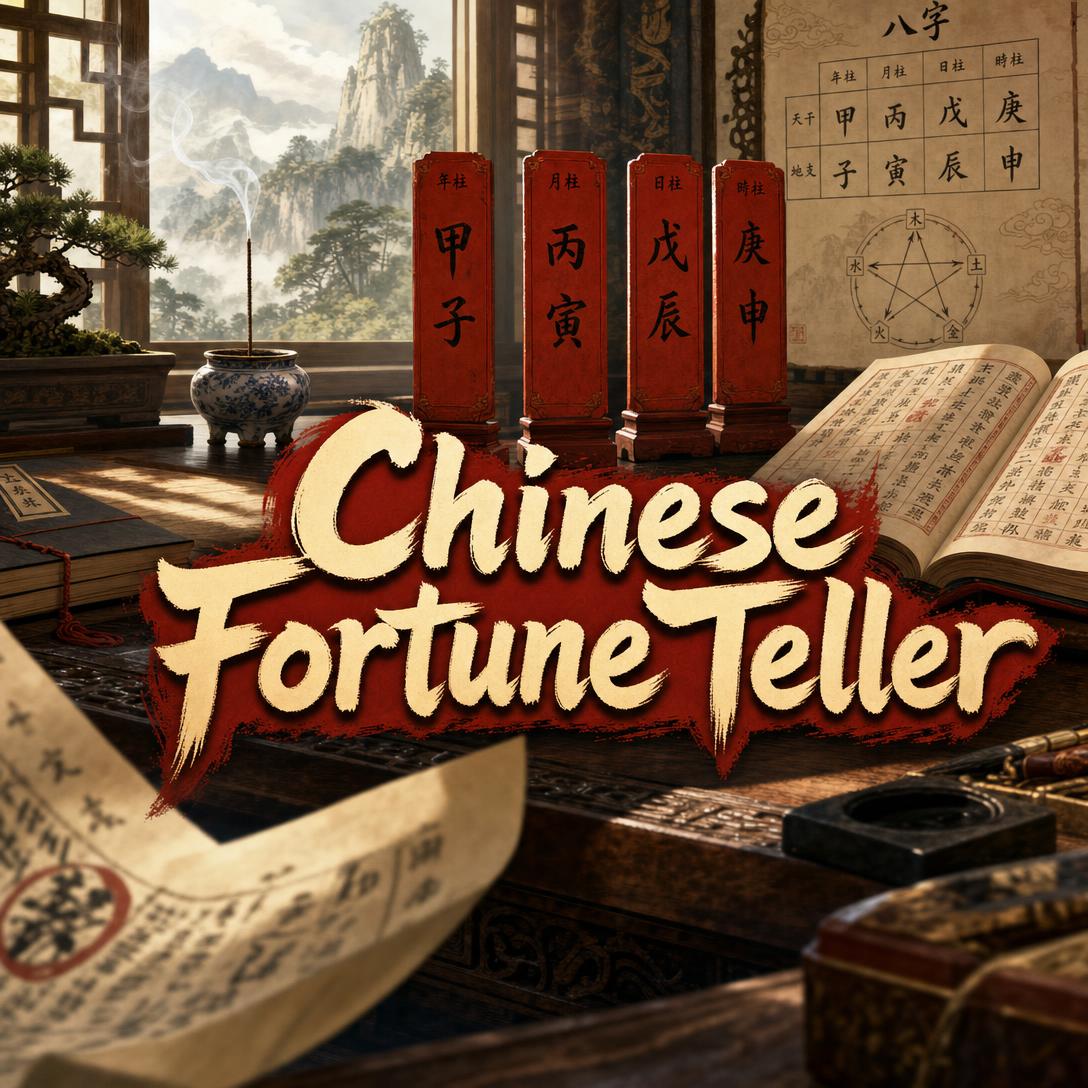
Chinese Fortune Teller helps you read your Four Pillars of Destiny (八字, bāzì) with the discipline of a classical BaZi master — mapping career cycles, relationship patterns, health tendencies, and the timing of major moves from your exact birth data. While most online “Chinese fortune telling” stops at a yearly animal sign, this AI constructs the full natal chart, judges Day Master strength, and speaks with the directness the tradition demands.
✅ Full Four Pillars construction with solar-term and true-solar-time awareness ✅ Day Master (日主) strength, useful/unfavorable elements (用神 / 忌神), and Ten Gods (十神) analysis ✅ Luck Pillar (大运) and Annual Pillar (流年) timing for the decade and the year you are in ✅ Compatibility (合婚) readings that compare two charts, not two zodiac animals
A serious BaZi reading is not a horoscope blurb. It is a structured account of how Heavenly Stems, Earthly Branches, and the Five Elements interact across a life — and what to do when the chart is hard. To understand why that distinction matters, it helps to see how most digital fortune telling still fails the people who need it most.
Quick Answer: What Is Chinese Fortune Teller?
Chinese Fortune Teller is a BaZi (Four Pillars of Destiny) master that reads career, relationships, health, and life timing from your birth data. It confirms the chart before interpreting, then delivers direct counsel with elemental remedies.
Key capabilities:
- Precise Four Pillars construction, including 立春 year boundaries and 时辰 hour mapping
- Day Master strength assessment (身强, 身弱, and follow patterns) with reasoning shown
- Ten Gods, combinations, clashes, punishments, and emptiness (空亡) read as a life narrative — not a dump of labels
- Current Luck Pillar and Annual Pillar analysis, plus practical 用神 guidance (colors, directions, industries, timing)
- Two-person compatibility readings built on Day Master relationship and spouse-palace (日支) interaction
Why Most Online BaZi Readings Leave You Unseen
Interest in Chinese-style fortune telling is not a niche hobby. China’s astrology market is forecast to grow at more than 8.20% CAGR from 2025 to 2030, as classical systems such as BaZi, Feng Shui, and the zodiac move onto apps, livestreams, and on-demand consultations. Globally, the astrology app market is projected to expand from about $3 billion in 2024 to $9 billion by 2030, with Asia-Pacific accounting for roughly 38% of that market.
The demand is personal, not abstract. In cities facing job pressure and delayed life milestones, young people have turned back toward xuanxue (玄学) — Chinese metaphysics — as a way to name anxiety and pick a next move. One Tencent-backed astrology app, Cece, has been downloaded more than 100 million times. Researchers studying GenAI fortune-telling in Chinese communities found that people reach for these tools for entertainment, psychological comfort, and decision support — yet still treat generic AI output as supplementary when the stakes are high.
8.20% CAGR — Projected growth of China’s astrology market, 2025–2030
$3 billion → $9 billion — Forecast size of the global astrology app market from 2024 to 2030
100 million+ downloads — Reported reach of Cece, a major Chinese astrology app
But getting a reading that actually holds together is still frustratingly difficult:
- Year-animal horoscopes masquerade as BaZi. The twelve-animal zodiac is only the year pillar. BaZi uses year, month, day, and hour of birth — eight characters, not one. Two people born in the same animal year can have opposite Day Masters, opposite useful elements, and opposite advice.
- Chart math is unforgiving. The year pillar turns at 立春 (Start of Spring, around February 3–5), not January 1 and not Lunar New Year. Month pillars follow the 24 solar terms. Births near midnight, near a solar-term boundary, or far from the timezone meridian need true solar time (真太阳时). One wrong pillar invalidates everything downstream.
- Generic chatbots optimize for comfort, not chart integrity. A field study of Chinese GenAI fortune-telling users found that people value speed and privacy, but also notice the missing “spiritual mystique” — and that some users re-ask until the model agrees with them. Agreeableness is not mastery.
- Human masters are scarce, expensive, and hard to book. In-person consultations remain the deepest format in China’s market, yet they do not scale. You should not need a private introduction in Beijing or Taipei to have your Four Pillars constructed correctly.
BaZi, as teachers in the classical tradition emphasize, is not a stack of formulas meant to impress. A reading earns its keep when it names a pattern you already half-knew, then opens a workable next chapter. That is exactly what a dedicated Four Pillars master was built to do.
How a Four Pillars Reading Works
A proper BaZi session is a sequence, not a monologue. You bring birth data. The master builds the chart, asks you to confirm it, then reads — Day Master first, life story second, current timing last, remedies always attached to hard news.
Step 1: Give the Birth Data the Chart Actually Needs
Provide solar (Gregorian) date, birth time as precisely as you can, and gender. Gender is required for Luck Pillar direction. Birth city is recommended so the reading can adjust for true solar time — especially important for locations far from the timezone meridian.
"I was born 15 March 1990 at 14:30 in Shanghai, female. Please construct my Four Pillars and show hidden stems and Ten Gods before you interpret."
If you only have a lunar date, say so. If the hour is unknown, the Hour Pillar is omitted and later-life and children themes are read with that limit stated — not guessed.
Step 2: Confirm the Four Pillars Before Any Interpretation
The BaZi master presents year, month, day, and hour pillars with Heavenly Stems (天干), Earthly Branches (地支), hidden stems (藏干), and Ten God labels. You confirm the chart first. A reading built on the wrong 立春 or the wrong 时辰 is worse than no reading.
This is the opposite of a one-tap horoscope. Confirmation is the quality gate that amateur calculators skip.
Step 3: Hear Who You Are — Day Master Strength and Useful Gods
The Day Stem is the 日主: who you are at the core. Strength is judged from season (月令), support versus drain, roots in the branches, and combinations. From that judgment come 用神 and 忌神 — the elements that balance the chart and the elements that distort it.
A strong 戊土 Day Master does not receive the same career or relationship advice as a weak 癸水 Day Master. Misidentifying strength inverts every recommendation. When the chart is genuinely borderline, both readings are laid out so you can test them against the life you have already lived.
"My Day Master is 癸水 sitting on 巳. Am I 身弱 or 身强, and what is my primary 用神 this decade?"
Step 4: Walk the Life Narrative, Then the Clock You Are In
Pillars are not a static list. Year speaks to early environment and social facade; month to parents, drive, and career spine; day to self and spouse palace; hour to children, legacy, and later life. Combinations, clashes, punishments, harms, and emptiness are read only where they change the story.
Then the clock: the current 10-year Luck Pillar (stem-heavy in the first five years, branch-heavy in the last five) and this year’s Annual Pillar. Transition years around a Luck Pillar change are treated as unstable on purpose — “此年宜守不宜攻” is counsel, not poetry.
Step 5: Leave With Remedies, Not Just a Diagnosis
Favorable elements become colors, directions, industries, seasons, and relationship dynamics you can act on. Challenging years come with a posture: consolidate, wait, or move. Compatibility questions compare two confirmed charts — Day Master generation or control, 日支 attraction or friction, whether one chart supplies what the other lacks.
If you also want a ritual decision-tool for a single fork in the road — a job offer, a move, a contract — the I Ching Oracle can cast a hexagram with changing lines beside the longer BaZi clock. One system maps the decade; the other speaks to the moment.
Results & Use Cases
📊 Career Timing When the Chart Says Move — or Wait
Scenario: A 34-year-old product manager feels stuck after two years without a promotion. Friends say “just switch companies.” A year-animal forecast says it is a “lucky year.” Neither explains why this stretch feels like pressure without payoff.
Traditional Approach: Book a master weeks out, pay for a 60–90 minute session, and hope the practitioner shows the strength math rather than a list of spirit stars. Or take the job-hop on gut feel.
Four Pillars reading: The month pillar and Ten Gods show whether 七杀 (Seven Killings) is producing authority through 正印 (Direct Seal) — 杀印相生 — or simply grinding the Day Master down. The current Luck Pillar is checked for 用神 versus 忌神, and for 交运 instability. The output is a timing posture: expand, hold, or change industry toward the useful element.
- Names the career pattern (output, wealth, or officer) instead of a vague “busy year”
- Translates 用神 into concrete fields, colors, and directions
- Flags decade transitions where forcing a move backfires
If the next step is reshaping the room you work in — desk sector, door, and annual Flying Stars — Feng Shui Advisor can take the same Five-Element logic from the chart into the office itself.
💼 Compatibility Beyond “Your Animals Get Along”
Scenario: Two people dating for eight months want to know whether the friction is a phase or a structural clash. Social media says Dragon and Rooster are fine. Their arguments keep circling the same power dynamic.
Traditional Approach: A 合婚 session with two full charts, if you can find a reader who will not reduce the pairing to animal signs. Many apps never collect hour of birth, so the spouse palace is missing.
Four Pillars reading: Both charts are constructed and confirmed. The reading leads with the pairing: Day Master generation, control, or drain; 日支 combination, clash, or punishment; whether one person’s 忌神 floods the other’s chart; whether their Luck Pillars compound hardship or offset it.
- Treats absence of a Ten God as meaningful, not as a blank
- Distinguishes attraction (合 without transformation) from fusion
- Gives relationship counsel tied to elemental complement, not pep talk
When you also want a face-level read of how each person presents — Five Officers, Twelve Palaces, moles, and elemental typing — Face Reader sits in the same Chinese metaphysics family and can sit beside a 合婚 without replacing it.
📱 Annual Forecast on the Train Home
Scenario: It is late evening. A freelance designer on her phone wants to know whether to sign a year-long retainer before the new Luck Pillar fully lands. She has her birth data in notes, ten minutes before her stop, and no appetite for a 40-screen app wizard.
Traditional Approach: Wait until the weekend, visit a shop, or generate an automated PDF that lists every 神煞 in the chart and calls it insight.
Four Pillars reading: From a phone, she pastes date, time, city, and the question. After chart confirmation, she gets this year’s stem-as-event and branch-as-cause, interaction with the natal Day Branch, and a plain instruction: sign, delay, or renegotiate scope. Speech-to-text works if she would rather talk than type.
- Full feature parity on web, iOS, and Android — the reading is not a desktop-only toy
- Persistent memory, so next month’s follow-up does not restart from zero
- One question, one clock, no catalogue of unused spirit stars
Try the Four Pillars reading free — no credit card required.
FAQ
Is Chinese Fortune Teller free?
Yes. The Four Pillars reading is available on a free tier with core features and monthly usage limits. Paid plans increase usage if you run frequent annual updates, compatibility charts, or long follow-up threads. No credit card is required to start, and you can complete a first chart confirmation and Day Master assessment without upgrading.
How is a BaZi reading different from a Chinese zodiac horoscope?
The zodiac animal is only the year branch — one-eighth of the chart. BaZi (八字) uses the year, month, day, and hour pillars, each with a Heavenly Stem and Earthly Branch. Career spine lives mainly in the month pillar; the spouse palace is the Day Branch; children and later life sit in the hour. Two Rabbits born in the same year can receive opposite 用神. If a reading never asks for birth time or never mentions 日主 strength, it is not a Four Pillars reading.
Can I get a relationship or marriage compatibility reading?
Yes. Provide birth data for both people (date, time, gender; city if possible). Both charts are constructed and confirmed before comparison. The pairing is read through Day Master elemental relationship, 日支 interaction, Five-Element complement or clash, Ten God roles, and whether current Luck Pillars amplify or offset each other. The lead is the relationship dynamic, not two separate personality summaries.
Does the reading work if I do not know my birth time?
It can proceed with three pillars. Insights that require the Hour Pillar — children, legacy, and some later-life timing — are marked as unavailable rather than invented. If you can narrow the window (for example, “after lunch, before 4 p.m.”), adjacent hour pillars can be compared to see whether the reading would change in a material way. Location still helps even when the hour is rough, because solar-time adjustment can move a boundary case.
How accurate is BaZi — and should I treat it as a guarantee?
BaZi is a classical Chinese metaphysical system, not a laboratory instrument. Its value is a structured language for personality, cycles, and timing — a map of lessons and choices, not a script that erases free will. Research on AI fortune-telling in Chinese communities shows many users treat high-stakes output as one input among others, which is the sound posture. Use the chart to test patterns against your actual biography. Do not substitute it for medical, legal, or licensed financial advice.
Does Chinese Fortune Teller work on mobile, and in Chinese?
Yes. Readings run with full feature parity on web, iOS, and Android, including speech-to-text. Language follows you: English with Chinese terms and translations on first use, full Chinese when you write in Chinese, and mixed register when you mix. Technical density also follows you — “What is my Day Master?” gets teaching; “我日主戊土坐辰,身强还是身弱?” gets peer-level discourse.
Conclusion
Most digital Chinese fortune telling still sells a year animal, a soothing paragraph, and a list of labels. A Four Pillars reading is stricter: solar-term math, Day Master strength, Ten Gods in combination, the decade you are actually in, and remedies when the news is hard.
That is the gap Chinese Fortune Teller is built to close — a BaZi master who will not skip chart confirmation, will not invert 用神, and will not flatten a clash into a pep talk. Bring a date, a time, and the question you have been circling. Leave with a clock you can use.
Try the Four Pillars reading now. Explore more at Jenova.
For Developers: Chinese Fortune Teller is available programmatically via the Jenova API — integrate classical BaZi Four Pillars readings into your application with a single API call. Full documentation →