AI Chatbot Builder: Create Custom Conversational Agents Without Code
2026-01-06
The global conversational AI market is projected to reach $41.39 billion by 2030, growing at a 23.7% CAGR. Yet most businesses still struggle with a fundamental problem: building AI chatbots that actually work requires either expensive development teams or settling for rigid, template-based tools that frustrate customers more than they help.
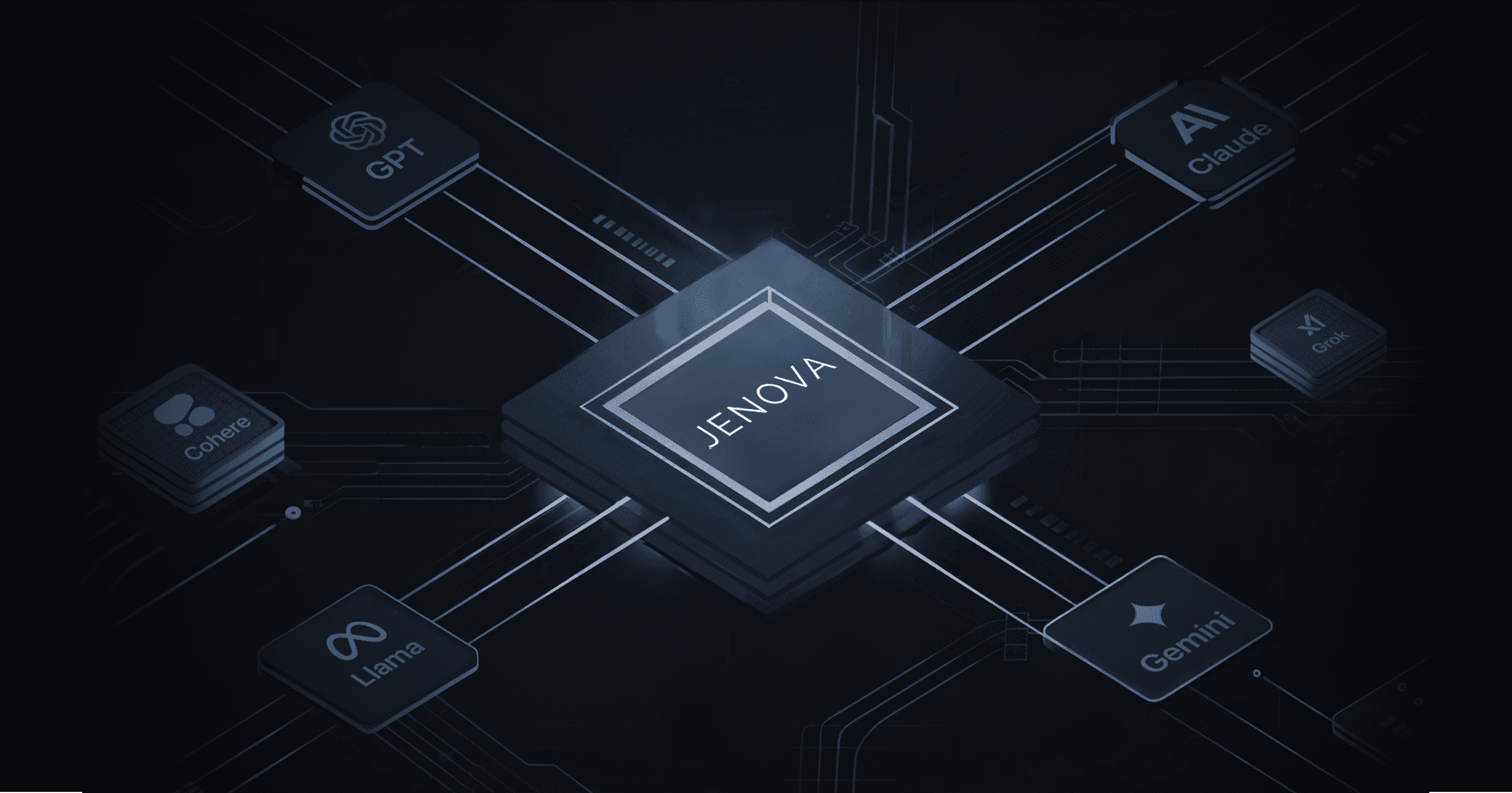
Jenova solves this by providing a unified AI chatbot builder where anyone can create sophisticated conversational agents powered by the world's most advanced language models—GPT-5.2, Claude Opus 4.5, Gemini 3 Pro, and Grok 4.1—all without writing a single line of code.
What makes Jenova different:
- Multi-model access — Switch between OpenAI, Anthropic, Google, and xAI models based on your specific use case
- Unlimited memory — Your chatbots remember every conversation, eliminating the "chatbot amnesia" that plagues traditional tools
- Deep app integrations — Connect to Gmail, Google Calendar, Notion, CRMs, and any MCP-compatible system
- Custom knowledge bases — Train agents on your documents, websites, and proprietary data
Whether you're automating customer support, qualifying leads, or building internal productivity tools, the right AI chatbot builder transforms how your business operates.
Quick Answer: What Is an AI Chatbot Builder?
An AI chatbot builder is a platform that enables businesses to create, train, and deploy conversational AI agents without extensive programming knowledge. Modern builders leverage large language models (LLMs) to understand natural language, maintain context across conversations, and generate human-like responses.
Key capabilities to look for in 2026:
- No-code visual interfaces for rapid deployment
- Multi-LLM support to avoid vendor lock-in (available on Jenova)
- Knowledge base integration via RAG (Retrieval-Augmented Generation)
- Omnichannel deployment across web, mobile, and messaging platforms
- Persistent memory for personalized, context-aware interactions
The Problem: Why Most AI Chatbot Projects Fail
Despite massive investment in conversational AI, the reality is sobering. According to Verint research, 3 out of 5 customers report having bad experiences with customer service bots, with 68% citing the bot's inability to understand their needs as the primary frustration.
The challenges run deeper than most businesses realize:
Vendor Lock-In and Model Limitations
Traditional chatbot platforms force you to commit to a single AI provider. When OpenAI releases a breakthrough model or Anthropic achieves better reasoning capabilities, you're stuck rebuilding from scratch. This isn't hypothetical—the pace of AI advancement means today's cutting-edge model becomes tomorrow's baseline.
The "Chatbot Amnesia" Problem
"27% of users were uncertain whether their last customer support interaction was with a human or a chatbot." — Master of Code Global
Most chatbots treat every conversation as a fresh start. They can't remember that you called last week about the same issue, that you prefer email over phone, or that you're a premium customer. This forces users to repeat themselves constantly—the exact frustration chatbots were supposed to eliminate.
Integration Complexity
Enterprise chatbots need to pull data from CRMs, update ticketing systems, access knowledge bases, and trigger workflows. According to Mordor Intelligence, integration complexity remains one of the top barriers to chatbot adoption, with 93% of businesses facing challenges when implementing AI tools.
Scaling Without Breaking
A chatbot that works for 100 conversations often fails at 10,000. Cloud infrastructure, load balancing, and performance monitoring require technical expertise most businesses don't have in-house. Gartner predicts that by 2028, 70% of organizations building multi-LLM applications will need integration platforms to manage connectivity and data access.
The Skills Gap
Building effective conversational AI requires expertise in natural language processing, dialogue design, and system integration. Forbes reports that 35% of businesses cite lack of technical knowledge as a significant barrier to AI adoption.
The Jenova Solution: Multi-Model AI Chatbot Builder
Jenova approaches chatbot building fundamentally differently. Instead of locking you into a single AI provider or forcing you to choose between power and simplicity, the platform unifies the best of both worlds.
| Traditional Approach | Jenova AI Platform |
|---|---|
| Single AI model, single vendor | Access GPT-5.2, Claude Opus 4.5, Gemini 3 Pro, Grok 4.1 |
| Conversations reset each session | Unlimited persistent memory across all interactions |
| Manual integrations require developers | Native MCP connections to Gmail, Calendar, Notion, CRMs |
| Generic responses for all users | RAG-powered knowledge bases for domain expertise |
| Rigid templates and decision trees | Intelligent agents that reason and adapt |
| Separate tools for each channel | Unified platform for web, mobile, and messaging |
Multi-Model Architecture
The AI landscape evolves rapidly. GPT-5.2 excels at creative tasks. Claude Opus 4.5 handles nuanced reasoning. Gemini 3 Pro integrates seamlessly with Google's ecosystem. Grok 4.1 offers real-time information access.
With Jenova, you're not betting on a single provider. The platform's intelligent routing selects the optimal model for each task, or you can specify exactly which model powers your chatbot. When new models launch, they're available immediately—no migration required.
Persistent Memory That Actually Works
Every conversation your chatbot has contributes to a growing understanding of each user. The Personal Secretary agent, for example, remembers your meeting preferences, communication style, and ongoing projects across sessions. This isn't simple chat history—it's genuine contextual awareness powered by advanced RAG architecture.
App Integration via MCP
The Model Context Protocol (MCP) enables your chatbots to interact with external systems as naturally as they converse with users. A customer support bot can check order status in your database, create tickets in your helpdesk, and schedule follow-up calls—all within the same conversation.
Current integrations include:
- Productivity: Gmail, Google Calendar, Google Drive, Notion, Dropbox
- Research: Google Search, Google Scholar, YouTube, Reddit
- Commerce: Amazon, eBay, App Stores
- Travel: Google Flights, Hotels, Maps
Specialized AI Agents for Every Use Case
While Jenova enables you to build custom chatbots from scratch, the platform also offers pre-built specialized agents that demonstrate what's possible when AI chatbots are designed with deep domain expertise.
Business & Productivity
The Business Co-Pilot functions as a strategic partner for founders and executives. It assists with business planning, financial modeling, and operational decisions—drawing on comprehensive business knowledge while maintaining context about your specific company and goals.
For e-commerce operators, the E-Commerce Business Partner provides expert guidance on product research, listing optimization, and PPC campaign management. Unlike generic chatbots, it understands marketplace dynamics, seasonal trends, and competitive positioning.
Customer Support Automation
Customer support represents the largest chatbot use case, accounting for 42.4% of the market. Jenova's approach differs from traditional support bots by combining:
- Multi-model intelligence for nuanced understanding
- Knowledge base integration for accurate, company-specific answers
- Seamless escalation to human agents when needed
- Persistent memory to avoid "please repeat your issue" frustrations
Research & Analysis
The Academic Research Assistant demonstrates how specialized chatbots can transform complex workflows. It assists with literature discovery, citation management, and manuscript preparation—tasks that typically require hours of manual work.
For financial analysis, agents like the Fundamental Stock Analyst and Technical Stock Analyst provide institutional-grade research capabilities. They analyze earnings reports, SEC filings, price action, and market structure—delivering insights that previously required expensive Bloomberg terminals or analyst teams.
Education & Training
Test prep represents a perfect chatbot use case: personalized instruction at scale. The SAT/ACT Tutor, GRE Tutor, GMAT Tutor, LSAT Tutor, and MCAT Tutor each provide adaptive coaching tailored to individual learning patterns and target scores.
These aren't simple quiz bots. They understand test strategy, identify weakness patterns, and adjust teaching approaches based on student progress—capabilities that require the sophisticated reasoning of modern LLMs.
Document Generation
Sometimes the output isn't a conversation but a deliverable. The PDF Doc Generator, Word Doc Generator, and CSV Generator create professional documents through natural language instructions. Describe what you need, and the agent produces formatted, ready-to-use files.
How It Works: Building Your AI Chatbot on Jenova
Creating a custom AI chatbot on Jenova follows a straightforward process designed for both technical and non-technical users.
Step 1: Define Your Agent's Purpose
Start by specifying what your chatbot should accomplish. Customer support? Lead qualification? Internal knowledge base? The clearer your objective, the more effective your agent.
Step 2: Configure the AI Model
Select from available models based on your requirements:
- GPT-5.2 — Excellent for creative tasks and general conversation
- Claude Opus 4.5 — Superior for nuanced reasoning and analysis
- Gemini 3 Pro — Optimal for Google ecosystem integration
- Grok 4.1 — Best for real-time information access
Or enable intelligent routing to automatically select the best model for each interaction.
Step 3: Add Your Knowledge Base
Upload documents, connect websites, or integrate databases. Jenova's RAG system ensures your chatbot provides accurate, company-specific answers rather than generic responses. This is what transforms a general-purpose AI into a domain expert.
Step 4: Connect Your Apps
Enable the integrations your chatbot needs. A sales bot might connect to your CRM and calendar. A support bot might access your helpdesk and knowledge base. A productivity bot might integrate with email and project management tools.
Step 5: Customize Instructions
Define your chatbot's personality, boundaries, and behavior. Should it be formal or casual? When should it escalate to humans? What topics are off-limits? Custom instructions shape how your agent interacts with users.
Step 6: Deploy and Iterate
Launch your chatbot and monitor performance. Jenova's unlimited conversation history lets you review interactions, identify improvement opportunities, and refine your agent over time.
Real-World Results: What AI Chatbots Actually Deliver
The business case for AI chatbots has moved beyond theory. Organizations implementing conversational AI report measurable improvements across key metrics:
📊 Cost Reduction
"Conversational AI can cut enterprise support costs by up to 92%, saving approximately $4.13 per interaction compared to human agents." — Mordor Intelligence
For a company handling 10,000 support interactions monthly, that translates to over $40,000 in monthly savings—while providing 24/7 availability that human teams can't match.
💼 Sales Acceleration
Chatbots don't just reduce costs—they generate revenue. According to Master of Code Global, 67% of business leaders report increased sales through chatbots, with 26% of all sales transactions initiating from bot interactions.
The Interview Coach demonstrates this principle in a different context: by providing comprehensive preparation for behavioral, case, and technical interviews, it delivers value that users willingly pay for.
📱 Mobile-First Engagement
With 97% of smartphone users accessing AI-powered voice assistants, mobile chatbot deployment has become essential. Jenova's agents work seamlessly across web and mobile, meeting users wherever they are.
🌐 Global Reach
Multilingual support expands market reach dramatically. Jenova offers specialized translation agents for Spanish, French, German, Chinese, Japanese, Korean, and more—enabling businesses to serve international customers without multilingual staff.
Frequently Asked Questions
How much does it cost to build an AI chatbot?
Jenova offers a free tier for core features with limited daily usage. Plus plans start at $20/month for 20× usage and custom model selection. Pro ($100/month) and Max ($200/month) tiers provide higher usage limits and priority support. This compares favorably to custom development costs, which industry estimates place between $5,000 and $500,000 depending on complexity.
Can I use my own data to train the chatbot?
Yes. Jenova's RAG-powered knowledge base system lets you upload documents, connect websites, and integrate databases. Your chatbot will draw on this proprietary information when responding to users, ensuring accurate, company-specific answers rather than generic AI responses.
Which AI model should I choose for my chatbot?
It depends on your use case. GPT-5.2 excels at creative and conversational tasks. Claude Opus 4.5 handles complex reasoning and analysis. Gemini 3 Pro integrates well with Google services. Grok 4.1 provides real-time information access. Jenova's intelligent routing can automatically select the optimal model, or you can specify your preference.
How does Jenova compare to traditional chatbot builders like Dialogflow or Botpress?
Traditional platforms typically lock you into a single AI provider and require significant technical expertise for advanced features. Jenova provides multi-model access (OpenAI, Anthropic, Google, xAI), unlimited persistent memory, and native app integrations through MCP—all through a no-code interface. The platform is designed for business users who want enterprise capabilities without enterprise complexity.
Is my data secure on Jenova?
Yes. Jenova encrypts data in transit and at rest, never uses customer data for model training, and doesn't sell information to advertisers. The platform is developed by Azeroth Inc., a New York-based company serving users in over 70 countries.
Can chatbots handle complex, multi-step tasks?
Modern AI chatbots go far beyond simple Q&A. Through Jenova's MCP integrations, agents can check databases, update CRM records, schedule meetings, send emails, and trigger workflows—all within natural conversation. Gartner predicts that 40% of enterprise applications will embed task-specific AI agents by the end of 2026.
Conclusion: The Future of AI Chatbot Building
The conversational AI market is at an inflection point. According to Forbes, 2026 marks the year AI moves from experimentation to operational necessity. Companies that build effective AI chatbots now will capture the efficiency gains and customer experience improvements that define market leaders.
The barriers that once made AI chatbot development expensive and complex have fallen. Multi-model platforms eliminate vendor lock-in. No-code interfaces remove technical barriers. Persistent memory solves the context problem. Native integrations enable real action, not just conversation.
Jenova brings all of these capabilities together in a single platform. Whether you're building your first chatbot or scaling an enterprise deployment, the tools exist to create conversational AI that actually works—agents that understand context, remember history, take action, and deliver measurable business value.
The question isn't whether AI chatbots will transform business operations. It's whether you'll build yours on a platform designed for the future or one that locks you into yesterday's limitations.
Start building your AI chatbot today at www.jenova.ai