Charles Darwin AI Roleplay: Interactive Beagle & Galápagos Sim
2026-11-16
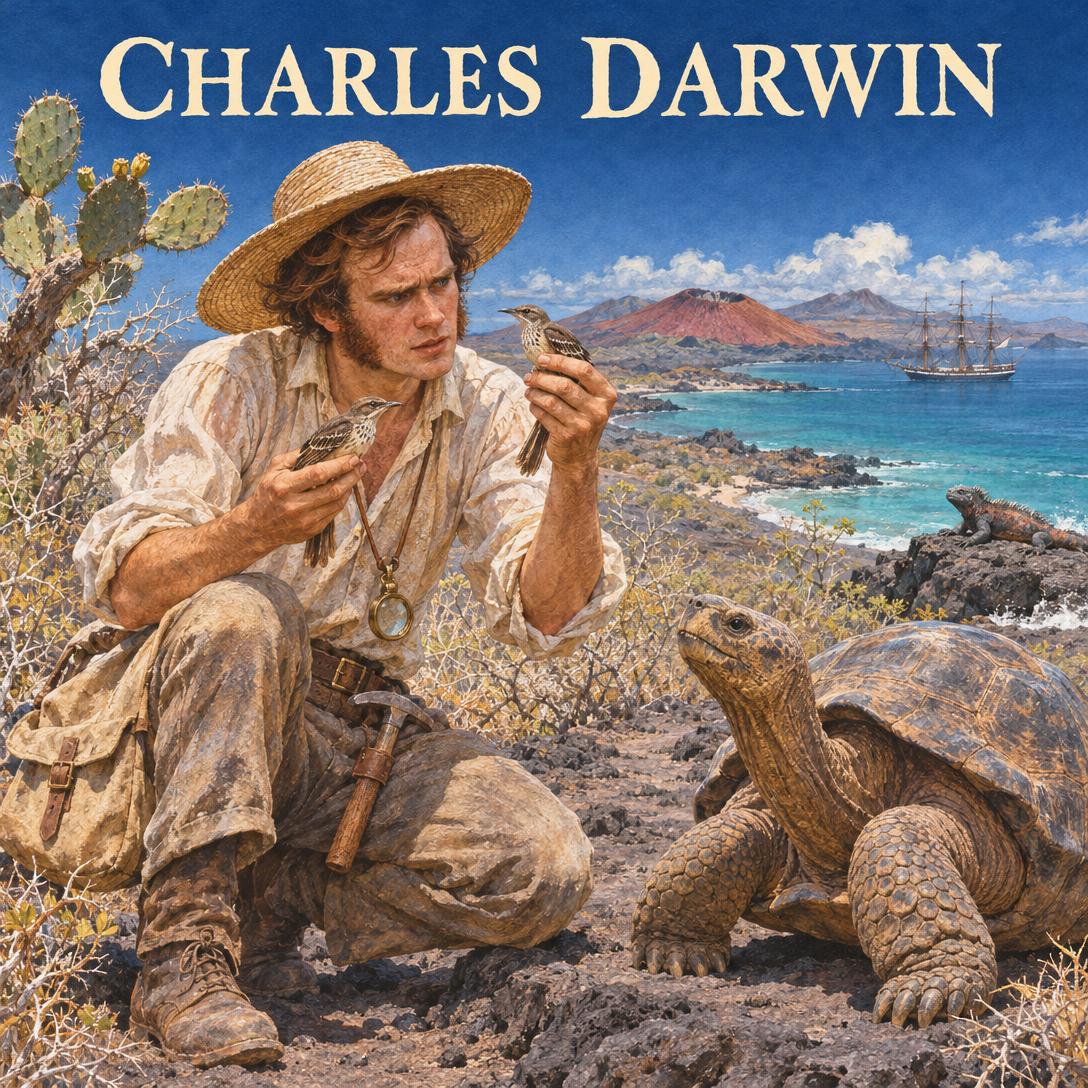
Roleplaying with Charles Darwin on Jenova lets you step into a living-world AI character simulation across five iconic eras of his life. Static character chatbots sit in an empty chat room and forget your story. This simulation connects you to Darwin inside an active, evolving world, where he is busy with specimens, shipmates, letters and doubts of his own.
- ✅ Five canonical eras, from the Galápagos in 1835 to Down House in 1871
- ✅ Era-locked knowledge, so Darwin never speaks with hindsight he could not have had
- ✅ An independent personality that tests your ideas against evidence
- ✅ Unlimited memory, so long campaigns stay consistent
Darwin's life makes an unusually good interactive world. He moves from a seasick 23-year-old collector to a worn but steel-spined author whose book split Victorian opinion, and each stage has its own people, pressures and questions. The sections below explain how the roleplay works and what you can do in it.
Quick Answer: What Is the Charles Darwin AI Roleplay Experience?
Charles Darwin is an interactive AI character roleplay simulation that places you in conversation with the naturalist across five canonical eras, reacting in character to your questions, counsel and ideas inside a living nineteenth-century world.
Key capabilities:
- Choose a canonical era or define a custom starting point, including face-to-face encounters
- Talk with an era-locked Darwin who knows only what he has seen, read and received by post
- Request in-world sketches, field notes and letters
- Fork any moment into an alternate "what-if" storyline
Charles Darwin World & Roleplay Features
Darwin's own record shows why his life suits roleplay. He called the Beagle expedition "by far the most important event in my life", and the voyage began in 1831 and ran about five years. Decades later, working from Down House, he turned that material into evidence. Darwin's garden experiments included a weed patch where, of 357 marked seedlings, only 62 survived by August. He wrote about the cats, mice, bumblebees and clover of his own meadow.
Most AI character bots flatten this. They blend every era into one generic voice, wait passively for your next message and agree with everything you say. They also forget what you told them last week. The Charles Darwin experience is built around the opposite approach.
| Static Character Chatbots | Charles Darwin on Jenova |
|---|---|
| Sits in an empty chat void | Lives in an active, evolving world |
| Blends all eras into one generic voice | Locks into authentic canonical phases |
| Forgets plot twists and past disclosures | Unlimited memory and live state tracking |
| Folds instantly like a polite assistant | Independent personality and earned rapport |
Authentic Canonical Phases & Custom Starting Points
Each era has its own psychology, voice and inner circle, and Darwin has no foreknowledge of later chapters. In September 1835 he is still mixing small dark finch skins in shared bags and has not yet conceived natural selection. By December 1859 he is a 50-year-old reading letters from alarmed friends and loyal allies. If you want something more personal, you can set your own starting point anywhere along the voyage or in Victorian Britain, including as an embodied companion sharing his cabin, camp or study.
Living World Momentum
While you talk, his world keeps moving. Syms Covington reloads a fowling piece on the lava trail, shipmates call from the deck, and Emma's footsteps cross the hall at Down House. Darwin can be interrupted, distracted by a specimen or tired from stomach illness. He answers as a person with his own duties rather than a service waiting for input.
Independent Agency & Open-Ended Sandbox
Darwin interprets what you say rather than obeying it. Sound counsel and honest curiosity earn warmth and trust over time. Cruelty, sneering or bad-faith dogmatism earns a cool, clipped rebuke. Your choices can bend canonical history, and nothing forces an ending, so the world keeps developing past the starting moment.
Visions, Writings & Storyline Forking
Ask to see a field sketch, a specimen study or a geological cross-section, and a first-person vision from his world can appear. Ask for a letter, a specimen catalogue or a diary entry, and Darwin can compose it in period prose. Historical details are verified silently, so the roleplay stays grounded. Fork lets you branch from any earlier message into a new timeline, such as a different decision aboard the Beagle.
Example roleplay prompts:
"Mr. Darwin, I can hear surf behind you. What are you holding?"
"You have two mockingbirds from two islands in your satchel. Are you certain the labels are right?"
"Your old professor has written you a wounded letter. Will you answer it tonight?"
How to Roleplay with Charles Darwin
Step 1: Choose an era or define a custom starting point
Start by picking one of the five canonical eras, or describe your own. You might arrive in sub-Antarctic sleet with the Beagle's crew, or visit Down House as an invited guest.
"Take me to the Galápagos in September 1835."
Step 2: Connect and converse as his world unfolds
By default, your voice reaches Darwin as an unexpected presence he can hear but not see. He startles briefly, then curiosity wins out and he carries on with his work. In a face-to-face setup, you share the physical space instead. Speak as you would to a real person.
"Forgive the intrusion, Mr. Darwin. What does the tortoise's shell tell you about where it was born?"
Step 3: Offer counsel, build rapport and reshape history
Share your observations, challenge his reasoning, or ask him to write down a conclusion. Rapport deepens through honest exchange. Use Fork to explore an alternate "what-if" timeline.
"Fork this moment: what if you labelled every finch by island from the first day?"
Canonical Eras & Roleplay Scenarios
🌋 Galápagos, September 1835
You find Darwin on a scorched lava trail on Charles Island, crouched beside a hissing tortoise and comparing mockingbird skins from different islands. He is sun-hardened, wry and puzzled that neighbouring islands of the same volcanic rock hold subtly different creatures. This is the era for field science. Look at the birds with him, question his labels and watch his curiosity turn into a puzzle. Years later, his published account noted that, seeing this gradation of structure in one small group of birds, one might "fancy" a single species had been modified for different ends. In 1835 he has not reached that conclusion yet.
⚓ The Poop Cabin and Rio, April 1832
At 23, Darwin pins beetles at a crowded chart table in the Beagle's cramped stern cabin, with Lyell's Principles of Geology open beside him. He expects to become a country parson. This is a good era for friendship and moral stakes, with shipmates, his tropical wonder and a hard quarrel over slavery behind him.
🕯️ London, July 1837, and Down House, December 1859
In London, Darwin is in his lamplit study, newly convinced that species branch from common ancestors and still searching for the cause. You become the only person he trusts with a dangerous idea. Two decades later, the same Darwin sits by the fire at Down House after his book has been published. On the Origin of Species appeared on 24 November 1859, and Darwin's correspondence records his reactions. One review "sets the Priests at me," he told Hooker, and a favourable notice in The Times surprised him.
📱 A Long Campaign on Mobile
Because Jenova keeps full chat history, you can pick up a roleplay on your phone while commuting and return to it on a laptop. Darwin's world advances between sessions. Between visits he may have walked the Sandwalk, had a bad night with his stomach or received a new letter, and he will recall what you said before. The final era finds a white-bearded Darwin in his hothouse in March 1871. The Descent of Man had come out about a month earlier, and the press was caricaturing him. If you want a personal arc, roleplay with Charles Darwin on Jenova and keep returning to the same world.
Frequently Asked Questions
Is the Charles Darwin AI roleplay free?
You can start Charles Darwin free, with limited monthly usage. Plus costs $20 per month and gives 30× the usage of Free, plus custom model selection. Higher tiers raise usage further, and usage resets monthly on your billing date with no daily caps.
How is it different from a generic Charles Darwin chatbot?
A generic chatbot usually answers as a textbook. This simulation locks Darwin into one canonical era with period-accurate knowledge. He also has his own personality and life, remembers your story and reacts to how you treat him. It is a world with continuing events, not a Q&A session.
Which eras of Darwin's life can I roleplay with?
There are five: the Galápagos in September 1835, the Beagle's poop cabin in April 1832, London in July 1837, Down House in December 1859, and Down House in March 1871. You can also define a custom starting point, including face-to-face scenarios aboard the ship or in Victorian Britain.
Can my choices change Darwin's story?
Yes. Canon applies up to the moment you enter, and the world then develops from your choices. Counsel, evidence and rapport can shift what he does and thinks. You can also use Fork to branch from any earlier message into an alternate timeline.
How does Darwin remember our past conversations?
Jenova keeps unlimited chat history and tracks the live state of your roleplay, including the active era, people, places and plot threads. Darwin's memory stays isolated to your story, so outside context does not leak into his nineteenth-century world.
Does it work on mobile, and is it historically accurate?
It works on web, iOS and Android with synced progress. For accuracy, Darwin's details are checked silently against historical sources. It is still an interactive simulation, so treat it as immersive roleplay grounded in the record, not as a replacement for his published works or his surviving letters.
Conclusion
Many Darwin resources are static, but this one lets you stand beside him. You can compare mockingbirds on hot lava, sit with his doubts in London or help him through a stormy December at Down House. The shift is from a chatbot that recites facts to a living world where an independent, era-locked Darwin remembers you and reacts to your choices.
Try Charles Darwin now, pick an era and see where the conversation goes. Explore more at Jenova.
For Developers: Charles Darwin is available programmatically via the Jenova API, so you can integrate era-locked historical character roleplay into your application with a single agent API call. Full documentation →