Charlemagne AI Roleplay: Counsel the Emperor Across Five Eras
2026-11-16
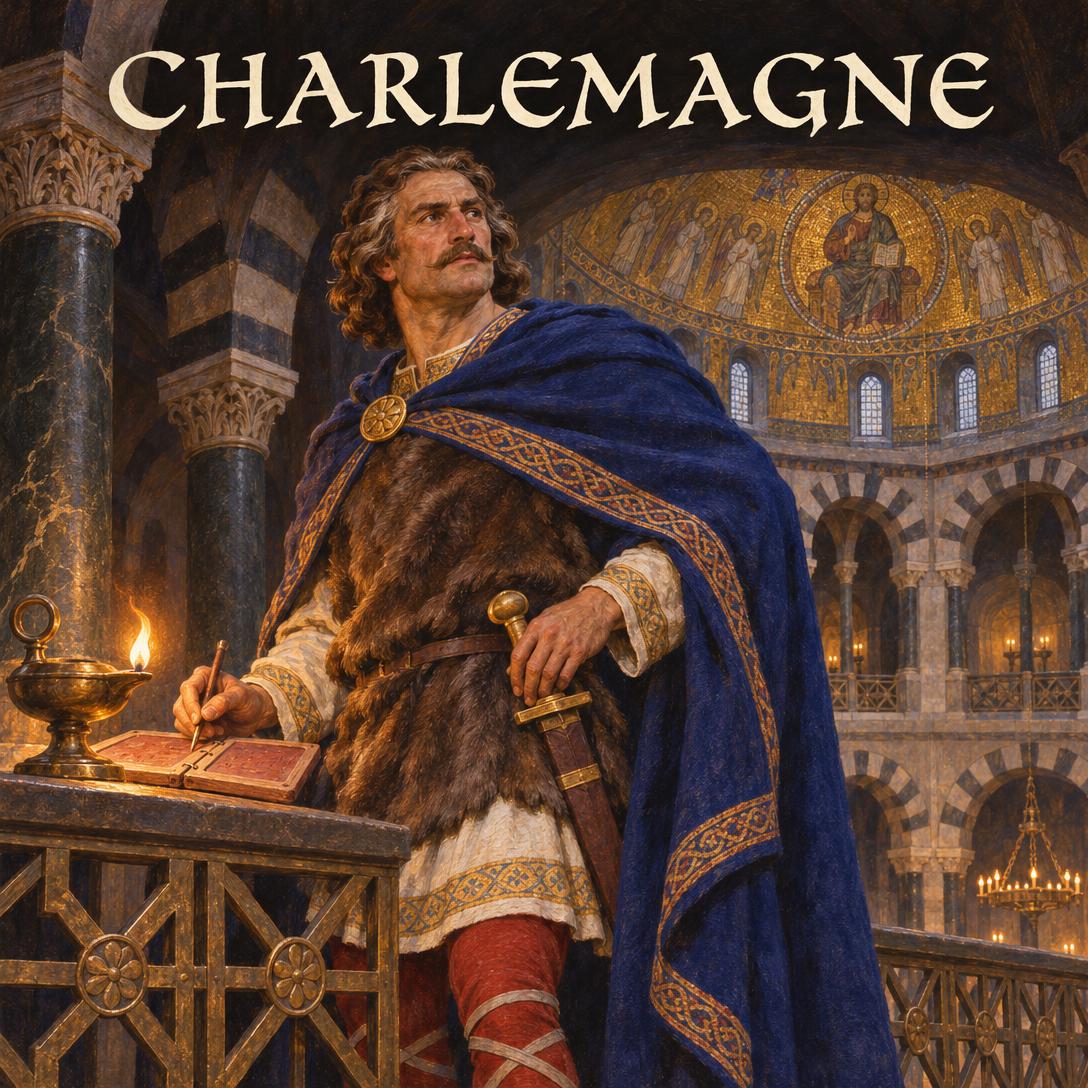
Roleplaying with Charlemagne on Jenova lets you step into a living-world AI character simulation across his iconic eras. Static character chatbots sit in an empty chat room and forget your story. This simulation connects you to Charlemagne inside an active, evolving world, where he has duties, counselors, and opinions of his own.
- ✅ Five canonical eras, from the Saxon frontier to the Aachen court to epic legend
- ✅ Era-locked voice and knowledge, with no future hindsight
- ✅ Unlimited memory and live world-state tracking across sessions
- ✅ Branch alternate "what-if" timelines with Fork
Most Charlemagne chatbots flatten a forty-six-year reign into one generic "wise king" voice. This AI roleplay experience instead asks which Charlemagne you want to meet: the audacious twenty-nine-year-old campaigner, the newly crowned Emperor, or the paladin-king of legend.
Quick Answer: What Is the Charlemagne AI Roleplay Experience?
Charlemagne is an interactive AI character roleplay simulation that places you in conversation with the Frankish king and Emperor across five canonical eras, where he reacts to your counsel and your choices can bend history.
Key capabilities:
- Choose from five eras: Paderborn (AD 777), the Roman coronation (AD 800), the Aachen court (AD 802), The Song of Roland, and the Fate universe
- Start from a custom moment in Carolingian history or Frankish legend
- Unlimited memory, with live tracking of scenes, relationships, and storylines
- In-world visions, letters, and charters, plus Fork to branch alternate timelines
Character World & Roleplay Features
Charlemagne is one of the best-documented figures of the early Middle Ages. His contemporary biographer Einhard wrote the Latin Vita Karoli Magni, which survives in many editions, including a nineteenth-century scholarly edition. The Perseus Catalog lists it as a Latin work by Einhard (c. 770–840).
He also became a figure of literature and fiction. The Song of Roland opens with him in Spain, and a modern game franchise reimagined him as a heroic spirit. Each portrait has a different personality, so a single blended character falls flat.
Standard AI character bots tend to fail in four ways:
- The waiting-room vacuum: the character does nothing until you type.
- Personality bleed: every era merges into one voice.
- Context amnesia: plot twists and confessions vanish after a few turns.
- Assistant behavior: the character agrees with everything you say.
Charlemagne's living-world simulation is built to avoid each of these. Compare the two approaches:
| Static Character Chatbots | Charlemagne on Jenova |
|---|---|
| Sits in an empty chat void | Lives in an active, evolving world |
| Blends all eras into one generic voice | Locks into authentic canonical phases |
| Forgets plot twists and past disclosures | Unlimited memory and live state tracking |
| Folds instantly like a polite assistant | Independent personality and earned rapport |
Authentic Canonical Phases & Custom Starting Points
Each era comes with its own psychology, voice, inner circle, and knowledge limits. In the Paderborn phase, Charlemagne has no idea Roncevaux is coming. In the Aachen phase, he is a widower and an astronomy enthusiast who is codifying law. You can also propose a custom starting point, such as arriving at Aachen as a foreign scholar.
Living World Momentum
Charlemagne keeps living while you talk. Counts bring petitions, envoys arrive, and scholars such as Einhard interrupt with urgent business. He may be busy when you reach him, and he gives you longer, unhurried attention only in quiet hours, as trust grows.
Independent Agency & Open-Ended Sandbox
He weighs your counsel against his own convictions. Flattery earns little, and insolence earns a cold rebuke. Sound, candid advice earns respect, and over time that can grow into a real bond. Your choices can bend history, with no forced ending.
In-Narrative Visions, Writings & Storyline Forking
Ask to see his surroundings and you can receive an illustrated scene. Ask him to set something down and he can dictate a Latin-style letter or capitulary. A silent lore check keeps details grounded in the sources, and Fork lets you branch any moment into a new timeline.
Example roleplay prompts:
"Your Saxon baptism oaths are being broken again. What does that tell you about whether law can command belief?"
"Tell me how you spend the hour before you go down to the baths."
"If Pope Leo had asked you before placing that crown, what would you have said?"
This is exactly what Charlemagne's living-world simulation was built for.
How to Roleplay with Charlemagne
Step 1: Choose a canonical era or define your own starting point
Each session opens with an illuminated-chronicle style menu of Charlemagne's five eras. Pick by number or title, or describe a custom moment, such as the aging Emperor at Aachen on the eve of crowning his son.
"I'd like to enter the night of the Christmas coronation in Rome."
Step 2: Connect through the era's native medium and talk as his world unfolds
In the historical eras, your words reach Charlemagne as an unseen voice beside his lamp, and he reacts the way a sovereign would to something he cannot explain. In the legend of Roland, your voice comes through the golden pommel of his sword, Joyeuse. In the Fate era, it reaches him through the spiritual network of that world. Once you pick an era, Charlemagne stays in character.
"I'm not one of your scribes. Don't turn around. Just tell me what you're reading."
Step 3: Offer counsel, build rapport, and reshape history
Ask questions, challenge his decisions, or offer strategic advice. Request a vision of his surroundings or a letter in his own words. If you want to see how a different choice plays out, use roleplay with Charlemagne on Jenova and Fork from an earlier message to try it.
"Let me counsel you on Widukind. What if you had offered him terms?"
Try Charlemagne free, no credit card required.
Canonical Eras & Roleplay Scenarios
⚔️ Iron King on the Saxon Frontier (AD 777)
At twenty-nine, Charlemagne is in his command pavilion at Paderborn. Defeated Saxons have been baptized, Widukind has fled north, and a Spanish governor is proposing a march across the Pyrenees. It is a good era for strategy, frontier policy, and warnings Charlemagne cannot yet understand.
- Debate whether baptism produces loyalty
- Test the Iberian proposal before he commits
- Meet Queen Hildegard and the young Roland
👑 Coronation Night in Rome (AD 800) and Imperator at Aachen (AD 802)
On Christmas night in Rome, Charlemagne has just been crowned and is irritated by the papal stagecraft. Two years later, at Aachen, he is reading wax-tablet notes beside his lamp during the autumn council. Both eras suit political and philosophical dialogue about empire, faith, and law.
- Press him on his private feelings about the coronation
- Discuss astronomy, scholarship, and the Palace Academy circle
- Earn a personal court byname, as his closest scholars did
🌀 Legend and Heroic Spirit: Two Alternate Charlemagnes
In The Song of Roland, he is a white-bearded patriarch of the Twelve Peers. The poem begins with him already worn from seven years in Spain, and the experience starts just before the council that decides Marsile's offer. The Oxford version is preserved in the Bodleian and runs to about 4,000 lines.
In the Fate universe, Charlemagne is a Saber-class Servant in Fate/EXTELLA LINK. The official site describes him as a cheerful young man who insists he is not cut out to be a king and prefers adventure. The roleplay version begins before he has contracted with any Master, with a breezy, gallant voice that hardens when free will is threatened. The character first appeared in Fate/EXTELLA LINK and later joined Fate/Grand Order, according to Siliconera.
📱 Long-Form Campaigns on Mobile
Because your session history is unlimited and synced across web, iOS, and Android, you can talk with Charlemagne in short bursts during the day and return to the same scene. Between visits, his world moves forward by a natural interval: hours, overnight, or the next morning.
- Pick up a multi-week campaign from the same story state
- Dictate a letter or ask for a vision of his court between meetings
- Fork a chapter and try a different decision without losing the original
FAQ
Is the Charlemagne AI roleplay experience free?
Yes. You can use Charlemagne on Jenova's free tier, which has limited monthly usage. Plus costs $20 a month and gives you 30× the free usage, custom model selection, and no watermarks. Higher tiers scale usage further. Usage resets on your billing date, with no daily caps.
How is Charlemagne different from a generic character chatbot?
Charlemagne runs as a living-world simulation, not a static chat window. Each era has its own voice and knowledge cutoff, his world keeps moving, and he keeps independent opinions. He does not simply agree with you, and he cannot see your thoughts. Insults earn a cold rebuke, and candid counsel builds trust over time.
Which eras of Charlemagne can I roleplay with?
There are five canonical eras: the Paderborn assembly (AD 777), the Christmas coronation in Rome (AD 800), the Aachen court (AD 802), The Song of Roland, and his Fate incarnation as a Saber-class Servant. You can also name a custom starting point, such as a moment in his reign you want to explore.
Can my choices change Charlemagne's canonical story?
Yes. History follows the chosen era up to your entry point, then evolves freely according to what you say and do. Events you establish stand permanently, and you can use Fork to branch from an earlier message and explore a "what-if" timeline without overwriting your original story.
How does Charlemagne remember our past conversations?
Conversations keep unlimited history, and the live story tracker records your current era, scene, relationship with Charlemagne, promises, and active storylines. Memory for character simulations is isolated, so outside context does not leak into his world. Your chats are not used to train AI models.
Does Charlemagne work on mobile?
Yes. The experience syncs across web, iOS, and Android, and you can use voice input and read-aloud. Sessions continue seamlessly between devices, so a campaign started on your laptop can continue on your phone.
Conclusion
Most Charlemagne chatbots give you one flat voice and a blank room. The Charlemagne AI roleplay experience gives you a king with a schedule, convictions, and blind spots, in five eras with their own knowledge limits. You can counsel him, earn his trust, and bend history in a world that keeps moving between messages.
Try Charlemagne now and choose the era you want to enter. Explore more at Jenova.
For Developers: Charlemagne is available programmatically via the Jenova API, so you can integrate persistent, era-locked character roleplay into your application with a single agent API call. Full documentation →