AI Character Simulator: Build, Test & Roleplay Living Characters
2026-08-07
An AI character simulator lets you create a character with a defined personality, history, and voice — then interact with that character as a living, responsive entity that remembers everything. Static character sheets and one-off chatbot conversations forget who your character is between sessions. A true simulator holds the persona steady across hundreds of exchanges.
✅ Persistent memory that carries character details across every session ✅ Perfect personality consistency — no drift, no breaking character ✅ Unlimited scenario freedom across any genre, tone, or setting ✅ Works for writers, game designers, trainers, and roleplayers alike
To understand why persistent character simulation matters, it helps to look at what creators, writers, and developers actually struggle with when they try to make fictional characters feel real — and why most tools fail at exactly the point where the interaction gets interesting.
Quick Answer: What Is an AI Character Simulator?
An AI character simulator is a tool that brings a defined fictional character to life as an interactive entity, maintaining consistent personality, memory, and behavior across ongoing conversations and scenarios. Unlike a one-off generator, it sustains the character over time.
Key capabilities:
- Define a character's personality, backstory, motivations, and speech patterns
- Interact in real time through open-ended dialogue and scenario play
- Retain memory of past interactions, relationships, and plot developments
- Adapt character behavior dynamically based on your choices and the evolving situation
The Problem: Why Most Character Tools Break Down
Character creation tools have exploded in availability, but the vast majority stop at the surface — generating a portrait, a description, or a single conversation. The moment you need the character to persist, most systems collapse.
The scale of interest is real. Character AI reached roughly 69 million total downloads and around 4 million monthly active users, while the broader roleplay category continues expanding:
13.1% projected CAGR — AI Roleplay Chatbot market growth forecast
70% of Gen Z consumers are comfortable interacting with AI chatbots — AI Roleplay Research Stats
But turning that interest into a character that actually holds up is frustratingly difficult:
- Memory resets — the character forgets your name, your history, and every prior decision
- Personality drift — a sardonic mercenary slowly softens into a generic helpful assistant
- Shallow interaction — responses feel like a description being read aloud, not a person reacting
- Content ceilings — dark, morally complex, or emotionally intense scenarios get sanitized into nothing
- Fragmented workflow — visual design lives in one tool, personality in another, and the actual roleplay in a third
Memory Resets Kill Long-Form Storytelling
A character that can't remember chapter one is useless by chapter twelve. Writers building a novel, game designers testing an NPC arc, and roleplayers running a months-long campaign all depend on continuity. When context evaporates between sessions, you spend more time re-establishing who the character is than actually playing.
Personality Drift Breaks Immersion
Consistency is the hardest technical problem in character simulation. Research into simulation design highlights this directly — effective systems rely on complex character modeling with distinct traits, hidden agendas, and conflicting priorities that persist across an entire interaction. Characters "don't always tell you the whole truth, don't always agree with each other, and definitely don't all want the same thing." Without that layered modeling, every character converges toward the same agreeable middle.
Surface-Level Generation Isn't Simulation
There is a meaningful gap between generating a character and simulating one. As D-ID's technical glossary explains, a generator is "the means or process, while the digital avatar is the resulting interactive entity." Most tools sell you the process and stop there. What you actually need is the entity — something that behaves, reacts, and holds a position.
Sanitized Scenarios Undercut Serious Creative Work
Fiction lives in conflict. A screenwriter stress-testing an antagonist, a novelist writing a morally compromised protagonist, or a designer building a genuinely menacing villain needs a system that doesn't flinch. Tools that hedge every dark turn produce characters with no teeth.
This is exactly what the Roleplay Game Master was built for.
Why the Roleplay Game Master
The Roleplay Game Master treats character simulation as its core function, not a side feature. It maintains unlimited memory across sessions and holds character consistency with precision — so the person you're talking to in your fiftieth exchange is the same person you defined in your first.
| Traditional Character Tools | Roleplay Game Master |
|---|---|
| Memory resets between sessions | Unlimited persistent memory across every session |
| Personality drifts toward generic | Perfect character consistency, indefinitely |
| Single-character interactions only | Full scenes with multiple characters and evolving dynamics |
| Sanitized, restricted scenarios | Complete creative freedom across any theme or tone |
| Static description output | Live, reactive simulation that responds to your choices |
Persistent Memory That Actually Persists
Every detail you establish — a scar, a grudge, a promise made in chapter three — stays in play. The simulator tracks relationships, plot threads, and emotional history so your character's reactions are informed by everything that came before.
Character Consistency Under Pressure
Consistency isn't just remembering facts; it's holding a worldview. A character defined as pragmatic and distrustful will remain pragmatic and distrustful when you offer them an easy out. The persona doesn't soften because the conversation got long.
Scenario Depth and Creative Freedom
You aren't limited to a chat window. Run full scenes with environmental description, multiple characters, branching consequences, and long-arc narrative structure.
"You are Kaelen, a disgraced court alchemist exiled for a poisoning you didn't commit. Cynical, brilliant, guards your real intentions. I'm a knight arriving at your hut at midnight asking for a favor."
"Continue our campaign. Last session, my rogue betrayed the merchant guild. Show me the consequences three weeks later in the capital."
"Play both the detective and the suspect in an interrogation scene. Give the suspect a hidden motive I have to uncover through questioning."
Related Agents You'll Also Find Useful
Character simulation rarely exists in isolation. If you're building characters, you're usually also designing them, writing around them, or shipping them into a larger project.
Character Creator
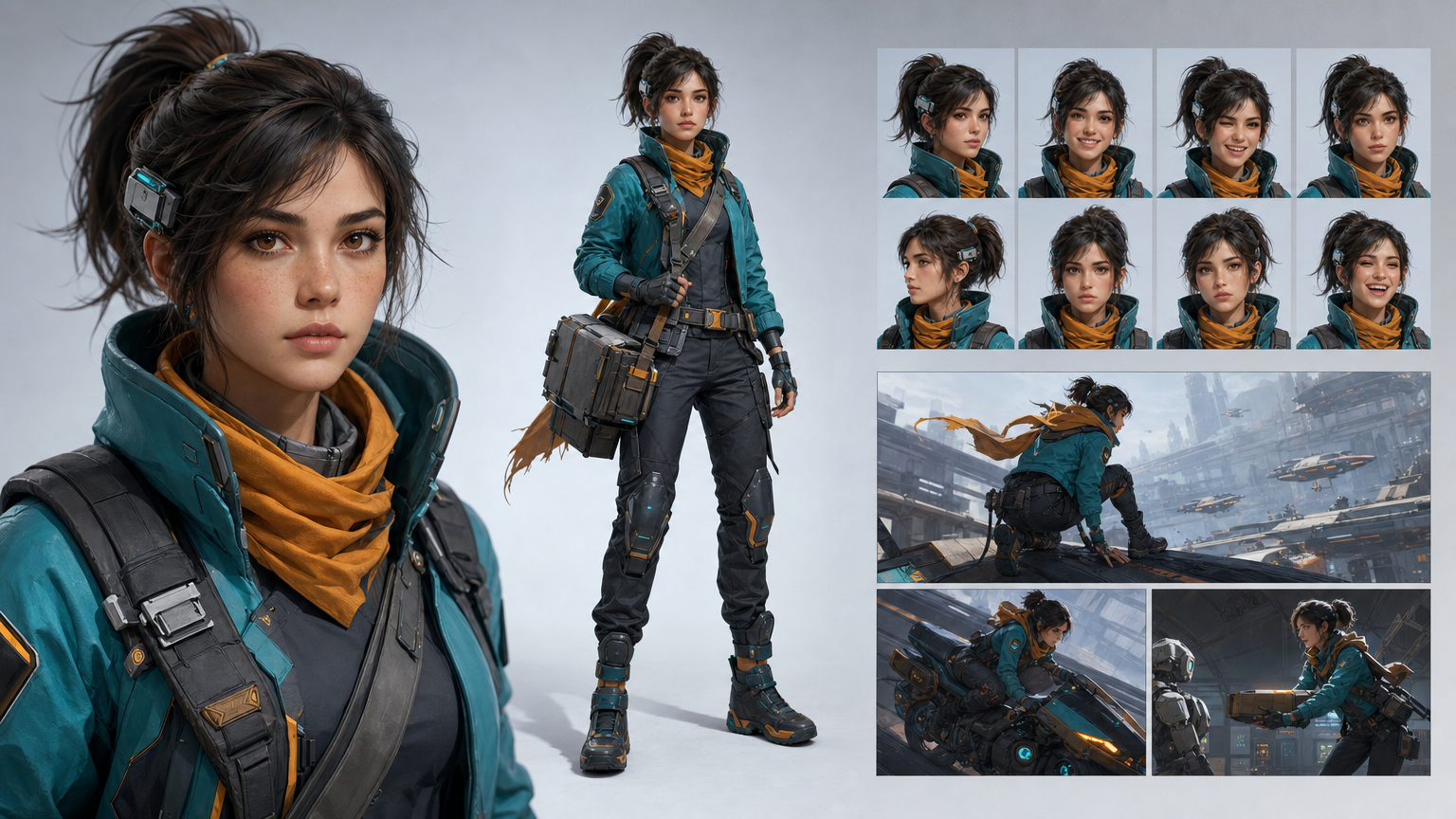
If you're at the design stage — figuring out who this person is before you play them — the Character Creator handles the build. It runs quick-generation or guided deep-dives, researches source media for accuracy, and produces character portraits across genres.
- Guided personality, backstory, and motivation development
- Portrait generation across fantasy, sci-fi, contemporary, and stylized aesthetics
- Media research for canon-accurate fan characters and OCs
Creative Fiction Writer
Once your character is alive, you need prose around them. The Creative Fiction Writer turns simulated scenes into finished chapters with editorial-grade craft.
- Genre-fluent drafting from outline through final manuscript
- Deep research for authentic settings and period detail
- Line-level editorial feedback on voice and pacing
Game Designer Assistant
If your characters are destined for a game, the Game Designer Assistant bridges narrative and systems — turning a compelling NPC into a mechanically sound one.
- NPC behavior design, dialogue trees, and quest integration
- Systems analysis across genres and platforms
- Concept art and design documentation
Manga Creator
For visual sequential storytelling, the Manga Creator takes your simulated characters into panel form with consistent art across long serialized runs.
- Panel flow and visual storytelling structure
- Consistent character art across hundreds of pages
- One-shots through full serialized epics
Try the Roleplay Game Master free — no credit card required.

How It Works
Step 1: Define Your Character
Describe who they are — personality, history, speech patterns, motivations, and what they want. The more specific you are, the sharper the simulation. Include contradictions; real characters have them.
"Marisol, 34, former paramedic turned smuggler. Dry humor, hates being thanked, physically fearless but avoids emotional conversation. Speaks in short sentences unless she's lying."
Step 2: Set the Scene
Establish the world, the situation, and your own role in it. The simulator uses this frame to govern how the character behaves and what's at stake.
"Setting: a rain-soaked cargo dock, 2 AM, an inspection three minutes away. I'm her contact and I've just told her the shipment is compromised."
Step 3: Interact and Let It Develop
Speak, act, and make choices. The character responds in-persona, and their reactions accumulate. Push them, lie to them, earn their trust — the simulation tracks all of it.
"I lie about who tipped off the inspectors and see if she believes me."
Step 4: Continue Across Sessions
Return days or weeks later and pick up exactly where you left off. Memory persists, so the relationship you built and the consequences you triggered are still in effect.
"Resume from the dock scene. It's been two months. She hasn't spoken to me since."
Results & Use Cases
📖 Novelists Stress-Testing Protagonists
Scenario: A literary fiction writer needs to know whether her morally ambiguous lead would actually make the choice her outline demands in chapter nineteen.
Traditional Approach: Weeks of drafting, discarding, and second-guessing — or an expensive developmental editor's opinion after the manuscript is already written.
Roleplay Game Master: She simulates the character and walks them into the scene directly, testing three different pressure points in an afternoon.
- Discovers her character resists the plotted choice, revealing a structural flaw early
- Generates authentic dialogue she can lift and refine
- Builds a consistent voice reference for the remaining 200 pages
🎮 Game Designers Prototyping NPCs
Scenario: An indie studio is designing a companion character and needs to know if the personality actually holds up over a 40-hour playthrough.
Traditional Approach: Write dialogue trees, implement them, playtest, discover the character is flat, rewrite everything.
Roleplay Game Master: The designer simulates the companion across dozens of scenario branches before a single line is implemented. Pairing this with the Game Designer Assistant turns those findings into shippable dialogue systems.
- Identifies personality dead-ends before production cost is sunk
- Tests reactions to edge-case player behavior
- Produces a validated voice bible for the writing team
🎭 Long-Form Roleplay Campaigns
Scenario: A tabletop group's campaign stalls between sessions and continuity slips — NPCs contradict themselves, plot threads get dropped.
Traditional Approach: The GM maintains sprawling notes and still loses track of who knows what.
Roleplay Game Master: The simulator holds every NPC, relationship, and unresolved thread across months of play.
- Zero continuity drift across an indefinite campaign length
- Solo play between group sessions to develop side arcs
- Multiple distinct NPCs maintained simultaneously in a single scene
📱 Mobile Character Work on the Move
Scenario: A screenwriter has a 45-minute commute and wants to develop an antagonist's interrogation scene without a laptop.
Traditional Approach: Voice memos and scattered notes that never get organized.
Roleplay Game Master: Full simulation on mobile with speech-to-text input, syncing to the same session on desktop later.
- Complete feature parity between mobile and web
- Speech-to-text for hands-free scene development
- Session state syncs automatically across devices
FAQ
Is an AI character simulator free to use?
The Roleplay Game Master is available on Jenova's free tier with access to all core features and limited monthly usage. Paid tiers start at $20/month and scale usage substantially, add custom model selection, and remove watermarks. Usage resets monthly on your billing date with the full limit available immediately — no daily caps.
How is an AI character simulator different from a character generator?
A generator produces output — a description, a portrait, a stat block — and stops. A simulator sustains an interactive entity that remembers, reacts, and evolves. If you need the design artifact, use the Character Creator. If you need the character to actually live and respond over time, you need a simulator.
Can the character remember previous conversations?
Yes. The Roleplay Game Master maintains unlimited memory across sessions. Details established weeks earlier — names, grudges, promises, plot events — remain active and inform how the character behaves in every subsequent exchange.
Does it work for dark or morally complex scenarios?
Yes. The agent is built for complete creative freedom across any theme, tone, or intensity. Serious fiction requires characters who can be cruel, deceptive, or genuinely dangerous, and the simulation supports that without flattening the scenario.
Can I run multiple characters in the same scene?
Yes. You can stage full scenes with several distinct characters who each hold their own motivations and react to one another, not just to you. This mirrors how sophisticated simulation systems model disagreement and competing agendas rather than presenting a single agreeable voice.
Does it work on mobile?
Full feature parity across web, iOS, and Android, including speech-to-text input. Sessions and settings sync automatically, so you can start a scene on your phone and continue it on desktop.
Conclusion
The gap between a character concept and a character that feels alive is memory and consistency. Most tools generate a description and forget it by the next conversation. An AI character simulator closes that gap — holding personality steady, retaining every established detail, and reacting with the specificity that makes fiction land.
Whether you're pressure-testing a protagonist, prototyping a game companion, or running a campaign that spans months, persistent character simulation replaces guesswork with direct observation. You stop wondering what your character would do and simply ask them.
Try the Roleplay Game Master now. Explore more at Jenova.
For Developers: Persistent character simulation with unlimited memory is available programmatically via the Jenova API — integrate consistent, stateful character interactions into your game, app, or platform with a single API call. Full documentation →