AI Character Sheet Generator: Game-Ready Concept Art Sheets
2026-09-05
A character sheet generator helps you lock a character’s look — front, side, back, three-quarter views, expressions, and costume callouts — before anyone models, animates, or draws page one. In September 2026, that work no longer has to wait on a week of silhouettes and revision rounds. Jenova turns a written brief into production-ready reference by combining illustration, game design, sequential art, and story craft in one workspace.
✅ Turnaround views and expression studies from a single description ✅ Armor, weapon, and costume callouts that 3D and 2D teams can actually use ✅ Persistent memory so a protagonist stays on-model across sessions ✅ Multi-model access plus custom agents tailored to your art bible
To understand why this matters, it helps to look at how character sheets are built today — and where traditional pipelines stall.
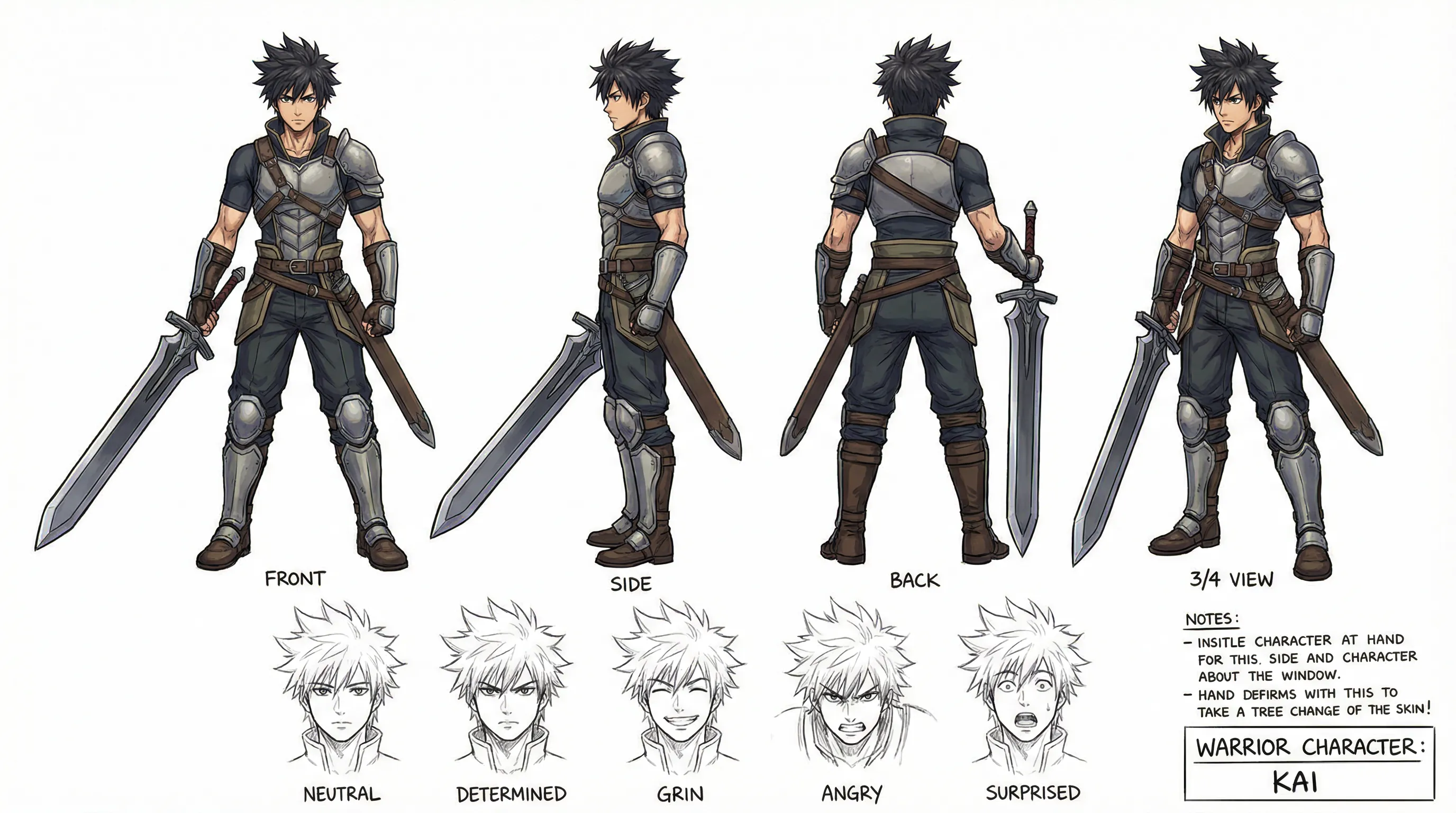
Quick Answer: What Is a Character Sheet Generator?
A character sheet generator is an AI-powered design workflow that produces turnaround views, expression studies, and costume callouts so teams can lock a character before modeling or animation. It is the visual contract between writer, artist, and production.
Key capabilities:
- Full-body turnarounds (front, side, back, 3/4) with Graphic Designer
- Expression sets and costume breakdowns for games, comics, and animation
- Style-consistent casts via Game Designer Assistant and sequential-art agents
- Backstory, personality, and naming that stay attached to the visual design
Why Character Sheets Still Stall Production
Concept art is the first visual step in game and animation pre-production. It defines identity, tone, and art style before modeling, rigging, or layout begin, which is why schools and studios still treat it as a bridge from abstract idea to buildable asset. A usable character sheet is more than a pretty portrait. It is a technical document: proportions, materials, weapon scale, and a face that reads in every mood.
Demand for that document is rising with the rest of generative visual work. The generative AI in art market reached $0.62 billion in 2025 and is estimated at $0.88 billion in 2026, on a path toward $3.56 billion by 2030 at a 42% CAGR. Entertainment, gaming, and design are named application areas in that research — exactly the teams that live on character sheets.
$0.88 billion — Estimated generative AI in art market size in 2026
42% CAGR — Projected growth of generative AI in art through 2030
Adoption is uneven. OECD data cited in that same industry analysis found about 28% of ICT firms using AI versus 8% of firms overall. Creative teams feel the gap: tools exist, but the output is often a single hero image, not a sheet a modeler can trust.
But getting a production-ready sheet is still frustratingly difficult:
- Turnarounds drift — the side view no longer matches the front
- Faces break when you need angry, grin, and surprise on the same skull
- Armor, stitches, and emblems are invented twice for 2D and 3D
- A five-character cast quietly becomes five different art styles
- Indie budgets cannot absorb a full concept pass every time the director changes the silhouette
Turnarounds That Do Not Match
A professional sheet needs orthographic clarity: front, side, back, and a 3/4 view that shows volume. Concept art in games is a sequence of sketches and detailed drafts, not one illustration. Single-image generators optimize for a dramatic pose. They rarely hold belt height, pauldron width, or sword length when the camera orbits the character. Downstream, modelers guess — and guessing is expensive.
Expressions That Break the Face
Industry teaching still starts with purpose, then research, then iterative sketching, then expressiveness as a design requirement. Neutral, determined, grin, angry, and surprised only work if the same bone structure sits under every drawing. Without that, animation and comics lose the character the audience already recognized.
Costume and Prop Callouts Missing From the Brief
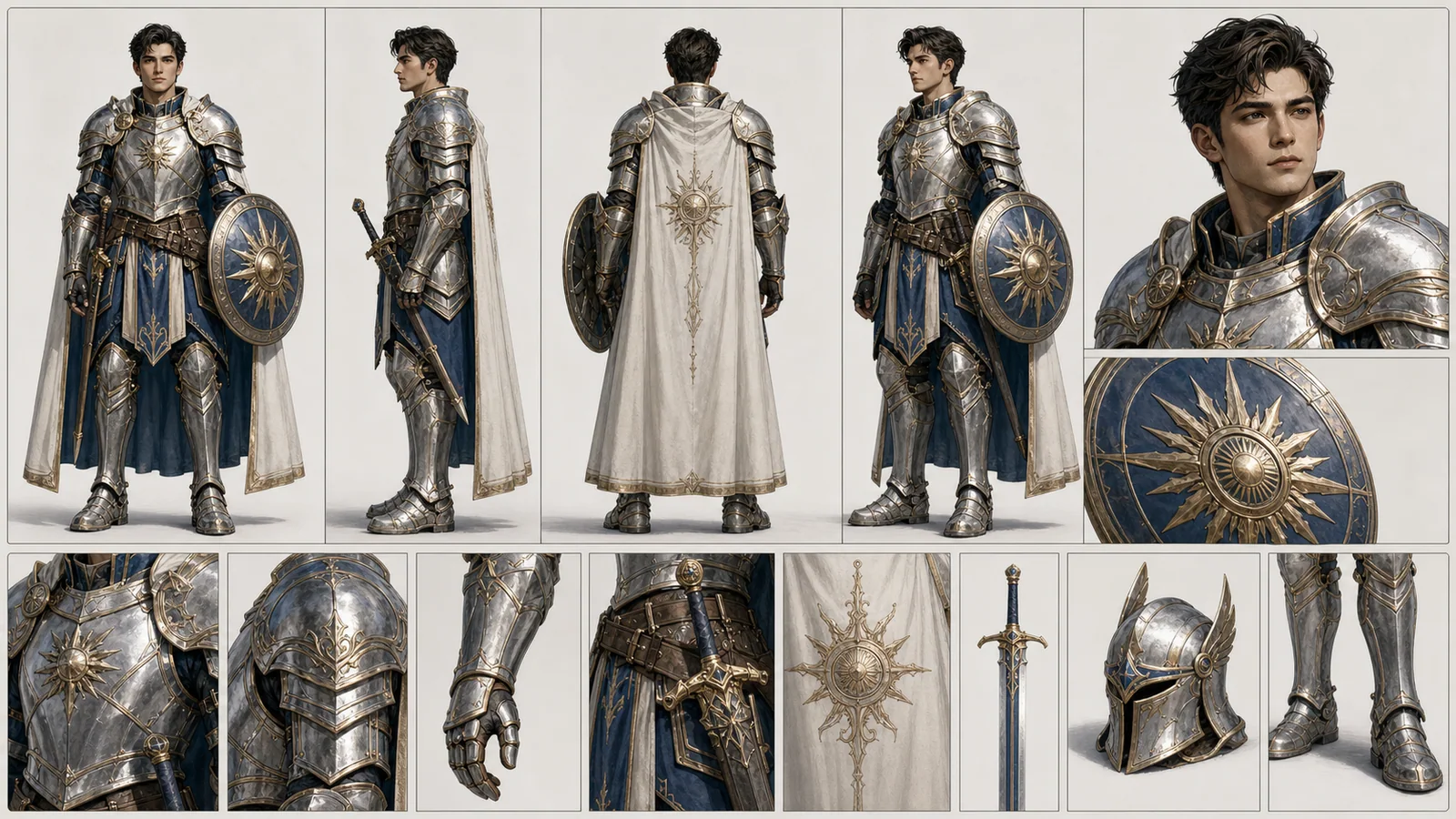
Plate seams, cape embroidery, shield heraldry, and boot construction are not decoration. They are specs. Character concept work exists to give 3D and animation teams a readable plan. When the sheet skips close-ups, every department invents its own version of the sunburst, the stitching, or the scabbard.
Casts That Will Not Stay On-Model
Visual storytelling research treats character design as narrative made visible: silhouette, palette, and costume should encode role. That only holds if the rogue, the knight, and the mage share one world. Prompt-only workflows reset style every session. Memory does not.
Iteration Cost When Direction Changes
A bibliometric review of generative AI in creative industries maps a whole research cluster around human–AI collaboration and professional workflows — product design, employment, and how tools sit inside real pipelines. The pain practitioners report is not “can AI draw.” It is “can we revise a locked character in an afternoon without redrawing the bible.” Traditional concept cycles cannot. This is exactly what Jenova was built for.
The Jenova Solution
Jenova is not a one-shot image box. It is a gallery of specialist agents that cover the full character bible: illustration, game systems, manga and comics, screenwriting, and prompt craft. You describe the character once. Persistent memory keeps proportions, palette, and lore attached to the next request. Multi-model access lets you pick the renderer that matches your art direction without juggling accounts.
| Traditional Approach | Jenova |
|---|---|
| One heroic pose, then a week of manual turnarounds | Front, side, back, and 3/4 views in one working session |
| Expression studies redrawn from scratch | Neutral-to-extreme faces on the same skull |
| Separate writers, concept artists, and designers | Story, sheet, and gameplay notes in one thread |
| Style drift across a cast | Cross-session memory and a shared art bible |
| New tool stack per department | One workspace, custom agents, any major model family |
Visual Design and Illustration
Graphic Designer treats the sheet as a designed artifact: hierarchy, callouts, readable silhouettes, and print-safe layouts. Ask for orthographic turnarounds, labeled armor plates, or a clean expression row. Pair it with Prompt Generator when you need tighter control over style tokens — “late-90s shonen line weight,” “oil-study plate armor,” “graphic-novel ink” — before you generate.
“Create a character sheet for Kai, a lean warrior in layered leather and steel. Front, side, back, and 3/4 views, plus a five-face expression row: neutral, determined, grin, angry, surprised. Keep the same sword length and boot height in every view.”
Games and Interactive Media
Game Designer Assistant sits next to the art, not after it. Use it to check whether the silhouette reads at game-camera distance, whether the weapon conflicts with the animation set, and how the design maps to class fantasy. Roleplay Game Master then stress-tests the character in play — the same face and voice, session after session — so NPCs and player avatars stay consistent in tabletop or digital campaigns.
Sequential Art and Publishing
When the sheet has to survive hundreds of pages, sequential specialists take over. Manga Creator holds line language, hair masses, and costume folds across a series. Comic Creator builds Western sequential grammar — spotting blacks, costume color holds, and issue-to-issue continuity. Webtoon Creator adapts the same bible to vertical scroll: simpler reads at phone width, stronger color keys, episode-thumbnail faces.
Children's Book Creator is the right handoff when the character must stay gentle, readable, and identical from spread to spread.
Story, Voice, and the Written Half of the Sheet
A sheet without biography is only a costume. Creative Fiction Writer drafts origin, flaw, and visual motifs that earn the scars and the emblem. Film Screenwriter pressure-tests whether that design will read in a close-up and a wide. Writing Assistant compresses the result into the one-page bio that sits in the corner of the PDF you send to the team.
While general image generators such as Midjourney or Leonardo produce striking single frames, Jenova is built for the document those frames are supposed to become — a sheet with views, notes, and a story that does not reset tomorrow.
Specialized AI Agents for Character Sheets
If you are assembling a character bible this month, these are the agents most teams reach for first.
Graphic Designer
Graphic Designer is the layout brain of the sheet. It organizes turnarounds, detail crops, and notes the way a studio art director would: labels under views, a notes block for hand placement or skin tone, and equipment callouts that survive a zoom.
- Orthographic and 3/4 presentation on one board
- Crop-ins for helmets, gauntlets, emblems, and weapons
- Export-minded composition for pitch decks and art bibles
Game Designer Assistant
Game Designer Assistant asks production questions while the paint is still wet. If the cape will clip in a climb animation, or the shield emblem is too busy at minimap scale, you want that answer before the model sheet is locked.
- Class and faction readability
- Concept-art notes aimed at 3D and animation
- Genre fluency across action, RPG, and strategy
Manga Creator
Manga Creator is the right specialist when the sheet must feed panels, not a game engine. Hair clumps, speed lines, and costume black/white balance stay consistent from one-shot to long serial.
- On-model faces across emotion extremes
- Costume folds that survive action pages
- Series bibles for 200-page epics
Comic Creator and Webtoon Creator
Comic Creator and Webtoon Creator split by format, not by talent. One thinks in issue covers and double-page spreads. The other thinks in thumb-stopping episode breaks. Both consume the same character sheet and refuse to reinvent the jawline in episode twelve.
Try Jenova free — no credit card required.
How to Generate a Character Sheet
Step 1: Write the brief like an art director State role, silhouette, materials, and the views you need. Name the world so costume logic has somewhere to live. One tight paragraph beats a mood board of contradictions.
“High-fantasy knight, early 20s, dark wavy hair. Ornate silver plate with gold filigree, blue undertunic, white cape with a central sunburst. Need full turnaround, face close-up, shield emblem, winged helm, and sword.”
Step 2: Build the visual sheet Open Graphic Designer (or Manga Creator if you want ink-led anime). Attach any sketch you already have. Ask explicitly for front, side, back, and 3/4, then a second pass of equipment crops. Persistent memory keeps the first pass available when you refine the pauldron.
Step 3: Lock the face Request a labeled expression row on the same head. Neutral and determined first; then grin, angry, surprised. If a view drifts, say which landmark moved — eye line, ear height, scar — and regenerate only that panel.
“Keep Kai’s eye shape and scar identical. Redraw only the mouth and brows for angry and surprised. Do not change hair volume.”
Step 4: Attach story and systems Hand the sheet to Creative Fiction Writer or Film Screenwriter for a one-page bio, then to Game Designer Assistant for class kit and readability notes. Writing Assistant can format the combined bible for your wiki.
Step 5: Reuse, do not restart Next session, continue in the same thread or mention the character by name. The platform’s memory is the difference between a generator and a pipeline. When the director wants the cape shorter, you revise a known design instead of gambling on a new prompt.
Results and Use Cases
🎮 Indie RPG Hero Bible
- Scenario: A five-person studio needs a paladin locked before environment art begins.
- Traditional Approach: Freelance concept pass, then a second artist for turnarounds, then a writer for lore — days of coordination.
- Jenova: Game Designer Assistant and Graphic Designer produce the knight sheet (armor, sunburst shield, helm, sword crops) and a one-page class brief in a single working block.
- Faster art-lock for the 3D contractor
- Heraldry that matches the faction document
- A file the whole Discord can annotate
📚 Manga and Webtoon Protagonist
- Scenario: A creator is pitching a 40-episode action series and needs a model sheet investors can trust.
- Traditional Approach: Commission a character designer, then redraw when the editor asks for a younger face.
- Manga Creator: Anime-style warrior sheet with four body views and a five-face row, then Webtoon Creator adapts color and crop for mobile episodes.
- On-model hair and costume from pitch to episode one
- Expression coverage for fight and comedy tones
- Vertical-scroll variants without a second hire
📱 Sketch-to-Sheet on a Phone
- Scenario: An art lead sees a costume idea on the commute and needs a shareable sheet before standup.
- Traditional Approach: Voice memo, then a studio day to block the turnaround.
- Jenova: Same agents on iOS or Android, full feature parity with web. Dictate the brief, generate views, send the image to the channel before you sit down.
- Speech-to-text for messy, specific art notes
- Synced history so the desktop session continues the phone draft
- No “I’ll do it when I’m at the tablet” delay
🎬 Picture Book and Film Development
- Scenario: A writer-director needs a child-readable lead and an adult knight in the same world for a hybrid pitch.
- Traditional Approach: Two stylists, two bibles, a hope they feel related.
- Children's Book Creator plus Film Screenwriter: a gentle, spread-safe lead and a cinematic armor sheet that share palette and emblem language. Creative Fiction Writer ties both to one origin story.
- Shared motif (sunburst, color, silhouette family)
- Age-appropriate proportions where they belong
- Pitch deck pages that look like one production
FAQ
What is an AI character sheet generator?
An AI character sheet generator is a workflow that outputs turnaround views, expression studies, and costume details from a written or sketched brief. On Jenova, that workflow is a set of specialist agents — illustration, games, manga, comics, and writing — rather than a single image prompt. The goal is a document production can use, not a one-off portrait.
Is Jenova’s character sheet generator free?
Yes. Jenova has a free tier with core features and limited usage, so you can produce a first sheet without a credit card. Higher tiers increase usage and unlock custom model selection. Start on the homepage, generate a turnaround, then upgrade only if you outgrow the free allowance.
How is this different from Midjourney or Leonardo?
Those tools excel at single, high-impact images. A character sheet needs matching orthographic views, labeled gear, and a face that survives five expressions. Graphic Designer and Manga Creator are built for that document. Persistent memory and companion agents for story and game design keep the bible coherent after the first render.
Can it produce expression sheets and armor callouts?
Yes. Ask for a labeled row (neutral, determined, grin, angry, surprised) and for cropped details of helm, gauntlet, emblem, and weapon. The knight example above — plate filigree, sunburst shield, embroidered cape, winged helmet — is the level of breakdown modelers expect. Iterate by naming the part that is wrong instead of regenerating the whole board.
Does a character sheet generator work on mobile?
Jenova runs with full feature parity on web, iOS, and Android. You can dictate a brief, attach a sketch, and review turnarounds on a phone, then continue the same thread on desktop. Speech-to-text is useful when your notes are visual and messy.
How do I keep a whole cast consistent?
Stay in one project thread and refer to locked measurements (eye line, palette, motif). Game Designer Assistant can police silhouette contrast across the party. Sequential agents — Manga Creator, Comic Creator, Webtoon Creator — refuse new hair physics every chapter. For custom house style, build a private agent with your art-bible instructions and reference pack.
Conclusion
A character sheet is the contract that stops a protagonist from mutating between the pitch and the build. Traditional pipelines spread that contract across illustrators, writers, and designers, then pay again when direction shifts. An AI character sheet generator on Jenova collapses the loop: Graphic Designer and Game Designer Assistant lock the views, Manga Creator and Comic Creator hold the line, and Creative Fiction Writer or Film Screenwriter attach a biography that explains the scars.
Describe the warrior. Generate the turnaround. Crop the shield. Keep the face. That is the job — and it no longer requires a week of mismatched poses to get there.
Explore the full agent library at Jenova.
For Developers: Every agent in this article is available programmatically via the Jenova API — build AI-powered character-sheet and concept-art features into your application with a single integration. Full documentation →