AI Character Secret Generator: Hidden Lives That Drive Plot
2026-09-06
Writing Assistant helps you generate character secrets that actually drive a story—hidden pasts, withheld truths, and private motives that force bad decisions. While random clue tables spit out “unsent message” or “eavesdropped secret,” this AI writing partner designs what the character is hiding, why they cannot tell, who the reveal would destroy, and when the truth should surface.
As of September 2026, novelists, screenwriters, and game masters still treat secrets as flavor: a locked diary, a false name, a crime with no cost. A dedicated writing partner that remembers your cast, genre, and stakes is a sharper way to work.
- ✅ Secrets tied to identity, relationships, and plot—not a random prompt
- ✅ Works for novels, scripts, comics, and tabletop RPGs
- ✅ Persistent memory so a secret stays consistent across drafts
- ✅ Free to start, with no credit card required
To understand why this matters, look at how most “character secret generators” actually work—and why so many hidden pasts never change a scene.
Quick Answer: What Is an AI Character Secret Generator?
An AI character secret generator is a writing tool that turns a character’s history, relationships, and story stakes into a hidden truth that creates tension, deception, and a reveal. Used well, it replaces random mystery prompts with secrets a reader can feel.
Key capabilities:
- Separate a secret (what someone is hiding) from a clue (what someone else finds)
- Root the concealment in fear, shame, loyalty, or power—not a locked box
- Design the cost of keeping it, the tell that leaks it, and the scene that breaks it
- Keep a whole cast consistent about who knows what, and when
Why Most Character Secret Generators Produce Empty Mysteries
Secrets work because people are social animals who track what others know. Research on storytelling shows we are wired to follow hidden motives: narrative transport depends on psychological realism, and theory of mind—the ability to track another mind—is how readers stay inside a lie. When a character withholds something, the audience leans in.
But accessing that kind of specificity from a generator is frustratingly difficult:
- Random tables confuse clues with secrets
- Lists name a hidden fact without a reason to hide it
- “Secretly kind” and “has a mysterious past” never cost anyone anything
- Writers still have to invent the tell, the cover story, and the reveal by hand
65 percent — share of speaking time spent on social topics and gossip in public conversation
Every secret should carry weight — consequences and repercussions of revelation, including the emotional and psychological fallout
Random tables confuse clues with secrets
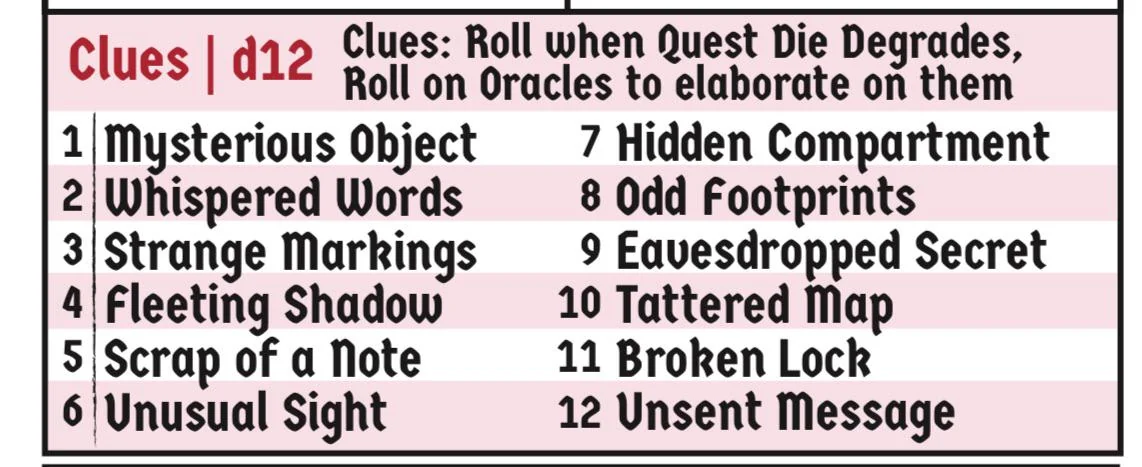
A D12 chart can start a mystery session. It is a poor substitute for character work. “Tattered map,” “broken lock,” and “fleeting shadow” are clues—objects and traces in the world. A character secret is a choice: someone knows something, believes the truth would harm them, and spends energy keeping it buried. Craft guides on using secrets in fiction treat that concealment as identity and motivation, not as loot. A roll does not decide who would be ruined if the truth got out.
Catalogs do not choose the cost
A character secret thesaurus is useful reference. It will not tell you whether this protagonist is hiding a crime, a child, a debt, or a change of faith. The hard part is picking the concealment that belongs to one life, in one genre, at one point in the arc—and then making the cover story leak.
Secrets without a reveal are just backstory
If nobody ever learns the truth, the secret is a private note. When a character has a secret, there must be a reveal scene: who learns it, what event forces it, and what changes. Generators that stop at “she has a dark past” skip the only part the plot can use.
Fake secrets leave the plot untouched
A protagonist who is “secretly a genius” or “secretly the nicest person in the room” is wearing a costume. Real concealment takes a toll on relationships, health, reputation, and self-view. If the character never lies, never avoids a room, and never makes a worse choice to protect the truth, it is not doing story work.
This is exactly what Writing Assistant was built for.
Why Writing Assistant
Writing Assistant is not a dice roller with nicer typography. It is a writing partner that treats a secret as a design problem: What does this person know that others must not? What would the reveal cost? Who already suspects? What behavior keeps the lid on?
You bring the character, the genre, and the stakes. It returns a hidden truth with a cover story, a tell, a person who would be hurt, and a scene that cannot stay buried—rather than a single ominous adjective.
| Traditional Approach | Writing Assistant |
|---|---|
| Roll a clue and call it a secret | A hidden fact tied to identity, fear, and plot |
| “Mysterious past” with no content | The specific truth, the lie they tell, and who it protects |
| No plan for the reveal | Timing, witness, and fallout designed with the secret |
| Separate notes for novel, script, and RPG | One character bible that adapts to format |
| You rebuild who-knows-what every session | Persistent memory across drafts and sessions |
Secrets that generate plot, not wallpaper
Craft discussion keeps returning to the same test: a secret should be woven into identity and motivation, not taped onto a bio. Ask for a hidden truth and you should get the bad decision it produces. That is the difference between “has a secret child” as a label and a scene where the protagonist skips a funeral so nobody from the other life will see their face.
"Mara is a city magistrate in a low-magic sword-and-sorcery setting. She is publicly devout. Give her one secret that would end her office if it surfaced. Show the lie she tells, one relationship it damages, and the act-two choice it forces."
Who knows, who doesn’t, and when
Dramatic irony is a control problem. Readers can know more than the hero, less than the hero, or the same amount—and each choice changes the tension. Specify the information map: the protagonist knows, the ally suspects, the antagonist has proof, the reader is one scene behind. The output should track that map instead of dumping the whole truth in paragraph one.
"The reader should learn the secret at the midpoint. The love interest should suspect earlier. Do not let the antagonist know until the climax. Give me three accidental tells that only the love interest would notice."
A cast, not a single locked diary
Supporting characters need secrets that collide. A mentor protecting a crime, a sibling covering a debt, an official hiding a patronage—those are engines. Because the writing partner keeps context, you can generate a secret for character B that specifically threatens character A’s cover, then keep both consistent fifty pages later.
Format-aware, not template-locked
A novel wants interior contradiction and delayed confession. A screenplay wants behavior the camera can see: a letter burned, a name not spoken, a door not opened. A TTRPG wants a secret a player can roleplay in one sentence without wrecking the table. You can ask for any of those without rebuilding the character from scratch.
Related Agents You'll Also Find Useful
If you are generating secrets as part of a larger production, these partners sit next to the same desk.
Film Screenwriter
If the secret has to play on camera, Film Screenwriter turns concealment into visible action: the question they dodge, the object they cannot throw away, the silence that reads as guilt. Useful when a secret looks sharp in prose and disappears in a scene.
- Structure, dialogue, and character development through draft and revision
- Visual storytelling so the cover story is something an audience can watch
- Outline-to-page workflow for features and shorts
Game Designer Assistant
Tabletop and video-game characters need secrets that are playable, not literary. This partner helps you convert a hidden loyalty, a false identity, or a buried crime into a bond, a clock, or a GM-facing hook—without recycling “the innkeeper works for the cult” for the hundredth time.
- Systems analysis and documentation across genres and platforms
- NPC and player-character design that survives contact with a party
- World and faction logic so a secret has somewhere to land
Personality Analyzer
When a secret feels arbitrary, run it through a real personality lens. Shame, attachment, status, and the Big Five dimensions that make fictional people feel round rather than flat are how you check that “hidden past” is not just a costume.
- Integrative profiles instead of a single-type slogan
- Pattern language for wounds, defenses, and what a person will lie to protect
- A useful brake on clichés when a secret is doing too much or too little
Try Writing Assistant free—no credit card required. Pair it with the agents above when the same hidden life has to survive a novel, a session zero, and a second draft.
How It Works
Step 1: Describe the life, not the mystery adjective
Open Writing Assistant and give role, pressure, relationships, and what this person cannot afford to lose. Skip “make them mysterious.” Specifics produce specific secrets.
"Protagonist: 34, assistant to a provincial governor, sends money to a sister the court thinks is dead. Publicly loyal. Court intrigue, no magic. I need a secret that would get her exiled if it surfaced."
Step 2: Name the story job the secret must do
Tell it whether you need a private shame, a ticking political bomb, or a twist that recontextualizes act one. Add genre promises so the concealment belongs in this book, not a generic thriller.
"I need one major secret that will sabotage an alliance subplot and one minor secret that only shows up as a verbal tell. Do not use amnesia or 'secret royalty.'"
Step 3: Demand cost, cover, and tell
Ask for the truth, the lie they tell instead, a damaged relationship, and a concrete behavior that leaks. If the reply could be swapped onto another character, push back.
"Rewrite so the secret is a distorted version of her loyalty. Show the scene where she burns a letter that would have saved an ally, because the letter names her sister."
Step 4: Design the reveal, not just the hiding
Specify who learns it, what event forces it, and what cannot go back. Readers sense a secret is in play and try to ferret it out—your job is to make the discovery earned.
"The sister is alive in the capital. Reveal to the reader at the midpoint through an object, not a monologue. The governor learns at the climax. Give me the object and the line she cannot take back."
Step 5: Lock the information map and reuse it
Save the agreed language—truth, cover, tell, who knows, growth condition—and reuse it in later chapters, session notes, or a screenplay pass. Persistent memory means you are not re-explaining the lie every time you sit down.
Results & Use Cases
📊 Novel protagonist whose kindness is a cover
- Scenario: A reserved aide is endlessly helpful. Early drafts make her sympathetic; beta readers say she has no interior life.
- Traditional Approach: Skim a secret list, pick “hiding a sibling,” and hope the middle of the book develops a pulse.
- Writing Assistant: The help is redesigned as concealment: she volunteers for extra work so nobody looks at her ledgers, then resents the people she saves.
- The lie (“If I am useful, I am invisible”) becomes an act-two betrayal of an ally
- A minor tell—never sitting with her back to a door—stays human without stealing the plot
- Revision notes target scenes, not vibes
💼 Tabletop NPC who is more than a D12 clue
- Scenario: A GM needs a city magistrate for a political campaign. Random tables keep returning tattered maps, broken locks, and “eavesdropped secret.”
- Traditional Approach: Roll, copy a one-liner, and improvise when players poke the character.
- Game Designer Assistant with a writing pass: The magistrate’s piety is a cover for a banned faith she adopted after a public humiliation, with three roleplay beats and a faction consequence.
- Players can exploit the secret without the NPC collapsing into cartoon evil
- The defect connects to a vote, a temple, or a patron—so it is playable
- Session notes stay consistent when the party returns three weeks later
Mystery-focused tables already reward investigation, missable clues, and timed events. A designed secret gives those clues a person to belong to.
🎬 Screenplay lead whose secret has to photograph
- Scenario: A feature outline has a brilliant architect whose “secret” is working too hard. The pages feel airless.
- Traditional Approach: Add a hidden drinking habit in act two and call it depth.
- Film Screenwriter: The hidden truth is that she is not licensed under her own name. The camera gets the tell: she flinches when anyone asks for ID at a site.
- Dialogue carries the concealment without a monologue about trauma
- The reveal costs a building, a partner, or a client—not a speech
- Later drafts can scale the same wound for a limited series
📱 Mobile rewrite between rehearsal and the subway
- Scenario: A writer is on a phone between scenes, staring at a supporting character who only exists to agree with the hero.
- Traditional Approach: Bookmark another listicle and forget it by the next stop.
- The same writing partner on iOS or Android: A 40-second voice note becomes a withheld affair with one stolen action and one line that cannot be taken back.
- Full feature parity with desktop, including speech-to-text
- The same character bible is waiting when you open a laptop
- Useful for punching up a scene, not just brainstorming at a desk
FAQ
What is a character secret generator?
A character secret generator is any tool that proposes hidden truths for fictional people. Random tables and simple web forms produce clues and labels. An AI character secret generator, used with a partner like Writing Assistant, should also return origin, cover story, cost, tell, and a reveal—so the concealment can drive a scene instead of sitting in a bio.
Is an AI character secret generator free?
Jenova’s Writing Assistant is available on a free plan with core features and limited monthly usage. Paid tiers increase usage if you are generating full casts, revising novels, or running a campaign bible. You can start without a credit card and upgrade only if you outgrow the free limit.
How is this different from a random D12 or a mystery prompt list?
Dice and short forms ignore context. They cannot tell a clue from a secret, and they will happily hand a contemporary realist novel a “tattered map” pulled from a fantasy table. This workflow starts from your character’s history and the job the secret must do in the plot, then iterates until the hidden truth would not fit anyone else.
Can I use it for RPG characters and NPCs?
Yes. Describe system, tone, and table needs—bonds, ideals, a one-sentence roleplay hook—and ask for playable concealment rather than novelistic interiority. Playing a secret identity at the table only works if the other players have something to notice. For mechanics, factions, and encounter logic, bring in Game Designer Assistant and keep the psychological through-line in your writing partner.
Does it work on mobile?
Yes. Web, iOS, and Android share the same conversations, memory, and documents. You can dictate a character, generate a secret on a phone, and continue the same thread on a laptop without rebuilding context.
Will the secrets feel earned or just edgy?
They feel earned when you demand structure: truth, cover, relationship cost, tell, and a reveal that changes a choice. Pairing the draft with Personality Analyzer is useful when you want attachment patterns or trait language that is not a TV-diagnosis. Edgy is easy. Coherent is the standard.
Conclusion
Perfect characters are unreadable. Random clues are not the fix. A serious character secret generator has to produce hidden truths that belong to one life, collide with other people, and force a reveal the plot cannot dodge.
That is the job Writing Assistant is built to do: take the person you already care about and give them something they cannot say—until the story makes them say it. Use it to replace D12 clichés, empty “dark pasts,” and two-field web forms with secrets a reader—or a party—will remember.
Try Writing Assistant now. Explore more at Jenova.
For Developers: Writing Assistant is available programmatically via the Jenova API — integrate context-aware character secret generation into your writing or game application with a single API call. Full documentation →