AI Character Relationship Generator: Map Bonds That Drive Plot
2026-09-06
Writing Assistant helps you generate character relationships that actually drive plot — bonds, rivalries, debts, and secrets mapped with enough texture to survive a novel, a campaign, or a series bible. In September 2026, many casts still look complete on a character sheet and then collapse on the page, because no one can say who owes whom, who is lying, or why two people cannot share a room. This AI character relationship generator turns a list of names into a living social web.
✅ Maps friendship, rivalry, romance, and mentorship with current status and history ✅ Scores trust, intimacy, respect, and tension so dynamics stay consistent across drafts ✅ Turns the map into scene-ready conflict instead of a static chart
To understand why this matters, it helps to look at what breaks when the social web is vague — and what a dedicated generator changes.
Quick Answer: What Is a Character Relationship Generator?
A character relationship generator is an AI writing tool that maps bonds, rivalries, and history between fictional characters so their dynamics stay consistent and plot-ready. It does not just label two names as “friends” or “enemies.” It specifies type, status, leverage, and the events that made the bond real.
Key capabilities:
- Pairwise maps for friendship, rivalry, romance, mentorship, and custom types
- Status labels such as affectionate, warming, strained, or broken
- Quantified stats for trust, intimacy, respect, dependency, and rivalry
- Ensemble “relationship webs” that include factions, debts, and secrets
- Scene prompts that force those bonds to collide on the page
Why Character Relationships Stall Stories
Readers do not attach to résumés. They attach to how people treat each other under pressure. Research on audience loyalty shows that circumstances outside a character’s control — misfortune, windfalls, health scares — systematically change how we feel about them, independent of moral choice.
397 participants — University of Florida-linked study on how behavior-independent events shape likeability
That is why a relationship history is not decoration. Shared scarcity, an unpaid debt, or a hometown someone destroyed will do more narrative work than another personality adjective. Writers have long used character relationship maps for this reason: one page that shows every major bond at once. Craft guides likewise treat the social network as part of knowing each character’s purpose.
But building that network by hand is frustratingly slow:
- Pairwise notes explode as the cast grows (10 characters means 45 unique pairs)
- Status drifts between drafts — last chapter they were rivals, this chapter they banter like siblings
- Spreadsheets capture labels, not the scene that would test the bond
- Game masters must track player characters, NPCs, factions, and villains in the same web
Too Many Names, Not Enough Leverage
A cast list is not a story engine. Without specified leverage — who holds the artifact, who is blackmailing whom, who still believes a childhood lie — scenes default to exposition. Relationship-mapping practice in tabletop games exists because GMs learned the hard way that unmarked NPCs become furniture.
Charts That Die After Session Zero
Hand-drawn maps and visual templates help at the start. They rarely survive revision. A subplot changes, a romance cools, a mentor dies, and the chart is already fiction about the fiction.
Tropes Without Texture
“Rivals to lovers” and “found family” are starting points, not relationships. If you cannot score trust versus rivalry, or name the milestone that broke a friendship, the dialogue will sound interchangeable.
This is exactly what Writing Assistant was built for.
Why Writing Assistant
Writing Assistant is a dedicated writing partner you can run as a character relationship generator — not a random trope spinner. You bring the cast, the genre, and the constraints. It returns typed bonds, current status, scored dynamics, and the milestones that make those numbers mean something on the page.
It treats the relationship as a standalone object you can revise: change one secret, and the surrounding web updates in language you can paste into a bible, a beat sheet, or session notes.
| Traditional Approach | Writing Assistant |
|---|---|
| Sticky notes and forgotten grudges | Typed bonds with status, history, and next pressure point |
| Hours drawing a web that goes stale after one twist | Regenerated maps when a betrayal, death, or alliance lands |
| “They’re close” with no score to write against | Trust, intimacy, respect, dependency, and rivalry on a 1–10 scale |
| Random generators that ignore your plot | Dynamics grounded in your factions, debts, and genre rules |
| Separate tools for novels, scripts, and campaigns | Same partner across prose, screenplay, comics, and TTRPG notes |
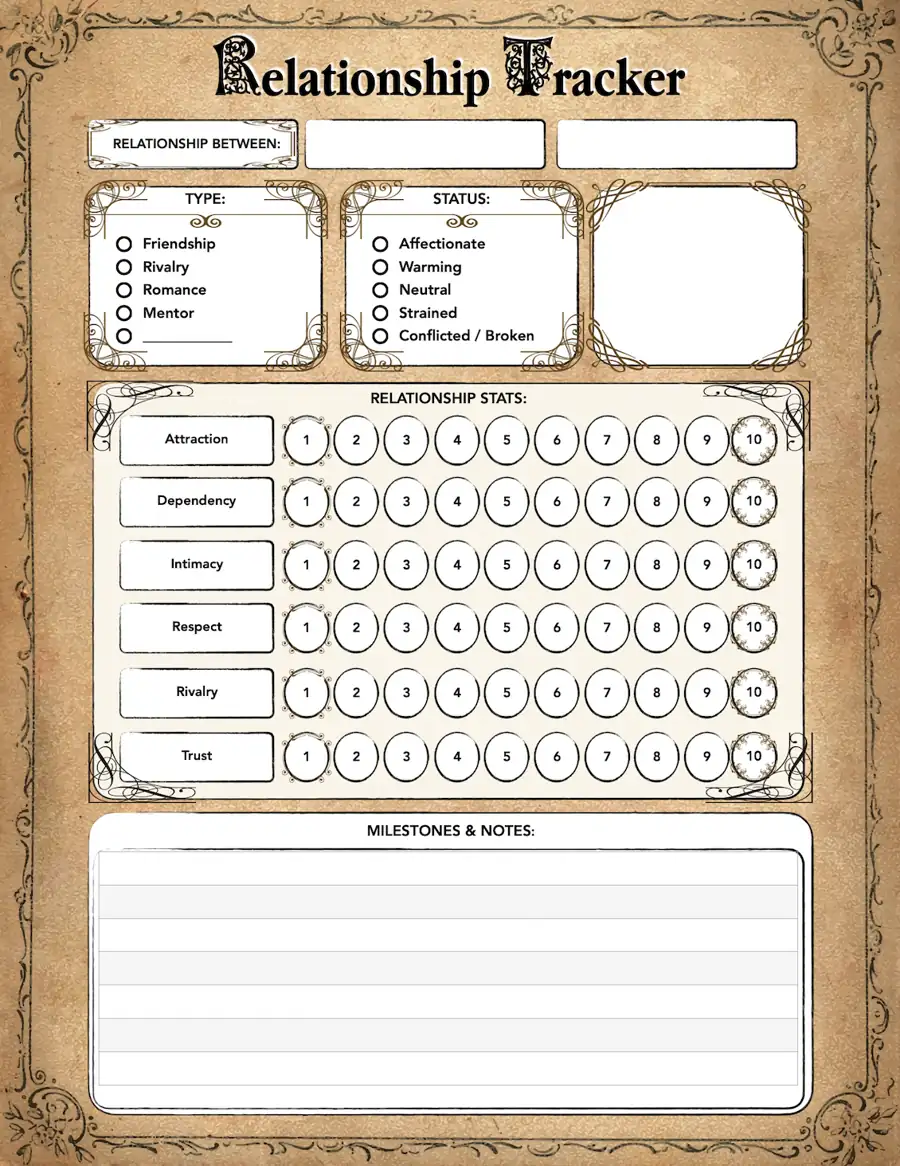
A pairwise tracker like this is the right unit of work: two names, a type, a status, and stats you can actually write against.
Type and Status, Not a Single Label
Friendship, rivalry, romance, and mentorship can coexist. A mentor can be strained. Childhood friends can be conflicted. The generator keeps type (what the bond is) separate from status (how it feels today), which is what stops “they’re close” from meaning everything and nothing.
Stats You Can Direct a Scene With
Attraction, dependency, intimacy, respect, rivalry, and trust are not flavor. They are conflict knobs. High rivalry and high respect produce a different argument than high dependency and low trust. Ask for a 1–10 grid, then ask what a +2 or −3 would look like after the midpoint.
Pressure the Map Until It Yields Plot
A finished web should answer: who would lie to protect whom, who benefits if a secret lands, and which pair cannot be in the same room without changing the story. That is the difference between a pretty diagram and a generator you keep using in draft two.
"Map the bond between a disgraced knight and the thief who hid him for three nights. Score trust, debt, and rivalry. Give me the secret neither will say, and the scene that would break the truce."
"Five-person heist crew. Who owes whom money, who is sleeping together, who is the childhood friend, and who will sell the others. Return a relationship web plus one pressure scene per pair."
Related Agents You'll Also Find Useful
If you are generating character relationships, you are usually one step away from putting those bonds on a page, a table, or a panel. These agents sit in that same workflow.
Film Screenwriter — When the map has to survive dialogue, visual set-pieces, and a three-act structure, take the web into screenplay craft. Useful when you need:
- Relationship turns that read in behavior, not in speeches
- Romantic or rival pairs whose scenes have a job in the outline
- Character development tied to image, blocking, and subtext
Roleplay Game Master — Campaigns die when NPCs reset every session. An immersive GM with persistent character memory is the live version of the web you just generated. Useful when you need:
- NPCs who remember debts, insults, and favors
- Factions that keep their own agendas while the party is elsewhere
- Relationship consequences that land without you re-explaining last month’s lore
Manga Creator — Ensemble manga lives on who stands where, who looks away, and which pair the reader ships. Useful when you need:
- Visual beats that express a bond without a caption
- Recurring pair chemistry across chapters
- Rivalry and found-family blocking that stays on-model
Try Writing Assistant free — no credit card required. Bring a cast list; leave with a web you can write.
How to Generate Character Relationships Step by Step
Step 1: Drop in the Cast and the Constraint Name the people, their public roles, and the one rule of the world that shapes intimacy (a war, a studio system, a heist timeline, a court). Specificity prevents generic “friends since childhood” filler.
"Fantasy port city. Cast: dock-boss Mara, priest Calder, smuggler Rin, city watch captain Sera. Constraint: the harbor tax is killing independent crews. Generate the starting relationship web."
Step 2: Force Type, Status, and Asymmetry Ask for non-reciprocal bonds. Calder may revere Mara; Mara may find him useful. Rin may be Sera’s informant; Sera may not know Rin is also selling to the antagonist. Asymmetry is where plot hides.
"For each pair: type (friendship, rivalry, romance, mentor, or custom), status (affectionate / warming / neutral / strained / conflicted), and who has leverage."
Step 3: Score the Bond and Attach a Milestone Have the generator fill a 1–10 grid, then demand the event that justifies the numbers. “Trust 8” with no milestone is a wish. “Trust 8 because Rin burned a ledger to keep Sera’s brother off a warrant” is a story.
Step 4: Expand From Pairs to a Web Once pairwise notes exist, request the ensemble view: PCs, NPCs, factions, antagonists, arrows, and labels such as owes money, ordered to spy, childhood friends, destroyed hometown. This is the document GMs pin above the table and novelists keep beside the outline.
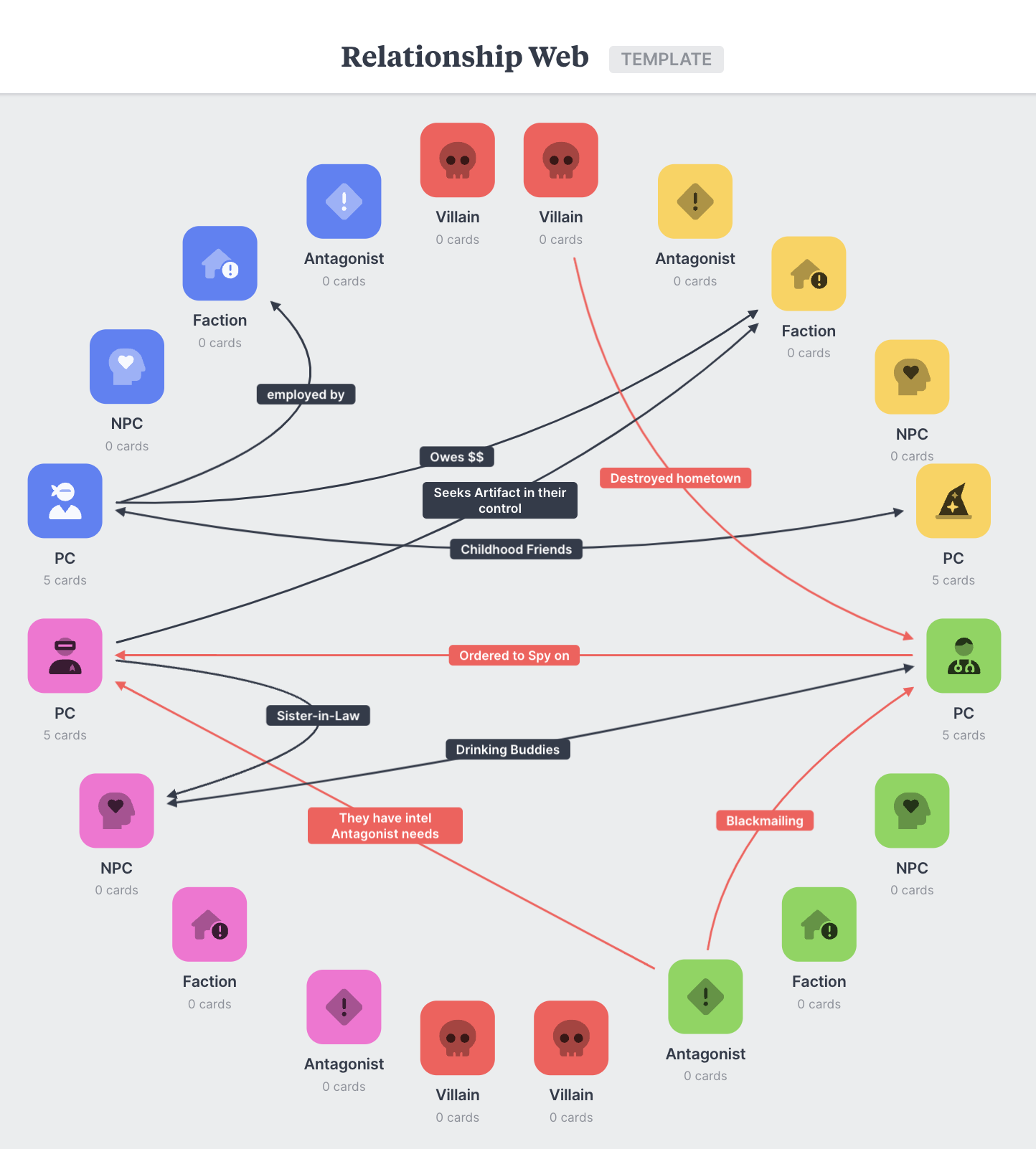
A web like this is what you want after step 4: not a mood board, a directed graph of obligations.
Step 5: Stress-Test With One Scene Per Fragile Bond Ask for the conversation or confrontation that would move a stat by two points. Keep the ones that hurt. Discard the ones that only restate the map. Then lock the generator’s memory of the new status so later chapters do not quietly heal a rift you earned.
"Write the tavern scene where Sera almost catches Rin. Do not resolve the bond. End on a choice that could drop trust or raise rivalry."
TTRPG worldbuilding advice makes the same demand: couple character evolution to plot progression, or the journey never pays off. Your generator should do that coupling on command.
Results & Use Cases
📊 Ensemble Novel With a Rotating Point of View
- Scenario: A literary or SFF novel with six viewpoint characters in one city. Draft 1 reads like six linked short stories.
- Traditional Approach: A weekend with index cards, then a wiki that nobody updates after chapter twelve.
- Writing Assistant: A full pairwise matrix plus three “load-bearing” secrets. Each chapter goal is restated as which relationship is under test.
- Benefits:
- POV switches still feel like one social world
- Subplots stop cloning the same argument
- Revision starts from the web, not from vibes
💼 Screenplay Triangle That Has to Play in Behavior
- Scenario: A feature with a love triangle that currently exists only in the logline.
- Traditional Approach: Talky coffee scenes and a third-act speech.
- Film Screenwriter: Take the generated scores into scene work — who interrupts whom, who pays, who leaves first — so the triangle is visible without a monologue.
- Benefits:
- Status changes land on the page as action
- Each pair has a distinct rhythm
- The outline can assign a relationship job to every sequence
🎯 Campaign Web for a Tabletop Group
- Scenario: A GM with four players, two rival factions, and a villain the party has not met.
- Traditional Approach: Recycled innkeepers; last session’s ally forgotten.
- Roleplay Game Master: Generate the web first, then run play against it. NPCs keep debts, spy orders, and in-laws consistent because the relationship object already exists.
- Benefits:
- Hooks (owes money, seeks the artifact, blackmail) are visible before session start
- Player choices rewrite status instead of resetting it
- Villains connect to the party through people, not only through a MacGuffin
📱 Mobile: Comic or Manga Pair Chemistry Between Commutes
- Scenario: A creator outlining a series on a phone, ten minutes at a time.
- Traditional Approach: Notes app soup; the rival’s motivation changes every Sunday.
- On iOS or Android: Dictate the cast, generate the tracker, screenshot the web, then send a pair into Manga Creator for a silent two-page scene that proves the scores.
- Benefits:
- Full writing workflow on the device already in your bag
- Relationship bibles that travel with you
- Visual proof that the bond reads without a caption
FAQ
What is a character relationship generator?
A character relationship generator is a writing tool that builds the social web of a story: who is bound to whom, how the bond feels today, what history justifies it, and what scene would change it. Used well, it produces more than labels. It produces obligations, secrets, and conflicts you can drop into a chapter or a session.
Is Writing Assistant free to use as a relationship generator?
Yes. You can start on the free tier with no credit card. Paid plans raise usage if you are generating full campaign bibles, series-wide matrices, or many revision passes. For most writers, the first useful output is a pairwise tracker plus one ensemble web.
Can a character relationship generator handle romance, rivalry, and found family in the same cast?
Yes — and it should. Real ensembles mix types. Ask for overlapping bonds (mentor and rival; romance and debt) and for non-matching status on each side of the pair. If you are taking those dynamics into script format, Film Screenwriter is the natural next step so the map becomes playable scenes.
How is this different from a random relationship chart?
Random charts ignore your plot. A dedicated generator accepts your setting rules, your villain’s goal, and your existing timeline, then returns bonds that could only exist in that story. You can demand scores, milestones, and a stress-test scene. You can also refuse generic “they trained together” filler until the map names a specific cost.
Does it work on mobile for game night or outlining?
Yes. Web, iOS, and Android share the same workflow, including voice-to-text if you want to capture table talk. Many GMs generate the web on a phone, then continue the same cast in Roleplay Game Master so NPCs do not forget who blackmailed whom.
Will the relationships stay consistent across a series or a long campaign?
They stay consistent if you treat the map as canon and update it when the story earns a change. Save the tracker, note the milestone that moved a score, and start the next session or chapter from the new status. That is the same discipline narrative researchers describe when they treat character mapping as a time-aware method, not a one-time poster.
Conclusion
Thin casts fail for a simple reason: names without obligations do not generate scenes. A character relationship generator repairs that by making type, status, leverage, and history visible — then by forcing those facts to collide.
Writing Assistant gives you that object on demand: pairwise trackers, scored dynamics, ensemble webs, and the pressure scenes that prove the map. Use it to draft the social engine of a novel, a screenplay, a comic, or a campaign, then keep revising the web as the story earns new scars.
Try it with the cast you already have. Explore more at Jenova.
For Developers: Writing Assistant is available programmatically via the Jenova API — integrate character relationship generation into your application with a single API call. Full documentation →