AI Character Prompt Generator: Consistent Personas in Minutes
2026-09-07
Prompt Generator helps you turn a rough persona into a reusable, model-ready character prompt by locking appearance, voice, backstory, and style into language that text, image, and video models can actually follow. While most writers and artists still bounce between random trait wheels, sticky-note bios, and a dozen regenerations just to keep a face from drifting, this AI writes the prompt layer that holds a character together. As of September 2026, that gap between “I can picture them” and “I can reuse them” is where most creative AI work stalls.
✅ Builds complete character prompts for text, image, music, and video models ✅ Locks identity details so hair, face, wardrobe, and voice stop drifting ✅ Adapts one persona for novels, concept art, comics, film, and RPGs ✅ Refines weak prompts with you instead of dumping a one-shot blob
To understand why this matters, let's examine what happens when character prompts stay vague — and why a dedicated character prompt generator beats another round of trial and error.
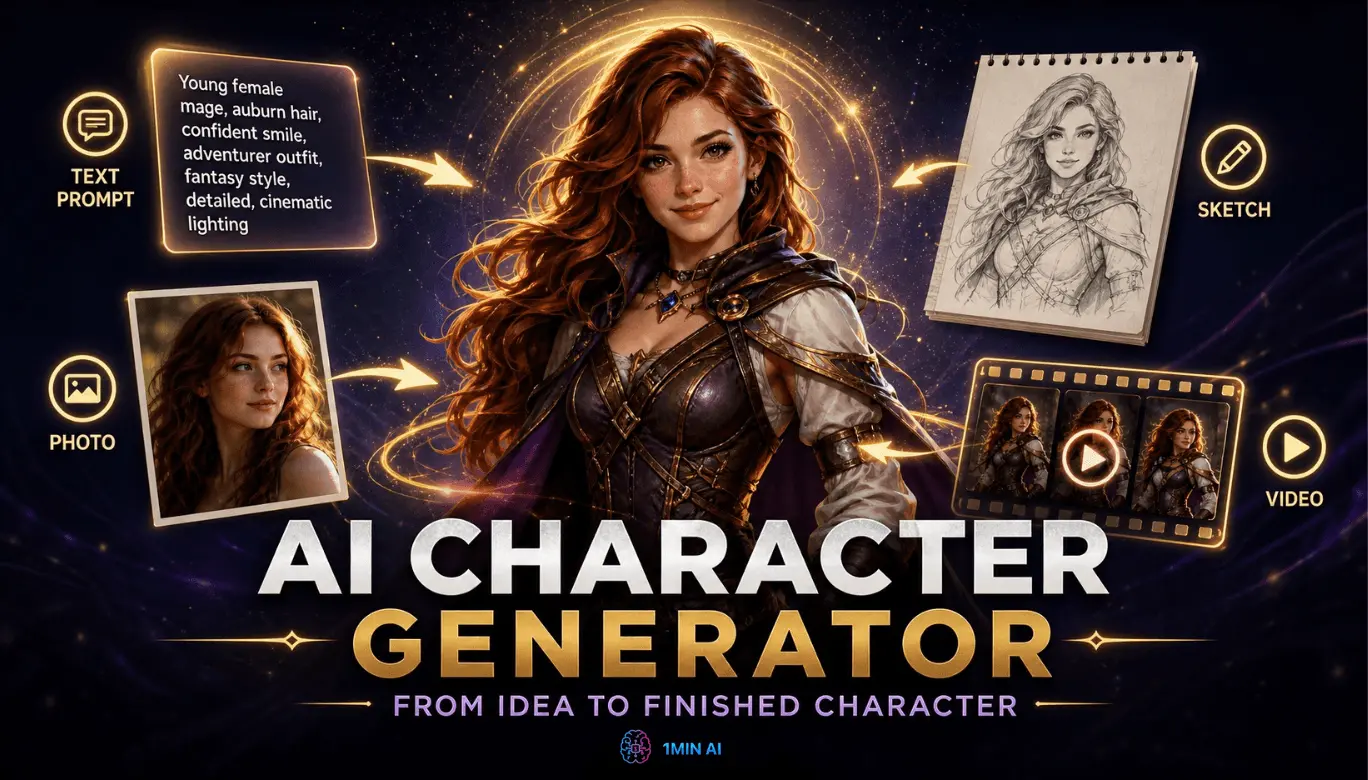
Quick Answer: What Is a Character Prompt Generator?
Prompt Generator is an AI character prompt generator that turns a rough persona into a structured, reusable prompt for fiction, art, and games. You describe who they are; it returns language models can follow.
Key capabilities:
- Master character sheets covering face, body, wardrobe, voice, motive, and constraints
- Image- and video-ready prompts with identity locked separately from scene and lighting
- Negative-prompt language that blocks beard drift, eye-color swaps, and wardrobe changes
- Collaborative refinement so the same persona works in prose, comics, and concept art
Why Most Character Prompts Fall Apart
Generative AI is now a working part of writing rooms, concept-art pipelines, and game preproduction. Research on creative-industry automation estimates that generative systems could automate up to 26% of tasks in arts, design, entertainment, media, and sports. Visual generation is the center of gravity: visual art and image generation account for 61.8% of the AI-in-art market. The World Economic Forum describes conversational interfaces that turn a short brief into scripts, storyboards, and variations — the same loop character work now lives in.
But getting a repeatable person out of that loop is still frustratingly difficult:
- Random name-and-trait wheels produce novelty, not a usable identity
- Generic chat prompts mix face, pose, lighting, and plot into one unstable paragraph
- Image models forget scars, hair texture, and signature clothes from scene to scene
- Writers, illustrators, and GMs each rewrite the same character in a different dialect
10–20 attempts — typical tries needed just to pin down a character’s look in AI generation
That is not a talent gap. It is a prompt-structure gap. Consistency guides are blunt about the cause: models do not remember past generations, so identity has to be re-specified — same keywords, same order, every time. Most people spend two to three hours on the first pass before later scenes get faster. A character prompt generator exists to collapse that first pass.
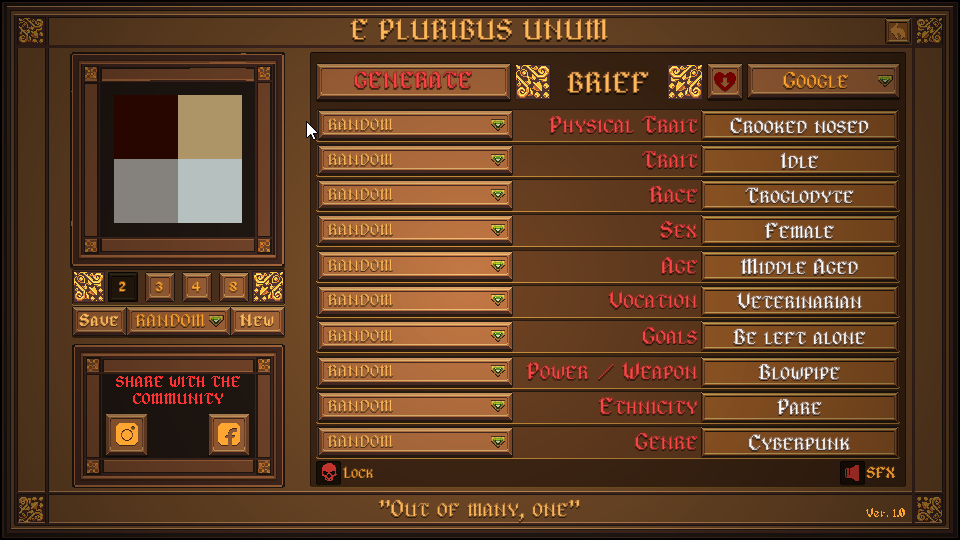
Randomizers are useful for a spark — a crooked nose, a veterinarian who wants to be left alone, a blowpipe in a cyberpunk clinic. They are a poor master document. Without a locked identity block, the next image grows a different jawline, the next chapter a different age, the next panel a different coat.
There is a legal reason to keep the human layer of that document strong. The U.S. Copyright Office has spent years mapping authorship and training issues around generative works, and current U.S. practice treats fully machine-generated output as ineligible for copyright. Lay studies find people still credit creativity and effort in AI-assisted images. A prompt you actually designed — choices about motive, contradiction, and visual lock — is the part of the work that remains yours.
This is exactly what Prompt Generator was built for.
Why Prompt Generator
Prompt Generator is a prompt-engineering partner for character work, not a slot machine of random NPCs. You bring a fragment — a job, a face, a genre, a single reference photo — and it returns a master description you can paste into a novel, an image model, or a session zero.
| Traditional Approach | Prompt Generator |
|---|---|
| Name wheels and trait dice | Full identity, voice, motive, and visual lock |
| One tangled paragraph per scene | Identity block separated from action, setting, and style |
| 10–20 regenerations to stabilize a face | Reusable keywords and negative prompts from the first draft |
| Different wording for Midjourney, ChatGPT, and your GM notes | Prompts tuned for text, image, music, and video models |
| Hours of first-pass trial and error | A character sheet you can refine in conversation |
A master identity, not a lucky generation
The tool writes the paragraph consistency guides keep asking for: age, hair, eyes, skin, build, distinguishing marks, signature clothes, and how the person stands. It keeps those terms stable so you are not swapping “auburn” for “redhead” between scenes — a change that is enough to break visual continuity.
Identity separated from scene
Strong character prompts do not dump everything into one clause. Identity (face, hair, proportions, signature items) stays in a fixed block. Scene (location, action, lighting) changes. Style and quality modifiers sit at the end. That order is what image and video models parse reliably, and it is what this AI returns by default.
Negative prompts that prevent drift
When a jawline, beard, or eye color keeps mutating, the fix is not more adjectives on the face. It is an explicit “do not” list. The generator adds those constraints so the model is told what must not change.
Collaborative refinement across media
The same persona rarely ships in one format. You may need a Midjourney prompt, a one-page prose bio, and a short voice sample for a trailer. Because the agent is built for text, image, music, and video prompts, you can ask for each format without starting over.
Try prompts like these:
"Build a master character prompt for a 34-year-old cartographer with a burned left hand, laconic speech, and a rust-red coat. Lock hair, eyes, scars, and wardrobe so I can reuse this in an image model and in a novel."
"Turn this NPC spark into an image prompt and a separate prose bio: idle middle-aged veterinarian, crooked nose, wants to be left alone, cyberpunk clinic, blowpipe on the counter."
"Rewrite this character prompt so the face stays identical across three scenes: tavern, rooftop chase, and rain-soaked interrogation. Add negative-prompt terms for beard, glasses, and hair-color drift."
Related Agents You'll Also Find Useful
A character prompt is the brief. The rest of the pipeline still has to write, draw, and stage the person.
If you are drafting the story around that persona, Creative Fiction Writer takes the locked bio into scenes, dialogue, and revision — the character sheet becomes behavior on the page instead of a list of traits.
If you need a visual turnaround, sheets, or marketing stills from the same brief, Graphic Designer can push the prompt into layouts, character posters, and illustration direction without you restating the wardrobe from scratch.
If the destination is sequential art, Manga Creator keeps panel flow, costume continuity, and expression sheets aligned with the identity block you already generated.
If the character has to survive a screenplay, Film Screenwriter uses that same prompt as the spine for want, contradiction, and visual storytelling across an outline and draft.
Try Prompt Generator free — no credit card required.
How It Works
Step 1: Dump the fragment you already have Open the character prompt generator and paste whatever exists — a paragraph, a randomizer roll, a photo note, or “young mage, auburn hair, adventurer’s coat.” You do not need a complete sheet. Incomplete is the normal starting point.
"Young female mage, auburn hair, confident smile, adventurer outfit, fantasy, cinematic lighting. Expand this into a reusable master prompt."
Step 2: Lock identity before you lock the scene Ask for a master description that covers face, hair, body, marks, wardrobe, voice, and motive, then a separate scene line. Keep the identity paragraph identical in every later prompt. Save it as your source of truth.
"Split this into (1) a frozen identity block and (2) three scene variants: library research, rooftop flight, and a quiet kitchen. Do not change hair, eyes, or coat."
Step 3: Add negatives and format for the model you will actually use Specify the target: prose, Midjourney-style image prompt, video shot list, or tabletop NPC handout. Request negative terms for the features that usually drift. If you are moving between tools, ask for a version of the same identity in each tool’s dialect rather than rewriting it yourself.
"Give me an image-model version with negative prompts, plus a 120-word prose bio in close third person. Same person. No new scars, no glasses."
Step 4: Stress-test across three scenes, then freeze the sheet Generate — or write — the character in three different situations before you commit. If the jaw, hair, or coat slips, send the failed output back and ask for tighter measurements and texture words (“dark auburn, shoulder-length, loose waves,” not “red hair”). Freeze the winning block and reuse it verbatim.
Step 5: Hand the sheet to the next stage of the work Drop the same identity into fiction, a comic page, or a pitch deck. On a phone between sessions, you can voice-note a new scene (“she argues with the harbormaster at dawn”) and keep the identity block untouched so the person does not mutate overnight.
Results & Use Cases
📊 Indie novelist building a series bible
Scenario: A fantasy writer has five recurring characters and a messy notes app. Chapter 4’s mercenary no longer matches chapter 1’s eye color.
Traditional Approach: Re-read old chapters, rebuild prompts by hand, and burn an evening every time a new set-piece needs art or a blurb.
Prompt Generator: One master prompt per character, stored and reused. Scene lines change; faces do not.
- Series-bible language you can paste into every chapter brief
- Image prompts for cover tests that match the prose description
- A clean handoff into Creative Fiction Writer for scene drafts
💼 Game master stocking a city in one sitting
Scenario: Session starts in six hours. The clinic, the docks, and the city watch all need people who feel specific, not renamed stat blocks.
Traditional Approach: Random tables for race, job, and quirk, then improvising voice at the table while notes contradict each other.
Prompt Generator: Sparks from a randomizer become full NPCs — goal, mannerism, tell, and a short image prompt for a VTT token.
- Playable voice and motive, not just a trait list
- Tokens and handouts that match the spoken description
- Recurring NPCs you can retrieve next session without rewriting
📱 Concept artist iterating on a phone between meetings
Scenario: An artist on mobile has a face they like and thirty minutes on a train. They need three costume variants that still read as the same person.
Traditional Approach: Retrype the whole prompt each time, watch the nose change, start over.
Prompt Generator: Identity stays frozen; only wardrobe and lighting swap. The same brief can move to Graphic Designer for a turnaround layout when they are back at a desk.
- Works on iOS and Android with the same conversation history
- Fast costume tests without facial drift
- A prompt packet ready for a client or art director
🎬 Writer-director packing a pitch
Scenario: A short-film pitch needs a protagonist who is recognizable in a mood board, a one-page, and a lookbook.
Traditional Approach: Separate bios for the deck, the script, and the image tool — three slightly different people.
Prompt Generator: One identity block, three formats. Film Screenwriter can then pressure-test want versus need without the face dissolving in the stills.
- Lookbook prompts that match the script’s age and wardrobe
- A prose bio that does not invent new backstory
- Less time reconciling “the person in the deck” with “the person in the draft”
The market around this work is not theoretical. Generative AI in creative industries was estimated at $4.06 billion in 2025, with forecasts pointing to further expansion. The bottleneck for most individuals is not access to a model. It is a character brief those models will honor twice.
FAQ
What is an AI character prompt generator?
An AI character prompt generator is a tool that turns a loose persona — a job, a face, a genre, a motive — into a structured prompt you can reuse in writing and image models. Prompt Generator focuses on that brief: identity, constraints, and format, rather than rolling random names and hoping the next picture matches.
How is a character prompt generator different from a random character generator?
A random generator gives you sparks: race, vocation, a crooked nose, a weapon. A character prompt generator turns those sparks into a master description with stable keywords, negative prompts, and versions for prose versus images. Use the randomizer for surprise; use the prompt tool for continuity.
Can this AI write prompts for Midjourney, novels, and tabletop NPCs?
Yes. Ask for the output format you need. The same identity can be returned as an image-model prompt, a 120-word bio, or a GM-facing NPC block. If you also need pages or stills, pair the sheet with Manga Creator or a design pass rather than inventing a second character.
Is Prompt Generator free?
Yes. There is a free tier with core features and limited usage. Paid plans increase usage if you are generating large casts or iterating heavily. You can start a character sheet without a credit card.
Does a character prompt generator work on mobile?
Yes. You can brief a character, lock the identity block, and request a new scene from a phone — useful between writing sessions or at a game table. Conversations persist, so the master prompt does not vanish when you switch devices.
Will AI-generated characters be copyrightable?
In the United States, works with no human authorship generally cannot be copyrighted; the Copyright Office’s AI reports are the primary reference. Your selection, arrangement, and written character design still matter. A prompt you crafted — and the prose or direction you add — is the human layer. That is also why many artists want clearer protection around generative tools. Treat the generator as a drafting partner, not as the author of record.
Conclusion
Random traits make a spark. They do not make a person you can reuse. A character prompt generator exists to freeze the part that must not change — face, voice, wardrobe, motive — and to phrase it so fiction, image, and video tools keep agreeing with each other.
Prompt Generator is that brief-writer: master identity, scene variants, negative prompts, and format-specific output without another two-hour pinning session. Build the sheet once. Walk the same character through a chapter, a panel, a token, and a pitch still.
Try it with the next NPC, cover face, or protagonist who keeps slipping. Then keep writing. Explore more at Jenova.
For Developers: Prompt Generator is available programmatically via the Jenova API — integrate character-prompt generation into your writing or game tool with a single API call. Full documentation →