AI Character Motivation Generator: Drives for Fiction & NPCs
2026-09-06
Creative Fiction Writer helps you generate psychologically grounded character motivations by turning a role, a wound, and a story pressure into wants, needs, fears, and contradictions that actually drive scenes. In September 2026, novelists, screenwriters, and game masters still lean on random tables that spit out a single noun — "revenge," "greed," "family" — then wonder why the character feels like a plot device. This AI provides a dedicated storytelling partner that builds inner drives, tests them against conflict, and keeps them consistent from first draft to finished manuscript.
✅ Want-versus-need engines that create real internal conflict ✅ NPC and supporting-cast motivations that survive a campaign or a sequel ✅ Wound, lie, and fear that explain why someone acts ✅ Usable for novels, screenplays, comics, and tabletop sessions
To understand why a dedicated character motivation generator matters, it helps to look at how inner life actually fails on the page — not from a lack of ideas, but from tools that hand you a label and call it a person.
Quick Answer: What Is a Character Motivation Generator?
A character motivation generator is a storytelling tool that produces a character's wants, needs, fears, and inner drives so their choices stay psychologically consistent across a story. It is built for usable psychology, not a one-word prompt.
Key capabilities:
- Public want versus private need, with the clash that creates scenes
- Wound, lie, fear, and habit that make behavior feel earned
- Supporting-cast and NPC motivations that do not collapse into "quest giver"
- Output you can drop into a novel, screenplay, comic, or tabletop brief
Why Character Motivation Is Still So Hard to Get Right
Readers and players do not follow plots. They follow people — and they do it with the same social machinery they use in real life. Cognitive neuroscience research on narrative shows that people approach stories in a strongly character-centered, psychological way, tracking mental states rather than event lists. A 2025 neuroimaging review describes narrative engagement as a live mix of memory, emotion, and social cognition. Game-design research now treats character-driven storytelling as central to emotionally resonant digital play, not as garnish on mechanics.
That is a high bar. Most generators still fail it.
1 in 3 developers — now use generative AI to streamline production, per GDC’s 2025 State of the Game Industry report
20% of new Steam games — disclosed AI use by mid-2025, double the prior year, according to BCG’s global gaming research
Half of all developers — are self-funding their games, which leaves little room for a dedicated narrative designer on every NPC (GDC)
But turning that boom into a stable inner life is still frustratingly difficult:
- Random d100 charts give a trait ("altruism," "reputation," "conquest") with no want, need, or cost
- Generic chatbots invent a tragic backstory that never constrains the next scene
- Protagonists move because the outline requires a midpoint, not because something in them changed
- NPCs have jobs and accents, then evaporate the moment the party leaves the tavern
Indie teams and solo writers feel this most. BCG’s survey found 40% of gamers consuming more user-generated content than a year earlier, which means more original casts, more one-shot NPCs, and more pressure to make strangers memorable in a single conversation. On the publishing side, hiring research in creative writing reports that over 65% of hiring managers in content-driven fields now want writers who can collaborate with AI — and still supply the human judgment AI cannot fake: emotional nuance, cultural sense, and a character who does not collapse into a trope.
A roll on a motivation chart is a starting noun. A character is a system of pressures. This is exactly what Creative Fiction Writer was built for.
Why Creative Fiction Writer
Creative Fiction Writer treats motivation as craft, not as a lottery. You brief a person the way you would brief a story editor: role, relationship, the thing they think they want, the thing they cannot admit, and the scene that will test both. The tool then returns a drive structure you can write from — not a slogan, and not a paragraph of unusable trauma.
| Traditional Approach | Creative Fiction Writer |
|---|---|
| Roll "37 Business and Enterprise" and improvise the rest | A want, a need, a lie, and a cost that generate scenes |
| One tragic backstory that never affects chapter twelve | Drives you can stress-test against a specific conflict |
| NPCs who exist to hand over a key | Supporting cast with private agendas that collide |
| Outline-first characters who obey the beat sheet | Psychology-first characters who force the beat sheet to earn them |
| Separate notes for novel, script, and campaign | One inner-life brief you can reuse across formats |
Want versus need, not a single noun
A usable motivation has two layers. The want is what the character would say out loud (the relic, the promotion, the duel). The need is the change they will resist until the story makes it expensive (honesty, belonging, the end of a revenge fantasy). This generator holds both at once, then shows where they contradict. That contradiction is the scene.
Wound, lie, and fear as engine parts
Backstory only matters when it produces behavior. Ask for the wound (what happened), the lie (what they concluded), the fear (what they will not risk), and one contradictory habit (the priest who steals candles, the cartographer who never signs her work). Transmedia craft teaching has long treated inner states as the center of serious storytelling. This tool makes those states operational.
NPCs who want something while you are not looking
A tavern keeper is not "friendly." She is protecting a ledger, a child, a secret berth, or a reputation with the harbormaster. Generate a room of five people and you should get five public faces and five private needs — plus one way a bag of gold would split them. That is campaign fuel, not flavor text.
Briefs other people can write from
Output is meant to travel: a short motivation card, a scene test, and "do not break" notes a co-writer, GM, or artist can honor. Ohio State research on the psychology of stories shows narratives shape moral judgment. If your antagonist’s motive is thin, the audience will not grant the ending any weight.
"A disgraced cartographer who wants her name restored on the royal maps but needs to accept that the coast she surveyed was never hers to claim. Give me want, need, lie, fear, and one contradictory habit."
"Generate motivations for five tavern NPCs in a port town. Each needs a public want, a private need, and one way those clash when a smuggler offers gold."
"My protagonist's want is revenge on the magistrate. Stress-test that against a scene where the magistrate is already dying. What does she still need?"
Related Agents You'll Also Find Useful
If inner life is only the first beat of a larger project, these partners sit naturally next to a character motivation generator.
Film Screenwriter
If the drive has to survive a sequence, a midpoint, and a visual last shot, Film Screenwriter turns psychology into structure, dialogue, and character development on the page.
- Arc beats that follow from want versus need, not from a template
- Dialogue that reveals motive without speechifying
- Scene work that makes the inner conflict visible
Roleplay Game Master
If you are putting that drive across a table, Roleplay Game Master keeps NPCs consistent in play — memory intact, motives stable, improvisation still in character.
- Recurring NPCs who remember what they wanted last session
- Faction agendas that do not reset when the party leaves town
- Play that stays inside the psychology you already designed
Comic Creator
Motivation should show up in a face, a pause, and a panel. Comic Creator builds sequential stories where inner drives control layout, not just captions.
- Silent beats that still communicate want and fear
- Supporting-cast blocking that reveals agenda
- Issue-to-issue consistency for a long-running cast
Try the character motivation generator free — no credit card required.
How to Generate Character Motivation in Minutes
Step 1: Brief the person under pressure
Open this storytelling partner and describe who they are and what is squeezing them. Role, relationship, and the one thing they cannot afford to lose give the generator something to hold. A job title alone will get you a stereotype.
"Late-thirties harbor clerk, supporting a sister in the surgeons' college. The customs seal in her desk is forged. She should look helpful, not sinister."
Step 2: Split want from need
Ask for the public goal and the private change as two different sentences. If they are the same sentence, you do not have an inner conflict yet. Request the cost of getting the want without the need — that cost is usually your second act.
"Want: get the forged seal replaced before the audit. Need: stop using other people's names as cover. Show me what she loses if she 'wins' the audit and never tells the truth."
Step 3: Add wound, lie, fear, and a habit
Call for the history only as far as it produces behavior. One wound, one lie they tell themselves, one fear that will make them refuse help, and one small habit that betrays the lie. This is the difference between a biography and a character you can write.
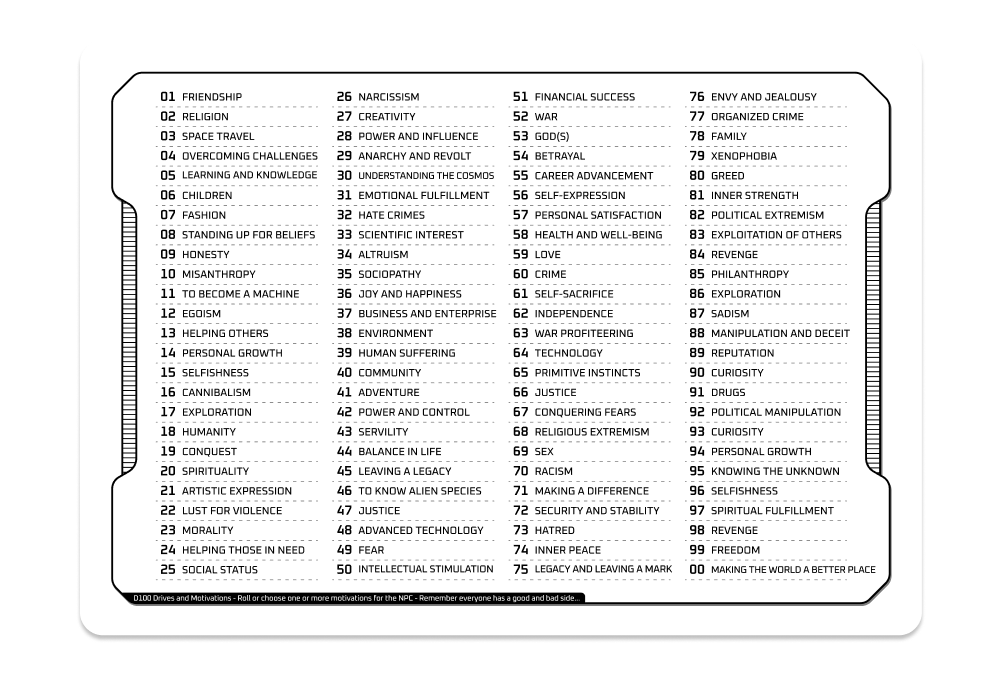
A chart like this is useful as a spark. It is not a psychology. "Independence," "legacy," and "revenge" can describe a hundred different people. The work is specifying whose independence, whose cost, and what they will do at 2 a.m. when the easy version of the want appears.
Step 4: Stress-test against a scene
Put the motive in a situation that should break it: the rival apologizes, the relic is fake, the magistrate is dying, the gold is real. Anything that still produces the same speech gets a correction pass ("she would not gloat; she would inventory the room"). Writers who treat psychology as craft use this kind of pressure on purpose. So should a generator.
Step 5: Cast the rest of the room
Generate two to five surrounding motivations that collide with the hero's. Allies should want something that is not identical. Antagonists should be right about one thing. That package — hero card, scene test, supporting wants — is what you hand to a co-author, a table, or your future self before a draft session.
Results & Use Cases
📚 Novelist unsticking a protagonist
- Scenario: An epic-fantasy author has 60,000 words and a heroine whose "revenge" has started repeating the same argument in every chapter.
- Traditional Approach: A new outline, a writing-group note that "she needs more agency," and another flashback that still does not change her choices.
- Creative Fiction Writer: A rebuilt want/need pair, a lie that can actually be disproved, and a scene test in which revenge is already obsolete — so chapter twelve has somewhere new to go.
- Inner conflict that produces different scenes, not louder versions of the same one
- Supporting cast whose agendas complicate the heroine instead of echoing her
- A motivation card you can paste above the manuscript and refuse to violate
🎬 Screenwriter locking an arc before pages pile up
- Scenario: A feature writer has a strong first ten pages and a blurry midpoint. The antagonist's motive is "power."
- Traditional Approach: Structure software that places beats on a calendar without asking whether anyone on screen would make those choices.
- Film Screenwriter plus this generator: Psychology first, then structure. The want becomes the A-story engine; the need becomes the invisible B-story; dialogue stops explaining the theme out loud.
- Midpoint that costs the character their lie, not just their MacGuffin
- Antagonist who shares a need and diverges on method
- Pages that can be rewritten without recasting the person
Examining employer expectations for narrative work shows the same split: AI can accelerate drafting, but the skill that still gets hired is judgment about authenticity — exactly the layer a motivation pass is for.
📱 Game master generating NPCs on a phone
- Scenario: Tomorrow's one-shot needs a rival captain the table will remember. You are on a bus, not at a desk full of binders.
- Traditional Approach: A random motivation roll ("77 Organized Crime") and a voice you will not be able to justify when they ask why.
- Creative Fiction Writer: A three-sentence brief becomes a public want, a private need, and one tell. Roleplay Game Master can then run that person in session without the motive resetting.
- Tokens and recap notes from the same inner life
- Last-minute "what if they offer to help?" forks that still fit
- Same workflow on web, iOS, and Android
The AI-in-gaming market was already estimated at about $3.28 billion in 2024, with forecasts running into the tens of billions as studios automate more production. Motivation work is the narrative counterpart of that shift: faster casts, without hollow NPCs.
🎯 Comic writer aligning panels with inner drive
- Scenario: A five-issue mini has a thief whose captions say "I work alone" while every plot beat requires a team.
- Traditional Approach: More narration boxes. The pictures still show a group hug.
- Creative Fiction Writer: A need (trust under specific conditions) that the want (solitary score) can fight in images. Comic Creator can then stage the contradiction in silent panels instead of speeches.
- Visual tells that match the lie
- Supporting faces with agendas you can thumbnail
- An ending that pays off the need, not just the heist
Across these cases the pattern is the same. Generators that output a trait are cheap. Generators that output a pressure system are what drafts, tables, and series actually run on.
FAQ
What is a character motivation generator?
A character motivation generator is a tool that produces a complete inner-life brief for a fictional person: public want, private need, wound, lie, fear, and enough contradiction that their next choice is not arbitrary. Unlike a random trait list, it is meant to stay consistent across chapters, episodes, and sessions so writers, game masters, and collaborators share one psychology.
Is Creative Fiction Writer free to use as a character motivation generator?
Yes. Creative Fiction Writer is available on a free plan with core features and limited monthly usage. Paid tiers increase usage if you are generating full casts, many NPC rooms, or frequent scene tests. You can start with a single protagonist on the free tier and scale only if the volume requires it.
How is this different from a d100 motivation table?
A table gives you a noun. A character motivation generator gives you a system: what they would admit, what they will not, what it costs, and how that breaks in a specific scene. Use a chart to spark a direction if you want — then specify whose greed, whose friendship, and what they will refuse at 2 a.m. The second step is the one readers feel.
Can it generate NPC motivations for tabletop and video games?
Yes. Brief the role, the social pressure, and the scene they will be in (tavern offer, checkpoint interrogation, rival's funeral). Ask for public face versus private need, plus one tell. For live play with memory across sessions, pair the brief with Roleplay Game Master so the NPC does not forget what they wanted last week.
Does an AI character motivation generator work on mobile?
Yes. You can brief a character, split want from need, and save a motivation card from a phone or tablet with the same workflow as desktop — useful for GMs, novelists, and screenwriters who lock a drive between meetings or on the way to a session.
Can it tell want from need, or does it just invent trauma?
That distinction is the point of the tool. Want is the goal they would put on a job application or a revenge list. Need is the change they will fight. If your brief is only "make them tragic," ask instead for a cost, a lie, and a scene that could disprove the lie. The result should constrain the next page, not decorate it.
Give Every Character a Reason to Act
A memorable character is not a lucky personality roll. It is a want they will name, a need they will resist, and a fear that makes the wrong choice feel inevitable until it is not. Generic generators make labels. A dedicated AI character motivation generator makes a pressure system — one you can put in a chapter, a scene heading, a panel, or a session recap.
Brief the person. Split the want from the need. Stress-test the lie. Then keep that inner life stable for every scene that follows.
Try Creative Fiction Writer now, and explore more at Jenova.
For Developers: Creative Fiction Writer is available programmatically via the Jenova API — integrate AI character motivation generation into your application with a single API call. Full documentation →